How to Become a Better Trader in 7 Steps
BY TIOmarkets
|March 4, 2026To become a better trader who approaches markets with discipline and consistency and not one who blows up their account, rarely comes down to intelligence or market knowledge. Brilliant market analysts can lose everything while seemingly average traders compound year after year. The distinction lies in execution: how you manage risk, control emotions, and refine your approach over time. If you want to become a better trader, you need to understand that trading success is built on habits and systems, not hunches and hot tips.
What follows is a practical framework covering the seven areas that actually move you closer to achieving your trading goals. These aren't theoretical concepts - they're the specific practices that separate experienced traders from the majority who fail.
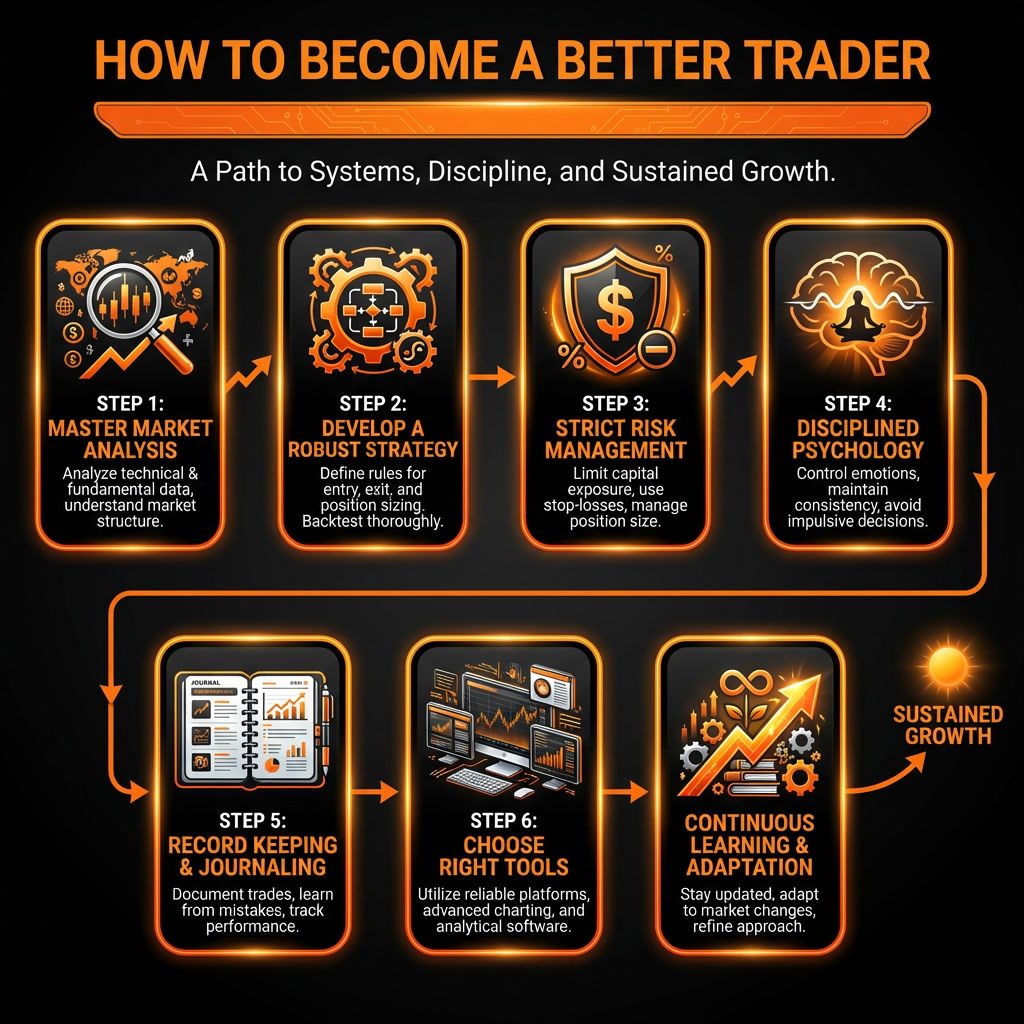
Some of this will challenge what you think you know about markets. That's intentional. The comfortable path in trading usually leads to empty accounts.
The Key Skills Every Trader Must Develop
Improving as a trader usually involves developing skills across several key areas. While markets are unpredictable and losses are always possible, traders who focus on the following principles often build a more structured and disciplined approach to trading.
- Master the fundamentals of market analysis
- Develop a clear and testable trading strategy
- Implement strict risk management rules
- Build disciplined trading psychology
- Keep a detailed trading journal
- Use reliable tools and trading platforms
- Commit to continuous education and adaptation
Become a Better Trader by Mastering the Fundamentals of Market Analysis
Before placing a single trade, you need a coherent framework for understanding why prices move. Markets aren't random, but they're also not predictable in the way most beginners think. Price movements reflect the collective decisions of millions of participants, each acting on their own information, biases, and timeframes.
The foundation of market analysis is understanding that every price represents a temporary agreement between buyers and sellers. When that balance shifts, prices move. Your job as a trader is to identify situations where that balance is likely to shift in a predictable direction, then position yourself accordingly.
Technical vs. Fundamental Analysis
Technical analysis examines price charts and patterns to predict future movements. Fundamental analysis studies financial statements, economic data, and business metrics to determine intrinsic value. The debate over which approach works better has raged for decades, and honestly, is the wrong question.
Most successful traders use elements of both to become a better trader. A fundamental analyst might identify an undervalued stock but use technical analysis to time their entry. A technical trader might filter their setups by only trading stocks with strong earnings growth. The approaches aren't mutually exclusive.
Here's what matters: pick an approach that matches your personality and stick with it long enough to develop genuine competence. Fundamental analysis requires patience and the ability to hold positions through volatility. Technical analysis demands quick decision-making and comfort with frequent trading. Neither is superior, but one will suit you better depending on your trading needs.
Understanding Price Action and Volume
Price action trading strips away indicators and focuses purely on how price moves. This approach reveals what's actually happening in the market rather than what lagging indicators suggest might be happening.
Volume confirms price movements. When price rises on heavy volume, buyers are genuinely committed. When price rises on declining volume, the move lacks conviction and often reverses. This relationship between price and volume is one of the most reliable signals in all of trading.
Key price action concepts to master include support and resistance levels, trend structure, and candlestick patterns. Support levels are prices where buying pressure historically emerged. Resistance levels are prices where selling pressure appeared. Trends persist until they don't, and learning to identify when a trend is weakening saves you from painful reversals.
Developing a Robust Trading Strategy
A trading strategy is your complete plan for entering, managing, and exiting trades. Without one, you're gambling. With a poorly defined one, you're gambling with extra steps. A proper strategy removes emotion from individual decisions by establishing rules in advance.
Your strategy must answer several questions: What setups will you trade? What conditions must exist before you enter? Where will you place your stop-loss? How will you determine position size? When will you take profits? If you can't answer these questions specifically, you don't have a strategy.
Finding Your Trading Style
Trading styles exist on a spectrum from scalping (holding positions for seconds or minutes) to position trading (holding for months or years). Day trading falls in between, with all positions closed before the market closes. Swing trading typically involves holding for days to weeks.
Your optimal style depends on your schedule, personality, and capital. Scalping requires intense focus during market hours and quick reflexes. It's unsuitable for anyone with a day job or slow internet connection. Position trading requires patience and the ability to ignore short-term fluctuations. It suits people who can't watch markets constantly but can tolerate seeing positions move against them temporarily.
Most beginners gravitate toward day trading because it seems exciting and promises quick results. Most beginners also fail. Consider starting with swing trading, which provides enough action to stay engaged while allowing time for thoughtful analysis.
Backtesting and Forward Testing
Backtesting involves applying your strategy to historical data to see how it would have performed. This process reveals whether your edge is real or imagined. Many strategies that seem brilliant in theory fail miserably when tested against actual price data.
Quality backtesting requires honest methodology. Don't cherry-pick favorable periods or adjust parameters until you find something that works. Test across different market conditions: trending markets, ranging markets, volatile periods, and quiet periods. A strategy that only works in one environment will eventually destroy your account when conditions change.
Forward testing means trading your strategy with small positions or paper trading to verify real-time performance. Backtesting can't capture execution challenges like slippage, missed fills, and the psychological pressure of real money. Forward test for at least three months before committing significant capital.
Implementing Strict Risk Management Rules
Risk management isn't the exciting part of trading, but it's the part that keeps you in the game and is the key to becoming a better trader. Every successful trader I've met obsesses over risk. Every blown-up trader I've met dismissed it as something that applied to other people.
The math is brutal: a 50% loss requires a 100% gain just to break even. A 90% loss requires a 900% gain. Becoming a better trader means understanding that protecting capital isn't conservative - it's the only way to survive long enough to profit from your edge.
| Loss | Gain Needed to Recover |
| 10% | 33% |
| 50% | 100% |
| 75% | 300% |
Position Sizing and Leverage
Position sizing and lot sizes determines how much of your account you risk on each trade. The standard recommendation is risking no more than 1-2% of your account per trade. This sounds conservative until you realize that even with a 1% risk, ten consecutive losers cost you nearly 10% of your capital.
Leverage amplifies both gains and losses. A 10:1 leverage ratio means a 10% move against you wipes out your entire position. Retail traders consistently overestimate their ability to handle leveraged positions. The emotional pressure of watching amplified losses clouds judgment and leads to poor decisions.
Start with no leverage or minimal leverage. As you prove consistent profitability, you can gradually increase. But understand that many professional traders use less leverage than retail platforms offer, not more. The goal is sustainable returns, not spectacular single trades followed by account destruction.
The Importance of Stop-Loss Orders
A stop-loss order automatically exits your position at a predetermined price, limiting your loss. Trading without stop-losses is like driving without a seatbelt: you might be fine for a while, but eventually, the crash comes.
Place stops at levels where your trade thesis is invalidated, not at arbitrary percentages. If you're buying because the price bounced off support, your stop belongs below that support level. If support breaks, your reason for being in the trade no longer exists.
The hardest part of stop-losses is accepting them. Every stop triggered feels like failure. But stops are the cost of doing business. They're not failures - they're the mechanism that prevents small losses from becoming catastrophic ones.
Cultivating a Disciplined Trading Psychology
Technical skill gets you to breakeven. Psychology determines whether you become profitable. The market constantly tests your emotional resilience, and most traders fail these tests repeatedly.
Trading psychology isn't about eliminating emotions - that's impossible. It's about recognizing emotional states and preventing them from driving decisions. When you feel euphoric after a winning streak, that's when you're most likely to take oversized risks. When you feel desperate after losses, that's when revenge trading destroys accounts. Learning to control your emotions is a fundamental step to becoming a better trader.
Managing Fear and Greed
Fear manifests as hesitation on valid setups, premature profit-taking, and inability to pull the trigger when your strategy signals entry. Greed shows up as oversized positions, holding winners too long hoping for more, and ignoring exit signals because you want bigger gains.
Both emotions stem from the same source: attachment to outcomes. The antidote is process focus. Instead of measuring success by daily P&L, measure it by how well you executed your strategy. Did you take the setups your system identified? Did you follow your risk rules? Did you exit according to plan?
Keeping position sizes small enough that individual trades don't feel significant helps enormously. If a loss would meaningfully impact your lifestyle or emotional state, you're trading too large. Scale down until you can execute with emotional neutrality.
The Power of Record Keeping and Journaling
A trading journal transforms random trading into a systematic improvement process. Without records, you're relying on faulty memory and confirmation bias to evaluate your performance. With detailed records, patterns emerge that would otherwise remain invisible.
Your journal should capture more than just entry and exit prices. Record your reasoning for each trade, your emotional state, market conditions, and any deviations from your plan. This information becomes invaluable during review sessions.
Analyzing Winning and Losing Trades
Review your trades weekly and monthly. Look for patterns in your winners: what conditions were present? What was your emotional state? How well did you execute? Do the same for losers.
Most traders discover uncomfortable truths during this process. Maybe your winners come from patient setups while your losers come from impulsive entries. Maybe you perform well in trending markets but give back profits during ranges. Maybe your best trades happen in the morning while afternoon trades consistently lose.
These insights allow targeted improvement. If you lose money every afternoon, stop trading afternoons. If impulsive trades lose money, implement a mandatory waiting period before entering. Your journal provides the data; your job is acting on what it reveals.
Choosing the Right Tools and Platforms
Your trading platform and tools should support your strategy without adding unnecessary complexity. The best platform is one you understand thoroughly and can operate without thinking during fast-moving markets.
Essential features include reliable order execution, clear charting capabilities, and risk management tools like bracket orders. Advanced features matter less than reliability. A fancy platform that crashes during volatile moments will cost you more than any feature could save.
Charting software ranges from free options like MT4 and MT5. Start with free or low-cost options until you know exactly what features you need. Many traders pay for tools they never use because they assume more expensive means better.
Avoid indicator overload. New traders often clutter charts with dozens of indicators, hoping more data means better decisions. The opposite is usually true. Most professional traders use clean charts with minimal indicators. They've learned that additional indicators often provide conflicting signals rather than clarity.
Committing to Continuous Education and Adaptation
Markets evolve constantly. Strategies that worked five years ago may be obsolete today. The traders who thrive long-term are those who continuously learn and adapt to become better traders.
Read broadly: trading books, market history, psychology, probability theory. Understanding why strategies work matters more than memorizing patterns. When you understand underlying principles, you can adapt when surface-level patterns change.
Study market history, especially periods of crisis. The 2008 financial crisis, the 2020 COVID crash, various flash crashes - these events reveal how markets behave under stress. Strategies that can't survive these periods aren't strategies; they're accidents waiting to happen.
Connect with other serious traders, but be selective. Trading communities range from invaluable to actively harmful. Avoid groups focused on hot tips or get-rich-quick schemes. Seek out traders who discuss process, risk management, and long-term development. One mentor who's been profitable for a decade teaches more than a thousand social media traders showing cherry-picked wins.
Accept that becoming a better trader is a multi-year journey. The learning curve is steep, and most of the lessons come from painful experiences. Traders who expect quick mastery quit when reality doesn't match expectations. Those who embrace the process and focus on gradual improvement eventually reach consistency.
The path forward is clear, even if it's not easy. Master analysis fundamentals. Develop and test a specific strategy. Implement strict risk management. Work continuously on psychology. Keep detailed records and learn from them. Use appropriate tools without overcomplicating. Never stop learning.
Becoming a better trader is a constant journey of learning. These seven steps won't guarantee success - nothing can in markets. But they dramatically improve your odds. More importantly, they transform trading from gambling into a skill-based endeavor where improvement is possible and measurable. Start implementing them today, and you'll be ahead of 90% of traders who never bother with systematic development.
TIOmarkets believes that education is fundamental to improving your trading skills. Visit our extensive educational page and start improving your skills now.

FAQ
Risk disclaimer: CFDs are complex instruments and come with a high risk of losing money rapidly due to leverage. You should consider whether you understand how CFDs work and whether you can afford to take the high risk of losing your money. Never deposit more than you are prepared to lose. Professional client’s losses can exceed their deposit. Please see our risk warning policy and seek independent professional advice if you do not fully understand. This information is not directed or intended for distribution to or use by residents of certain countries/jurisdictions including, but not limited to, USA & Countries included in the OFAC sanction list. The Company holds the right to alter the aforementioned list of countries at its own discretion.
TIOmarkets offers an exclusively execution-only service. The views expressed are for information purposes only. None of the content provided constitutes any form of investment advice. The comments are made available purely for educational and marketing purposes and do NOT constitute advice or investment recommendation (and should not be considered as such) and do not in any way constitute an invitation to acquire any financial instrument or product. TIOmarkets and its affiliates and consultants are not liable for any damages that may be caused by individual comments or statements by TIOmarkets analysis and assumes no liability with respect to the completeness and correctness of the content presented. The investor is solely responsible for the risk of his/her investment decisions. The analyses and comments presented do not include any consideration of your personal investment objectives, financial circumstances, or needs. The content has not been prepared in accordance with any legal requirements for financial analysis and must, therefore, be viewed by the reader as marketing information. TIOmarkets prohibits duplication or publication without explicit approval.
Join us on social media



Authors BIO

Behind every blog post lies the combined experience of the people working at TIOmarkets. We are a team of dedicated industry professionals and financial markets enthusiasts committed to providing you with trading education and financial markets commentary. Our goal is to help empower you with the knowledge you need to trade in the markets effectively.