


Can You Start Forex Trading with $100? A Realistic Guide for Beginners
BY Panagiotis Philippou
|March 18, 2026Quick Answer: Yes, you can start forex trading with $100. Many brokers, including TIOmarkets, accept deposits as low as $20, making forex accessible to beginners with limited capital. However, trading with $100 requires careful risk management, realistic profit expectations, and an understanding of leverage. While Forex trading with $100 won't generate life-changing returns, it provides an opportunity to learn real market dynamics, test strategies, and build trading skills without risking substantial capital.
But before you deposit that $100, you need to understand what's realistically possible, what limitations you'll face, and how to maximize your chances of success with a small account.
This comprehensive guide will walk you through everything you need to know about forex trading with $100.
Keep reading to learn more.
Is $100 Enough to Start Forex Trading?
The short answer is yes—$100 is enough to open a forex trading account and place real trades. The more important question is whether $100 is enough to trade effectively and what you can realistically achieve with that amount.
Let's be clear about what $100 can and cannot do for you in forex trading.
What $100 Can Do:
- Open a live trading account with most brokers, including TIOmarkets (minimum deposit $20)
- Allow you to trade micro lots and practice position sizing in real market conditions
- Provide hands-on experience with order execution, platform navigation, and trade management
- Help you develop discipline and emotional control without risking significant capital
- Give you the opportunity to test strategies with real money on the line
- Teach you about spreads, commissions, and how trading costs impact profitability
What $100 Cannot Do:
- Generate substantial income or replace your day job
- Provide enough buffer to survive multiple losing trades without careful risk management
- Allow aggressive position sizing or high-frequency trading strategies
- Give you access to premium account features that require larger deposits
- Protect you from the psychological pressure of seeing your entire account at risk
The reality is that $100 is a learning account, not a wealth-building account. Your primary goal with this capital should be education and skill development, not profit generation. If you approach forex trading with $100 expecting to turn it into $1,000 within a month, you're setting yourself up for disappointment and likely account depletion. You can always start your account with a bit more like $500 to jump start your account a little faster
However, if you view $100 as tuition for learning how real markets work—understanding leverage, managing risk, controlling emotions, and developing a trading process—then it's money well spent. Many successful traders started with small accounts and gradually built their capital through consistent, disciplined trading combined with additional deposits over time.
The key is maintaining realistic expectations while maximizing the educational value of every dollar you risk.
Account Types to start Forex Trading with $100
Not all forex trading accounts are created equal, and choosing the right account type for your $100 deposit can significantly impact your trading experience and costs.
At TIOmarkets, we offer several account types designed to accommodate traders at different experience levels and with varying capital amounts. When you start forex trading with $100, two account types are particularly relevant: the Standard account and the Nano account.
Standard Account:
The Standard account is our most popular option for everyday traders. With a minimum deposit of just $20, it's accessible to anyone starting with $100. Here's what makes it suitable for small accounts:
- Spreads from 1.1 pips: Competitive pricing on major currency pairs
- No commission charges: All costs are built into the spread, making fee structures simple and transparent
- Minimum trade size of 0.01 lots: Allows for precise position sizing even with limited capital
- Access to MT4 or MT5 platforms: Industry-standard trading platforms with full charting and analysis tools
- Leverage up to 1:2000: High leverage available (though you should use it cautiously)
The Standard account works well for beginners because the commission-free structure eliminates one variable from your cost calculations. You simply pay the spread, which makes it easier to understand your true trading costs.
Nano Account:
The Nano account is specifically designed for traders who want to start extremely small and practice with minimal risk. With a $20 minimum deposit, it's ideal for those treating their $100 as a learning account:
- Spreads from 0.6 pips: Tighter spreads than the Standard account
- $6 commission per round-turn lot: Separate commission structure similar to professional accounts
- Minimum trade size of 0.001 lots: Allows you to trade positions as small as 10 cents per pip
- MT5 platform only: Access to the more advanced MetaTrader 5 platform
- Lower leverage options: Encourages more conservative position sizing
The Nano account's ability to trade 0.001 lots (micro positions) is particularly valuable when you're learning. You can place trades that risk only a few dollars, allowing you to execute dozens of trades and gain experience without depleting your $100 quickly.
Which Account Type Should You Choose?
If your primary goal is learning and you want maximum flexibility in position sizing, the Nano account is the better choice. The ability to trade 0.001 lots means you can follow proper risk management (risking 1-2% per trade) even with a $100 account.
If you prefer simplicity and don't want to worry about commission calculations, the Standard account offers straightforward pricing and is perfectly adequate for trading with $100.
Both account types give you access to the same currency pairs, the same market conditions, and the same opportunity to learn. The main differences are in cost structure and minimum trade sizes. You can always open both account types and test them with small deposits to see which you prefer before committing your full $100 to one approach.
What Can You Actually Make Forex Trading with $100?
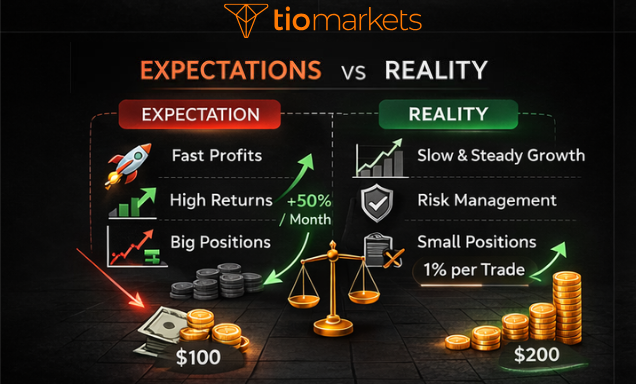
This is the question everyone wants answered, and it's where most beginners develop unrealistic expectations that lead to poor trading decisions. Let's address this honestly and directly.
The Uncomfortable Truth:
Starting Forex Trading with $100 in your trading account, you're not going to make significant money in absolute dollar terms. Even if you're a skilled trader who achieves excellent percentage returns, the math simply doesn't support substantial income generation from a $100 base.
Let's look at some hypothetical scenarios:
| Conservative Scenario (5% monthly return) | Aggressive Scenario (10% monthly return) |
| Month 1: $100 becomes $105 (+$5 profit) | Month 1: $100 becomes $110 (+$10 profit) |
| Month 2: $105 becomes $110.25 (+$5.25 profit) | Month 2: $110 becomes $121 (+$11 profit) |
| Month 3: $110.25 becomes $115.76 (+$5.51 profit) | Month 3: $121 becomes $133.10 (+$12.10 profit) |
| After 12 months: $179.59 (+$79.59 profit) | After 12 months: $313.84 (+$213.84 profit) |
A 5% monthly return is actually quite good in forex trading. Many professional traders would be thrilled with consistent 5% monthly gains. But on a $100 account, that's $5 per month initially—less than you'd earn in an hour at minimum wage.
A 10% monthly return is exceptional and extremely difficult to maintain consistently. Most traders attempting this level of return will experience significant drawdowns or account depletion. Even if you achieve it, you're looking at roughly $200 profit over a full year of trading.
The Reality Check:
These examples assume you never have a losing month, never withdraw, and consistently compound your gains. In reality, you'll have losing trades, losing weeks, and possibly losing months. Your actual results will likely be more volatile and less linear than these projections suggest. Forex Trading with $100 can be done, but the discipline required is high.
Risk Management Trading With $100 Accounts
Risk management isn't just important when Forex trading with $100—it's absolutely critical. With limited capital, you have almost no margin for error. A few careless trades can wipe out your entire account in days or even hours. Proper risk management is what separates traders who survive long enough to learn from those who blow up their accounts and quit.
The 1-2% Risk Rule:
The foundation of sound risk management is limiting your risk per trade to 1-2% of your account balance. This principle applies regardless of account size, but it's especially important with small accounts.
On a $100 account:
- 1% risk = $1 per trade
- 2% risk = $2 per trade
At first glance, risking only $1-2 per trade might seem overly conservative. You might think, "How am I supposed to make meaningful profits risking only $1?" But this approach serves a critical purpose: it ensures you can survive a normal losing streak without depleting your account.
Even good traders lose 40-50% of their trades. If you risk 10% per trade ($10 on a $100 account), five consecutive losses—which is entirely normal and expected—would cut your account in half. Ten losses would wipe you out completely. But if you risk only 2% per trade, you can survive 20 consecutive losses and still have 67% of your account remaining.
Position Sizing Based on Stop-Loss:
Proper risk management means calculating your position size based on your stop-loss distance, not on how much leverage you can access. Here's how it works:
Let's say you want to trade EUR/USD with a 20-pip stop-loss, and you're willing to risk 2% of your $100 account ($2).
- Your risk is $2
- Your stop-loss is 20 pips
- Therefore, each pip can be worth $0.10 ($2 ÷ 20 pips)
- A pip value of $0.10 corresponds to 0.01 lots (1 micro lot)
This calculation determines your position size. You're not asking "How much can I trade with my leverage?" You're asking "What position size keeps my risk at $2 if my stop-loss is hit?"
Stop-Loss Placement:
Every single trade you place should have a stop-loss order. No exceptions. Forex Trading with $100 means you cannot afford to let losses run unchecked hoping the market will turn around. Your stop-loss should be placed at a logical level based on your analysis—below support for long trades, above resistance for short trades—not at an arbitrary distance.
However, you also need to ensure your stop-loss distance is reasonable for your account size. If your analysis suggests a 100-pip stop-loss is appropriate, but that would require risking $10 to maintain proper position sizing, then the trade isn't suitable for a $100 account. You either need to find trades with tighter stop-losses or accept that some opportunities aren't appropriate for your capital level.
Avoiding Over-Leveraging:
We discussed leverage earlier, but it's worth repeating in the context of risk management: high leverage is dangerous, especially with limited capital. Just because your broker offers 1:500 leverage doesn't mean you should use it.
Calculate your position sizes based on risk per trade, not on maximum available leverage. If proper risk management says you should trade 0.01 lots, don't increase to 0.05 lots just because your leverage allows it. The leverage is there to provide flexibility and capital efficiency, not to encourage larger positions than your risk management permits.
The Psychological Challenge:
Risk management with a $100 account presents a unique psychological challenge. Risking only $1-2 per trade can feel frustratingly slow, especially when you see other traders (or think you see them) making large profits quickly. This frustration often leads to abandoning risk management rules and taking oversized positions "just this once" to try to accelerate growth.
This is the moment most small accounts die. One or two trades risking 20-30% of the account, and a normal loss turns into account devastation. The temptation to over-risk is strong, but succumbing to it almost always ends the same way: account depletion and a valuable but expensive lesson learned.
Building the Discipline:
Think of strict risk management on your $100 account as training for when you have $10,000 or $100,000. If you can't follow a 2% risk rule with $100, you won't magically develop that discipline with a larger account. In fact, the psychological pressure often increases with larger accounts, making discipline even harder.
Use your $100 account to build the habits that will serve you throughout your trading career. Every trade where you correctly calculate position size, place your stop-loss, and stick to your risk parameters is a small victory that compounds into long-term success.
How to Start Forex Trading with $100
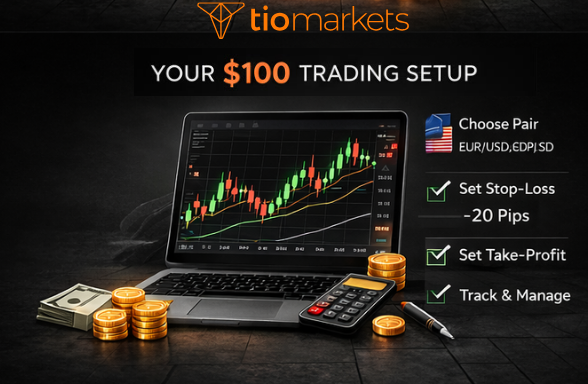
Once you understand the realities of trading with $100 and have realistic expectations, the actual process of opening your account and placing your first trade is straightforward. Here's your step-by-step roadmap.
Step 1: Register Your TIOmarkets Account
Visit TIOmarkets.com and click "Open Account" in the top right corner. You'll need to provide basic personal information including your name, email address, phone number, and country of residence. This initial registration takes just a few minutes and gives you access to your secure client portal.
Step 2: Complete Account Verification
Before you can deposit funds and trade, you'll need to verify your identity. This is a regulatory requirement that all legitimate brokers must follow. You'll need to upload:
- A valid government-issued ID (passport, driver's license, or national ID card)
- Proof of address dated within the last 3-6 months (utility bill, bank statement, or government correspondence)
Make sure your documents are clear, fully visible, and match the information you provided during registration. Verification typically takes 24-48 hours, though it's often faster.
Step 3: Choose Your Account Type
In your client portal, navigate to the account section and select "Open Live Account." You'll be asked to choose between account types. For a $100 deposit, both the Standard account and Nano account are suitable options:
- Standard Account: Choose this if you want commission-free trading with all costs built into the spread
- Nano Account: Choose this if you want tighter spreads and don't mind paying a separate commission, plus the ability to trade very small position sizes (0.001 lots)
You'll also select your base currency (USD, EUR, GBP, or others) and your preferred trading platform (MT4 or MT5). For beginners, MT4 is slightly simpler, while MT5 offers more advanced features.
Step 4: Fund Your Account
Once your account is created, go to the "Funds" section of your client portal and select "Deposit." TIOmarkets offers multiple funding methods:
- Bank transfer (wire transfer)
- Credit/debit card
- E-wallets (specific options vary by region)
- Cryptocurrency (in some jurisdictions)
Choose your preferred method and deposit your $100. Most deposit methods are instant or processed within a few hours. Bank transfers may take 1-3 business days. Make sure the deposit is made from an account in your name—brokers cannot accept third-party deposits for regulatory reasons.
Step 5: Download and Install Your Trading Platform
While your deposit is processing, download the MT4 or MT5 platform from the download center in your client portal. The platform is available for:
- Windows desktop
- Mac desktop
- Web browser (no download required)
- iOS mobile devices
- Android mobile devices
Install the platform and log in using the credentials sent to your email when you created your live account. Your account number, password, and server information will all be provided.
Step 6: Transfer Funds to Your Trading Account
Once your deposit is confirmed, you'll need to transfer the funds from your TIOmarkets wallet to your specific trading account (MT4 or MT5). This is done through the "Manage Funds" section of your client portal. Select "Internal Transfer," choose your TIOmarkets wallet as the source and your trading account as the destination, enter $100, and confirm.
Within seconds, you'll see your $100 balance reflected in your trading platform (visible in the bottom left corner of the terminal window).
Step 7: Locate Your Currency Pairs
In your trading platform, look at the "Market Watch" window on the left side. This displays all available trading instruments. If you don't see the currency pairs you want to trade (like EUR/USD), right-click in the Market Watch window and select "Show All." Scroll through the list to find your desired pairs.
Step 8: Place Your First Trade
Right-click on your chosen currency pair (for example, EUR/USD) and select "New Order." This opens the order window where you'll:
- Confirm the symbol is correct
- Select "Market Execution" for an immediate trade
- Enter your lot size (start with 0.01 lots for a $100 account)
- Set your stop-loss (based on your analysis and risk management)
- Set your take-profit (optional, but recommended)
- Click "Buy" if you think the price will rise, or "Sell" if you think it will fall
Your trade will execute immediately, and you'll see it appear in the "Trade" tab of the terminal window at the bottom of your platform.
Before You Place That First Trade:
Take a moment to double-check everything:
- Is your position size appropriate for your account? (0.01 lots is a good starting point)
- Have you set a stop-loss? (Never trade without one)
- Does your risk per trade equal 1-2% of your account? ($1-2 on a $100 account)
- Do you have a clear reason for this trade based on your analysis?
If you can answer yes to all these questions, you're ready to execute your first trade with real money.
Common Mistakes That Destroy $100 Accounts
Most traders who start Forex Trading with $100 lose that money quickly. It's not because forex trading is impossible with small capital—it's because they make predictable, avoidable mistakes. Learn from others' errors instead of repeating them yourself.
Mistake #1: Over-Leveraging
This is the number one account killer. Traders see that they can control a $50,000 position with their $100 and think, "Why not maximize my profit potential?" They open positions that are far too large for their account, and a normal market move against them triggers a margin call or wipes out their entire balance.
The fix: Calculate position sizes based on risk per trade (1-2% of account), not on maximum available leverage. Your position size should be determined by your stop-loss distance and risk tolerance, nothing else.
Mistake #2: Trading Without a Stop-Loss
Some beginners don't use stop-losses because they've seen trades move against them temporarily before reversing for a profit. They think, "If I just hold on, it'll come back." With a $100 account, this approach is financial suicide. One trade that moves significantly against you can eliminate your entire account.
The fix: Every single trade must have a stop-loss order placed immediately when you open the position. No exceptions, no "just this once," no hoping the market will turn around. Your stop-loss is your insurance policy, and trading without it is reckless.
Mistake #3: Unrealistic Profit Expectations
Traders start Forex Trading with $100 expecting to turn it into $1,000 within a month. These unrealistic expectations lead to over-trading, excessive risk-taking, and emotional decision-making. When the account doesn't grow as quickly as hoped, frustration sets in, and discipline disappears.
The fix: Understand that $100 is a learning account, not an income source. Focus on executing your strategy correctly, managing risk properly, and developing skills. If your account grows slowly or even stays flat while you're learning, that's success—you're still in the game and gaining experience.
Mistake #4: Emotional Trading
After a losing trade, the temptation to immediately jump back in and "win it back" is overwhelming. This revenge trading almost always leads to larger losses. Similarly, after a winning trade, overconfidence can lead to taking trades that don't meet your criteria or risking more than your rules allow.
The fix: Establish clear trading rules and follow them regardless of your emotional state. If you've just taken a loss, step away from the platform for at least 30 minutes before considering another trade. If you've just had a big win, resist the urge to increase your position size or trade more frequently.
Conclusion: Your Path Forward Forex trading with $100
Forex trading with $100 is absolutely possible, but success requires realistic expectations, disciplined risk management, and a commitment to learning rather than immediate profit. Your $100 isn't going to change your life financially in the short term, but it can provide an invaluable education in market dynamics, trading psychology, and risk management.
Remember these key principles as you begin your trading journey:
- Risk only 1-2% per trade to survive normal losing streaks
- Use leverage conservatively, regardless of what's available
- Focus on major currency pairs with tight spreads
- Every trade must have a stop-loss, no exceptions
- Trading costs matter significantly with small accounts
- Compounding works, but slowly—consider adding capital over time
- Your primary goal is education, not immediate income
If you're ready to start forex trading with $100, TIOmarkets offers account types specifically designed for traders with limited capital. Our Nano account allows position sizes as small as 0.001 lots, perfect for practicing proper risk management even with a small balance. Our Standard account offers commission-free trading with competitive spreads, ideal for beginners who want simplicity.
Ready to start trading? Register your account with TIOmarkets now.
FAQ
Risk disclaimer: CFDs are complex instruments and come with a high risk of losing money rapidly due to leverage. You should consider whether you understand how CFDs work and whether you can afford to take the high risk of losing your money. Never deposit more than you are prepared to lose. Professional client’s losses can exceed their deposit. Please see our risk warning policy and seek independent professional advice if you do not fully understand. This information is not directed or intended for distribution to or use by residents of certain countries/jurisdictions including, but not limited to, USA & Countries included in the OFAC sanction list. The Company holds the right to alter the aforementioned list of countries at its own discretion.
TIOmarkets offers an exclusively execution-only service. The views expressed are for information purposes only. None of the content provided constitutes any form of investment advice. The comments are made available purely for educational and marketing purposes and do NOT constitute advice or investment recommendation (and should not be considered as such) and do not in any way constitute an invitation to acquire any financial instrument or product. TIOmarkets and its affiliates and consultants are not liable for any damages that may be caused by individual comments or statements by TIOmarkets analysis and assumes no liability with respect to the completeness and correctness of the content presented. The investor is solely responsible for the risk of his/her investment decisions. The analyses and comments presented do not include any consideration of your personal investment objectives, financial circumstances, or needs. The content has not been prepared in accordance with any legal requirements for financial analysis and must, therefore, be viewed by the reader as marketing information. TIOmarkets prohibits duplication or publication without explicit approval.
Join us on social media



Authors BIO

Panagiotis is an online trading specialist with extensive experience in forex, indices, and commodities. He enjoys sharing his experience to help traders better understand global financial markets.