


What Are Trading Signals and How They Work? Buy & Sell Alerts Explained
BY Maria K.
|August 5, 2026Trading signals are alerts that indicate potential opportunities to buy or sell financial assets based on specific market conditions. A trader is confronted with multiple charts, candlesticks flickering, indicators overlapping and this data can be overwhelming. Trading signals cut through this noise by delivering clear, actionable prompts based on predefined criteria. Understanding what are trading signals represents a foundational skill.
Forex trading signals are rule-based alerts that can help guide a trader when to buy or sell a financial asset. They are generated by technical indicators, mathematical algorithms, or experienced market analysts, and typically include key information such as the entry price, stop-loss level, and take-profit target.
This guide covers how trading signals work, the different types available, their benefits and limitations, how to evaluate signal providers, and how to incorporate signals in trading.
What Are Trading Signals? The Simple Definition
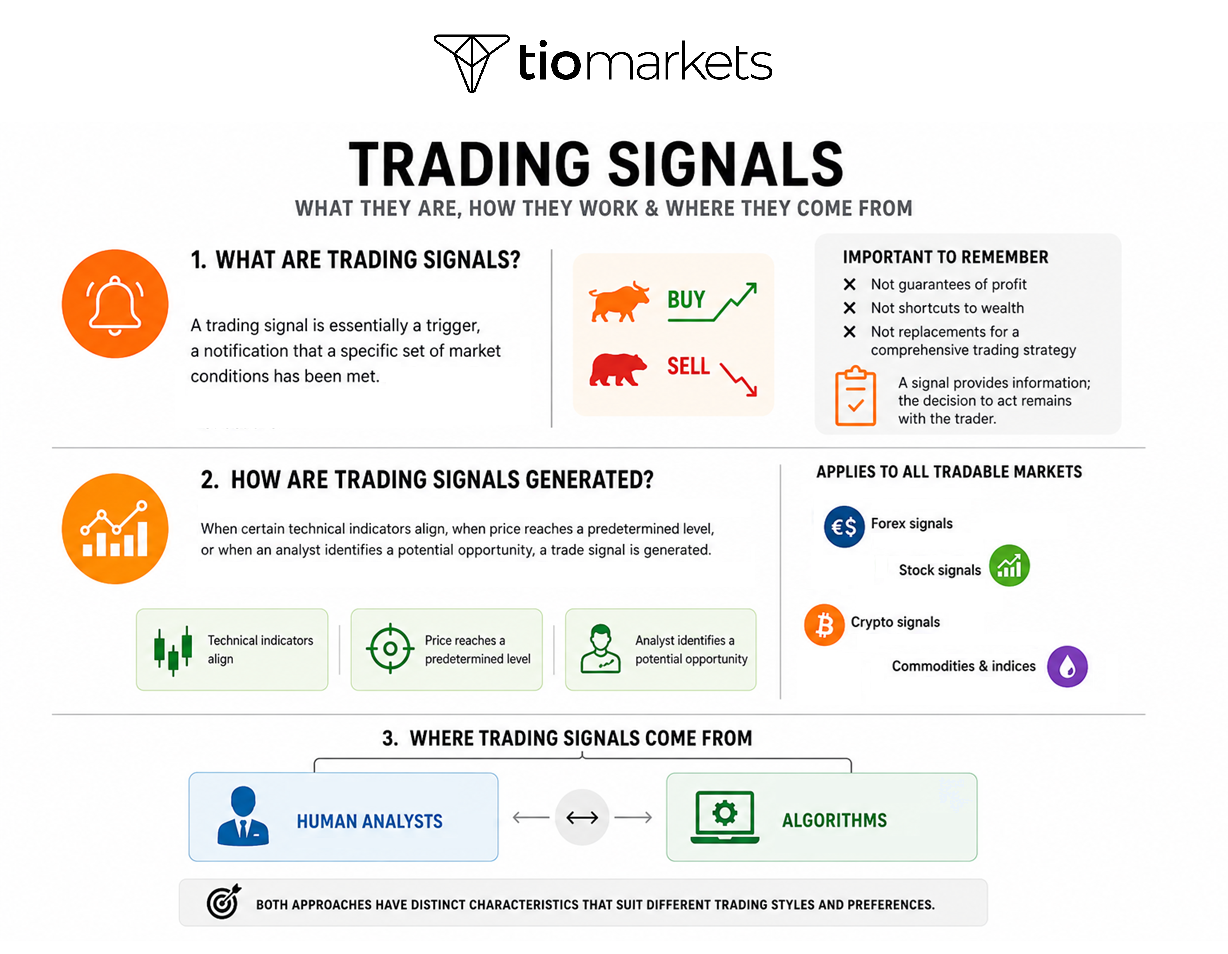
A trading signal is essentially a trigger, a notification that a specific set of market conditions has been met. Understanding what are trading signals begins with recognising them as alerts rather than instructions.
However, trade signals are not guarantees of profit, not shortcuts to wealth, and not replacements for a comprehensive trading strategy. A signal provides information; the decision to act remains with the trader.
How Are Trading Signals Generated
Now that we've established what are trading signals, let's explore how they're generated. When certain technical indicators align, when price reaches a predetermined level, or when an analyst identifies a potential opportunity, a trade signal is generated. These buy and sell signals serve as prompts that highlight moments when market conditions match specific criteria.
Trading signal alerts apply across any tradable market. Forex trading signals track currency pair movements. Stock trading signals monitor equity prices and earnings data. Cryptocurrency signals follow digital asset volatility. Commodities and indices also have dedicated signal for trading services.
Signals originate from two primary sources: human analysts who apply their expertise and judgment to market data, or algorithms that process information according to programmed rules. Both approaches have distinct characteristics that suit different trading styles and preferences.
How Do Trading Signals Work? The Key Components Explained
Understanding what are trading signals requires examining their core components. Every trading signal contains core components that provide traders with the information needed to evaluate and potentially execute a trade. Understanding how they work requires familiarity.
The Anatomy of a Trading Signal
The key components of a trading signal include asset name, direction, entry price, stop-loss, take-profit and a timeframe. More details are explained in the table below.
| Component | What It Means |
| Asset/Instrument | The market being traded (e.g., EUR/USD, Apple stock, Bitcoin) |
| Direction | Buy (long) or Sell (short) |
| Entry Price | The price level at which to open the trade |
| Stop-Loss Level | The price at which the trade closes to cap losses |
| Take-Profit Level | The price target at which to lock in gains |
| Timeframe | How long the signal is expected to be valid |
How a Signal Is Generated: Step by Step
Now let's understand how a signal is generated.
- Market data is continuously monitored (price, volume, economic news)
- Predefined conditions or indicators are applied to the data
- When conditions are met, a signal alert is triggered
- The signal is delivered to the trader via SMS, email, push notification, or directly within a platform
- The trader (or automated system) evaluates and potentially executes the trade based on the signal parameters
The speed of execution often matters significantly. In fast-moving markets, delayed action can reduce the effectiveness of a signal, as prices may have already moved beyond the suggested entry point by the time a trader responds.
How to Get Signals in Trading?
Traders can access them through several channels, each offering different levels of convenience, cost, and customisation.
- Broker and Platform Integration: Many brokers and trading platforms include built-in signal services as part of their offering, allowing traders to receive alerts directly within their trading interface.
- Automated Trading Systems: Expert Advisors (EAs) and trading bots can generate and execute signals automatically based on programmed criteria.
- Signal Provider Services: Independent signal providers deliver alerts via email, SMS, mobile app notifications, or messaging platforms.
- Social Trading Platforms: These platforms enable traders to follow and copy signals from other users, often displaying performance statistics and trading history.
- Self-Generated Signals: Some traders create their own signals by setting up custom alerts based on technical indicators within charting software; for example, receiving a notification when a moving average crossover occurs or when RSI reaches oversold levels.
TIOmarkets offers its clients access to MetaTrader 4 (MT4) and MetaTrader 5 (MT5) platforms, which support Expert Advisors capable of generating and executing automated trading signals. Through these platforms, traders can access the MQL5 signals marketplace, subscribe to signal providers, or deploy custom EAs to create their own signal-based trading systems.
However, TIOmarkets does not provide trading signals, recommendations, or trading advice. Acting as the platform provider, TIOmarkets enables traders to execute their own trading decisions using the tools and features available within MT4 and MT5, including access to any paid or free third-party signal services.
Types of Trading Signals: A Complete Breakdown
Many traders ask what are the best trading signals; but it is crucial to know that these tools vary considerably by source, methodology, and the markets they cover. Understanding what are trading signals should be combined with understanding their different types. It helps traders identify which approaches align with their preferences and goals.
By Source: Manual Trading Signals vs. Automated Trading Signals
| Aspect | Manual Signals | Automated Signals |
| Generated by | Human analyst or trader | Algorithm or software |
| Speed | Slower; subject to human processing time | Near-instant |
| Flexibility | Can account for nuance and current events | Follows predefined rules only |
| Best for | Traders who want expert insight | Traders who prefer systematic approaches |
| Risk | Subject to human error and bias | Can fail during unexpected market events |
Manual trader signals rely on human expertise, allowing analysts to incorporate qualitative factors and adapt to unusual circumstances. Automated trading signals in forex trading offer consistency and speed, processing vast amounts of data without emotional interference.
By Methodology: Technical, Fundamental, and Algorithmic Signals
- Technical Signals are derived from price action, chart patterns, and trading signal indicators. Examples include RSI signals for overbought/oversold levels, moving average crossover signals, MACD divergence, support and resistance breakouts, and candlestick patterns such as pin bars or engulfing candles. These tend to suit short-term and intraday traders.
- Fundamental Signals are based on economic data, earnings reports, central bank decisions, and geopolitical events. A signal might trigger following a stronger-than-expected employment report, a central bank rate decision, or a company's earnings surprise. These typically suit swing traders and longer-term investors.
- Automated Algorithmic/Quantitative Signals are generated by computer models analysing large datasets simultaneously. These can combine both technical and fundamental inputs, processing information at scales impossible for human analysts. They suit systematic traders and those using automated execution.
By Market Type: Forex, Stock, and Crypto Trade Signals
- What are Forex trading signals: These focus on currency pairs like EUR/USD or GBP/JPY. They often include pip targets for stop-loss and take-profit levels and are heavily influenced by economic data releases and central bank monetary policy.
- Stock signals explained: These are based on equity price movements, earnings data, and sector trends. They may incorporate fundamental valuation metrics such as price-to-earnings ratio triggers alongside technical analysis.
- Crypto trading signals explained: These are suited to the high-volatility nature of digital asset markets. They commonly rely on support/resistance levels, volume surges, and market sentiment analysis.
Signals also exist for commodities, indices, and exchange-traded funds.
Interested in exploring trading signals?
Starting with a demo account to test signal quality without capital risk, researching regulated providers, and developing foundational knowledge of technical and fundamental analysis provides a methodical starting point.
Trading is risky
What Are the Benefits of Using Signals in Trading?
Knowing what are trading signals is one thing; understanding their benefits helps determine whether to use them. When incorporated as part of a broader strategy, trading signals offer several practical advantages. These benefits vary based on how signals are used and the quality of the signal source.
- Saves Time: Signal services automate the market scanning process, freeing traders to focus on execution and portfolio management rather than spending hours analysing charts manually.
- Reduces Emotional Bias: Signals provide objective, data-driven triggers that may help traders stick to their plans rather than acting on fear or greed during volatile market conditions.
- Educational Value: For beginners, studying why a signal was generated can build understanding of technical indicators and fundamental analysis principles.
- Access to Multiple Markets: Signal services often cover a wide range of instruments, potentially enabling diversification across different asset classes and geographic regions.
- Built-In Risk Parameters: Quality signals include pre-set stop-loss and take-profit levels, ensuring every trade suggestion has a defined risk framework.
- Speed of Execution: Automated signals can react to market conditions faster than human analysts can process and communicate information.
Even well-regarded signals are only as effective as the risk management framework surrounding them. Validating signals against independent analysis and maintaining a coherent trading plan remains important.
What Are the Risks and Limitations of Trade Signals?
While we've covered what are trading signals and their benefits, traders must also understand the risks. They carry real risks that every trader should understand before incorporating them into their approach. These limitations apply regardless of signal source or methodology.
Over-Reliance and Stunted Skill Development
Blindly following signals may prevent traders from developing their own market analysis capabilities. If a signal service becomes unavailable or loses accuracy, traders who never cultivated independent skills may find themselves unprepared. Using signals as a secondary input rather than a primary decision-maker can help mitigate this risk.
Execution Delays and Slippage
By the time a signal is received and executed, market prices may have already moved. In volatile conditions, the actual entry price can differ significantly from the signal's suggested price. Automated execution systems and evaluating provider delivery speed can help address timing issues.
Fraudulent and Unverified Providers
The signal provider market contains services making unrealistic claims about win rates and profitability. Traders should approach any service claiming 80–90%+ accuracy without independently verified data with significant scepticism. Using regulated or independently audited providers offers some protection.
Lack of Personalisation
Generic signals do not account for individual risk tolerance, capital size, or specific trading goals. Adjusting position sizing and risk parameters to align with personal circumstances helps address this limitation.
Failure During Black Swan Events
Algorithmic signals are built on historical data patterns and may fail during sudden, unprecedented market events. Maintaining manual oversight and never removing protective stop-loss orders provides some safeguard against unexpected conditions.
How to Choose a Reliable Trading Signal Provider
Once you understand what are trading signals, the next step is selecting a reliable provider. With numerous signal services available, selecting a trustworthy provider represents one of the more consequential decisions for traders using signals. Several criteria can help evaluate potential providers.
Key Criteria to Evaluate When Using Trading Signals
- Verified Track Record: At least 3–6 months of independently audited performance history is more indicative that just selected winning trades
- Transparency of Methodology: Reputable providers typically explain how signals are generated; services that operate as complete "black boxes" may warrant additional scrutiny
- Regulation and Oversight: Check whether the provider is regulated by a recognised financial authority (FCA, ASIC, CFTC, CySEC)
- Realistic Win Rate Claims: Profitable trading involves risk-to-reward ratios, not just win percentages; claims of 90%+ accuracy often deserve scepticism
- Risk Management Inclusion: Quality signals generally include stop-loss and take-profit levels with defined risk-to-reward ratios
- User Reviews and Reputation: Independent trading forums and review platforms often provide more balanced perspectives than provider websites
- Customer Support Quality: Professional services typically offer responsive support through multiple channels
- Trial Period or Free Demo: Reputable providers often offer ways to evaluate signal quality before committing to paid subscriptions
How to Start Using Trading Signals: A Step-by-Step Beginner's Guide
For those new to what are trading signals, incorporating them into a trading approach involves several considerations beyond simply subscribing to a service. The following framework outlines a methodical approach.
Step-by-Step Action Plan
- Step 1: Defining Trading Goals and Risk Tolerance
Before evaluating any signal, clarifying objectives and determining acceptable risk per trade provides context for all subsequent decisions. - Step 2: Choosing a Market
Deciding whether to focus on forex, stocks, crypto, or another market allows for more targeted signal selection. - Step 3: Selecting a Reputable Signal Provider
Applying the evaluation criteria outlined above and starting with free trials or demo accounts reduces initial commitment. - Step 4: Validating Signals Against Independent Analysis
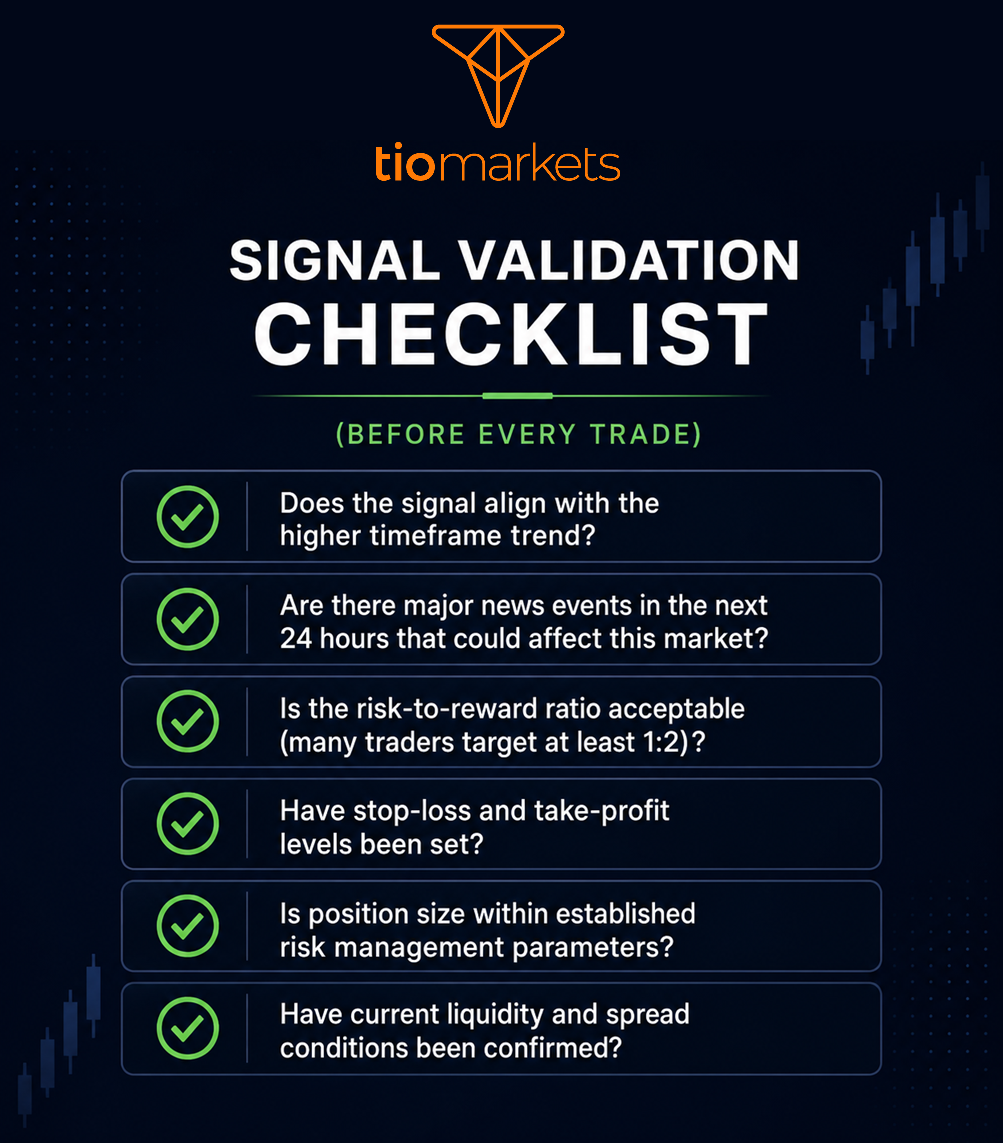
Checking higher timeframe trends, current market conditions, and upcoming news events provides additional context. - Step 5: Applying Proper Position Sizing
Using consistent risk-per-trade rules helps manage exposure regardless of signal confidence. - Step 6: Execution with Appropriate Order Types
Market orders provide immediate execution while limit orders target specific entry prices; each has different implications for fill prices. - Step 7: Monitoring and Recording Results
Maintaining a trading journal tracking which signals performed well, which did not, and potential reasons why.
Signal Validation Checklist
What Is the Difference Between Trading Signals vs. Trading Strategy?
A trading signal is a single trigger or alert; a trading strategy is a complete framework governing all aspects of trading. This distinction is fundamental to understanding how trade signals work within a broader context.
A signal indicates that specific market conditions have been met. A strategy encompasses when to enter, entry and exit points, how much to risk, and how to manage open positions. Signals serve as inputs to a strategy; they are components, not the strategy itself.
What Is the Future of Trade Signals? AI, Machine Learning, and What's Next
Artificial intelligence and machine learning are changing how signals are generated, enabling real-time analysis at scales beyond human capacity. These technologies are influencing several aspects of signal generation.
Technology enhances signal generation capabilities, but human judgment and disciplined risk management continue to play important roles. Traders who combine the processing speed of AI-driven signals with well-defined personal frameworks may be better positioned to navigate evolving market conditions.
The Bottom Line: What Are Trading Signals and Should You Use Them?
Trading signals are tools that identify potential trading opportunities based on predefined criteria; they are not guaranteed profit systems.
Key takeaways
- Trade signals are rule-based alerts indicating potential buy or sell opportunities across forex, stocks, crypto, and other markets
- Signals vary by source (manual vs. automated), methodology (technical, fundamental, algorithmic), and market focus
- Benefits include time savings and reduced emotional bias, while risks include over-reliance and execution delays
- Evaluating providers requires examining verified track records, transparent methodologies, and regulatory status
- Signals function most effectively when integrated into a well-defined trading strategy with consistent risk management
TIOmarkets provides the trading platform and tools for clients to execute their own decisions but does not offer trading signals, recommendations, or trading advice.
For those interested in exploring trading signals, starting with a demo account to test signal quality without capital risk, researching regulated providers, and developing foundational knowledge of technical and fundamental analysis provides a methodical starting point.
FAQ
Risk disclaimer: CFDs are complex instruments and come with a high risk of losing money rapidly due to leverage. You should consider whether you understand how CFDs work and whether you can afford to take the high risk of losing your money. Never deposit more than you are prepared to lose. Professional client’s losses can exceed their deposit. Please see our risk warning policy and seek independent professional advice if you do not fully understand. This information is not directed or intended for distribution to or use by residents of certain countries/jurisdictions including, but not limited to, USA & Countries included in the OFAC sanction list. The Company holds the right to alter the aforementioned list of countries at its own discretion.
TIOmarkets offers an exclusively execution-only service. The views expressed are for information purposes only. None of the content provided constitutes any form of investment advice. The comments are made available purely for educational and marketing purposes and do NOT constitute advice or investment recommendation (and should not be considered as such) and do not in any way constitute an invitation to acquire any financial instrument or product. TIOmarkets and its affiliates and consultants are not liable for any damages that may be caused by individual comments or statements by TIOmarkets analysis and assumes no liability with respect to the completeness and correctness of the content presented. The investor is solely responsible for the risk of his/her investment decisions. The analyses and comments presented do not include any consideration of your personal investment objectives, financial circumstances, or needs. The content has not been prepared in accordance with any legal requirements for financial analysis and must, therefore, be viewed by the reader as marketing information. TIOmarkets prohibits duplication or publication without explicit approval.
Join us on social media



Authors BIO

Maria is a writer and content strategist with over 10 years of experience in the finance industry. She specializes in developing research-backed articles that help financial professionals navigate complex market topics with confidence. Her expertise spans forex, stocks, CFDs and global markets, creating insightful content that educates readers and supports informed decision-making.