What Is Slippage in Trading? Understanding FX Slippage and How to Avoid It
BY Maria K.
|July 27, 2026Imagine a trader clicks "buy" expecting to enter at $50.00 per share, but the order fills at $50.25 instead. Why? This is basically what slippage in trading means: the difference between an expected price and the actual execution price. Understanding what is slippage in trading matters because it directly affects trading costs, overall profitability, and whether a strategy performs as backtested.
This article covers why trading slippage happens, the types of slippage traders encounter, how to avoid slippage in trading, how it varies across the various markets, and practical ways to reduce its impact on your trades.
What Is Slippage in Trading? Slippage Definition
Slippage in trading is the gap between the price a trader expects when placing an order and the price at which that order actually executes. This price difference is a natural consequence of how financial markets operate, not a broker error or system malfunction.
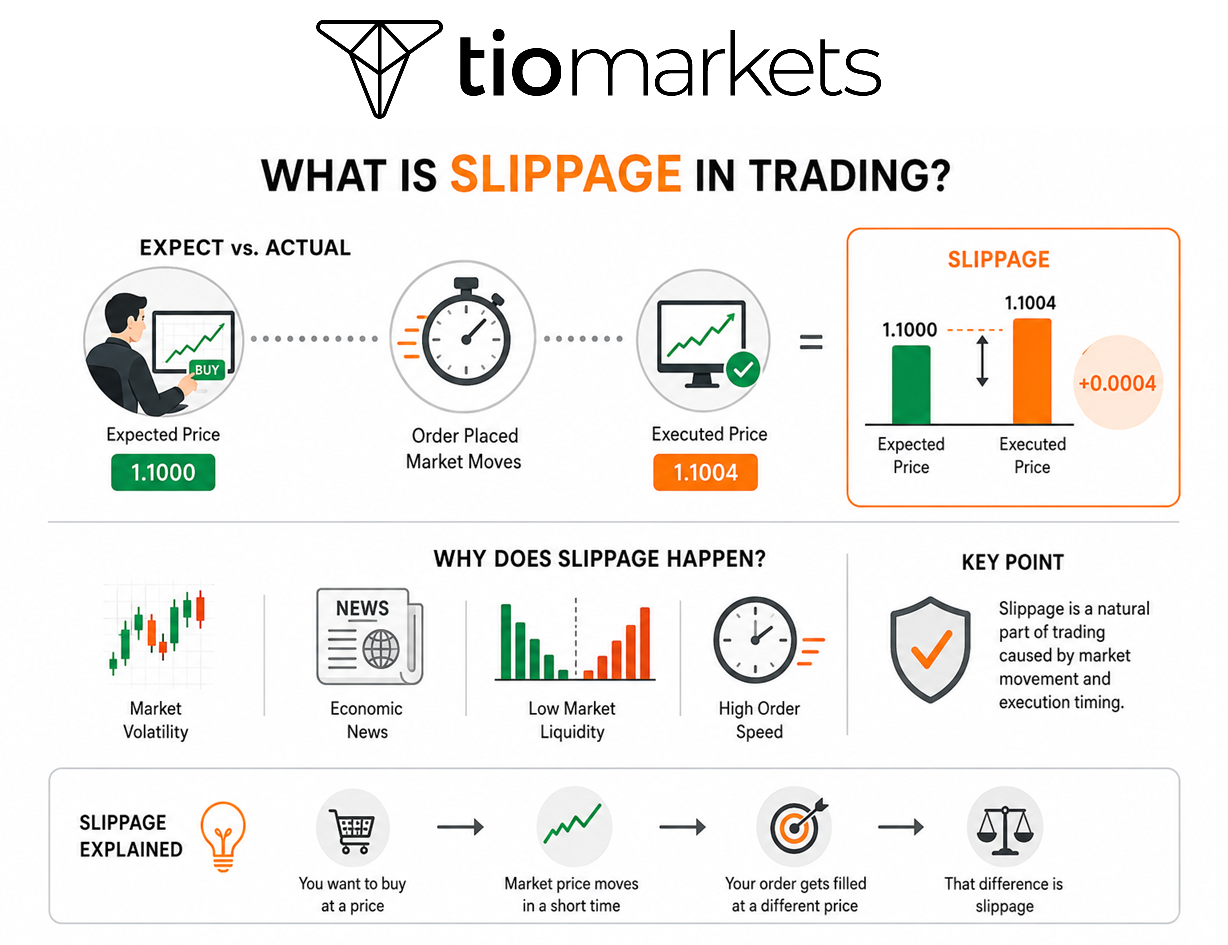
The slippage definition trading professionals use becomes clearer when examining the bid/ask spread. When a trader places an order, the spread between buying and selling prices can shift in the milliseconds between order placement and execution. This movement creates the price discrepancy known as slippage.
Trading slippage falls into two main categories: positive slippage and negative slippage, each affecting trade outcomes differently. Read on to learn more about this.
Why Does Slippage Happen? What Causes Trading Slippage?
Trading slippage stems from identifiable market conditions rather than random occurrence. Several factors influence when and how much slippage a trader experiences.
1. High Market Volatility
Rapid price movements during major events cause the most pronounced slippage. Earnings reports, economic data releases, central bank announcements, and geopolitical developments can reprice assets in milliseconds; faster than most orders execute. Common high-volatility triggers include Non-Farm Payrolls (NFP) releases, Federal Reserve interest rate decisions, and surprise earnings beats or misses. During these periods, the price displayed when clicking "submit" may no longer exist by the time the order reaches the market.
2. Low Market Liquidity
When fewer buyers and sellers participate in a market, bid-ask spreads widen and individual orders have greater price impact. Low liquidity conditions are most common in exotic forex pairs (like USD/TRY), small-cap stocks, thinly traded altcoins, and after-hours markets. Large orders in low-liquidity environments can "consume" the order book, meaning subsequent portions of the order fill at progressively worse prices as available liquidity depletes.
3. Large Order Size Relative to Available Liquidity
A retail trader buying 100 shares of Apple typically experiences minimal slippage due to the stock's deep liquidity. However, an institutional trader buying 500,000 shares may move the market against themselves simply through the act of buying. This phenomenon, called "market impact," occurs when an order itself causes the price movement.
4. Order Execution Delays and Latency
The time between placing and executing an order, even measured in milliseconds, allows market prices to move. High-frequency trading firms exploit latency disparities, while retail traders using standard brokers might face higher delays.
5. Market Order Usage
Market orders prioritise execution speed over price certainty. By design, they execute at the best available price at the moment of execution, not necessarily the price displayed when the order was placed. This contrasts with limit orders, which specify the exact price at which a trader is willing to transact. Market order slippage is generally more common because the order type accepts whatever price the market offers.
6. Trading Outside Peak Market Hours
Pre-market, after-hours, and weekend trading sessions typically have lower liquidity than regular hours. Overnight gaps (when prices jump between sessions) can cause significant slippage when markets reopen. This factor is particularly relevant for stocks and indices, where trading halts create natural gaps between sessions.
Types of Slippage: Positive Slippage vs. Negative Slippage
Price slippage falls into three categories based on whether the execution price benefits, harms, or matches trader expectations. Understanding these distinctions helps traders assess their actual slippage trading outcomes and execution quality.
What Is Negative Slippage?
Negative slippage occurs when a trade executes at a worse price than expected. For a buy (long) order, this means the ask price rises before the order fills. For a sell (short) order, the bid price falls before execution. The impact of negative slippage includes increased entry costs or reduced proceeds from exits.
Example: A trader places a buy order for a stock at $50.00, but it fills at $50.30. That $0.30 represents negative slippage.
What Is Positive Slippage?
Positive slippage occurs when a trade executes at a better price than expected. For buy orders, the ask price falls before filling; for sell orders, the bid price rises. Positive slippage reduces entry costs or increases exit proceeds, effectively improving trade outcomes.
Example: A trader places a buy order at $50.00, and it fills at $49.80. That $0.20 improvement represents positive slippage.
What Is Zero Slippage?
Zero slippage, sometimes marketed as "no slippage", occurs when orders fill exactly at the requested price. This outcome is more common in highly liquid markets during stable conditions. Limit orders are one tool traders use to achieve zero or positive slippage, though they carry the trade-off of potentially not filling at all.
When Is Slippage Most Likely to Occur?
Certain market conditions and timing factors increase slippage probability. Recognising these situations allows traders to adjust their approach accordingly.
- During major economic announcements: NFP, CPI, Fed meetings, and GDP releases create rapid price movements
- Around company earnings reports: especially when released outside regular trading hours
- At market open and close: the highest volatility windows of the trading day
- During flash crashes or sudden market dislocations: when liquidity temporarily evaporates
- When trading low-liquidity assets: penny stocks, exotic currency pairs, and micro-cap cryptocurrencies
- During news-driven gap openings: when prices jump overnight between sessions
Real-world example: During the Swiss National Bank's unexpected removal of the EUR/CHF floor in January 2015, EUR/CHF dropped nearly 30% in minutes. Traders with stop-loss orders experienced slippage measured in hundreds of pips as prices gapped through their specified levels.
How to Avoid Slippage in Trading: Ways to Lower Your Risk
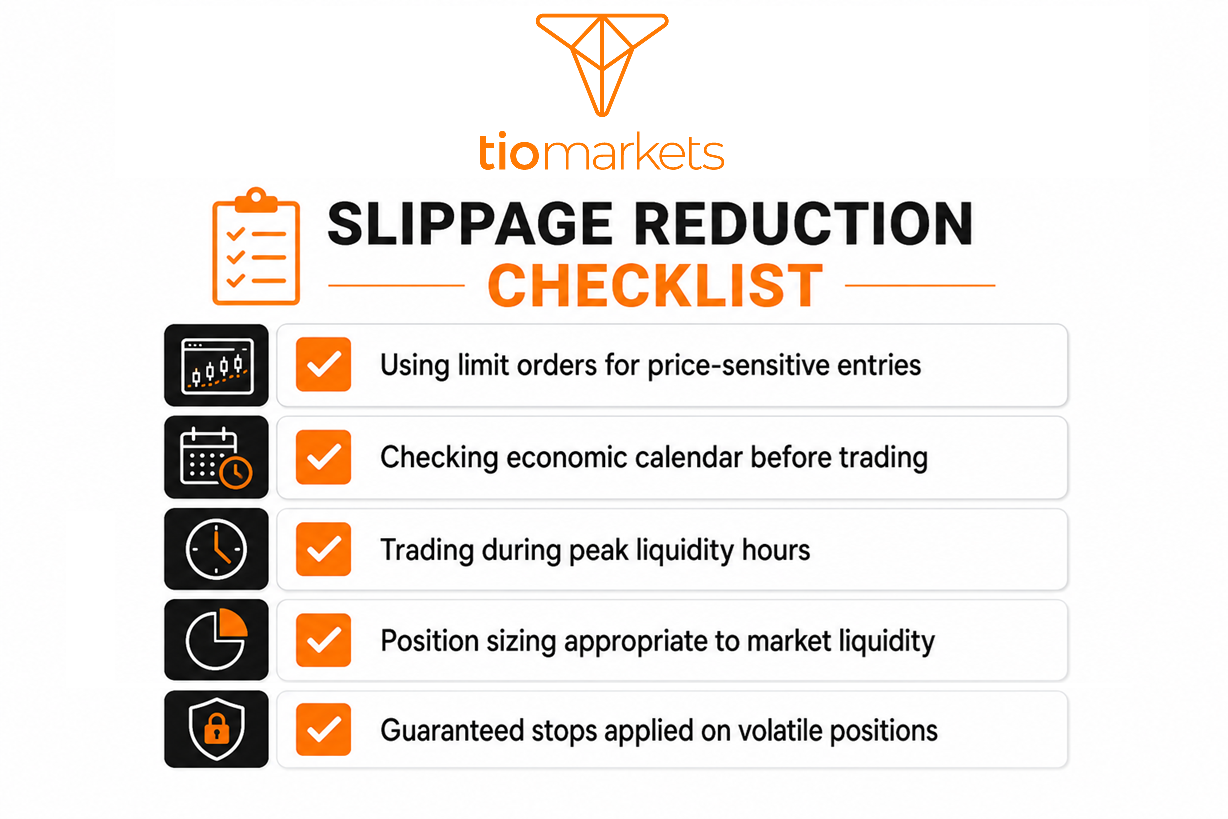
While eliminating slippage entirely is not possible, several strategies can reduce its frequency and magnitude in your slippage trading experience. The following approaches address different aspects of slippage risk.
Slippage Reduction Checklist
1. Using Limit Orders Instead of Market Orders
Limit orders only execute at a specified price or better, eliminating negative slippage by design. If the market doesn't reach the limit price, the order simply doesn't fill. This approach suits traders who prioritise price certainty over execution speed. The trade-off is potential missed opportunities when markets move away from the limit price.
2. Guaranteed Stop-Loss Orders
Guaranteed stop-loss orders close positions at exactly the specified price regardless of market gaps or slippage conditions. Most brokers charge a small premium when these orders trigger. They are particularly relevant in volatile markets where regular stop-loss orders may gap, executing far from the intended level.
3. Trading During High-Liquidity Windows
For forex trading, the overlap of London and New York sessions typically offers the deepest liquidity. For stocks, the first and last hours of regular trading see high volume, though also elevated volatility. Most traders often avoid pre-market, after-hours, weekend, and major holiday periods when liquidity thins significantly.
4. Avoiding High-Impact News Events
Economic calendars identify upcoming data releases that historically trigger volatility. Some traders wait for initial price reactions to subside before entering positions. When trading during news events is necessary, reducing position size limits potential slippage costs.
5. Reducing Order Size or Breaking Large Orders Into Smaller Chunks
Splitting large orders prevents a single trade from moving the market against itself. Institutional traders use VWAP (Volume-Weighted Average Price) or TWAP (Time-Weighted Average Price) execution algorithms to spread orders over time.
Slippage Across Different Markets: How Price Execution Gaps Vary by Asset Class
Slippage behaves differently depending on market structure, liquidity depth, and trading hours. Understanding these variations helps traders set appropriate expectations.
Slippage in Forex Trading
Forex is the world's most liquid market, yet slippage in forex still occurs. Major pairs like EUR/USD, GBP/USD, and USD/JPY experience lower slippage due to deep liquidity, while exotic pairs such as USD/TRY and USD/ZAR see significantly higher slippage. Forex slippage typically spikes around central bank decisions, NFP, and CPI releases.
Slippage in Crypto Trading
Crypto markets operate 24/7 with highly variable liquidity. Slippage in crypto for Bitcoin and Ethereum tends to be relatively lower on major exchanges. Altcoins and DeFi tokens can experience extreme slippage of 5–20% or more in thin markets.
Slippage in Stock Markets
Large-cap stocks like Apple, Microsoft, and Amazon experience minimal slippage during regular trading hours. Small-cap and penny stocks carry much higher slippage risk due to thinner order books. Pre-market and after-hours trading significantly increases slippage probability.
| Asset Class | Typical Slippage Level | Key Risk Factors |
| Major Forex Pairs | Low (1–3 pips) | News events, off-hours trading |
| Exotic Forex Pairs | Medium–High | Low liquidity, wide spreads |
| Large-Cap Stocks | Low | After-hours gaps, earnings |
| Small-Cap/Penny Stocks | High | Thin order books |
| Bitcoin/Ethereum | Low–Medium | Flash crashes, exchange liquidity |
| Futures (Major) | Low–Medium | Expiration, macro events |
How Broker Execution Models Affect Slippage
The way a broker routes and executes orders directly influences slippage outcomes. Different execution models create different slippage characteristics.
- Market Makers take the opposite side of client trades, creating potential conflicts of interest. Spreads may be wider, and slippage policies vary; some brokers fill at worse prices while others requote.
- ECN (Electronic Communication Network) brokers route orders directly to liquidity providers including banks and institutions. This model typically offers tighter spreads, faster execution, and more transparent pricing with lower slippage potential.
- STP (Straight-Through Processing) brokers pass orders directly to the market without dealer intervention. This reduces execution delays, minimising slippage caused by latency.
What to Check About Slippage When Choosing a Broker
When evaluating brokers, consider their slippage policy and business model: Do they fill orders at worse prices or reject them? What slippage tolerance or price band policy do they apply? Do they offer guaranteed stop-loss orders? How do they handle slippage during news events?
TIOmarkets employs a hybrid trade execution model, strategically combining internal liquidity matching with Straight-Through Processing to external liquidity providers. This helps balance fast order execution with efficient and reliable order processing in milliseconds. Our core objective focuses on maintaining fast order execution, tight pricing, and reliable trading conditions for all clients.
Conclusion
Slippage in trading is an inherent feature of financial markets, not a flaw. It results from the natural dynamics of price discovery, liquidity, and order execution timing. Understanding the slippage meaning in trading, from market volatility and liquidity conditions to order types and broker execution models, allows traders to make more informed decisions about when and how they trade. There are practical approaches to managing slippage but while no strategy guarantees zero slippage, applying them can help reduce slippage impact on trading performance over time.
If you want to learn more about TIOmarkets and its unique approach to order execution - and therefore reducing slippage in your trading - you can contact us any moment.

FAQ
Risk disclaimer: CFDs are complex instruments and come with a high risk of losing money rapidly due to leverage. You should consider whether you understand how CFDs work and whether you can afford to take the high risk of losing your money. Never deposit more than you are prepared to lose. Professional client’s losses can exceed their deposit. Please see our risk warning policy and seek independent professional advice if you do not fully understand. This information is not directed or intended for distribution to or use by residents of certain countries/jurisdictions including, but not limited to, USA & Countries included in the OFAC sanction list. The Company holds the right to alter the aforementioned list of countries at its own discretion.
TIOmarkets offers an exclusively execution-only service. The views expressed are for information purposes only. None of the content provided constitutes any form of investment advice. The comments are made available purely for educational and marketing purposes and do NOT constitute advice or investment recommendation (and should not be considered as such) and do not in any way constitute an invitation to acquire any financial instrument or product. TIOmarkets and its affiliates and consultants are not liable for any damages that may be caused by individual comments or statements by TIOmarkets analysis and assumes no liability with respect to the completeness and correctness of the content presented. The investor is solely responsible for the risk of his/her investment decisions. The analyses and comments presented do not include any consideration of your personal investment objectives, financial circumstances, or needs. The content has not been prepared in accordance with any legal requirements for financial analysis and must, therefore, be viewed by the reader as marketing information. TIOmarkets prohibits duplication or publication without explicit approval.
Join us on social media



Authors BIO

Maria is a writer and content strategist with over 10 years of experience in the finance industry. She specializes in developing research-backed articles that help financial professionals navigate complex market topics with confidence. Her expertise spans forex, stocks, CFDs and global markets, creating insightful content that educates readers and supports informed decision-making.