What Is Synthetic Indices Trading? How Virtual Markets Work, Types & Strategies
BY Maria K.
|July 10, 2026What if you could trade a financial market that never closes, remains immune to economic news, and allows you to choose instruments with different predefined volatility profiles? For traders seeking alternatives to conventional markets, synthetic indices trading is an intriguing option.
This comprehensive guide covers everything you need to know about trading synthetic indices, from understanding the underlying technology to exploring different index types, developing effective strategies, and recognising the associated risks. This article provides the practical insights you need to make informed decisions about virtual markets trading.
What Is Synthetic Indices Trading?
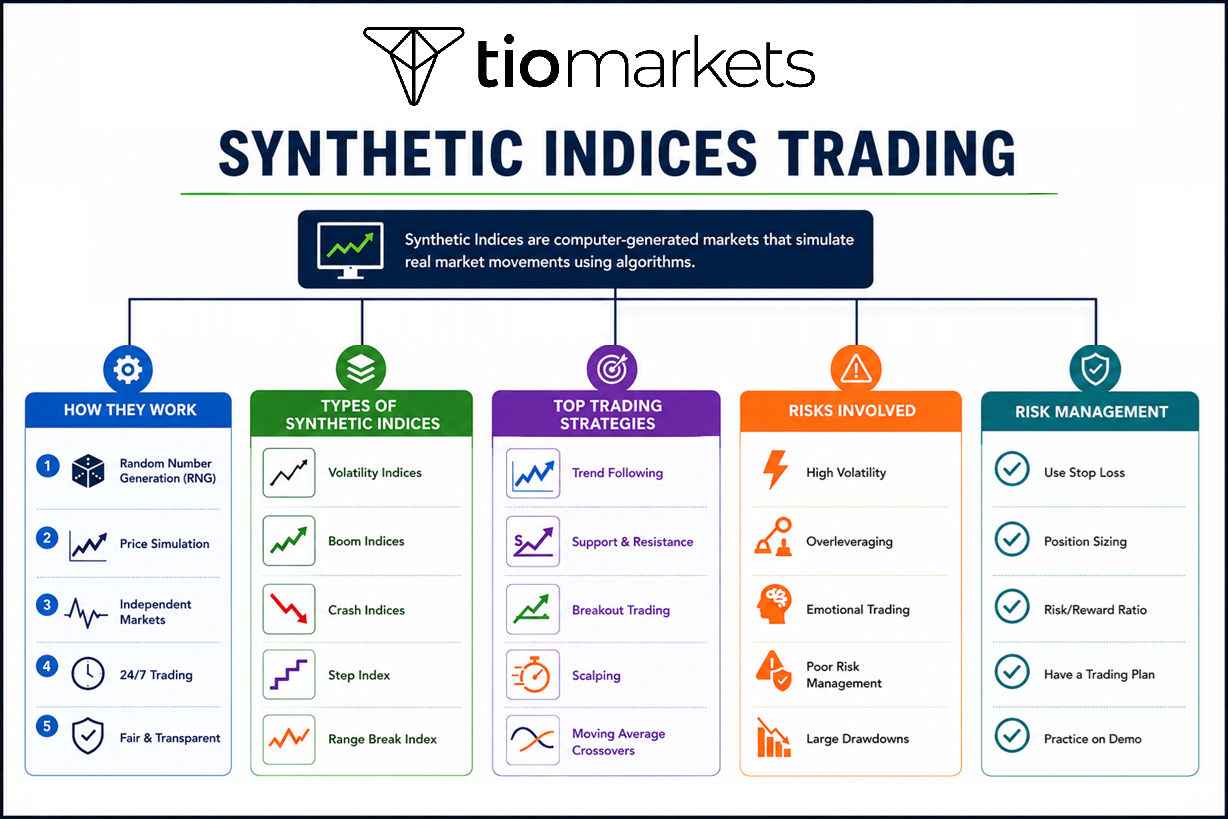
Synthetic indices trading involves speculating on price movements of algorithm-driven financial instruments that exist entirely within a digital environment. Synthetic indices generate their price movements through sophisticated computer algorithms. These simulated indices trading instruments create price patterns that mimic real market volatility without any connection to actual stocks, currencies, or commodities.
The fundamental distinction between synthetic indices and traditional indices, like the S&P 500 or FTSE 100 lies in their price determination mechanism. Traditional indices derive their value from baskets of underlying stocks. Synthetic indices, by contrast, produce price movements through a cryptographically secure random number generator (RNG) designed to produce statistically random price movements based on audited RNG systems.
Key Characteristics of Synthetic Indices
- Prices generated using random number generator (RNG) systems, which may be independently audited depending on the provider
- No connection to real-world economic events or assets
- Available for trading 24 hours a day, 7 days a week
- Pre-programmed volatility levels that remain consistent
- Traded as CFDs (Contracts for Difference) on broker platforms
- Not directly affected by central bank decisions, earnings reports or geopolitical events
News events that would typically move forex or stock markets have zero impact on synthetic index prices. The algorithms continue generating price movements based purely on mathematical models. Traders access these derived indices trading opportunities through CFD trading on regulated broker platforms - just speculating on price direction without owning any underlying asset.
Key Takeaway: Synthetic indices are computer-generated markets designed to simulate real price volatility, giving traders a clean, noise-free environment to apply their strategies 24/7.
How Do Synthetic Indices Work? The Technology Behind Algorithm-Driven Markets
Understanding the mechanics behind synthetic indices can help traders appreciate both their potential benefits and limitations. The technology powering these markets is more sophisticated than many realise.
The Role of Random Number Generators (RNG)
At the heart of every synthetic index lies a cryptographically secure random number generator. In simple terms, this is a computer algorithm designed to produce sequences of numbers that are genuinely unpredictable, similar to the technology used in online games and secure communications.
What makes these RNG systems "cryptographically secure" is their resistance to prediction. Even with knowledge of previous outputs, determining future numbers remains mathematically impossible. This means that price movements are designed so future outputs cannot reasonably be predicted or manipulated by any party, including the broker.
The algorithms are designed so that annualised volatility falls within a specified confidence level, typically around 95%. This means the price behaviour over time should statistically match the advertised volatility characteristics of each index type.
How Price Movements Are Simulated
Synthetic indices generate prices on a tick-by-tick basis, with each tick representing a small price movement. The frequency of these ticks varies between index types: some update every second, others every two seconds, and some at irregular intervals designed to create specific market behaviours.
Different indices incorporate different volatility levels into their programming. A Volatility 10 Index, for example, is coded to produce gentler price swings than a Volatility 100 Index. The underlying mathematics ensure these volatility characteristics remain consistent over time, giving traders a predictable environment in terms of potential price range.
Each tick's direction and magnitude come from the RNG, but the parameters controlling the range of possible movements are pre-set according to the index specification.
Are Synthetic Indices Fair to Trade?
Scepticism is understandable since the broker controls the algorithm that determines prices. Brokers address this concern by using independently audited RNG systems. Third-party auditors examine the algorithms to verify that outcomes are statistically fair and match the advertised specifications. Independent audits are intended to provide assurance that the RNG operates according to its published specifications.
Types of Synthetic Indices: A Complete Breakdown of Virtual Market Instruments
Synthetic indices come in multiple categories, each with a distinct price behaviour, volatility profile, and ideal use case. Understanding these differences is crucial for selecting instruments that align with your trading style and risk tolerance. This section provides one of the most comprehensive breakdowns available.
Comparison Table: Types of Synthetic Indices at a Glance
| Index Type | Price Behaviour | Volatility Level | Best For | Trading Style |
| Volatility Indices | Constant, steady movement | Low to Extreme | Technical traders | Scalping, trend following |
| Boom Indices | Upward trend + random spikes | Medium-High | Bullish breakout traders | Momentum trading |
| Crash Indices | Downward trend + random drops | Medium-High | Bearish breakout traders | Momentum trading |
| Jump Indices | Random sharp leaps up/down | Very High | Experienced scalpers | Scalping |
| Step Indices | Fixed step movements (±points) | Low-Medium | Algorithmic traders | EA testing, grid trading |
| Range Break Indices | Ranging + periodic breakouts | Medium | Breakout traders | Channel/breakout trading |
| Drift Switching Indices | Shifting trends at set intervals | Medium | Trend followers | Trend following |
| Daily Reset Indices | Bull/bear simulation, daily reset | Low-Medium | Swing traders | Swing trading |
| DEX/Spike Indices | Spikes/drops at fixed intervals | High | Event-driven traders | Directional spike plays |
Synthetic Indices vs. Traditional Markets - Key Differences Explained
Understanding where synthetic indices trading fits within the broader trading landscape helps traders make informed decisions about how to allocate their time and capital across different market types.
Comparison Table: Synthetic Indices vs Forex vs Stocks vs Traditional Indices
| Feature | Synthetic Indices | Traditional Indices | Forex | Stocks |
| Market Hours | 24/7 (never closes) | Exchange hours only | 24/5 | Exchange hours only |
| Affected by News | No | Yes | Yes | Yes |
| Affected by Economic Data | No | Yes | Yes | Yes |
| Volatility Control | Pre-set, choosable | Variable | Variable | Variable |
| Asset Backing | None (RNG-based) | Basket of stocks | Currency pairs | Company shares |
| Liquidity Risk | Not applicable in the same way | Low-Medium | Low-Medium | Low-Medium |
| Swap/Overnight Fees | Some brokers do not charge these fees | Yes | Yes | Yes |
| Suitable for Algorithms | Excellent | Good | Good | Moderate |
| Beginner Friendly | Yes (with low volatility) | Moderate | Moderate | Moderate |
The most significant distinctions centre on market hours and external influences. Synthetic indices operate continuously, while traditional markets follow exchange schedules. Moreover, the immunity to news events represents both an advantage and a limitation. Traders who excel at fundamental analysis may find synthetic indices less engaging, while technical traders often appreciate the absence of sudden news-driven gaps and spikes that can trigger stop-losses.
Synthetic indices are not designed as replacements for traditional markets. They serve a different purpose: providing a controlled environment for technical trading, strategy testing, and skill development without the complexity of real-world market drivers.
Advantages of Trading Synthetic Indices
Trading synthetic indices offers several potential benefits that distinguish these instruments from conventional markets:
- 24/7 Market Access: Markets remain open around the clock, including weekends.
- Immunity from News: No central bank decisions or geopolitical developments impact them.
- Controllable Volatility: Volatility levels match traders’ risk appetite and strategy requirement.
- Zero Swap Fees: Some brokers do not charge overnight financing charges on certain synthetic indices
- Consistent Market Conditions: The programmed volatility characteristics remain consistent over time.
- Ideal for Strategy Testing: The controlled environment suits backtesting and forward-testing strategies.
- Accessible to All Traders: Low minimum trade sizes, allowing trading without substantial capital.
- No Traditional Liquidity Risk: Price execution isn't affected by low market liquidity.
- Traditional Market Liquidity Constraints Not Applicable: Risk does not work in the same way as exchange-traded markets but execution, pricing and counterparty risks still exist.
Risks of Synthetic Indices Trading
Synthetic indices carry real financial risks that every trader should understand before committing capital.
- Leverage risk: Synthetic indices are leveraged products and you can lose more than your initial deposit.
- Overtrading risk: 24/7 availability makes them appealing but traders may engage in excessive trading.
- Misunderstanding the RNG: Problems when traditional technical analysis is incorrectly applied.
- Broker risk: Not all platforms offering synthetic indices operate under regulatory oversight.
- Psychological risk: Rapid price movements can trigger emotional reactions that override rational strategy execution.
- No fundamental analysis applicable: economic analysis and news interpretation is not available to traders.
Best Strategies for Synthetic Indices Trading
Strategies for synthetic indices rely primarily on technical analysis since fundamental factors don't apply. Different index types favour different approaches, making strategy-index alignment crucial for potential success.
Scalping Synthetic Indices is a strategy traders use on Volatility Indices (particularly higher volatility variants) and Jump Indices. Scalpers typically operate on M1 and M5 timeframes, using tools like RSI, Bollinger Bands, and EMA crossovers.
Trend Following on Synthetic Indices is a strategy commonly applied to Drift Switching Indices and medium-volatility Volatility Indices, where clearer directional movements emerge. Traders typically monitor M15 and H1 timeframes, employing Moving Averages (20 EMA, 50 EMA), MACD, and ADX indicators.
Breakout Trading with Boom and Crash Indices is another strategy traders use. Operating on M5 and M15 timeframes, breakout traders use support/resistance levels, Bollinger Bands, and volume indicators to time entries.
Algorithmic and EA Trading on Synthetic Indices leverages the consistent, news-free environment that makes these markets particularly suitable for automated strategies. Step Indices and fixed-volatility instruments provide stable conditions for Expert Advisor development and testing.
Swing Trading Daily Reset Indices appeals to traders preferring longer holding periods. Using H1 and H4 timeframes with Fibonacci retracements, support/resistance analysis, and candlestick patterns, swing traders can capture multi-hour moves.
How to Start Trading Synthetic Indices: A Step-by-Step Guide
Beginning your synthetic indices trading journey involves a straightforward process, though each step deserves careful attention.
Step 1: Choose a broker that offers synthetic indices with audited RNG systems
Step 2: Open and verify your trading account
Step 3: Fund your live account
Step 4: Select your synthetic index
Step 5: Analyse the market and place your trade
Common Mistakes to Avoid When Trading Synthetic Indices
Learning from common errors can accelerate your development as a synthetic indices trader, while protecting your capital from avoidable losses.
- Treating synthetic indices like forex
- Ignoring the index type's built-in behaviour
- Overleveraging on high-volatility indices
- Trading without a stop-loss
- Overtrading due to 24/7 availability
- Skipping the demo phase
- Chasing losses
- Using the wrong technical indicators for the index type
Is Synthetic Indices Trading Right for You?
Synthetic indices trading offers a unique proposition in the financial markets: a 24/7, news-free environment where technical traders can apply their skills without fundamental noise. The algorithm-driven nature creates consistent conditions that many traders find appealing.
These markets serve multiple purposes, while the wide range of index types offers a range of instruments that may suit different trading styles.
- Beginners can learn risk management and chart reading in a controlled setting.
- Experienced traders can test algorithmic strategies without worrying about economic calendars.
- Conservative scalpers preferring low volatility can explore their possibilities.
- Aggressive traders seeking extreme price swings can rejoice in the opportunity.
If you are ready to explore trading, open your account and discover how all this information might fit into your trading approach.

FAQ
Risk disclaimer: CFDs are complex instruments and come with a high risk of losing money rapidly due to leverage. You should consider whether you understand how CFDs work and whether you can afford to take the high risk of losing your money. Never deposit more than you are prepared to lose. Professional client’s losses can exceed their deposit. Please see our risk warning policy and seek independent professional advice if you do not fully understand. This information is not directed or intended for distribution to or use by residents of certain countries/jurisdictions including, but not limited to, USA & Countries included in the OFAC sanction list. The Company holds the right to alter the aforementioned list of countries at its own discretion.
TIOmarkets offers an exclusively execution-only service. The views expressed are for information purposes only. None of the content provided constitutes any form of investment advice. The comments are made available purely for educational and marketing purposes and do NOT constitute advice or investment recommendation (and should not be considered as such) and do not in any way constitute an invitation to acquire any financial instrument or product. TIOmarkets and its affiliates and consultants are not liable for any damages that may be caused by individual comments or statements by TIOmarkets analysis and assumes no liability with respect to the completeness and correctness of the content presented. The investor is solely responsible for the risk of his/her investment decisions. The analyses and comments presented do not include any consideration of your personal investment objectives, financial circumstances, or needs. The content has not been prepared in accordance with any legal requirements for financial analysis and must, therefore, be viewed by the reader as marketing information. TIOmarkets prohibits duplication or publication without explicit approval.
Join us on social media



Authors BIO

Maria is a writer and content strategist with over 10 years of experience in the finance industry. She specializes in developing research-backed articles that help financial professionals navigate complex market topics with confidence. Her expertise spans forex, stocks, CFDs and global markets, creating insightful content that educates readers and supports informed decision-making.