WTI Crude Oil Forecast for the Week of 16th March 2026
BY TIOmarkets
|March 16, 2026WTI Crude Oil Market Overview
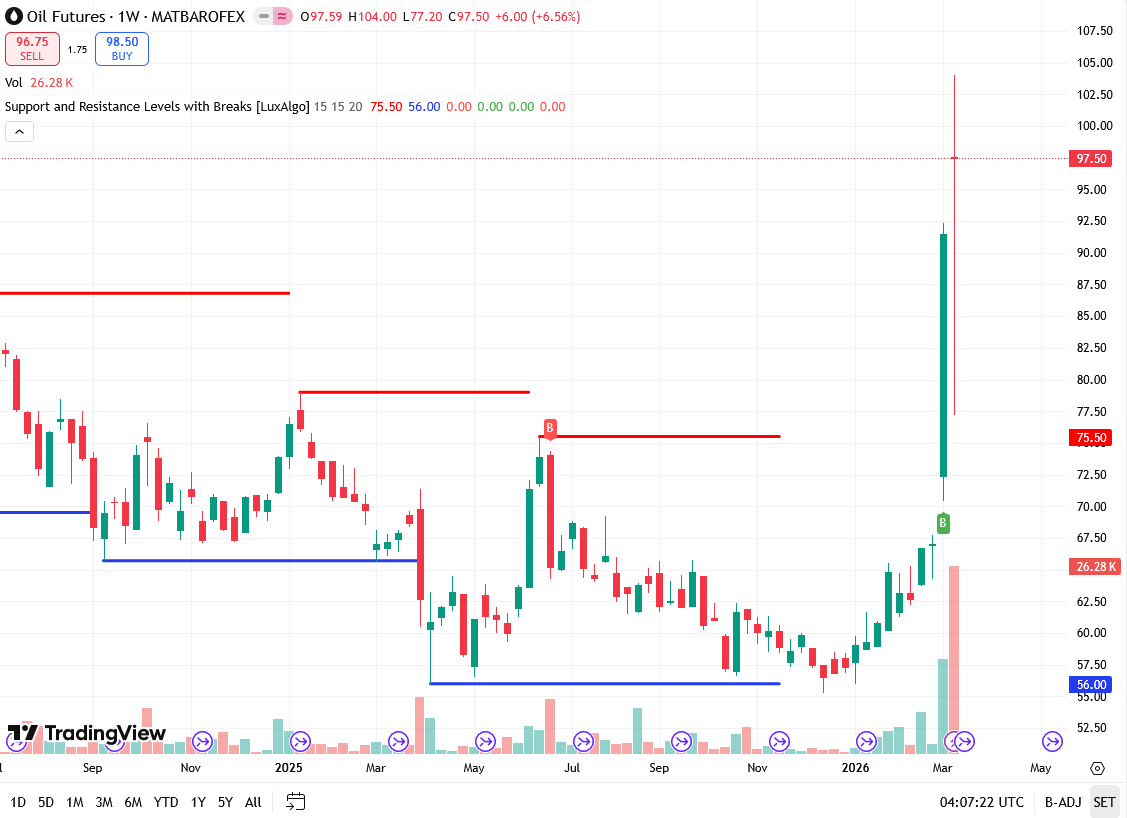
WTI crude oil is set to start the week of 16-20 March 2026 at a level close to $97.50 per barrel, thus making it a continuation of the strong price rally that was witnessed last week. Oil prices have sharply surged in the past few sessions, the extent of the gains being more than 6%, primarily due to the rising geopolitical tensions in the Middle East and the worries of the disruption of supplies in the main maritime routes.
The market has increasingly factored in a geopolitical risk premium, notably concerns over Iran and the safety of the Strait of Hormuz, which is one of the most important corridors for the transportation of oil in the world. A huge portion of the oil exports in the world passes through this narrow waterway, and hence, any disruption or the mere thought of a supply threat can lead very quickly to higher energy prices.
The resultant effects have raised oil market volatility considerably. Traders' reactions depend not only on actual occurrences but also on the potential for escalation, which can cause drastic changes in market expectations regarding worldwide supply conditions.
In addition to geopolitics, oil prices depict a close correlation with global macroeconomic factors and the most important ones are possibly those that relate to the changes in US monetary policy. An increase in the prices of oil would have the effect of raising the inflation expectations, which, in turn, may lead to changes in the outlooks for the policies of the central banks, especially in view of the Federal Reserve meeting that is scheduled for this week.
As energy prices are among the key drivers of inflation dynamics, movements in crude oil thus cause changes in the following:
- Inflation expectations
- Bond yields
- Equity markets
- Currency markets
The beginning of the week sees the oil market influenced by the issues of geopolitical risk, supply worries, inventory data, and global demand expectations, resulting in a market situation where volatility may stay at a high level.
Technical Analysis for WTI Crude Oil
Current Market Structure
Looking at the technical charts, WTI crude oil is still following the path of a very bullish trend. In the last few weeks, the price movements have been so fast that the market has been led up to the point of being well above the major moving averages, and at the same time, the strong upward structure has been confirmed.
The rise has been marked repeated higher highs and higher lows, which indicate uninterrupted buying pressure.
On the other hand, the market is very close to the $100 mark, which is a psychological level for the price and at the same time, represents a significant technical point.
When price levels are rounded numbers, they tend to draw extra attention from the market because they serve as resistance levels, potentially triggering volatility. As WTI prices are nearing $100, traders, especially after the rapid rise in price over the last few days, could get more cautious.
Even though the larger picture is still favorable, the market might go into consolidation or have temporary pullbacks as the players are assessing if the present fundamentals warrant more upside.
Moving Averages and Trend Structure
The moving-average setup totally backs the current trend's robustness.
The 10-period and 20-period EMAs, which are very short-term moving averages, are still quite a distance below the current price level, signifying a very strong upward momentum. In case of price decline corrections, these indicators now act as dynamic support levels.
The 30-period and 50-period moving averages are medium-term indicators. They have not only contributed to the strengthening of the overall bullish structure but are also part of the important support area around the $85-$90 range, which might come into play if the market experiences a deeper pullback.
The 100-period and 200-period moving averages, the longer-term averages, have the trend pointed upward, confirming the strength of the multi-month structure.
All in all, the pattern of these indicators is consistent with conditions that would lead to a continuation of the trend even though the big gap between price and moving averages suggests that it is probably a temporary stretch of the market.
Momentum Indicators
Momentum is one of the things that the momentum indicators look at. They show a strong bullish momentum at the moment, but at the same time, they also point out the possibility of the market being very tired in the short term.
The Relative Strength Index (RSI) is one of the momentum indicators, and it specifically tells you that the market is very overbought at the moment because it is above 80.
This does not mean that the product will change the direction immediately, but the possibility of consolidation or a correction is definitely higher.
The positive MACD is indicative that the rally is still strong. At the same time, trend-strength indicators like the Average Directional Index (ADX) reveal that the trend remains sufficiently strong.
Short-term momentum results show, however, that the rate of the rally could reduce, especially as the market gets close to the resistance level.
Key Support and Resistance Levels
The possible main support and resistance levels for the direction of WTI are:
Resistance Levels
- $100 major psychological resistance
- $105 extended breakout target
- $110 macro resistance level
Support Levels
- $95 first support level
- $90 important structural support
- $85 medium-term support area
- $83 strong technical support level
In all likelihood, the $100 level will be the main technical focus this week. If the market can make a strong breakout of this level, it is possible that the buying related to the momentum that is driven by the market will increase.
Bullish Scenario
In bullish terms, the market will most likely keep the upward bias as long as the $95 support level is not broken.
The move beyond $100, especially if it is sustained, may give the market a fresh momentum, which could take the price all the way to $105 and then to $110 in the case of a strong upswing.
This should be accompanied by a scenario of the tensions continuing to flare up in the Middle East, thereby raising concerns of the supply being cut off.
Besides this, the two factors that could act in the market are strong global demand expectations and dropping inventory levels.
On the basis of this, the market might raise the risk premium, which is a large part of the oil prices.
Bearish Scenario
The bear situation is such that WTI would not be able to keep the momentum at the $100 level and would, therefore, make a downward movement to less than the $95 support level.
Profit-taking activity could lead to the short-term correction back to the $90 level, and under heavy selling, it could go further down to $85.
Easing geopolitical tensions or new data pointing to demand being weaker globally might make such a scenario occur.
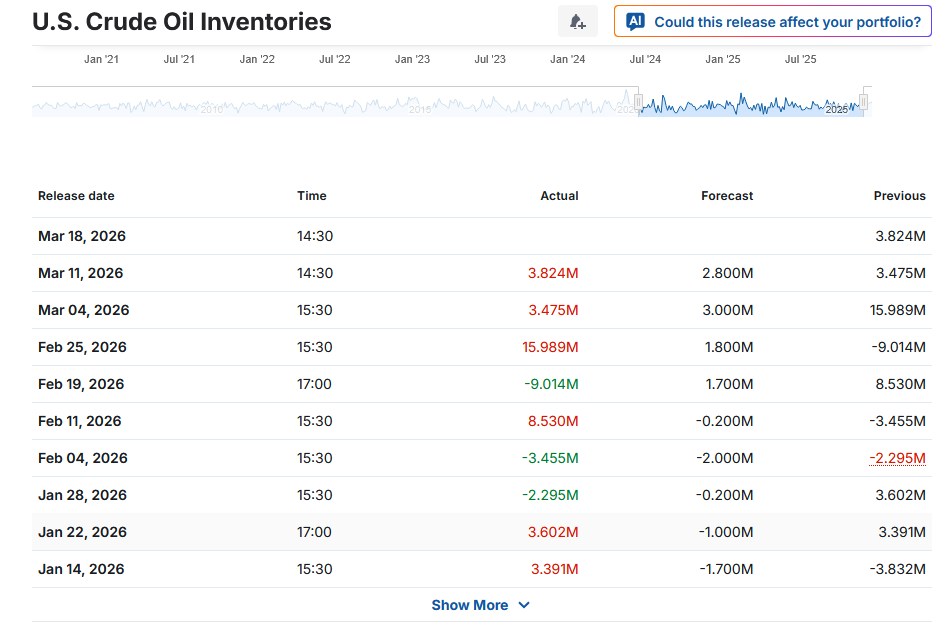
Also, an increase in the US crude oil inventories signals a market oversupply and would certainly put some pressure on the price.
Since the rally was so strong in the last few sessions, even a retracement to some of the lower support levels can quite likely be seen as a technical correction rather than a change in the overall trend.
WTI Crude Oil Fundamental Drivers
Geopolitical Risk Premium
The most important factor driving the oil market currently is the geopolitical risk premium.
Tensions involving Iran and fears over the impact of an incident on the shipping security of the Persian Gulf have made the possibility of disruptions in the Strait of Hormuz, the main route for oil exports worldwide, a concern in the minds of the market players.
A worsening of the tensions in the region can have a major effect on oil prices due to the higher risk of supply disruptions.
Federal Reserve and Inflation Expectations
Global monetary policy expectations influence the oil market as well.
The Fed meeting will be held from March 17-18. If oil prices continue to be high, this will lead to more challenges for policymakers in keeping inflation stable.
In other words, one of the paths through which oil prices move the markets is their impact on inflation and, consequently, on the decisions of central banks in respect of interest rates.
Global Demand and Chinese Economic Data
China is the biggest crude oil importer in the world, which is why its economic performance is one of the major determinants of global energy demand.
Retail sales, industrial production, and other figures are what market participants keep a close eye on in order to understand China's economic condition and potential energy consumption trends.
If the economic data are on the strong side, the oil market storyline that revolves around the bullish idea would be further encouraged, as increased demand is a typical outcome of stronger economic conditions.
This Week's WTI Crude Oil High-Impact Events
- US Crude Oil Inventories (EIA Report): Weekly inventory numbers highlight the balance between short-term supply and demand in the US energy market.
- Federal Reserve Interest Rate Decision: The outlook on the Fed's policy direction is capable of modifying inflation expectations, causing currency movements and changes in global financial conditions that have an impact on commodity markets.
- US Industrial Production Data: The level of manufacturing activity has the potential to play a role in forming expectations for energy demand in the U.S. economy.
- Chinese Retail Sales Data: It reveals the level of consumer spending in China, which, in turn, has an effect on expectations for global energy consumption.
- Chinese Industrial Production: Figures on industrial production are very significant as they provide the level of manufacturing activity and the related demand for oil.
Risk Considerations for WTI Crude Oil This Week
During the week, several risk factors can affect oil price volatility:
First, the escalation of conflicts and geopolitical disputes remains the main risk. If any developments occur regarding oil supply routes or the general stability of the region, it will be a matter of time before prices rise.
Second, surprises from inventory data can move the market very quickly, particularly if there is a significant unexpected rise or fall in US crude oil stocks.
Third, monetary policy expectations can have a very indirect influence on oil prices, but the transmission mechanism is via the US dollar and the global financial conditions.
Finally, based on the strong rally seen recently, the market is a bit vulnerable, technically speaking, to sudden price changes, as variations in large speculative positions could amplify the volatility.

Risk disclaimer: CFDs are complex instruments and come with a high risk of losing money rapidly due to leverage. You should consider whether you understand how CFDs work and whether you can afford to take the high risk of losing your money. Never deposit more than you are prepared to lose. Professional client’s losses can exceed their deposit. Please see our risk warning policy and seek independent professional advice if you do not fully understand. This information is not directed or intended for distribution to or use by residents of certain countries/jurisdictions including, but not limited to, USA & Countries included in the OFAC sanction list. The Company holds the right to alter the aforementioned list of countries at its own discretion.
TIOmarkets offers an exclusively execution-only service. The views expressed are for information purposes only. None of the content provided constitutes any form of investment advice. The comments are made available purely for educational and marketing purposes and do NOT constitute advice or investment recommendation (and should not be considered as such) and do not in any way constitute an invitation to acquire any financial instrument or product. TIOmarkets and its affiliates and consultants are not liable for any damages that may be caused by individual comments or statements by TIOmarkets analysis and assumes no liability with respect to the completeness and correctness of the content presented. The investor is solely responsible for the risk of his/her investment decisions. The analyses and comments presented do not include any consideration of your personal investment objectives, financial circumstances, or needs. The content has not been prepared in accordance with any legal requirements for financial analysis and must, therefore, be viewed by the reader as marketing information. TIOmarkets prohibits duplication or publication without explicit approval.
Join us on social media



Authors BIO

Behind every blog post lies the combined experience of the people working at TIOmarkets. We are a team of dedicated industry professionals and financial markets enthusiasts committed to providing you with trading education and financial markets commentary. Our goal is to help empower you with the knowledge you need to trade in the markets effectively.
Related Posts