AUD/USD Forecast for the Week of 16th March 2026
BY TIOmarkets
|March 16, 2026AUD/USD Market Overview
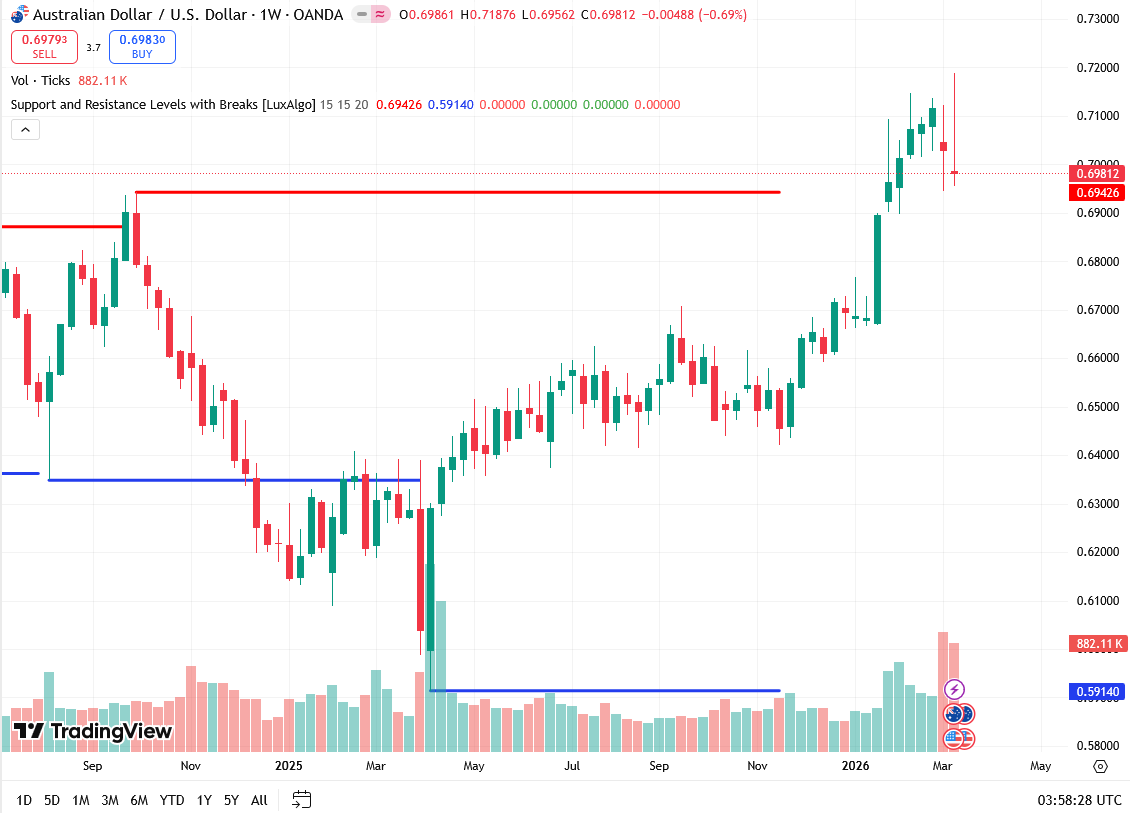
At the start of the week of 16-20 March AUD/USD is close to the 0.6980 level, maintaining the upward recovery that started at the beginning of the year. Three factors play into the gains experienced by the Australian dollar: stronger global risk sentiment, rising commodity prices, and the expectation that economic activity in China will stabilise in the first six months of the year.
The all-important 0.7000 psychological resistance level is historically a pivotal point in AUD/USD price action and the currency pair is fast approaching that level. Round number levels like this attract better market attention as traders determine if there’s a strong enough momentum to support a breakout.
Contrary to traditional safe-haven currencies, the Australian dollar is closely linked to global growth expectations, especially in the Chinese economy. As Australia’s largest trading partner, China is the main factor in determining demand for coal, iron ore, and other key exports from Australia. Hence, Chinese economic data can directly impact AUD/USD movements.
Moreover, the Australian dollar continues to be influenced by the global risk sentiment. It is only natural that when investors get more confident, capital gravitates toward higher-yielding and growth-sensitive currencies such as the AUD. However, the US dollar often gains strength during times of geopolitical tensions or market uncertainties, causing the fall of the risk-sensitive currencies.
Some of the main drivers for AUD/USD this week will be the release of Chinese economic data, the sentiment of global investors toward risk, the trend in commodity prices, and the expectations regarding monetary policies of the Federal Reserve and the Reserve Bank of Australia (RBA).
The pair is still moving forward with a bullish bias broadly, however, the close proximity to a major resistance level might result in heightened volatility throughout the week.
Technical Analysis for AUD/USD
Current Market Structure
On the technical front, AUD/USD still appears to be on a multi-timeframe upward trajectory without a break. Price action has been repeatedly creating higher highs and higher lows, indicating a growing demand for the Australian dollar against the US dollar.
The pair is gradually nearing the 0.7000 resistance level which, apart from being a psychological level, is a technically significant one too. It is common for markets to either become sluggish or to go into a consolidation phase close to these levels as traders recalibrate their positions and assess the momentum.
Though a brief consolidation phase cannot be ruled out, the overall positive trend will remain intact as long as the pair stays above the critical support areas formed during the recent price increase.
Moving Averages and Trend Structure
The trend currently in place is well-supported by the prevailing moving-average pattern.
The 10-period and 20-period EMAs, which are short-term moving averages, are still situated under the present price, thus serving as dynamic support levels in case of price retracements. This setup shows a continuation of the strong momentum to the upside.
Medium-term moving averages like the 30-period and 50-period ones are located even lower on the chart, thus constituting a further support area. This area around 0.6830-0.6700, where these averages are gathered is likely to be re-visited by buyers in case of a pullback.
Long-term averages like the 100-period and 200-period ones are not only steadily going up but their current positions also lend credence to the fact that the general market structure is bullish.
Taking everything into account, these indications clearly show a positive momentum across several timeframes, thus the present bullish stance is viable.
Momentum Indicators
Currently all momentum indicators show the presence of at least moderate bulls although the market is quite close to encountering a temporary sideways phase as the resistance levels are now within sight.
The Relative Strength Index or RSI is still in the positive zone but has not surpassed the overbought line yet. So, this means that the bulls have not over-extended yet.
Moreover, the MACD and other momentum-based oscillators are still showing a positive divergence. When the markets are in a long-term directional phase these penetrate deeply into the positive zone.
Trend strength indicators generally suggest that the present uptrend is being powered adequately from the underlying momentum side as well. However, the advancement towards the major technical barrier may cause some traders to take profits at the short-term level.
Key Support and Resistance Levels
During the week, certain price levels may have a significant impact in determining the direction of AUD/USD.
Resistance Levels
- 0.7000 - major psychological resistance level
- 0.7075 - short-term breakout target
- 0.7200 - medium-term resistance level
- 0.7250 - extended bullish objective
Support Levels
- 0.6950 - immediate technical support
- 0.6830 - key support zone from previous consolidation
- 0.6700 - medium-term structural support
- 0.6600 - deeper support level within the broader trend
The 0.6950, 0.7000 price range is expected to become the major technical battleground for the week.
Bullish Scenario
If the pair manages to stay above the 0.6950 support level and it surmounts the 0.7000 resistance level, then a bullish outcome could be on the cards.
If the pair is able to stay on the upside after the breakout, the momentum-driven buying behavior could accelerate and push the pair toward 0.7075 in the short term. Further rallying of the bulls may result in the pair strength near the 0.7200 level.
Such a situation may be supported by a result of stronger-than-expected Chinese economic data, in particular those indicators related to consumer spending and industrial activity. The strengthening of the expectations for commodity demand is usually the default reaction to any positive news coming from China and therefore it helps the Australian dollar in this scenario.
The pair may also gain further traction due to a recovery in global risk sentiment and ongoing strength in major commodities.
Bearish Scenario
However, when the 0.7000 key resistance level restrains AUD/USD, we enter a bearish scenario, especialy when it drops below the critical support level of 0.6950.
This brings the risk of accelerated downward pressure, which could see the currency pair reaching the technical support level of 0.6830. If the pair cannot hold this level, it could be followed by a further step down to 0.6700.
There are a number of things one can point to in such a scenario. For example, they could be worsening Chinese economic data, a slump in global risk sentiment or a rise in US Treasury yields. They would all lead, in one way or another, to a strengthening of the US dollar and a decline of AUD/USD.
Tensions and uncertainties in the geopolitical arena can also cause such impulses on the currencies of the risk-sensitive, like AUD, and thse can sometimes lead to a temporary fall,
AUD/USD Fundamental Drivers
Chinese Economic Data
Australian dollar performance is largely driven by China.
Economic indicators from China play a significant role in influencing regional economic growth and global commodity demand expectations. Some of the key releases include industrial production and retail sales, because these provide deep insight into industrial activity and domestic consumption.
Strong data from China can reinforce expectations for stable demand for Australian exports, thus providing support for AUD/USD.
Global Risk Sentiment
Global investor sentiment is a strong influencer of AUD/USD.
When the global markets become more optimistic and there’s an increase in appetite for risk, investors tend to move their capital into growth-sensitive currencies, like the Australian dollar. On the flip-side, when the global markets are uncertain, investors prefer to divert capital into safer assets, like the US dollar.
The financial markets have seen significant volatility recently, due largely to energy market fluctuations and geopolitical tension, and this is likely to have an influence on trading conditions for AUD/USD.
Federal Reserve Expectations
One of the most important events of the week is the Federal Reserve policy meeting scheduled for 17-18 March, and it’s likely to have an effect on the US dollar.
Economic projections and policy guidance will be the main focus of attention by market participants, as these will guide US interest rates in the future. The US dollar could see further strengthening if there is an indication from policymakers of continuing restrictive policy conditions.
On the other hand, if there’s an indication of gradual moderation in inflation pressures, it could result in expectations around interest rates being adjusted. This could potentially lead to a reduction in the upward pressure on the dollar.
Reserve Bank of Australia Policy
The Reserve Bank of Australia is maintaining its balance between managing inflation and economic stability.
Although there has been a decrease in inflation figures over the last couple of years, RBA officials still don’t want to commit to conceding that inflationary pressures are fully under control.
This is why RBA communications on interest rate trajectory could be a deciding factor in the direction of the AUD, and monetary expectations are likely to be realigned accordingly.
This Week's AUD/USD High Impact Events
- Federal Reserve Interest Rate Decision: The policy announcement by the Fed, along with their new projections, may have an influence on US interest rates and US dollar strength.
- Federal Reserve Press Conference: Fed Chair remarks could provide more insight into how policymakers view economic growth, inflation, and policy changes in the future.
- Chinese Retail Sales Data: Release of this data indicates consumer demand in China and could have an influence over global commodity demand expectations.
- Chinese Industrial Production: The figures for industrial output provide critical signals on economic momentum and manufacturing activity in China.
- Australian Labor Market Indicators: Indicators surrounding business confidence and employment could have some influence over sentiment around the Australian dollar and Australian economy.

Risk Considerations for AUD/USD This Week
There are several potential catalyst events that could cause the AUD/USD to be a bit more volatile this week.
First, a surprise in Chinese economic data negative or positive could significantly alter commodity demand expectations and consequently global growth conditions.
Second, global risk sentiment is to be considered thoroughly given the recent tensions, and if any further escalation were to happen it would most probably affect the AUD negatively.
Third, Federal Reserve policy communication could also be a source of change in expectations regarding US interest rates which is a major factor in the USD's relative strength.
Lastly, but by no means less important, if the currency pair shows a decisive break below or above the key level of 0.7000, technical breakout dynamics could magnify price swings.

Risk disclaimer: CFDs are complex instruments and come with a high risk of losing money rapidly due to leverage. You should consider whether you understand how CFDs work and whether you can afford to take the high risk of losing your money. Never deposit more than you are prepared to lose. Professional client’s losses can exceed their deposit. Please see our risk warning policy and seek independent professional advice if you do not fully understand. This information is not directed or intended for distribution to or use by residents of certain countries/jurisdictions including, but not limited to, USA & Countries included in the OFAC sanction list. The Company holds the right to alter the aforementioned list of countries at its own discretion.
TIOmarkets offers an exclusively execution-only service. The views expressed are for information purposes only. None of the content provided constitutes any form of investment advice. The comments are made available purely for educational and marketing purposes and do NOT constitute advice or investment recommendation (and should not be considered as such) and do not in any way constitute an invitation to acquire any financial instrument or product. TIOmarkets and its affiliates and consultants are not liable for any damages that may be caused by individual comments or statements by TIOmarkets analysis and assumes no liability with respect to the completeness and correctness of the content presented. The investor is solely responsible for the risk of his/her investment decisions. The analyses and comments presented do not include any consideration of your personal investment objectives, financial circumstances, or needs. The content has not been prepared in accordance with any legal requirements for financial analysis and must, therefore, be viewed by the reader as marketing information. TIOmarkets prohibits duplication or publication without explicit approval.
Join us on social media



Authors BIO

Behind every blog post lies the combined experience of the people working at TIOmarkets. We are a team of dedicated industry professionals and financial markets enthusiasts committed to providing you with trading education and financial markets commentary. Our goal is to help empower you with the knowledge you need to trade in the markets effectively.


