


Scalping Trading Strategy: Broker Requirements & Execution Explained
BY TIOmarkets
|February 24, 2026Scalping is one of the most active trading styles in the retail market. Where a swing trader might hold a position for days and a position trader for weeks or months, a scalper looks to enter and exit within minutes or seconds, capturing small price movements repeatedly across a trading session.
All information below is current as of Q1 2026.
The appeal is straightforward: short exposure times mean less overnight risk, and the strategy does not depend on predicting large directional moves. The challenge is equally clear: with profit targets measured in a handful of pips, trading costs and execution quality become the dominant variables. A broker that is unsuitable for scalping can turn a viable strategy unprofitable before market conditions even come into play.
This guide explains how scalping works, what it demands from a broker and platform, and how TIOmarkets is structured for traders who want to scalp forex and CFD markets on MT4 and MT5.
What Is Scalping?
Scalping is a short-term trading strategy in which traders open and close positions quickly, typically within seconds to a few minutes, targeting small incremental gains on each trade. Rather than waiting for large moves, scalpers rely on high trade frequency and tight risk control, with each individual trade contributing a small amount to the overall result.
In forex, a scalper might target 3 to 10 pips per trade, using a stop-loss of similar size and exiting as soon as the target is reached. In index or commodity CFD markets, the equivalent approach uses point-based targets on instruments like the US30 or XAUUSD.
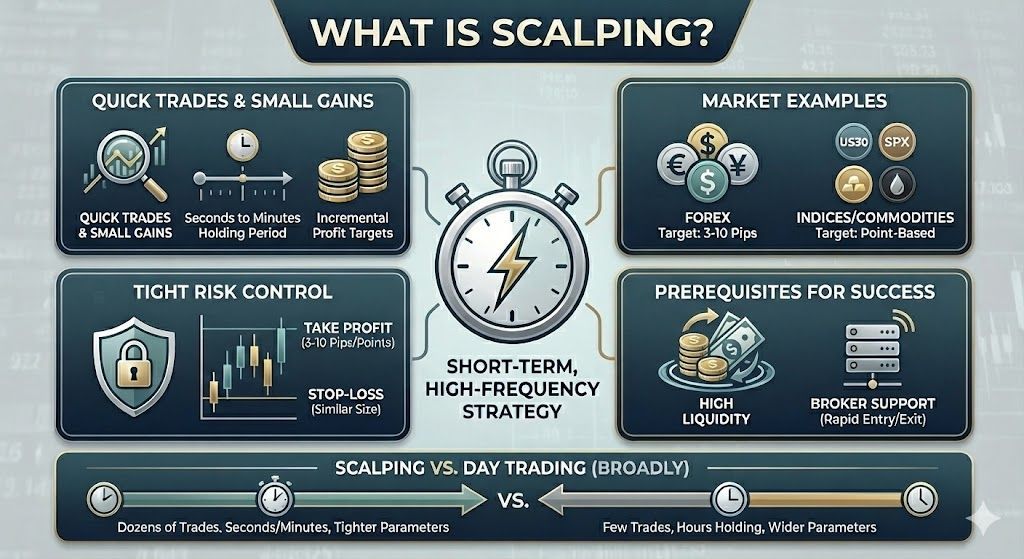
The strategy works across asset classes as long as the underlying market has sufficient liquidity and the broker's conditions support rapid entry and exit.
Scalping is distinct from day trading more broadly. A day trader might hold two or three positions for hours and close them before the end of the session. A scalper typically executes many more trades, often dozens in a single session, each with a much shorter holding period and tighter profit and loss parameters.
What Scalping Demands from a Broker
Because profits per trade are small, scalping is highly sensitive to trading costs. The two components that matter most are the spread and the commission.
The spread is the difference between the bid and ask price at the moment of execution. Every trade begins with an immediate cost equal to the spread. If a scalper is targeting 5 pips of profit and the spread on entry is 1.5 pips, they are starting each trade 1.5 pips offside. Over hundreds of trades, spread costs compound significantly. This is why scalpers consistently seek the tightest spreads available.
Commission is equally important when trading raw spread accounts. A raw spread account may offer 0.0 pip spreads but charge a fixed commission per lot. For scalpers, the relevant figure is the all-in cost: spread plus round-turn commission per standard lot, converted to pips. A 0.0 pip spread with a $6 round-turn commission per standard lot is equivalent to approximately 0.6 pips on a standard lot of EUR/USD. A 0.8 pip spread with no commission costs 0.8 pips. The raw account wins on cost only if the lower all-in cost (spread plus commission per lot) results in a lower effective pip cost than a spread-only account.
Beyond cost, execution speed matters. Scalpers need their orders filled at or very close to the price they see on screen. Significant slippage, where the fill price differs materially from the quoted price, erodes the small margins that scalping depends on. This makes platform stability, server infrastructure, and order routing quality meaningful considerations when choosing a broker for scalping.
Finally, the broker's policy matters. Some brokers place restrictions on very short-duration trades or limit the number of orders a client can place within a session. Before scalping with any broker, it is worth confirming that the strategy is permitted under their trading terms.
Scalping at TIOmarkets
TIOmarkets permits scalping across its account types, subject to its trading terms. This is outlined in TIOmarkets' help centre under the accounts section.
For scalpers, the Raw account is typically the most relevant. With spreads from 0.0 pips and a $6 round-turn commission, it offers the tightest available entry and exit conditions. The minimum deposit is $250. For traders who scalp at lower frequency or prefer simplified all-in pricing, the Standard account offers spreads from 1.1 pips with no commission, and the VIP Black account offers spreads from 0.3 pips with no commission, making it a strong option for higher-volume traders who want tight spreads without per-trade commission calculations.
Both MT4 and MT5 are available. MT4 remains widely used among scalpers for its stability and extensive Expert Advisor ecosystem, which allows automated scalping strategies to be deployed and back-tested. MT5 offers additional order types, faster multi-threaded processing, and tick-level strategy testing, which benefits traders running more complex automated approaches. Both platforms support one-click trading, which is relevant for manual scalpers who need to open and close positions quickly without navigating multiple confirmation steps.
The Best Markets for Scalping
Not all instruments suit scalping equally well. The key requirement is liquidity: markets where orders can be executed quickly and at consistent prices, with narrow spreads that do not widen materially during normal trading hours.
Major forex pairs are among the most scalp-friendly instruments available. EUR/USD, GBP/USD, and USD/JPY all carry high daily volume, tight spreads during active sessions, and predictable behaviour around key technical levels. These pairs are most active during the London and New York sessions, with the overlap between 12:00 and 16:00 GMT offering the tightest conditions and highest liquidity.
Index CFDs such as the US30 and Germany 40 (DE40) are also popular with scalpers, particularly during the opening hours of the relevant cash session when volatility is highest. Gold (XAUUSD) attracts scalpers due to its frequent intraday moves, though spreads can widen during quieter sessions and around major data releases, which requires additional care on entry and exit timing.
Scalping on exotic currency pairs or thinly traded instruments is generally not recommended. Wider spreads and less predictable liquidity make the cost-per-trade economics difficult to manage.
Risk Management for Scalpers
The short-term nature of scalping does not reduce risk; it changes its character. Because positions are opened and closed rapidly, individual losses are contained but can accumulate quickly if discipline breaks down.
Several principles apply consistently to scalping risk management. First, define your risk per trade before entering. A common approach is to risk no more than 0.5 to 1 percent of your account balance on any single scalp. With a small pip target and a correspondingly tight stop-loss, position sizing becomes the critical variable. Use lot sizes that keep the dollar value of your stop-loss within that threshold.
Second, do not move stop-losses once a trade is open. Scalping relies on a clear and consistent framework: the trade either hits the target or the stop. Widening a stop because the price has moved against you transforms a scalp into an unplanned longer-duration trade, often with worse risk parameters than intended.
Third, be aware of spread widening around scheduled economic data releases. Non-Farm Payrolls, central bank interest rate decisions, and CPI releases regularly cause spreads to widen temporarily across major pairs and instruments. Entering a scalp position immediately before a major release can result in execution at a significantly wider spread than normal, which affects the all-in cost of the trade materially. Many experienced scalpers pause during these windows and resume once spreads normalise.
Finally, trading session management matters. Scalping is mentally demanding. Many experienced scalpers deliberately limit their active trading to specific two to three hour windows during peak liquidity hours, rather than trading continuously throughout the day. Fatigue and overtrading are significant risk factors in a strategy that demands consistent, quick decision-making.
FAQ
Risk disclaimer: CFDs are complex instruments and come with a high risk of losing money rapidly due to leverage. You should consider whether you understand how CFDs work and whether you can afford to take the high risk of losing your money. Never deposit more than you are prepared to lose. Professional client’s losses can exceed their deposit. Please see our risk warning policy and seek independent professional advice if you do not fully understand. This information is not directed or intended for distribution to or use by residents of certain countries/jurisdictions including, but not limited to, USA & Countries included in the OFAC sanction list. The Company holds the right to alter the aforementioned list of countries at its own discretion.
TIOmarkets offers an exclusively execution-only service. The views expressed are for information purposes only. None of the content provided constitutes any form of investment advice. The comments are made available purely for educational and marketing purposes and do NOT constitute advice or investment recommendation (and should not be considered as such) and do not in any way constitute an invitation to acquire any financial instrument or product. TIOmarkets and its affiliates and consultants are not liable for any damages that may be caused by individual comments or statements by TIOmarkets analysis and assumes no liability with respect to the completeness and correctness of the content presented. The investor is solely responsible for the risk of his/her investment decisions. The analyses and comments presented do not include any consideration of your personal investment objectives, financial circumstances, or needs. The content has not been prepared in accordance with any legal requirements for financial analysis and must, therefore, be viewed by the reader as marketing information. TIOmarkets prohibits duplication or publication without explicit approval.
Join us on social media



Authors BIO

Behind every blog post lies the combined experience of the people working at TIOmarkets. We are a team of dedicated industry professionals and financial markets enthusiasts committed to providing you with trading education and financial markets commentary. Our goal is to help empower you with the knowledge you need to trade in the markets effectively.