USD/JPY Forecast for the Week of 16th March 2026
BY TIOmarkets
|March 16, 2026USD/JPY Market Overview
USD/JPY opens the week of 16-20 March 2026 at a level near the psychologically significant 160.00 figure. The pair is still reflecting the attractive interest rate differential between the US and Japan, along with the ongoing popularity of USD-funded carry trades. In fact, this momentum is the hallmark of the pair's movement in recent months.
The main trend is strongly underpinned by the relatively high US Treasury yields that constantly draw capital flows into assets denominated in dollars. Meanwhile, the Bank of Japan is sticking to a very loose monetary policy aimed at supporting the economy and achieving stable wage growth. This contrast in the monetary policies of the US and Japan is the main reason why USD/JPY finds ongoing structural support.
Furthermore, traders worldwide keep an eye on shifts in risk appetite and energy prices, which sometimes affect inflows into safe-haven currencies. Yet, the chief factor moving USD/JPY is the differential in yields between US Treasuries and Japanese government bonds.
At the same time, the duo is at a point where, historically, Japanese officials have shown a heightened interest. The exchange rate nearing 160 might lead to market sensitivity towards official remarks or intervention hints aimed at shoring up the yen should the decline become too fast.
USD/JPY maintains a powerful bullish momentum at a structural level, but its closeness to a significant psychological resistance point means that we could see a rise in volatility over the week.
USD/JPY Technical Analysis
Market Pattern
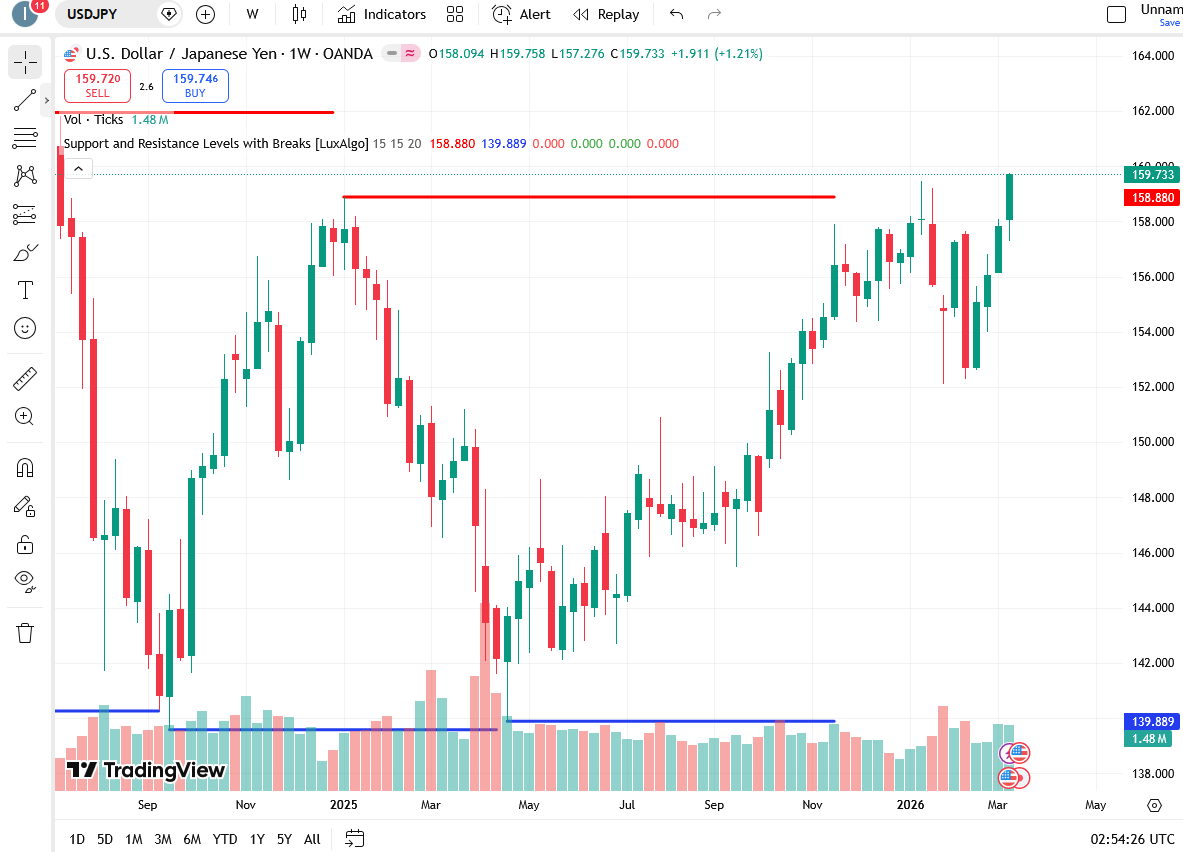
From the standpoint of technical analysis, USD/JPY is still enjoying a robust bullish momentum throughout various timeframes. The series of chart patterns provide better confirmations as the prices keep hitting new highs and making higher lows.
Prices remain at a substantial distance from major moving averages, which signals buyers' dominance over the main trend. However, the approach to 160.00 is an indicator that traders might start factoring in some hesitation or resistance in the upward movement.
The resistance around 160 has served as a point where profit-taking and monetary policy concerns have, at times, caused the pace of advance to slow down temporarily. As such, even though the trend is intact, the market may go through some consolidation phases.
EMAs and Trend Analysis
In terms of the moving averages, the bullish outlook is overwhelmingly supported.
Recently, the 10-, 20-, and 30-period EMAs, keeping a solid distance below the current price level, underscore the strength of the recent surge. Now, these indicators serve as levels of support dynamically during the phases of potential corrections.
Nearer to 152.50, the 50-period moving average acts as an important guide to the medium-term trend. In the event of a correction down to this level, the overall bullish structure would still remain intact.
The 100-period and 200-period moving averages stay very low in relation to the current price, proving that the long-term trend is positive without any doubts.
Generally speaking, the existing moving-average positioning points to a strong continuation of the trend, though it is common that rallies that last for a long time lead to temporary retracements as the market adjusts the positioning.
Oscillators and Momentum
Indicators of momentum mostly back the long-side bias, even though a few of them mention the possibility of a brief pause in the upward movement.
RSI stays in the zone where bulls are in control, but it has not yet reached the point of overbought extremes. This means that there is still room for the continuation of the upside momentum without a sign of exhaustion.
Simultaneously, the MACD reveals a hint of early signs of divergence, which indicates a deceleration of the upswing. Such divergence is not a reversal signal but rather an indication that the market may take a brief breather.
Usage of measures like the ADX shows that the core trend has nothing broken. Though, as resistance nears, volatility in the short term is likely to pick up.
Major Levels for Trading
Below is a list of important price levels that can significantly influence the USD/JPY direction during the week.
Resistance Levels
- 160.00: critical psychological resistance
- 163.50: bullish target beyond the current range
- 166.00: resistance zone of the longer term
- 170.00: a level of macro resistance
Support Levels
- 157.50: near to the immediate short-term support
- 155.50: significant within the current trending phase
- 152.50: medium-term support that ties with the 50-period moving average
- 150.00: an essential psychological support level
The 160.00 mark will serve as the key technical level throughout the week. Should there be a closed sustaining above the threshold, the pair might experience a rally driven by momentum-based buying.
Bullish Scenario
As long as USD/JPY remains above the 155.50 level, the bullish scenario will keep dominating. This level is quite crucial as it acts as the key foundation for the current trend structure.
Surpassing the 160.00 barrier could lead to an uninterrupted rally scenario where the pair reaches for 163.50 and possibly 166.00 levels due to the buying momentum that is gaining force.
Strongly supporting this result would be rising US Treasury yields, a rather hawkish stance from the Fed, or the prevalent belief that US interest rates will remain high for longer than those in Japan.
Due to the US asset yield advantage, global investors are compelled to borrow low-yielding yen and put their capital into higher-yielding USD-denominated instruments. Carry trade, as this practice is called, is one of the key forces structurally responsible for the uptrend of USD/JPY.
With that, even the short-term pullbacks might not be very deep as the USD exposure will remain the investors' preference.
Bearish Scenario
If USD/JPY fails to rise above the 160.00 level, the pair might start to fall beneath 157.50, which is the short-term support.
Further down, the pair would find areas near 155.50 and 152.50 as remaining supports. These zones depict historical consolidation and also include the important moving-average supports.
Several reasons may cause the emergence of such a correction, e.g., a dovish shift in Fed signaling or a decline in US Treasury yields, which would diminish the allure of dollar carry trades.
Besides, even just speculation over BoJ resorting to policy normalization could cause the yen to be temporarily strong. Japanese authorities' verbal guidance directed at them expressing concern over the fast depreciation is probably capable of influencing sentiment as well.
Such moves may not necessarily be the thread that redirects the broad trend, but, to the extent of this pair, they will be contributing to phases of weakness during correction.
USD/JPY Main Factors
US Monetary Policy
The Federal Reserve meeting due on 17-18 March will be one of the major factors for USD/JPY during this week.
Besides that, markets will be focused on the central bank's updated economic forecasts and signaling of future policy actions regarding interest rates. If hints are given that policy can be tight for longer, this will push up US Treasury yields, and in turn, the US dollar.
On the other hand, if signs come out that inflation is dropping faster than expected, then the whole policy outlook could be challenged and the dollar would weaken.
BOJ Policy Prospects
Unlike other top central banks, the BOJ is still going strong with its accommodative policy stance. Their focus is inflation and sustained wage growth as Japan has seen deflation for decades.
Such policies keep yields on Japanese government bonds very low, thus strengthening the interest rate gap versus the US.
Nonetheless, yen depreciation lately has been a cause of concern for Japanese authorities, and one could expect interventions if the currency approaches the 160 level.
Yield Differentials
Relative interest rates still are the number one macro variable influencing USD/JPY.
When US Treasury yields go up, particularly real yields, this can directly result in changes in the currency exchange rate. In other words, when US yields are higher than Japanese yields, the dollar normally rallies against the yen.
Consequently, changes in the US bond market greatly set off alarm bells for currency market players.
Key USD/JPY Events This Week
- FOMC Interest Rate Decision: Fed policy statement and release of updated economic projections could alter expectations of the monetary policy path and affect USD.
- Federal Reserve Press Conference: Fed Chair's comments on inflation and monetary policy may impact Treasury yields and currency markets.
- US Industrial Production Data: Report that reveals the state of industrial activity and that of economy as a whole.
- Japanese Trade Balance Data: Trade data might impact the economic outlook and demand for the Japanese yen.
Comments from the Japanese Authorities: When USD/JPY trades near sensitive levels, such comments may have a strong influence on market sentiment.

USD/JPY Risks for This Week
The volatility of USD/JPY could be affected by several different factors during this week.
The first is the risk of monetary policy communication remaining high due to the Fed meeting. Treasury yields and currency markets can be impacted quickly following the release of any change in policy guidance.
The second involves yields. Since USD/JPY is rather tightly linked to changes in US real yields, fluctuations in the bond market will be directly reflected in FX market volatility.
The third point to take into account is the intervention risk. If the yen swings to the downside too rapidly, it can provoke a situation where the Japanese authorities take verbal measures or some other policy actions to stabilize the currency.
Lastly, there is a risk of technical breakout near the important resistance level of 160.00. If the price decisively moves above the level, the market will be flooded with momentum-based price changes and volatility will go through the roof.

Risk disclaimer: CFDs are complex instruments and come with a high risk of losing money rapidly due to leverage. You should consider whether you understand how CFDs work and whether you can afford to take the high risk of losing your money. Never deposit more than you are prepared to lose. Professional client’s losses can exceed their deposit. Please see our risk warning policy and seek independent professional advice if you do not fully understand. This information is not directed or intended for distribution to or use by residents of certain countries/jurisdictions including, but not limited to, USA & Countries included in the OFAC sanction list. The Company holds the right to alter the aforementioned list of countries at its own discretion.
TIOmarkets offers an exclusively execution-only service. The views expressed are for information purposes only. None of the content provided constitutes any form of investment advice. The comments are made available purely for educational and marketing purposes and do NOT constitute advice or investment recommendation (and should not be considered as such) and do not in any way constitute an invitation to acquire any financial instrument or product. TIOmarkets and its affiliates and consultants are not liable for any damages that may be caused by individual comments or statements by TIOmarkets analysis and assumes no liability with respect to the completeness and correctness of the content presented. The investor is solely responsible for the risk of his/her investment decisions. The analyses and comments presented do not include any consideration of your personal investment objectives, financial circumstances, or needs. The content has not been prepared in accordance with any legal requirements for financial analysis and must, therefore, be viewed by the reader as marketing information. TIOmarkets prohibits duplication or publication without explicit approval.
Join us on social media



Authors BIO

Behind every blog post lies the combined experience of the people working at TIOmarkets. We are a team of dedicated industry professionals and financial markets enthusiasts committed to providing you with trading education and financial markets commentary. Our goal is to help empower you with the knowledge you need to trade in the markets effectively.
Related Posts