USD/JPY Forecast for the Week of 9th March 2026
BY TIOmarkets
|March 9, 2026USD/JPY Market Overview
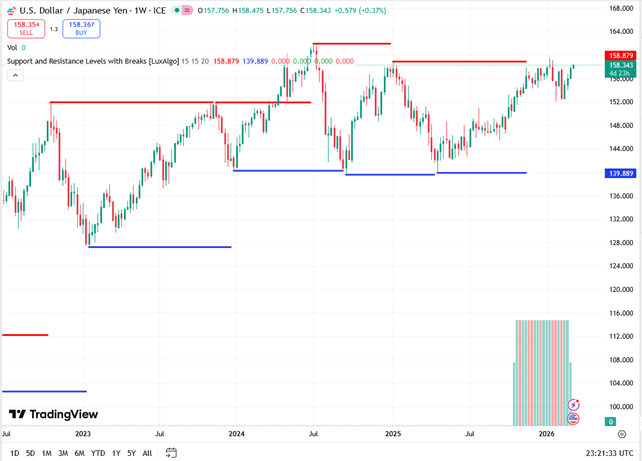
The USD/JPY pair enters the week of 9th March 2026 trading near 158.30, remaining close to multi-year highs after a sustained bullish trend that has developed over several months. The strength of the US dollar continues to be supported by relatively high US Treasury yields, persistent inflation pressures in the United States, and expectations that the Federal Reserve may maintain restrictive monetary conditions longer than previously anticipated.
Meanwhile, the Japanese yen continues to face structural weakness due to the ongoing divergence between US and Japanese monetary policy. While the Federal Reserve maintains interest rates at elevated levels, the Bank of Japan continues to operate with significantly lower rates, sustaining a wide yield differential that favors the US dollar.
Despite the strong uptrend, the pair has recently entered a short-term consolidation phase, with price fluctuations stabilizing just below the psychological 160.00 level. This zone has historically attracted increased attention from both market participants and Japanese policymakers.
The upcoming week may prove pivotal for USD/JPY as several major US macroeconomic releases are scheduled, including inflation indicators and labor market data. These reports could influence expectations about future Federal Reserve policy and potentially introduce higher volatility into the currency market.
Overall, while the broader trend remains bullish, markets may remain cautious in the near term as traders evaluate incoming macroeconomic signals.
Technical Analysis for USD/JPY
Current Price Structure
From a technical perspective, USD/JPY continues to display a well-defined bullish trend structure characterized by a sequence of higher highs and higher lows on the daily chart. The pair remains firmly above all major moving averages, suggesting that the broader upward momentum remains intact.
At the same time, price action around the 158.30 area suggests the possibility of temporary consolidation as the market approaches the psychologically important 160.00 threshold.
This pause in momentum is not unusual following a strong rally and may represent a phase of market positioning ahead of important macroeconomic events.
Moving Averages
The moving average structure reinforces the prevailing bullish trend.
The 10-day exponential moving average near 156.25 and the 20-day EMA around 155.25 are currently acting as dynamic support levels in the short term. Further below, the 50-day moving average near 152.50 marks an important medium-term support zone.
Longer-term averages also confirm the strength of the trend. The 100-day moving average near 150.00 and the 200-day moving average near 144.00 remain significantly below the current price level, highlighting the strong upward trajectory that has developed over recent months.
As long as the pair continues to trade above the 155.00–156.00 region, the underlying bullish technical structure remains largely intact.
Momentum Indicators
Momentum indicators suggest that the pair still maintains positive directional bias but may be entering a period of temporary moderation.
The Relative Strength Index (RSI) around 60 indicates moderately bullish momentum without entering overbought territory. This suggests that there may still be room for further upward movement.
The Stochastic oscillator near 70 signals that the market is approaching overbought conditions, which sometimes precede short consolidation phases.
Meanwhile, the MACD indicator has begun to flatten slightly, hinting that bullish momentum may be slowing in the very short term even though the broader trend remains positive.
Overall, these indicators suggest that USD/JPY may consolidate before attempting another upward move.
Key Support and Resistance Levels
The following levels may play an important role in price development during the week.
Support levels
155.00 – This psychological level represents the first important support area and aligns with recent consolidation zones.
152.50 – A deeper technical support area close to the 50-day moving average.
150.00 – A major structural support level and psychological threshold that could become relevant in the event of a broader correction.
Resistance levels
160.00 – The nearest psychological resistance level and a key barrier that the market has been approaching.
163.75 – A higher resistance level that could become relevant if bullish momentum accelerates.
170.00 – A longer-term resistance area that could come into focus if the broader trend continues over the coming months.
The reaction of the price around 160.00 will likely be particularly important, as this level has historically drawn attention from policymakers and market participants alike.
Bullish Scenario
A bullish scenario could develop if USD/JPY maintains support above the 155.00–156.00 region and gradually builds momentum toward the 160.00 resistance level. A sustained move above 160.00 would represent a significant technical breakout and could encourage further upside volatility as market participants reassess price expectations.
In such a scenario, the next areas of technical interest may appear around 162.50–163.75, where previous market activity and psychological resistance could emerge. This type of upward movement would likely be supported by strong US macroeconomic data, particularly if inflation indicators exceed expectations or if economic reports reinforce the view that US interest rates may remain elevated.
Higher US Treasury yields or stronger labor market data could also reinforce this bullish environment for the US dollar.
Bearish Scenario
A bearish scenario could emerge if the pair fails to maintain its position above 155.00 and selling pressure increases following macroeconomic releases. A break below 155.00 could expose the 152.50 support area, where the 50-day moving average may act as a technical floor for the price.
If downside momentum accelerates further, the 150.00 level could become an important target as it represents a major psychological and structural support zone. Such a scenario could be triggered by weaker-than-expected US inflation data, signs of slowing economic growth, or shifts in expectations regarding future Federal Reserve policy.
In addition, periods of heightened market uncertainty often lead to increased demand for the Japanese yen as a traditional safe-haven currency, which could also place downward pressure on USD/JPY.
USD/JPY Fundamental Drivers
Several macroeconomic forces are currently shaping the direction of USD/JPY.
Federal Reserve Policy Expectations
Expectations surrounding US monetary policy remain one of the most important drivers of the currency pair. With inflation still above the Federal Reserve's long-term target, policymakers have maintained a relatively cautious stance regarding future rate cuts. As a result, US interest rates remain significantly higher than those in Japan, supporting demand for the US dollar.
Market participants will continue to monitor economic data closely to assess whether inflation is slowing sufficiently to allow a shift toward a more accommodative stance later in the year.
Inflation Dynamics in the United States
Inflation data plays a central role in shaping Federal Reserve policy expectations. If inflation indicators remain elevated, markets may anticipate that interest rates will stay higher for longer. This could support US Treasury yields and strengthen the dollar.
Conversely, signs of cooling inflation could alter expectations regarding future monetary policy, potentially reducing the dollar’s strength against major currencies including the yen.
Monetary Policy Divergence
The divergence between the Federal Reserve and the Bank of Japan remains a major structural factor supporting USD/JPY. While the Fed maintains a restrictive policy stance, the Bank of Japan continues to operate with relatively low interest rates. This difference creates a substantial yield gap between US and Japanese assets.
Such conditions often encourage carry trade strategies, where investors borrow in low-yielding currencies like the yen and invest in higher-yielding assets denominated in US dollars.
Potential Policy Intervention
As USD/JPY approaches higher levels, market participants may also pay attention to potential signals from Japanese authorities. Historically, Japanese policymakers have occasionally intervened in currency markets when the yen weakens rapidly or when USD/JPY approaches major psychological thresholds.
Although such actions are difficult to predict, the proximity to the 160.00 level may increase market sensitivity to official comments.
This Week's USD/JPY High Impact Events
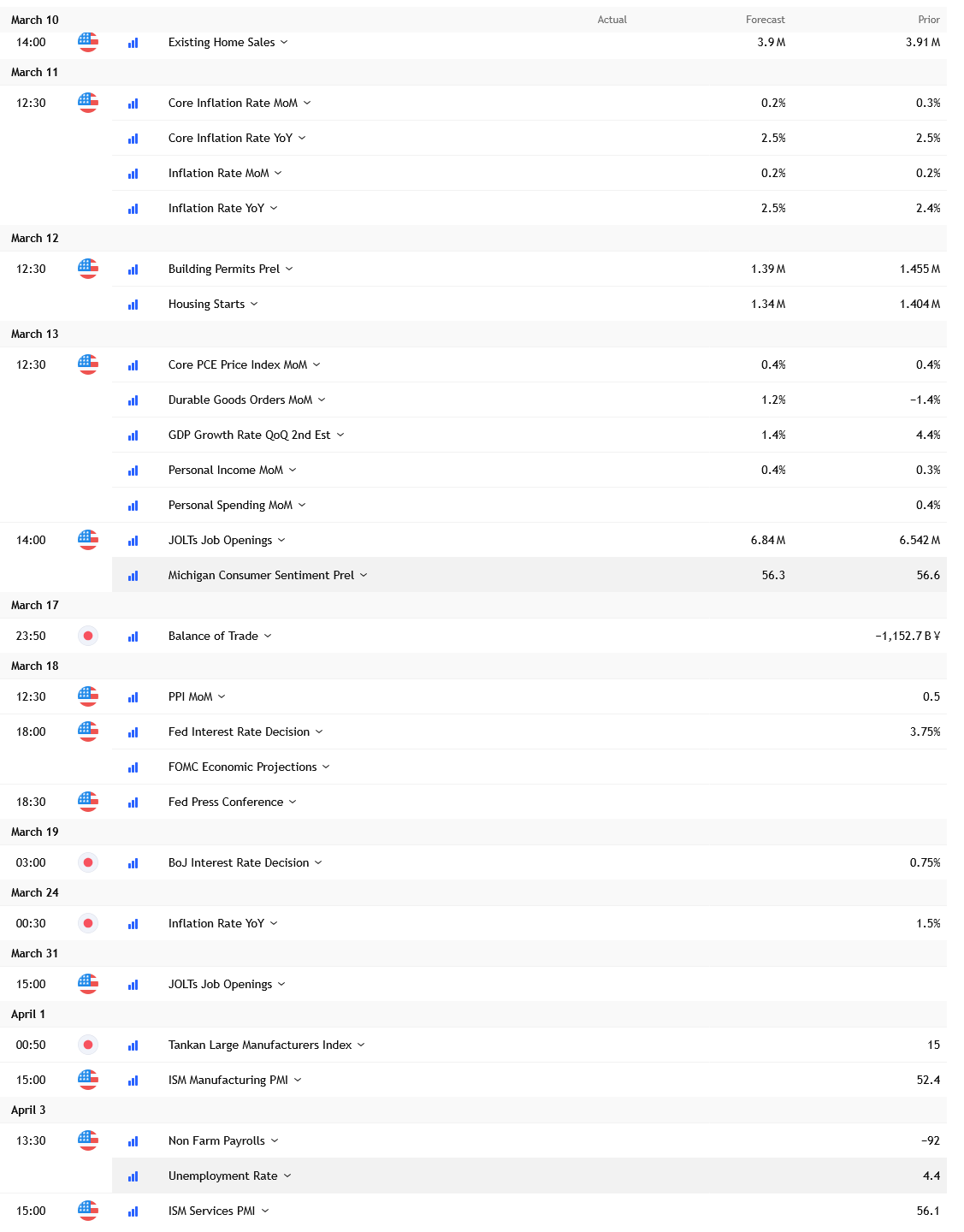
Several economic releases scheduled during the week may influence the direction of USD/JPY.
- US Consumer Price Index (CPI) – Inflation data is closely monitored by markets. A stronger-than-expected reading may reinforce expectations of higher US interest rates, potentially supporting the US dollar.
- Core Personal Consumption Expenditures (Core PCE) – This is one of the Federal Reserve’s preferred inflation indicators. Unexpected changes could alter expectations regarding the future policy path.
- JOLTS Job Openings – This report provides insights into labor market demand. Strong employment data may reinforce the view that the US economy remains resilient.
- Federal Reserve policy expectations and communication – Market participants will continue analyzing comments from Federal Reserve officials for signals regarding future interest rate policy.
- Bank of Japan policy outlook – Any communication regarding monetary policy adjustments or currency stability may influence the Japanese yen.
These events may generate periods of increased volatility in USD/JPY throughout the week.
Risk Considerations for USD/JPY This Week
There are several factors that could influence price volatility during the week.
Macroeconomic surprises
Unexpected outcomes in inflation or labor market data can significantly alter expectations regarding interest rate policy and lead to sharp market reactions.
Central bank communication
Statements from Federal Reserve or Bank of Japan officials may rapidly shift market sentiment if they signal changes in policy direction.
Policy intervention risk
As USD/JPY approaches major psychological levels, market participants may remain cautious due to the possibility of comments or actions from Japanese authorities.
Technical breakout dynamics
A sustained move above 160.00 or a break below 155.00 could trigger increased volatility as technical traders adjust their positions.

Risk disclaimer: CFDs are complex instruments and come with a high risk of losing money rapidly due to leverage. You should consider whether you understand how CFDs work and whether you can afford to take the high risk of losing your money. Never deposit more than you are prepared to lose. Professional client’s losses can exceed their deposit. Please see our risk warning policy and seek independent professional advice if you do not fully understand. This information is not directed or intended for distribution to or use by residents of certain countries/jurisdictions including, but not limited to, USA & Countries included in the OFAC sanction list. The Company holds the right to alter the aforementioned list of countries at its own discretion.
TIOmarkets offers an exclusively execution-only service. The views expressed are for information purposes only. None of the content provided constitutes any form of investment advice. The comments are made available purely for educational and marketing purposes and do NOT constitute advice or investment recommendation (and should not be considered as such) and do not in any way constitute an invitation to acquire any financial instrument or product. TIOmarkets and its affiliates and consultants are not liable for any damages that may be caused by individual comments or statements by TIOmarkets analysis and assumes no liability with respect to the completeness and correctness of the content presented. The investor is solely responsible for the risk of his/her investment decisions. The analyses and comments presented do not include any consideration of your personal investment objectives, financial circumstances, or needs. The content has not been prepared in accordance with any legal requirements for financial analysis and must, therefore, be viewed by the reader as marketing information. TIOmarkets prohibits duplication or publication without explicit approval.
Join us on social media




Behind every blog post lies the combined experience of the people working at TIOmarkets. We are a team of dedicated industry professionals and financial markets enthusiasts committed to providing you with trading education and financial markets commentary. Our goal is to help empower you with the knowledge you need to trade in the markets effectively.
Related Posts