What Is Liquidity in Trading?
BY Panagiotis Philippou
|June 4, 2026Liquidity in trading means how easily an asset can be bought or sold without causing a big change in its price.
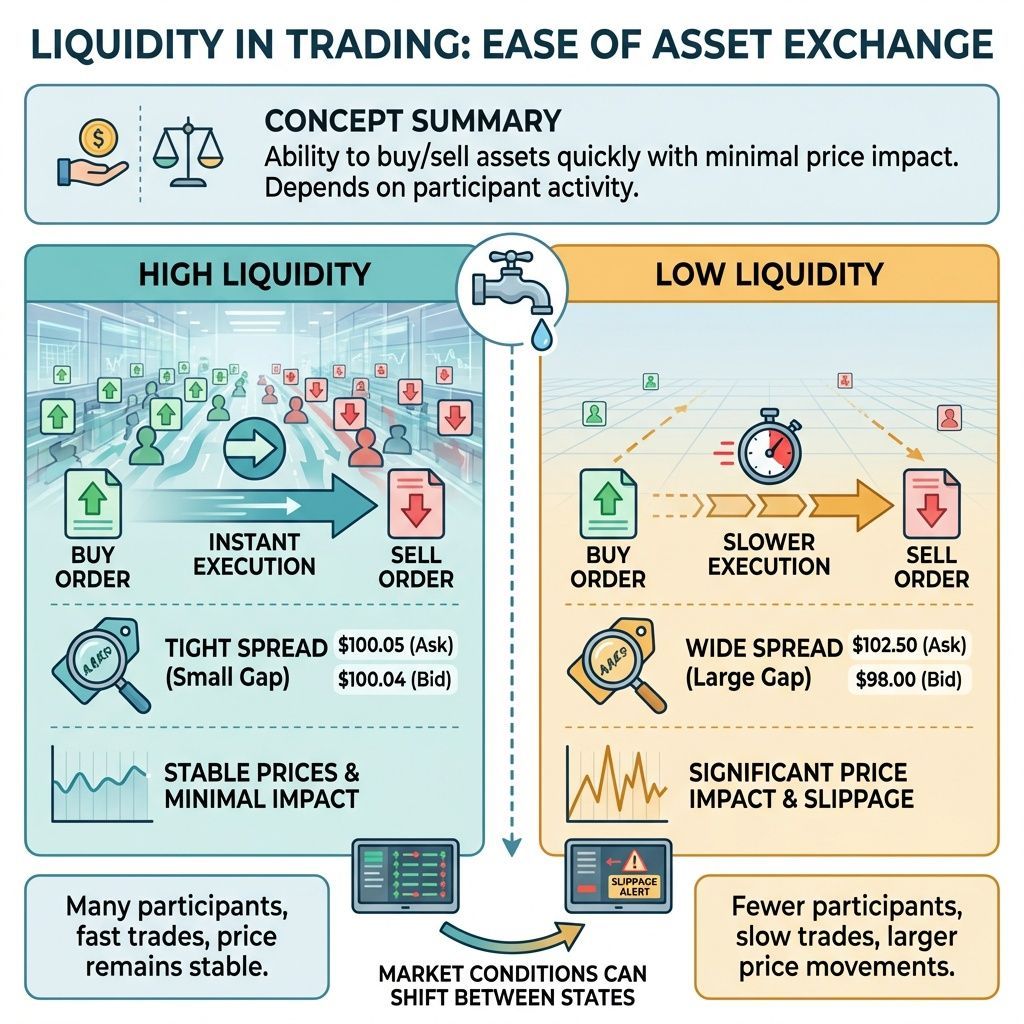
A market with high liquidity has many active buyers and sellers. This usually makes it easier to enter or exit a trade quickly and at a price close to what you expect. A market with low liquidity has fewer active buyers and sellers, which can lead to wider spreads, slower execution and more price movement when orders are placed.
For beginners, the simple answer is this: liquidity shows how easy it is to trade something at a fair price.
Liquidity Explained in Simple Terms
Think of liquidity like trying to sell something in real life.
If you want to sell a popular phone at a fair price, you can probably find a buyer quickly. That is similar to a liquid market.
If you want to sell a rare collectible, it may take longer to find the right buyer. You might also need to lower the price if you want to sell it quickly. That is similar to an illiquid market.
In trading, the same idea applies. If many people are buying and selling the same asset, it is usually easier to trade. If only a few people are active, trading can become harder.
High Liquidity vs Low Liquidity
The difference between high and low liquidity can affect how easy, fast and expensive it is to trade.
| Liquidity Type | What It Means | Trading Impact |
| High liquidity | Many buyers and sellers are active | Easier execution, tighter spreads, less slippage |
| Low liquidity | Few buyers and sellers are active | Wider spreads, slower execution, more slippage |
A major forex pair like EUR/USD is usually more liquid because it is traded heavily around the world. A small stock, exotic currency pair or niche crypto asset may have lower liquidity because fewer traders are active.
Example of High Liquidity
Imagine EUR/USD has a buy price of 1.1000 and a sell price of 1.1001.
The difference between these prices is very small. This usually means the market is liquid, because buyers and sellers are close together.
In a liquid market, traders may experience:
- Faster order execution
- Tighter spreads
- Less slippage
- Easier entry and exit
- More stable pricing under normal conditions
This is why many beginners start by watching major forex pairs or popular stocks. These markets are usually easier to understand than thinly traded assets.
Example of Low Liquidity
Now imagine a small stock has a buy price of $10.00 and a sell price of $10.50.
That is a much wider gap. If you buy at $10.50 and immediately sell at $10.00, the trade starts at a disadvantage because of the spread.
Low liquidity can cause:
- Wider spreads
- More difficult exits
- Larger price jumps
- More slippage
- Less reliable execution
This is why low-liquidity markets can be riskier, especially for beginners.
Why Liquidity Matters in Trading
Liquidity matters because it affects the real cost and risk of placing a trade.
Liquidity affects spreads
The spread is the difference between the buy price and the sell price.
In a liquid market, spreads are usually tighter because many buyers and sellers are active. In an illiquid market, spreads are usually wider because there are fewer participants.
A wider spread means the trade needs to move further in your favour before it becomes profitable.
Liquidity affects execution
Execution means how your trade is completed.
In a liquid market, your order is more likely to be filled quickly and close to the price you see on the screen. In a less liquid market, your order may be delayed or filled at a worse price.
Liquidity affects slippage
Slippage happens when your trade is executed at a different price than expected.
For example, you may try to buy at 1.1000, but the order is filled at 1.1003. This difference is slippage.
Slippage can happen in fast-moving markets, during news events or when liquidity is low.
Liquidity, the Order Book and the Bid-Ask Spread
The order book shows buy and sell orders in the market.
The bid price is the highest price a buyer is willing to pay. The ask price is the lowest price a seller is willing to accept. The difference between the two is the bid-ask spread.
| Market | Bid Price | Ask Price | Spread |
| Liquid market | 1.1000 | 1.1001 | 0.0001 |
| Illiquid market | 1.1000 | 1.1010 | 0.0010 |
In a liquid market, there are usually many orders close together, so the spread is smaller. In an illiquid market, there may be fewer orders, so the spread can become wider.
For beginners, this is one of the easiest ways to understand liquidity: the tighter the spread, the more liquid the market usually is.
What Are Liquidity Pools?
A liquidity pool is an area on a chart where many orders may be grouped together.
These areas often form around obvious price levels because many traders watch the same parts of the chart. For example, traders may place stop-loss orders above a recent high or below a recent low.
Liquidity pools may appear around:
- Recent highs
- Recent lows
- Support and resistance levels
- Round numbers, such as 1.1000 on EUR/USD
- Areas where many stop-loss or pending orders may sit
This does not mean price will always move to those levels. It simply means these areas may attract attention because many orders could be waiting there.
What Is a Liquidity Sweep?
A liquidity sweep happens when price briefly moves above a high or below a low, triggers orders in that area, and then reverses.
For example, imagine EUR/USD has a recent high at 1.1000. Some traders may place stop-loss orders just above that level. Price may move above 1.1000, trigger those orders, and then fall back below the level.
That move is often called a liquidity sweep.
However, beginners should be careful with this concept. Not every break of a high or low is a liquidity sweep. Sometimes price breaks a level and continues in the same direction.
How Larger Traders Use Liquidity
Large traders, such as banks, funds and institutions, usually need more liquidity because they trade bigger positions. In a low-liquidity market, a large order may move the price more sharply. This is why larger traders often prefer liquid markets, where it is easier to enter and exit with less price impact.
Liquidity in Forex Trading
The forex market is generally considered highly liquid because currencies are traded globally by banks, businesses, institutions and individual traders.
However, liquidity is not the same across all forex pairs.
Major pairs such as EUR/USD, GBP/USD and USD/JPY are usually more liquid. Exotic pairs are usually less liquid because fewer traders are active in those markets.
Liquidity can also change depending on the time of day. A forex pair may be more liquid during the trading sessions where its currencies are most active and less liquid during quieter hours.
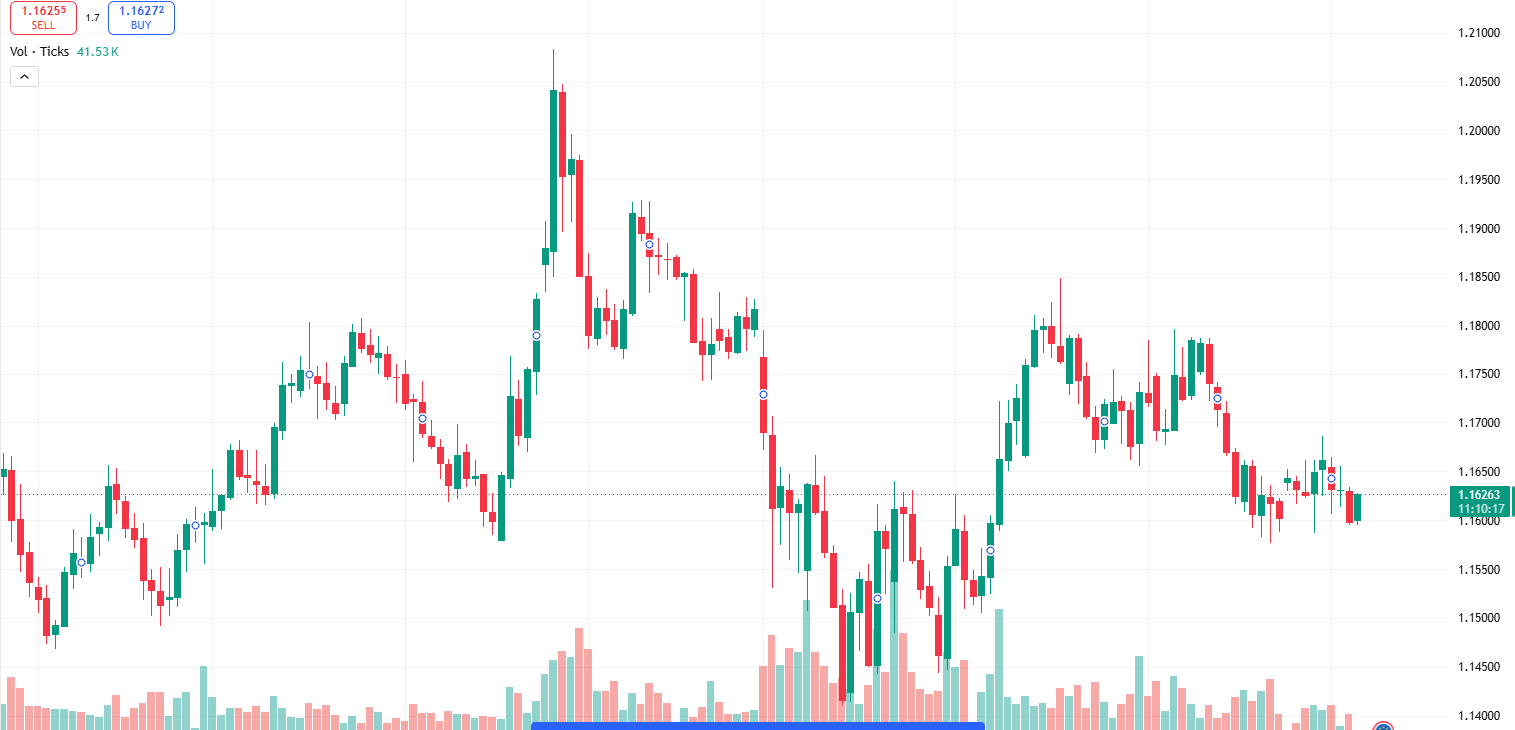
EUR/USD is one of the most actively traded forex pairs, which is why it is often used as an example of a highly liquid market. In liquid forex pairs, traders usually see tighter spreads, faster execution and more stable pricing under normal conditions. However, liquidity can still change during news events, quiet sessions or volatile market conditions.
Liquidity vs Volatility
Liquidity and volatility are not the same thing.
Liquidity is about how easy it is to buy or sell. Volatility is about how much the price moves.
A market can be liquid and volatile at the same time. For example, EUR/USD may have high liquidity but still move sharply during major economic news.
A market can also be illiquid and volatile. This can be riskier because there may be fewer buyers and sellers when the price starts moving quickly.
How to Tell If a Market Is Liquid
Beginners can look for a few simple signs:
| Sign | What It Usually Means |
| High trading volume | Many traders are active |
| Tight spread | Buy and sell prices are close together |
| Fast execution | Orders are filled quickly |
| Stable pricing | Price is less likely to jump sharply under normal conditions |
| Active market hours | More participants may be trading |
The easiest checks are spread, volume and how smoothly orders are executed.
Final Thoughts
Liquidity in trading means how easily an asset can be bought or sold without moving the price too much.
High liquidity usually means more buyers and sellers, tighter spreads, smoother execution and lower slippage. Low liquidity can mean wider spreads, slower execution and more difficult exits.
For beginners, the key is simple: before placing a trade, check whether the market has enough activity, whether the spread is reasonable and whether you understand the risks. Ready to get started? Open your account with TIOmarkets and start trading now.
Trading is risky. Liquidity can change quickly, especially during news events, low-volume periods or volatile market conditions.

FAQ
Risk disclaimer: CFDs are complex instruments and come with a high risk of losing money rapidly due to leverage. You should consider whether you understand how CFDs work and whether you can afford to take the high risk of losing your money. Never deposit more than you are prepared to lose. Professional client’s losses can exceed their deposit. Please see our risk warning policy and seek independent professional advice if you do not fully understand. This information is not directed or intended for distribution to or use by residents of certain countries/jurisdictions including, but not limited to, USA & Countries included in the OFAC sanction list. The Company holds the right to alter the aforementioned list of countries at its own discretion.
TIOmarkets offers an exclusively execution-only service. The views expressed are for information purposes only. None of the content provided constitutes any form of investment advice. The comments are made available purely for educational and marketing purposes and do NOT constitute advice or investment recommendation (and should not be considered as such) and do not in any way constitute an invitation to acquire any financial instrument or product. TIOmarkets and its affiliates and consultants are not liable for any damages that may be caused by individual comments or statements by TIOmarkets analysis and assumes no liability with respect to the completeness and correctness of the content presented. The investor is solely responsible for the risk of his/her investment decisions. The analyses and comments presented do not include any consideration of your personal investment objectives, financial circumstances, or needs. The content has not been prepared in accordance with any legal requirements for financial analysis and must, therefore, be viewed by the reader as marketing information. TIOmarkets prohibits duplication or publication without explicit approval.
Join us on social media



Authors BIO

Panagiotis is an online trading specialist with extensive experience in forex, indices, and commodities. He enjoys sharing his experience to help traders better understand global financial markets.