Best Time to Trade Forex: Market Hours, Sessions and Trading Tips
BY Panagiotis Philippou
|June 12, 2026The best time to trade forex is usually during the London-New York session overlap, when two of the world’s most active financial centres are open at the same time.
This period often brings higher liquidity, tighter spreads and stronger price movement, especially across major currency pairs such as EUR/USD, GBP/USD, USD/JPY and USD/CAD.
However, the best time to trade forex is not the same for everyone. It depends on the currency pair you trade, the strategy you use and whether you prefer fast-moving or slower market conditions.
In this guide, we explain the main forex trading sessions, the most active hours, the best days of the week and how to choose a trading schedule that fits your strategy.
Quick Answer: What Is the Best Time to Trade Forex?
The best time to trade forex is generally during the London-New York overlap. This is when both the London and New York sessions are open, creating one of the most active periods of the trading day.
In simple terms:
- Best overall time: London-New York overlap
- Best session for liquidity: London session
- Best days: Tuesday, Wednesday and Thursday
- Best pairs during peak hours: EUR/USD, GBP/USD, USD/JPY and USD/CAD
This period is popular because many major pairs become more liquid and more active. That can create better trading opportunities, but it can also increase risk, especially around major economic news releases.
Why Timing Matters in Forex Trading
The forex market is open 24 hours a day, five days a week, but not every hour offers the same trading conditions.
During active periods, there are usually more buyers and sellers in the market. This can make it easier to enter and exit trades, and spreads on major pairs may be tighter. During quieter periods, price movement can be slower, spreads may widen and the market can become more difficult to trade.
Timing also affects volatility. Some traders want more volatility because they need price movement to find short-term opportunities. Others prefer calmer markets because they use slower strategies or focus on range trading.
This is why knowing the main forex sessions is important. It helps traders focus on the hours that are more likely to suit their strategy instead of trying to trade all day.
The Main Forex Trading Sessions
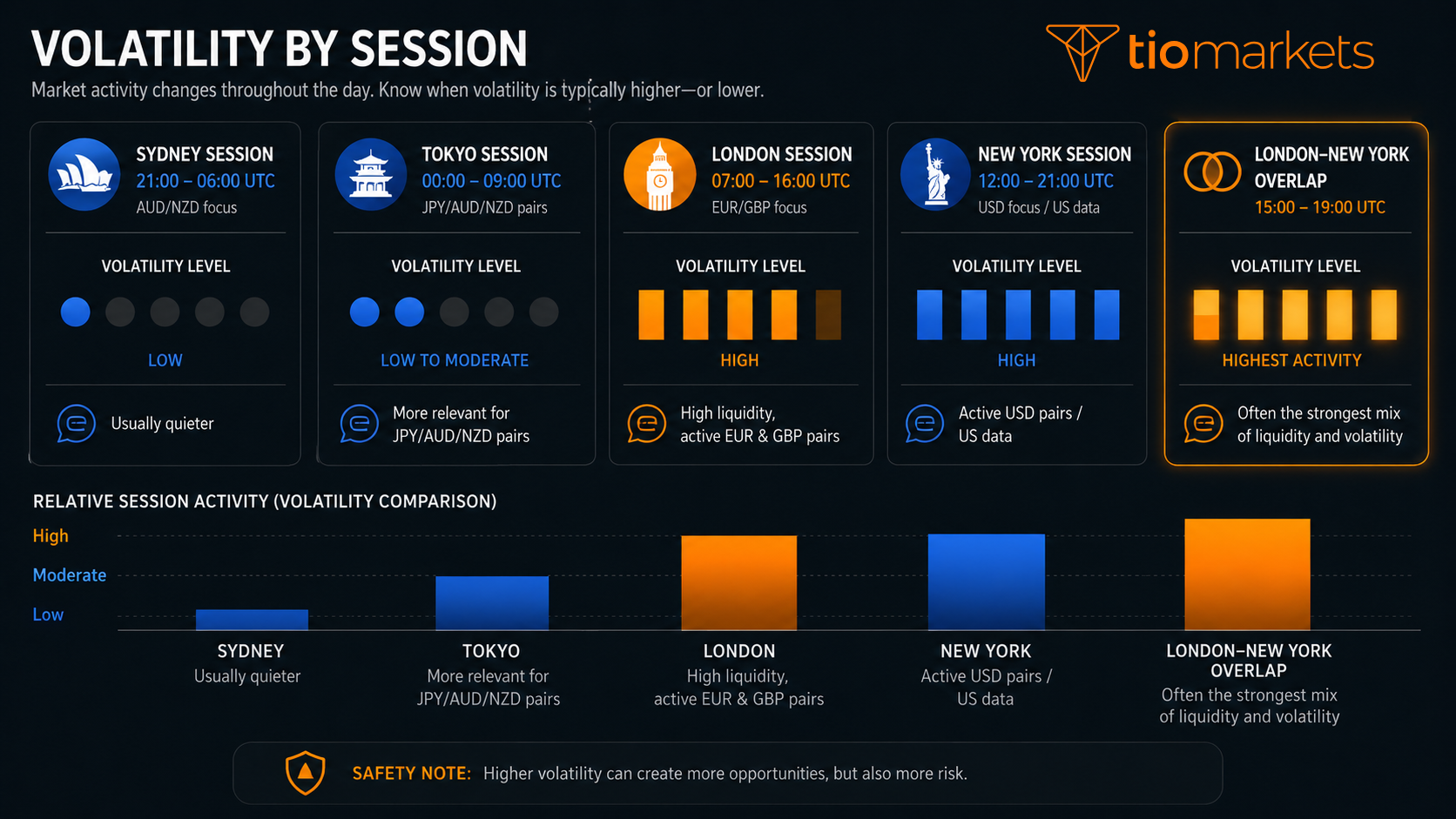
Forex trading is usually divided into four main sessions: Sydney, Tokyo, London and New York.
Each session has a different character. The Asian sessions are often quieter, while the London and New York sessions usually bring higher activity, especially for major currency pairs.
| Session | Approx. UTC Time | Typical Market Conditions |
| Sydney | 21:00–06:00 | Usually quieter, important for AUD and NZD pairs |
| Tokyo | 00:00–09:00 | More relevant for JPY, AUD and NZD pairs |
| London | 07:00–16:00 | High liquidity, active EUR and GBP pairs |
| New York | 12:00–21:00 | Active USD pairs, especially around US data |
Session times can shift because of daylight saving changes, so traders should always check their platform time and economic calendar.
Best Time to Trade Forex in Your Time Zone
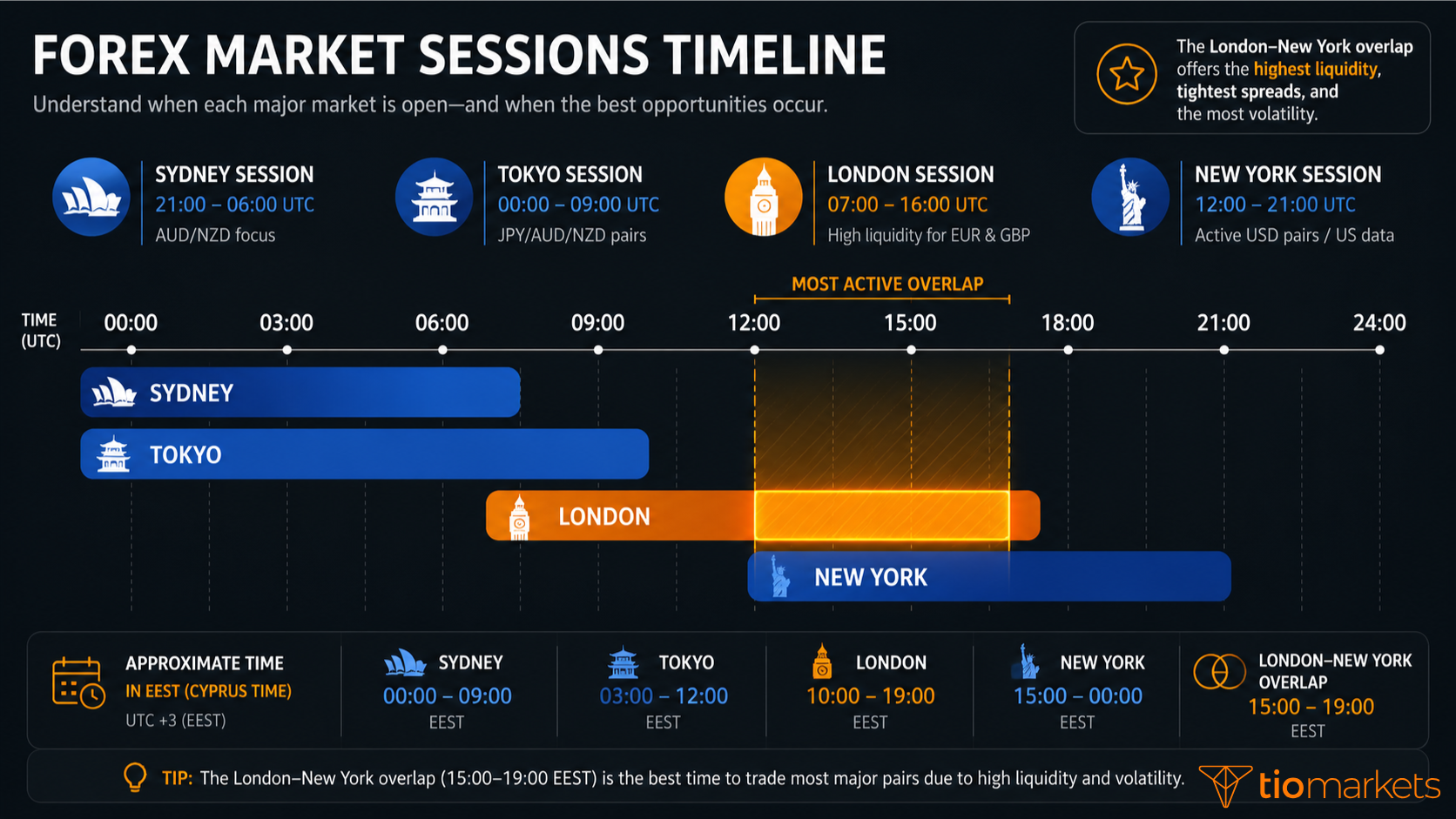
The best time to trade forex is usually when market activity is highest. For many traders, this means focusing on the London-New York overlap, which typically takes place from 12:00 to 16:00 UTC.
Because traders search for forex trading times in different locations, it can help to compare the most active forex trading window in several major time zones.
| Country / Region | Best Time to Trade Forex |
| United Kingdom | 12:00–16:00 UTC |
| United States | 12:00–16:00 UTC |
| Canada | 12:00–16:00 UTC |
| Germany | 12:00–16:00 UTC |
| France | 12:00–16:00 UTC |
| Italy | 12:00–16:00 UTC |
| Spain | 12:00–16:00 UTC |
| Kenya | 12:00–16:00 UTC |
| South Africa | 12:00–16:00 UTC |
| United Arab Emirates | 12:00–16:00 UTC |
| India | 12:00–16:00 UTC |
| Singapore | 12:00–16:00 UTC |
| Australia | 12:00–16:00 UTC |
| Japan | 12:00–16:00 UTC |
London-New York Overlap: Usually the Best Time to Trade Forex
The London-New York overlap is often considered the best time to trade forex because it brings together two major trading sessions.
During this period, European and North American traders are active at the same time. This can lead to stronger price movement and better liquidity across major pairs. It is especially important for pairs involving the US dollar, such as EUR/USD, GBP/USD, USD/JPY, USD/CAD and USD/CHF.
This overlap is also when many important US economic reports are released. Data such as inflation, employment, retail sales and central bank decisions can cause sharp market reactions.
That does not mean every move during this period is easy to trade. Higher volatility can create more opportunities, but it can also lead to fast reversals, wider spreads and sudden price spikes. Traders should always check the economic calendar before trading during this window.
London Session: Best for Liquidity
The London session is one of the most important trading periods in the forex market. It often sets the tone for the day, especially after the quieter Asian session.
Pairs such as EUR/USD, GBP/USD, EUR/GBP, EUR/JPY and GBP/JPY are often more active during London hours. Traders may see breakouts, trend continuation moves or reversals as European market activity increases.
The London session is popular because it can offer a good balance between liquidity and volatility. It is active enough for day traders and short-term traders, but it can also provide useful price levels for swing traders.
For traders based in Europe, the London session is also practical because it happens during normal daytime hours.
New York Session: Best for USD Pairs and News Events
The New York session is another important period because the US dollar is involved in many of the world’s most traded currency pairs.
The first part of the New York session is usually the most active because it overlaps with London. This is when pairs like EUR/USD, GBP/USD, USD/JPY, USD/CAD and USD/CHF can see stronger movement.
After London closes, the market can still move, especially if there is important US news or strong momentum from earlier in the day. However, conditions may become less consistent later in the New York session.
This session is especially important for traders who follow US economic data, Federal Reserve announcements or major market sentiment shifts.
Tokyo and Sydney Sessions: Better for Asian-Pacific Pairs
The Tokyo and Sydney sessions are usually quieter than London and New York, but they can still be useful depending on the pairs being traded.
These sessions are more relevant for currency pairs involving the Japanese yen, Australian dollar and New Zealand dollar. Examples include USD/JPY, AUD/USD, NZD/USD, AUD/JPY and NZD/JPY.
Because these sessions are often slower, they may suit traders who prefer range-based setups or calmer market conditions. However, volatility can increase when important data from Japan, Australia, New Zealand or China is released.
For traders focused on European or US pairs, the Asian session may offer fewer opportunities. But for traders watching JPY, AUD or NZD pairs, it can still be an important part of the trading day.
Best Days of the Week to Trade Forex
The best days to trade forex are usually Tuesday, Wednesday and Thursday.
Monday can be slower, especially early in the day, as traders react to weekend developments and wait for clearer direction. The market may still produce opportunities, but conditions are often less consistent.
Tuesday through Thursday often bring stronger activity because the trading week is fully underway. These days also tend to include more scheduled economic releases, which can create clearer market movement.
Friday can be active during the London session and early New York session, but conditions may become less predictable later in the day. Some traders close positions before the weekend, which can affect liquidity and price behaviour.
A simple weekly breakdown looks like this:
| Day | Typical Conditions |
| Monday | Friday |
| Tuesday | Often more active as the week develops |
| Wednesday | Usually one of the more active trading days |
| Thursday | Often active, especially around key data |
| Friday | Can be active early, less predictable later |
Best Time to Trade Forex by Strategy
The best trading time also depends on the type of trader you are.
| Trading Style | Better Trading Times | Why |
| Scalping | London open and London-New York overlap | Higher liquidity and tighter spreads |
| Day trading | London session and early New York session | More intraday movement |
| Swing trading | Session opens, daily closes and post-news setups | Better timing for entries and trade management |
| Range trading | Asian session or quieter market periods | Price may move more slowly within ranges |
Scalpers and day traders usually need active market conditions because they rely on short-term price movement. Swing traders may not need to trade during the most volatile hours, but they still benefit from knowing when the market is most active.
Range traders may prefer quieter hours, but they need to be careful when a major session opens or when high-impact news is due. A calm range can break quickly once liquidity returns.
Best Time to Trade Popular Forex Pairs
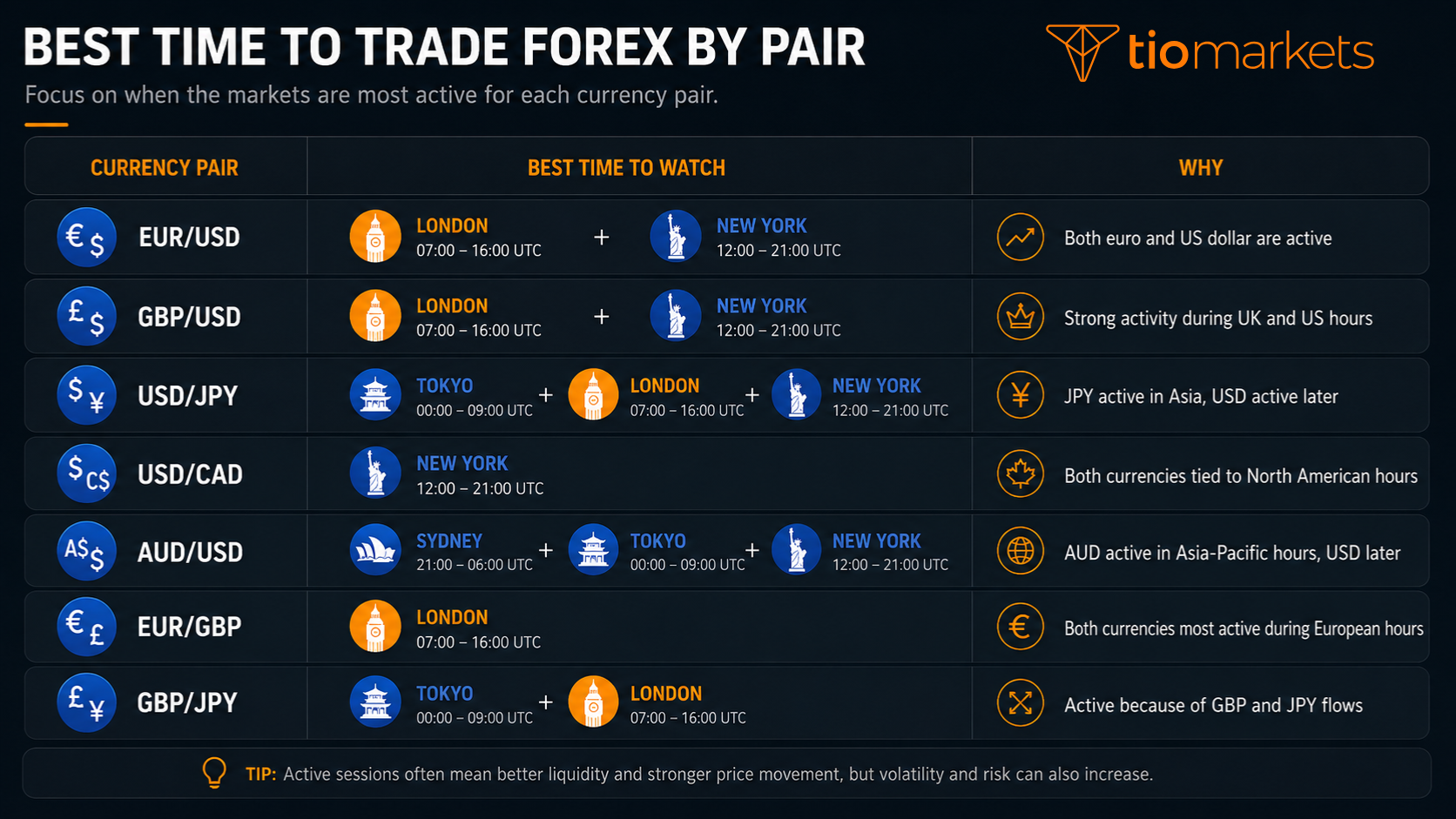
Different currency pairs are more active at different times because they are linked to different regions.
| Currency Pair | Best Time to Watch | Reason |
| EUR/USD | London and New York overlap | Both euro and US dollar are active |
| GBP/USD | London and New York overlap | Strong activity during UK and US hours |
| USD/JPY | Tokyo, London and New York | JPY activity in Asia, USD activity later |
| USD/CAD | New York session | Both currencies are tied to North American hours |
| AUD/USD | Sydney, Tokyo and New York | AUD active in Asia-Pacific hours, USD later |
| EUR/GBP | London session | Both currencies are most active during European hours |
| GBP/JPY | London and Tokyo | Can be active because of GBP and JPY flows |
This does not mean these pairs only move during those sessions. It simply means those are often the periods when they are more closely watched and more actively traded.
When Forex Trading Can Be Riskier
The most active trading times are not always the safest. High volatility can create opportunities, but it can also increase risk.
Traders should be especially careful around:
- major economic news releases,
- central bank decisions,
- low-liquidity periods,
- market open after the weekend,
- late Friday trading,
- public holidays,
- unexpected geopolitical events.
Major economic news releases can cause fast price movement, wider spreads and slippage. This is especially true around central bank decisions, inflation data, employment reports and unexpected geopolitical events.
Low-liquidity periods can also be risky. For example, trading near the weekend close, during holidays or shortly after the market opens can sometimes lead to wider spreads and less stable price action.
For beginners, it is usually better to avoid trading immediately before major news unless they have a clear strategy for that type of market environment.
How to Choose the Best Trading Time for You
There is no perfect trading time for every trader.
A trader using EUR/USD scalping strategies may prefer the London-New York overlap. A trader focused on AUD/JPY may care more about the Asian session. A swing trader may only need to check charts at key session opens, daily closes or after important news events.
Before choosing your trading window, consider:
- which currency pairs you trade,
- whether you prefer fast or slow markets,
- how much time you can realistically monitor charts,
- whether your strategy needs volatility,
- and whether major news is scheduled.
The goal is not to trade every hour. A better approach is to choose one or two reliable trading windows and study how your preferred pairs behave during those times.
This helps you build routine, reduce overtrading and avoid forcing trades during poor market conditions.
Final Thoughts: What Is the Best Time to Trade Forex?
The best time to trade forex is usually during the London-New York overlap, when market activity and liquidity are often strongest.
This period is especially important for major currency pairs such as EUR/USD, GBP/USD, USD/JPY and USD/CAD. The London session is also highly active, while the Tokyo and Sydney sessions may be more suitable for traders focused on Asian-Pacific pairs.
Still, the best time depends on your strategy. High volatility can create opportunities, but it can also increase risk. Before trading, check the market session, the currency pair, the economic calendar and whether current conditions actually match your setup.
The smartest approach is simple: trade when the market conditions suit your strategy, not just because the market is open.
Ready to put what you learned to use? Open your TIOmarkets trading account and start trading.

FAQ
Risk disclaimer: CFDs are complex instruments and come with a high risk of losing money rapidly due to leverage. You should consider whether you understand how CFDs work and whether you can afford to take the high risk of losing your money. Never deposit more than you are prepared to lose. Professional client’s losses can exceed their deposit. Please see our risk warning policy and seek independent professional advice if you do not fully understand. This information is not directed or intended for distribution to or use by residents of certain countries/jurisdictions including, but not limited to, USA & Countries included in the OFAC sanction list. The Company holds the right to alter the aforementioned list of countries at its own discretion.
TIOmarkets offers an exclusively execution-only service. The views expressed are for information purposes only. None of the content provided constitutes any form of investment advice. The comments are made available purely for educational and marketing purposes and do NOT constitute advice or investment recommendation (and should not be considered as such) and do not in any way constitute an invitation to acquire any financial instrument or product. TIOmarkets and its affiliates and consultants are not liable for any damages that may be caused by individual comments or statements by TIOmarkets analysis and assumes no liability with respect to the completeness and correctness of the content presented. The investor is solely responsible for the risk of his/her investment decisions. The analyses and comments presented do not include any consideration of your personal investment objectives, financial circumstances, or needs. The content has not been prepared in accordance with any legal requirements for financial analysis and must, therefore, be viewed by the reader as marketing information. TIOmarkets prohibits duplication or publication without explicit approval.
Join us on social media



Authors BIO

Panagiotis is an online trading specialist with extensive experience in forex, indices, and commodities. He enjoys sharing his experience to help traders better understand global financial markets.