


Is Forex Trading Halal or Haram? Answering a Crucial Question
BY Maria K.
|July 31, 2026So, is forex trading halal or haram? For practicing Muslims exploring online trading, this question carries significant weight. The short answer is that forex trading can be halal when specific conditions are met. The permissibility depends on four key factors that this guide will examine in detail.
By the end of this guide, you should be able to understand:
- The exact Islamic conditions that determine: is forex halal or haram
- What the Quran actually says about forex trading
- If certain trading styles are halal or haram
Disclaimer: This guide does not constitute a religious ruling; it is not meant to offer advice on Islamic finance matters, nor does it favour one scholarly opinion over another. It serves as an educational resource to help readers understand the scholarly landscape and make informed decisions in consultation with appropriate religious authorities.
Our aim is to present the different Islamic views on Forex trading and clear up the confusion about whether it is allowed. This confusion usually happens because people misunderstand how online trading works.
| Quick Answer: Forex trading is conditionally halal in Islam. It becomes permissible when traders use swap-free accounts (no interest), trade with immediate settlement, employ analysis-based strategies rather than gambling, and approach markets with legitimate intent. |
Is Forex Trading Halal or Haram? The Short Answer
Standard retail forex trading is often wrongly considered haram due to inherent trading elements like interest charges and speculation BUT forex trading can be halal when conducted under specific conditions. Online trading and currency exchange with immediate settlement, no interest, and genuine economic purpose is generally considered halal by many Islamic finance scholars.
How Forex Trading Works and Why Some Might Consider It Haram
Online trading allows individuals to buy and sell financial instruments, such as currencies, stocks, commodities, and indices, through internet-based platforms provided by brokers. The aim is to profit from price movements in these markets. Concerns sometimes arise because standard forex accounts might include overnight interest charges (swaps), the use of borrowed funds through leverage, and the potential for pure speculation without underlying economic benefit. These elements touch upon what many scholars consider prohibited in Islamic finance, which we will examine in detail below.
There is no single universal answer to the question is forex trading halal or haram and if forex trading in Islam is permitted. The permissibility depends entirely on how trading is conducted. Standard retail forex accounts typically involve overnight swap fees, leverage, and speculative intent, elements that the majority of Islamic finance authorities consider impermissible. However, modern online trading offers solutions to all of the above impediments, making trading accessible even to Muslim traders.
Let's start with the foundational principles of Islamic finance that govern all financial transactions and ultimately determine: is forex trading halal or haram.
The 4 Islamic Finance Principles That Determine If Forex Is Halal
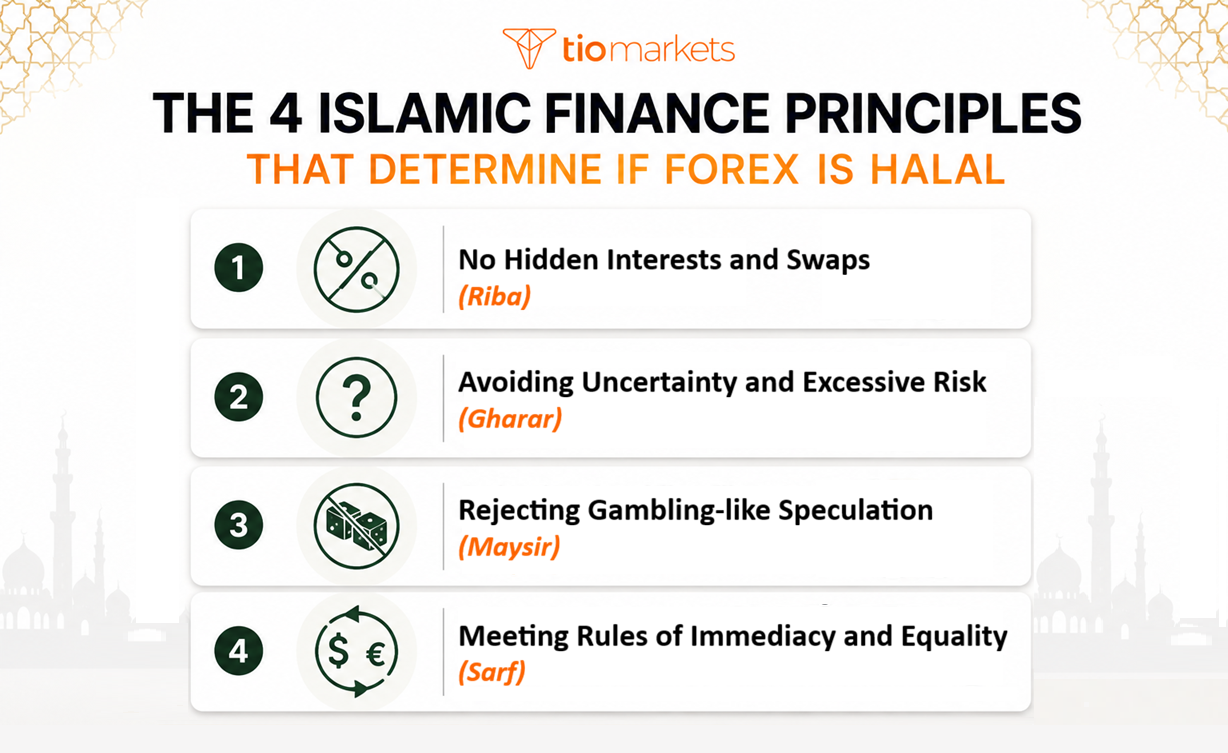
Every forex transaction must be evaluated against foundational pillars of Islamic finance to determine its permissibility. Four factors determine if online trading is halal or haram - these are:
- No Hidden Interests and Swaps (Riba)
- Avoiding Uncertainty and Excessive Risk (Gharar)
- Rejecting Gambling-like Speculation (Maysir)
- Meeting Rules of Immediacy and Equality (Sarf)
Understanding these four principles is essential for any Muslim trader asking is forex trading halal or haram in their specific situation - and forms the foundation of Islamic forex trading.
Riba: Why Overnight Interest Makes Most Forex Accounts Haram
Riba refers to any unjustified increase in capital, whether through lending or exchange. Riba in forex trading most commonly appears through overnight swap fees - the interest charged or credited when positions are held past the daily rollover time. Swap fees represent both types of riba recognized in Islamic jurisprudence: Riba al-Nasi'ah (interest from delay in payment) and Riba al-Fadl (inequality in exchange of similar items).
Gharar: Understanding Uncertainty in Islamic Finance
Gharar refers to excessive uncertainty, ambiguity, or deception in a contract that could lead to unfair outcomes. The principle aims to protect both parties by ensuring transparency and clarity in transactions. For forex trading, gharar concerns relate primarily to how a trader approaches the market rather than the tools available. A trader who enters positions without understanding risks or having a clear strategy may fall into gharar territory. Conversely, an informed trader using risk management and disciplined analysis operates with clarity, reducing gharar concerns regardless of what tools are used for their swap-free forex accounts. Market movements are inherently uncertain in all trading. What matters from an Islamic perspective is whether the trader understands and accepts these risks transparently - making informed, responsible participation the key factor in determining: is forex trading halal or haram.
Maysir: When Forex Trading Becomes Gambling
Maysir encompasses gambling and games of chance. Islamic finance distinguishes between legitimate business risk-taking and pure speculation that resembles gambling. Many scholars warn about speculative trading. But the key test is: Does the trade serve a genuine economic purpose, or is it purely a bet on price direction without underlying need?
Sarf: The Classical Islamic Rules for Currency Exchange
Sarf is the Islamic jurisprudence governing currency exchange, derived from prophetic traditions. Two core requirements apply: immediacy (yadan bi yad - hand to hand) and equality (for same-currency exchanges). A technical issue arises when trades are not settled immediately). Some scholars argue this violates sarf requirements, while others consider electronic confirmation of the trade to constitute the modern equivalent of 'hand to hand' exchange, thus satisfying the immediacy requirement.
The Consensus on Online Forex Trading in Islam
When asking is forex trading halal or haram, there is no single fatwa covering all forex trading; the ruling depends on the specific account structure and trading behavior.
What the Quran Says About Forex Trading
The applicable guidance comes from a well-known hadith: "Gold for gold, silver for silver, wheat for wheat, barley for barley, dates for dates, and salt for salt - like for like, equal for equal, hand to hand. If these classes differ, then sell as you wish if payment is made hand to hand."
This hadith establishes the core rules of exchange in Islamic faith. For halal currency trading, this means that exchanges of different currencies are permitted provided they occur immediately ("hand to hand"). The general scholarly consensus on the topic: is forex trading halal or haram, is that halal forex trading is permissible with conditions.
Major Bodies and Their Position on Forex Trading
AAOIFI (Accounting and Auditing Organization for Islamic Financial Institutions) is an internationally recognised non-profit body headquartered in Bahrain, established in 1991. It sets Sharia, accounting, auditing, and governance standards adopted by Islamic financial institutions across more than 45 countries. AAOIFI's standards are considered authoritative references for Islamic finance practitioners worldwide.
Particularly relevant to the question we are trying to answer here - is forex trading halal or haram - AAOIFI Standard No. 1 (Trading in Currencies) specifically addresses foreign exchange, stating that spot currency exchange conducted hand-to-hand (or its modern equivalent of immediate electronic settlement) is permissible. However, deferred settlement arrangements and interest-based accounts fall outside permissibility under this standard.
A similar view is expressed by the OIC Islamic Fiqh Academy: established in 1981 and affiliated with the Organisation of Islamic Cooperation (representing 57 member states), it serves as one of the most authoritative bodies in Islamic jurisprudence. Its rulings carry significant weight across the Muslim world as they represent scholarly consensus from diverse Islamic traditions. OIC Islamic Fiqh Academy’s position on currency trading aligns with AAOIFI: spot forex transactions are permissible when settlement is immediate, while futures, forwards, and interest-bearing arrangements are not permitted.
When Is Forex Trading Halal in Islam? The 5 Conditions That Must Be Met
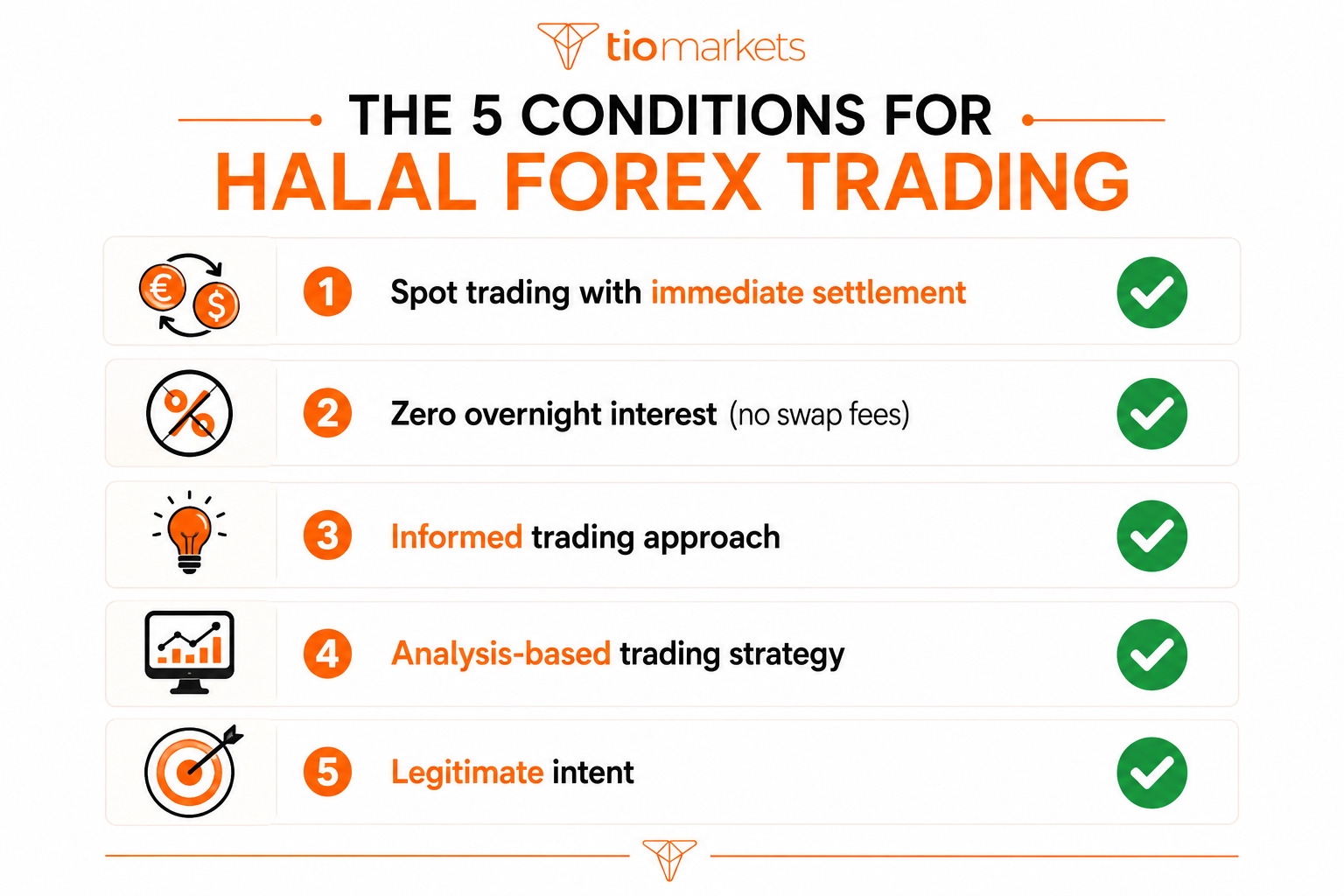
For forex trading to be considered halal, all five conditions must be satisfied simultaneously.
The 5 Conditions for Halal Forex Trading
- Trading with immediate settlement
- Zero overnight interest (no swap fees)
- Informed trading approach
- Analysis-based trading strategy
- Legitimate intent
Condition 1: Trading with Immediate Settlement
Trading that involves the immediate exchange of currencies at current market prices, typically settling within two business days is generally considered halal. This type of trading seems to align with the sarf requirement for immediacy. Scholarly opinion differs on whether modern electronic settlement satisfies classical sarf requirements. Some scholars maintain that T+2 settlement violates the 'hand to hand' requirement. Others argue that immediate electronic confirmation of the trade, even if actual settlement occurs later, constitutes the modern equivalent of immediate exchange.
Condition 2: Zero Overnight Interest (No Riba)
Swap fees charged on positions held overnight constitute riba and render standard forex accounts impermissible. For example, a trader holding one standard lot (100,000 units) of EUR/USD overnight might incur a $7-12 swap fee, calculated from the interest rate differential between the Euro and US Dollar.
Islamic forex accounts (also called swap-free accounts) remove these charges. However, a swap-free account alone does not automatically make trading halal; the other four conditions must also be met.
Condition 3: Informed Trading Approach (Avoiding Gharar)
Gharar concerns arise from how a trader approaches the market. Trading without understanding risks, proper analysis, or clear strategy may fall into gharar territory. Scholars generally agree that transparency and informed decision-making satisfy gharar requirements.
A trader who understands their position sizing, uses risk management tools, and accepts potential outcomes with full awareness operates with the clarity Islamic finance requires. For instance, setting a stop-loss at 2% of the trading account shows informed risk management, reducing gharar concerns. The emphasis here falls on responsible, knowledgeable participation rather than specific tools usage or limits.
Condition 4: Analysis-Based Trading (No Maysir)
The distinction between informed trading and gambling lies in the approach. Strategy-based trading using research, analysis, and documented methods differs fundamentally from trading based on gut feelings or the excitement of market movements. A practical test: traders can maintain a trading journal and follow a clear, documented strategy to ensure their activity remains on the permissible side.
Condition 5: Legitimate Intent
Trading should avoid reckless gambling (maysir). Scholarly opinion on Islamic finance varies: some permit profit-seeking if all other conditions are met; others prefer trading tied to genuine economic needs. Approaching markets with knowledge and discipline strengthens the case for permissibility.
Halal vs. Haram Forex Trading: Side-by-Side Comparison
The following table summarizes the key factors that determine is forex trading halal or haram:
| Factor | Halal Forex Trading | Haram Forex Trading |
| Settlement | Immediate | Deferred |
| Interest | Zero swap fees | Overnight swap charges |
| Intent | Analysis-based strategy | Gambling |
| Account type | Verified Islamic account with applicable parameters | Standard account with swap fees |
When Is Forex Trading Haram? Triggers to Avoid
When evaluating: is forex trading halal or haram, certain practices clearly move forex trading from permissible to forbidden under Islamic principles.
Things that Make Forex Trading Haram
- Paying or earning overnight swap interest
- Trading without proper risk management
- Speculative trading without strategy
- Using deferred settlement instruments
Trigger 1: Paying or Earning Overnight Swap Interest
This is the most clear-cut haram element. Notably, even earning interest (not just paying it) constitutes riba. A verified swap-free account addresses this issue.
Trigger 2: Trading Without Proper Risk Management
Trading without stop-losses, proper position sizing, or a clear strategy, represents uninformed speculation rather than legitimate trading. The issue is not the tools available but whether the trader approaches the market with knowledge, discipline, and full awareness of potential outcomes.
Trigger 3: Speculative Trading Without Strategy
Trading on emotion, chasing losses, lacking a documented strategy, or treating trading as entertainment crosses the line into maysir (gambling).
Trigger 4: Not Trading with Immediate Settlement
Classical Islamic jurisprudence emphasises immediate settlement in trading, as outlined in the sarf requirements. Many scholars favour spot transactions where settlement occurs promptly, as these most closely align with traditional sarf principles. Traders may wish to consult with knowledgeable scholars regarding specific products they intend to trade.
Islamic Forex Accounts Explained: Are Swap-Free Accounts the Solution?
A swap-free forex account removes overnight interest charges, but this alone does not guarantee Sharia compliance. However, for traders researching: is forex trading halal or haram, these accounts for sure represent a good starting point.
What Is an Islamic Forex Account (Swap-Free Account)?
An Islamic forex account removes overnight swap fees that would otherwise be charged on positions held past daily rollover. Brokers typically replace swap fees with alternative structures: fixed commissions, administrative fees, or adjusted spreads.
TIOmarkets offers the Islamic account which allows traders to hold positions overnight without incurring any swap fees, so you will not pay or receive any interest on your open positions. Moreover, depending on the account type you choose, the spreads can start very low at 0.3 and there could be no commission either.
The goal of Islamic finance is to conduct business with integrity, fairness, and genuine economic purpose. Applying that standard to your trading, and you will have your answer. You can learn how to open an Islamic account here.
TIOmarkets' Islamic Account: Built for Muslim Traders
Our Islamic account was specifically designed to address every Sharia compliance concern! Zero swap fees * Immediate electronic settlement * Spreads from 0.3 * Stop-losses, trading analysis, and educational resources
Trading is risky
Is Day Trading, Swing Trading, or Scalping Halal? Does Your Trading Style Follow Islamic Rules?
Different trading styles carry different levels of riba and maysir risk, directly affecting the answer to the question: is forex trading halal or haram for each approach. Check the table below to quickly assess the various Islamic finance risks associated with each trading style.
Islamic Ruling by Trading Style
| Trading Style | Overnight Exposure | Riba Risk | Maysir Risk | General Scholarly View |
| Spot Day Trading | None | Low (if swap-free) | Medium | Potentially permissible with conditions |
| Scalping | None | Low (if swap-free) | Medium | Potentially permissible if strategy-based |
| Swing Trading | High | Low (if swap-free) | Lower | Permissible only with verified Islamic account |
Many traders ask: is trading forex halal depending on their preferred style. The encouraging finding is that each major trading style can potentially align with Islamic principles when approached correctly. Below, we examine each approach individually.
Is Day Trading Halal in Islam?
Day trading involves no overnight exposure, eliminating swap fee concerns entirely. The primary consideration becomes whether trading is conducted with proper analysis and strategy rather than pure speculation. Many scholars view day trading favourably because positions close before any overnight interest would apply. The key factor is approaching trades with knowledge, research, and a documented methodology rather than impulsive decisions.
Many scholars consider day trading permissible when analysis-based and conducted through appropriate account structures.
Is Scalping Halal in Islam?
Very short holding periods eliminate overnight interest concerns completely. Speed itself does not make a trade haram, the determining factors remain riba and the trader's approach to risk. Scalping can align well with Islamic principles when traders use defined strategies, proper risk management, and approach the market with discipline rather than treating it as a game of chance.
Many scholars consider scalping permissible when strategy-based and conducted with appropriate risk management.
Is Swing Trading Halal in Islam?
Positions held for days or weeks involve overnight exposure, making account selection important. A verified Islamic swap-free account addresses the riba concern for swing traders. Interestingly, some scholars view swing trading favourably because it typically involves more thorough analysis and deliberate decision-making compared to shorter-term styles. The longer timeframe often reflects genuine market participation rather than speculation.
Many scholars consider swing trading permissible when conducted through a verified swap-free Islamic account with a disciplined, analysis-based approach.
Is Trading Gold, Crypto, or Other Assets on Forex Platforms Halal or Haram?
Beyond currency pairs, traders asking is forex trading halal or haram often want to know about gold, cryptocurrencies, and stocks; each has distinct considerations under Islamic finance principles.
Is Forex Currency Trading Halal?
Answering the question "is forex haram" is one of the more straightforward situations. Forex currency trading can be halal when conducted through transactions with immediate settlement, using swap-free accounts, and approaching trading with informed strategy rather than speculation. Many scholars permit it under these conditions, making forex one of the more accessible markets for Muslim traders seeking halal trading opportunities.
Is Trading Gold Halal?
Gold trading has a long history in Islamic commerce, and many scholars view it favourably under the right conditions. Physical gold ownership and transactions with immediate settlement are generally considered permissible by most scholars. The key considerations are ensuring immediate exchange (in line with classical sarf requirements) and using appropriate swap-free account structures when trading through online platforms.
Is Crypto Trading Halal?
Scholarly opinion on cryptocurrency continues to evolve as this asset class matures. Some scholars consider crypto exchange on a swap-free platform potentially permissible, particularly when approaching it as a genuine asset rather than speculation. Others question whether cryptocurrencies constitute legitimate assets under Islamic law, making this an area where individual traders may wish to seek specific guidance.
Is Trading Stocks Through Forex Platforms Halal?
Stock trading can align well with Islamic principles, but when accessing stocks through online platforms, traders should ensure their account structure avoids interest charges and that the companies they invest in meet Islamic screening criteria.
The Final Verdict: Is Forex Trading Halal or Haram?
Forex trading is neither universally halal nor universally haram, permissibility depends on specific factors that must all be satisfied. These determining factors are:
- settlement timing
- the presence of interest or swaps
- the intent behind the trade, and
- proper risk management.
When all conditions are met, many scholars consider forex trading permissible in Islam. Before opening any forex account, Islamic account or otherwise, and before concluding is forex trading halal or haram for yourself, consider three steps:
- read the full fee schedule, not just the marketing materials
- verify that the broker offers genuinely swap-free accounts without hidden charges that replicate interest
- consult a qualified Islamic finance scholar with your specific trading plan.
The goal of Islamic finance is to conduct business with integrity, fairness, and genuine economic purpose. Applying that standard to your trading, and you will have your answer.

FAQ
Risk disclaimer: CFDs are complex instruments and come with a high risk of losing money rapidly due to leverage. You should consider whether you understand how CFDs work and whether you can afford to take the high risk of losing your money. Never deposit more than you are prepared to lose. Professional client’s losses can exceed their deposit. Please see our risk warning policy and seek independent professional advice if you do not fully understand. This information is not directed or intended for distribution to or use by residents of certain countries/jurisdictions including, but not limited to, USA & Countries included in the OFAC sanction list. The Company holds the right to alter the aforementioned list of countries at its own discretion.
TIOmarkets offers an exclusively execution-only service. The views expressed are for information purposes only. None of the content provided constitutes any form of investment advice. The comments are made available purely for educational and marketing purposes and do NOT constitute advice or investment recommendation (and should not be considered as such) and do not in any way constitute an invitation to acquire any financial instrument or product. TIOmarkets and its affiliates and consultants are not liable for any damages that may be caused by individual comments or statements by TIOmarkets analysis and assumes no liability with respect to the completeness and correctness of the content presented. The investor is solely responsible for the risk of his/her investment decisions. The analyses and comments presented do not include any consideration of your personal investment objectives, financial circumstances, or needs. The content has not been prepared in accordance with any legal requirements for financial analysis and must, therefore, be viewed by the reader as marketing information. TIOmarkets prohibits duplication or publication without explicit approval.
Join us on social media



Authors BIO
Maria is a writer and content strategist with over 10 years of experience in the finance industry. She specializes in developing research-backed articles that help financial professionals navigate complex market topics with confidence. Her expertise spans forex, stocks, CFDs and global markets, creating insightful content that educates readers and supports informed decision-making.