


How to Choose a Forex Broker: A Comprehensive Guide for Traders
BY Maria K.
|June 19, 2026This article will show you how to choose a forex broker. Selecting a forex broker may be one of the most important decisions a trader makes. Your broker serves as your gateway to the markets, custodian of your funds, and provider of essential tools. Making the wrong choice can mean excessive costs, poor execution, or security concerns, while the right broker may provide a better trading experience and stronger safeguards for client funds.
In this guide we will walk you through what to look for and provide some tips for choosing a forex broker.
Quick Answer: How to Choose a Forex Broker
Look for a broker that is regulated, offers competitive trading costs, provides a reliable platform, and supports your preferred trading style. Before opening an account, test the broker through a demo or small live account and evaluate its execution quality, customer support, and withdrawal process.
- Regulation
- Costs
- Platform
- Execution quality
- Available markets
- Deposits and withdrawals
- Customer support
- Educational resources
- Risk management tools
Why Choosing a Good Forex Broker Matters
A forex broker facilitates the buying and selling of foreign currencies. The forex market operates over-the-counter and transactions occur directly between parties, via electronic networks.
Most retail forex brokers operate as CFD (Contract for Difference) providers, allowing traders to speculate on currency pair values without actually owning the physical currency. When you open a forex account, you’re trying to predict price movements rather than purchasing and holding currencies as investments.
Forex markets operate 24 hours a day, five days a week, so traders across all time zones can participate. This self-directed approach requires a solid risk management strategy, as you are entirely responsible for your trading decisions and outcomes.
Spreads and fees can affect profitability, execution quality may result in slippage or delayed order fills, but more importantly, fund security levels can vary significantly, so regulation and transparency are critical factors when selecting a broker. But let’s break everything down so you learn how to choose the best forex broker for beginners or experienced traders.
Finding a Good Broker: 9 Things to Consider
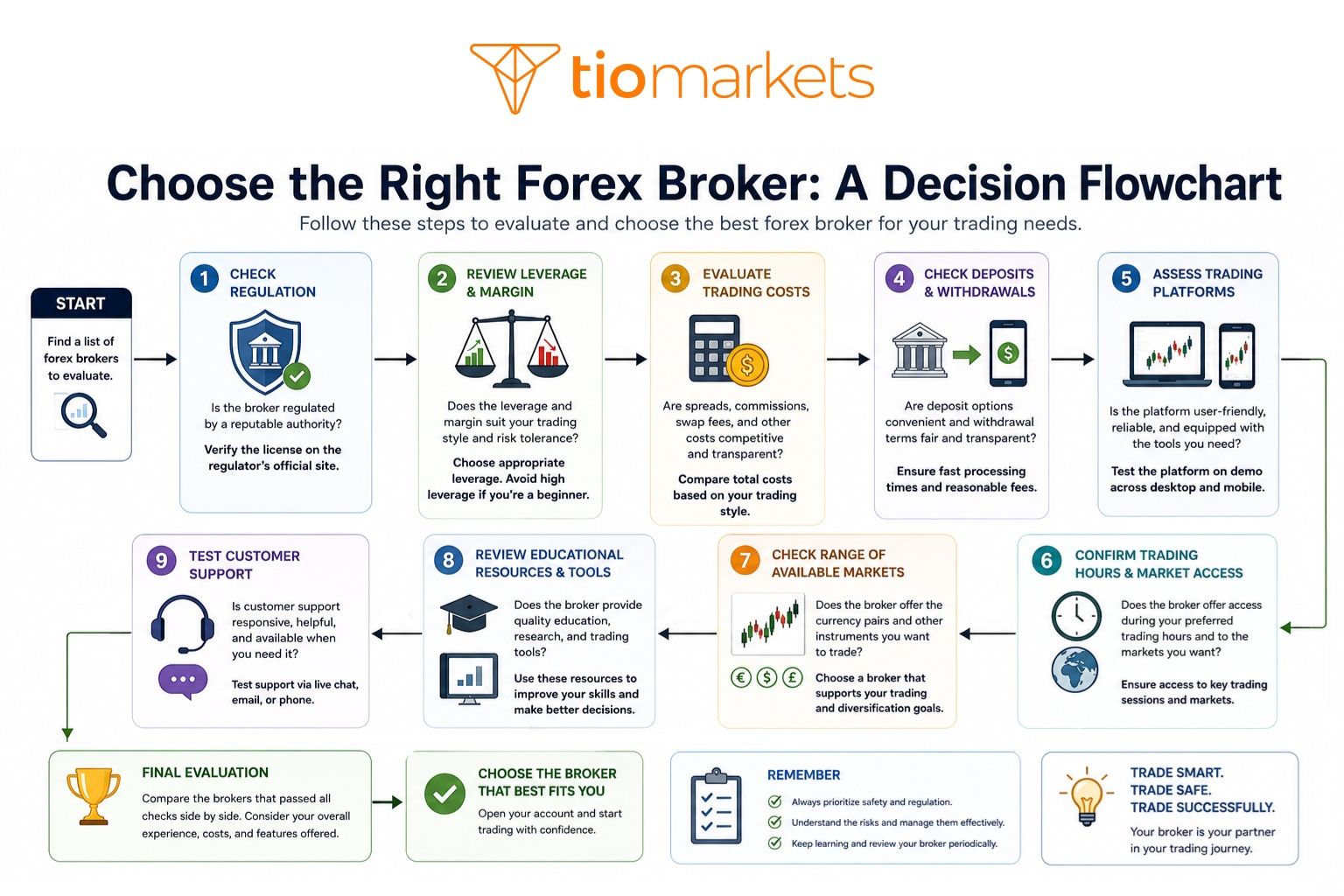
1. Regulatory Compliance: Check Regulation, Prioritize Safety
Regulation ensures that your broker follows strict rules on client fund handling, transparent pricing, execution practices, reporting, and dispute resolution. This adds a layer of safety because you deal with a licensed trading firm authorised by a recognised financial authority to provide forex and CFD trading services. Top-tier regulatory bodies include the Financial Conduct Authority (FCA) in the UK, the Australian Securities and Investments Commission (ASIC), the Cyprus Securities and Exchange Commission (CySEC), and the Commodity Futures Trading Commission (CFTC) in the US.
Regulated brokers are expected to hold client funds in segregated accounts, separate from company capital, to ensure that your money is protected even if the broker faces financial difficulties. Many regulatory frameworks also include compensation schemes for additional protection.
When checking how to find the best forex broker, verify their regulatory status by scanning their website for license numbers and cross-referencing this information on the regulator’s official site. Avoid brokers that are evasive about their regulatory status or lack verifiable details.
Moreover, regulated brokers must adhere to strict operational standards, such as maintaining adequate capital reserves and undergoing regular audits.
2. Leverage & Margin: A Double-Edged Sword
Leverage lets traders control larger trading positions with a smaller deposit. In this case both potential profits and losses are amplified. Different brokers offer varying leverage ratios, most often to comply with regulatory requirements. For instance, the EU caps leverage at 1:30 for retail traders, while other jurisdictions may allow up to 1:500.
Beginners may wish to start with lower leverage ratios while developing their understanding of risk management and trading mechanics.
Margin requirements also vary by currency pair and broker. Major pairs like EUR/USD typically require lower margins due to their liquidity, while exotic pairs may demand higher margins because of their volatility. Understanding these requirements is essential for managing your risk effectively.
Leverage can be a powerful tool, but it requires discipline and a clear understanding of its risks. Traders who misuse leverage often face significant losses. It is therefore crucial to choose a broker that provides educational resources on how to use leverage responsibly.
3. Calculating Trading Costs
Forex trading involves costs. Spreads, commissions and swap/overnight fees can all have an impact on your potential profits. Choosing a broker with competitive trading costs may help reduce overall trading expenses.
- Spreads: The spread is the difference between the buy (ask) and sell (bid) price of a currency pair. It can be fixed or variable. Fixed spreads remain constant, while variable spreads fluctuate based on market conditions. Examine spreads on the currency pairs you intend to trade most frequently.
- Commissions: In forex trading, a commission is a fee charged by a broker for executing buy and sell orders on behalf of a trader. It is usually calculated as a fixed amount per traded lot or as a percentage of the trade value. Some brokers offer low spreads but charge a separate commission, while others include their fees within wider spreads.
- Swap Fees: Beyond spreads and commissions, watch for additional costs like swap fees (for holding positions overnight), inactivity fees, and withdrawal fees. Swap fees, also known as rollover fees, are particularly important for traders who hold positions overnight. These fees are based on interest rate differentials between the currencies in a pair and can either add to or subtract from your profitability.
Some brokers offer zero-commission accounts, but these often come with wider spreads. It’s essential to calculate your total trading costs based on your trading style and frequency to determine which cost structure is more advantageous for you.
4. Deposits & Withdrawals: Can You Access Your Money?
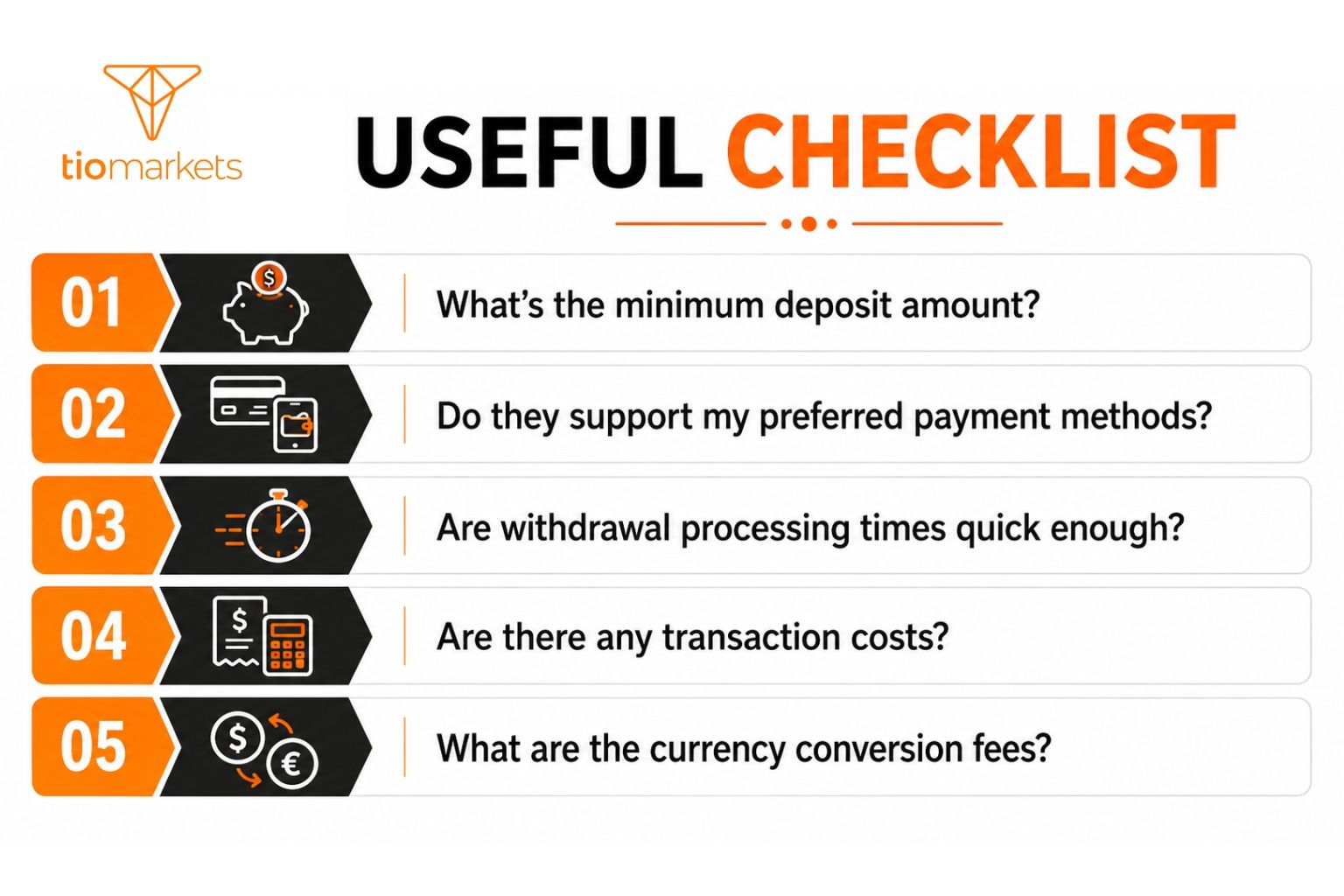
Evaluate brokers based on their deposit and withdrawal policies. Minimum deposit requirements vary, with some brokers requiring as little as $100, but others set higher thresholds. Check to see if the minimum aligns with your available capital. You also want to consider whether the broker imposes restrictions on withdrawal methods. This can impact your ability to access funds quickly.
In addition, a reliable broker should offer fast and transparent transaction processing, with clear timelines. Delays or unclear processing rules can be a red flag.
Accepted payment methods typically include bank transfers, credit or debit cards, and e-wallets. Withdrawal processing times and fees also vary. Quality brokers process withdrawals within one to five business days and charge minimal or no fees for standard methods.
If you’re depositing in one currency but trading in another, check for currency conversion fees. Some brokers offer multi-currency accounts to avoid these charges.
Transparency in deposit and withdrawal policies is a hallmark of a reputable broker. Look for brokers that clearly outline their fees and processing times, as hidden charges or delays can significantly impact your trading experience.
5. Trading Platforms: Your Daily Workspace
The trading platform is your primary interface with the markets. When considering how to choose a forex broker, this is one of the most important practical factors as it directly affects how efficiently you can execute trades or even analyze the market. Most brokers offer standard platforms, like MetaTrader 4 (MT4) and MetaTrader 5 (MT5), mobile apps, or browser-based access. Advanced traders may seek platforms offering direct market access (DMA) or integration with professional charting software. In any case, when evaluating platforms, you must consider:
- User Interface: Intuitive and easy to navigate?
- Charting Tools: Multiple timeframes, drawing tools, or technical indicators?
- Order Types: Supports advanced order types (stop-loss and trailing stops)?
- Mobile Functionality: Can you trade effectively on the go?
- Reliability and Speed: Executes trades quickly and reliably?
Some additional features to look out for are social trading - also known as copy trading, where you can follow and copy the strategies of experienced traders. Some traders use copy trading as a way to leverage the experience, skill and time of other traders, although results can vary significantly.
For algorithmic traders, platform compatibility with automated trading systems or APIs is another consideration.
6. Trading Hours and Market Access
Forex markets are open 24 hours a day during normal business days, but not all brokers provide access during all available hours. On the other hand, some brokers offer weekend trading on select currency pairs.
Consider your personal schedule and trading strategy. If you can only trade during specific hours, it is good to double check that those align with active market sessions for your preferred currency pairs. For example, the London and New York sessions often provide the highest liquidity and tightest spreads.
Lastly, some brokers offer extended market access for other asset classes, such as cryptocurrencies, which can be traded 24/7. This flexibility can be great for traders looking to diversify their portfolios.
7. Range of Available Markets
Brokers typically offer three categories of forex pairs as below.
| Pair Type | Description | Examples |
| Major Pairs | The most heavily traded and liquid currency pairs, typically involving the U.S. dollar. | EUR/USD, GBP/USD |
| Minor Pairs | Cross-currency pairs that do not include the US dollar but involve major currencies. | EUR/GBP, GBP/JPY |
| Exotic Pairs | Pairs that combine a major currency with the currency of an emerging or developing economy. | USD/ZAR, USD/TRY |
If you are looking to find a top broker, check any one offering extensive currency pair selections, i.e. 80 or more pairs. Many provide CFD trading on indices, commodities, stocks, ETFs, and cryptocurrencies, which is a chance to diversify your trading opportunities. Some offer forex options and futures, useful for traders looking to hedge positions or implement complex strategies. Understand the range of instruments available because it can help you choose a broker that aligns with your trading style.
8. Educational Resources and Research Tools
Comprehensive educational resources and research tools add significant value. What should you be looking for?
- Structured Learning Paths | Courses on forex fundamentals to advanced strategies.
- Demo Accounts | Risk-free environments.
- Market Analysis | Daily or weekly commentary from experienced analysts.
- Economic Calendars | Schedules of market-moving events.
- Webinars and Tutorials | Live or interactive sessions on various trading topics.
Content that offers education helps you develop realistic expectations and strong strategies. Some brokers also provide additional educational tools such as trading signals, market analysis, or automated trading features.
Experienced traders can benefit from advanced tools like performance tracking, backtesting capabilities, and trade journals in order to refine their strategies and improve long-term results.
9. Customer Support: Do You Get Help When Needed?
Responsive support means multiple channels like live chat, email, and phone, in the best case scenario with 24/7 availability. That’s what distinguishes a good broker from the best forex broker. Efficient and knowledgeable forex broker customer support can make the difference when resolving account, platform, or trading-related issues.
Evaluate brokers based on:
- Availability: Support should cover all major trading sessions, ideally 24/7.
- Contact Methods: Multiple channels like phone, email, and live chat.
- Response Quality: Knowledgeable staff who can resolve issues effectively.
- Language Support: Multilingual support if English isn’t your first language.
Test customer support before funding your account by asking questions about their services or platform features. Some brokers go as far as offering onboarding assistance, like one-on-one walkthroughs of their platform.
Making the Final Decision When Comparing Brokers
It’s good to create a comparison framework based on your priorities. For beginners, focus on low minimum deposits, educational resources, and demo accounts. For active traders, prioritize tight spreads, fast execution, and advanced platform features.
In summary, always keep in mind the below.
| Factor | Why It Matters |
| Regulation | Client protection |
| Costs | Trading expenses |
| Platform | Execution and analysis |
| Leverage | Risk exposure |
| Withdrawals | Access to funds |
| Support | Issue resolution |
Understanding Broker Business Models
Brokers operate under different business models. Each model has advantages and disadvantages. What matters most is that the broker is regulated, transparent, and provides quality execution.
- Market Makers: Take the opposite side of client trades, profiting from spreads. Reputable market makers hedge positions to minimize conflicts of interest.
- ECN/STP Brokers: Route orders directly to liquidity providers, profiting from commissions or spread markups.
- DMA Brokers: Provide direct access to interbank markets, often requiring larger account sizes.
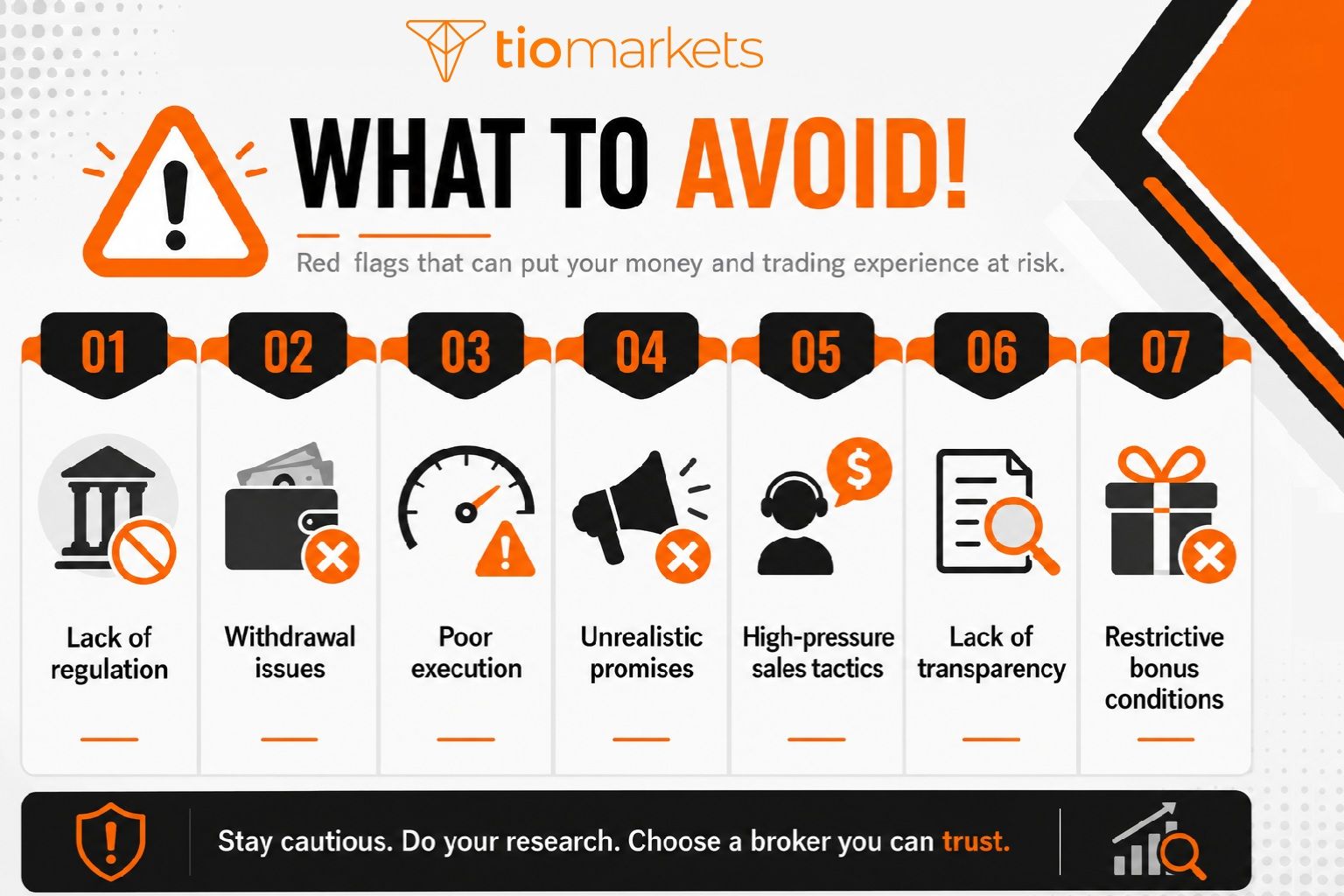
Red Flags to Keep in Mind
It is usually advisable to avoid brokers that show clear warning signs, such as operating without proper regulation, making it difficult to withdraw funds, or consistently providing poor trade execution. Be cautious of firms that promise guaranteed profits or unrealistic returns, use high-pressure sales tactics to rush your decisions, or lack transparency about their fees, conditions, and policies. It's also worth reading the fine print on promotional offers, as restrictive bonus conditions can make it harder to access your own money. If a broker displays any of these red flags, it may be best to look elsewhere and choose a provider with a stronger reputation for trust and transparency.
Taking the Next Step
Once you’ve selected a broker, the account opening process typically involves:
- Application: Provide personal information and trading experience.
- Verification: Submit identification and proof of address.
- Funding: Deposit funds using your preferred method.
- Education: Practice on a demo account and familiarize yourself with the platform.
- Start Small: Begin live trading with small positions and gradually increase as you gain confidence.
The Critical Role of Risk Management
Forex trading carries substantial risk. Many regulated providers disclose that a majority of retail investor accounts lose money when trading leveraged CFDs. Essential risk management practices include:
- Risking only a small percentage of your account per trade
- Using stop-loss orders
- Avoiding over-leveraging
- Trading only with money you can afford to lose
- Continuously educating yourself
Conclusion
Choosing a forex broker requires careful research. Focus on a practical evaluation process rather than marketing claims.
Start by creating a shortlist of regulated brokers and verify their licenses with the relevant financial authorities. Then compare key factors that affect your trading experience: spreads and commissions, available markets, execution quality, deposit and withdrawal methods, and customer support.
Before committing capital, open demo accounts and, if possible, small live accounts with your top choices. Test the trading platform, place trades during different market conditions, and evaluate how quickly withdrawals are processed. Choose the broker that best matches your trading style, budget, and long-term goals.
Take the time to compare options carefully, ask questions, and perform your own due diligence before making a final decision. Remember, even the best broker cannot guarantee success. Your knowledge, discipline, and risk management ultimately determine your outcomes. Should you decide to try TIOmarkets, register your account.
FAQ
Risk disclaimer: CFDs are complex instruments and come with a high risk of losing money rapidly due to leverage. You should consider whether you understand how CFDs work and whether you can afford to take the high risk of losing your money. Never deposit more than you are prepared to lose. Professional client’s losses can exceed their deposit. Please see our risk warning policy and seek independent professional advice if you do not fully understand. This information is not directed or intended for distribution to or use by residents of certain countries/jurisdictions including, but not limited to, USA & Countries included in the OFAC sanction list. The Company holds the right to alter the aforementioned list of countries at its own discretion.
TIOmarkets offers an exclusively execution-only service. The views expressed are for information purposes only. None of the content provided constitutes any form of investment advice. The comments are made available purely for educational and marketing purposes and do NOT constitute advice or investment recommendation (and should not be considered as such) and do not in any way constitute an invitation to acquire any financial instrument or product. TIOmarkets and its affiliates and consultants are not liable for any damages that may be caused by individual comments or statements by TIOmarkets analysis and assumes no liability with respect to the completeness and correctness of the content presented. The investor is solely responsible for the risk of his/her investment decisions. The analyses and comments presented do not include any consideration of your personal investment objectives, financial circumstances, or needs. The content has not been prepared in accordance with any legal requirements for financial analysis and must, therefore, be viewed by the reader as marketing information. TIOmarkets prohibits duplication or publication without explicit approval.
Join us on social media



Authors BIO
Maria is a writer and content strategist with over 10 years of experience in the finance industry. She specializes in developing research-backed articles that help financial professionals navigate complex market topics with confidence. Her expertise spans forex, stocks, CFDs and global markets, creating insightful content that educates readers and supports informed decision-making.
Proof read by


Panagiotis is an online trading specialist with extensive experience in forex, indices, and commodities. He enjoys sharing his experience to help traders better understand global financial markets.