Forex Lots Explained: What Are Lots & Calculating Lot Size
BY Maria K.
|July 2, 2026Before you place your first forex trade, understanding lot sizes helps determine your exposure to market movements and the potential profit or loss of each trade.
Forex trading uses standardised measurement units called lots. With forex lots explained properly, you'll understand how traders use lot sizes when managing position size and risk. Then with this understanding, it can help you make more informed position-sizing decisions.
Lot size selection isn't just a technical detail you can overlook. It is an important component of risk management in forex trading.
Forex lots explained: A forex lot is the standard unit used to measure trade size. Standard lots equal 100,000 units, mini lots 10,000, micro lots 1,000, and some brokers also offer nano lots of 100 units. Choosing the right lot size helps traders manage exposure and risk.
This comprehensive guide covers everything you need to know: what lots are, the four types of forex lot sizes, how pip values change with each lot size, how to calculate your ideal lot size, and how to use position sizing for smarter risk management.
What Are Lots in Forex Trading? A Simple Definition
A lot in forex trading is a standardised unit of measurement that defines the size of a trade. When you buy or sell a currency pair, you do so in quantities called lots.
To make forex trading viable, the market uses standardised lot sizes that bundle currency units together. Think of it like a wholesale warehouse: a retailer doesn't buy individual items, they buy pallets (standard lots), cases (mini lots), packs (micro lots), or occasionally individual units (nano lots). Forex brokers standardise trade sizes the same way.
These lot sizes are widely used market conventions adopted across the retail forex industry, helping standardise trade sizing between brokers. This standardisation means that when you trade 1.0 lots with any broker, you're always controlling the same amount of currency.
Key Takeaway
- A lot = a standardised trade size in forex
- The standard lot size = 100,000 units of the base currency
- Smaller lot sizes (mini, micro, nano) give traders more flexibility and risk control
The Four Types of Forex Lot Sizes Explained
Forex lots come in four standardised sizes. Each one suits a different type of trader and account size. Read on to see a breakdown of all four lot sizes.
An example is provided with each one. But to understand them better, assume our scenario is this: we are trading EURUSD and the quote price is at the moment at $1.20 - this means that with $1.20 you can buy €1.
Standard Lot = 100,000 Units
A standard lot forex position equals 100,000 units of the base currency. On trading platforms, this appears as 1.0 in the volume field.
Example: As per our scenario, the EURUSD exchange rate is $1.2000. In this case one standard lot of the base currency (EUR) is 120,000 units. This means you need 120,000 units of the quote currency (USD) to buy 100,000 units of EUR.
Buying 1 standard lot of EURUSD at 1.2000 means you're controlling €100,000 worth of euros. Here, each pip movement equals $10. This means each pip movement has a larger monetary impact, increasing both potential gains and losses. Therefore, standard lots are normally used by experienced traders, institutional traders, and those with significant trading capital.
Mini Lot = 10,000 Units
A mini lot forex position equals 10,000 units of the base currency, shown as 0.1 on trading platforms.
Example: If the EURUSD exchange rate is at $1.2000, one mini lot of the base currency (EUR) is 12,000 units. This means you need 12,000 units of the quote currency (USD) to buy 10,000 units of EUR.
If you buy 1 mini lot of EURUSD at 1.2000, you're controlling €10,000 worth of euros. And the pip value drops to $1 per pip on major pairs - a 50-pip move would result in approximately a $50 gain or loss, depending on market direction.
Mini lots allow fractional position sizing. Instead of choosing between 0 and 1 standard lot, you can trade 0.3 lots (or 3 mini lots) for more precise risk management. Intermediate traders, those transitioning from demo accounts to live trading, and traders who want finer control over position sizing, will use mini lots.
Micro Lot = 1,000 Units
A micro lot forex position equals 1,000 units of the base currency, displayed as 0.01 on most platforms.
Example: If the EURUSD exchange rate is $1.2000, one micro lot of the base currency (EUR) is 1200 units. This means you need 1200 units of the quote currency (USD) to buy 1000 units of EUR.
Buying 1 micro lot of EURUSD at 1.2000 means you're controlling €1,000 worth of euros. Here the pip value is $0.10 per pip.
As a result, micro lots dramatically reduce the dollar impact of each pip movement. This reduces the monetary impact of each pip movement compared with larger lot sizes. Micro lots are suitable for beginners learning to trade, experienced traders testing new strategies, and anyone with a smaller account.
Nano Lot = 100 Units
A nano lot forex position equals just 100 units of the base currency. The notation is 0.001.
Example: In our case where the EURUSD exchange rate is $1.2000, one nano lot of the base currency (EUR) is 120 units. This means you need 120 units of the quote currency (USD) to buy 100 units of EUR.
The pip value is even lower at $0.01 per pip. A 100-pip move earns you just $1, not enough to generate meaningful returns, but can be useful for practising with relatively small market exposure. Nano lots are primarily useful for education and testing. So who uses nano lots? Pure beginners, strategy testers, and traders on very small accounts who want real-market experience with minimal risk.
Not all brokers offer nano lots but TIOmarkets does, with the Nano account. It allows trading in the smallest possible increments for traders who want flexibility, especially beginners.
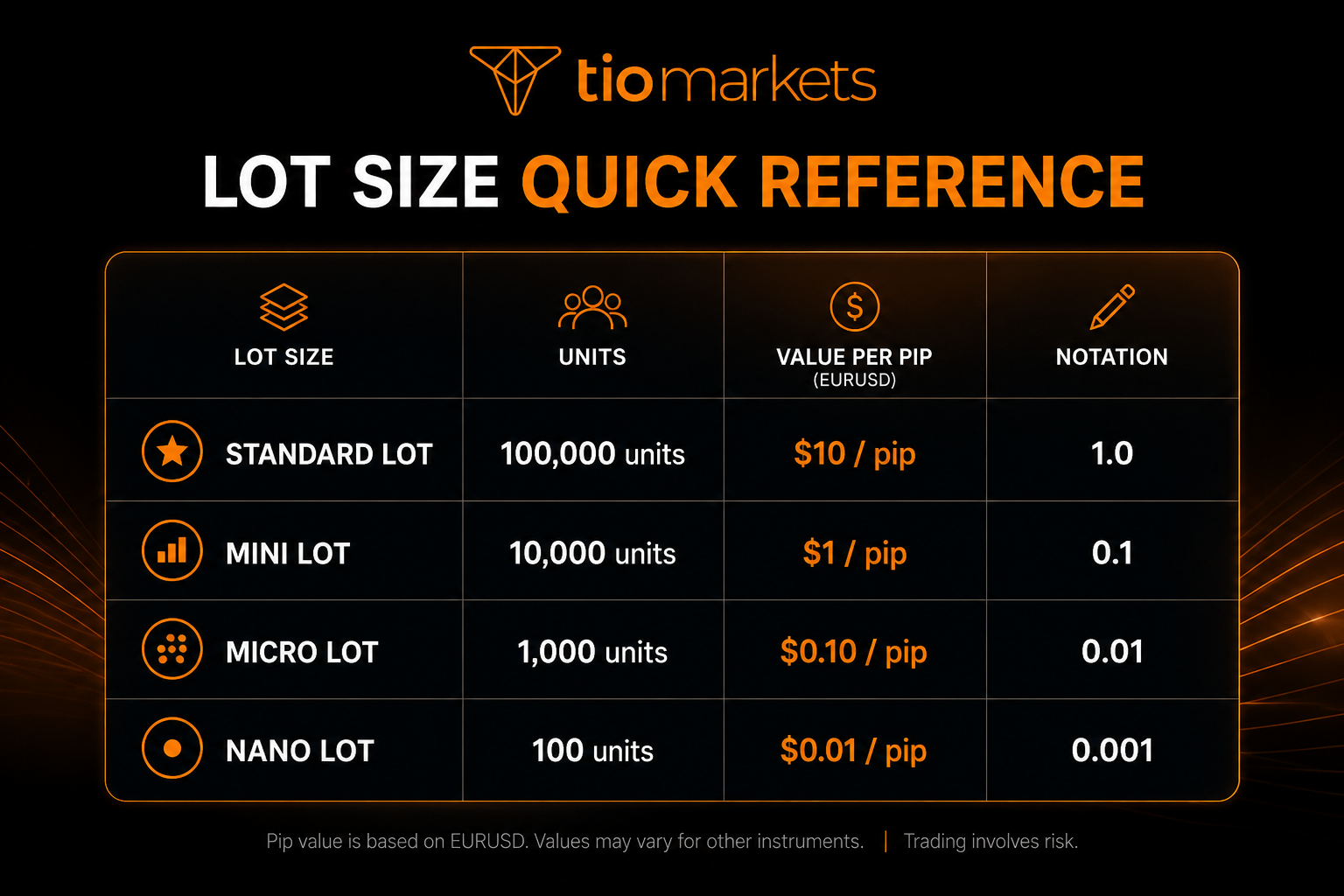
Forex Lot Size Comparison Chart
Understanding lot sizes is essential for managing risk in forex trading. The table below compares the four types of lot sizes, their corresponding trade volume, pip value on EUR/USD, and the trader profiles they are best suited for.
| Lot Type | Notation | Units | Pip Value (EUR/USD) |
| Standard | 1.0 | 100,000 | $10.00 |
| Mini | 0.1 | 10,000 | $1.00 |
| Micro | 0.01 | 1,000 | $0.10 |
| Nano | 0.001 | 100 | $0.01 |
Why Lot Size Matters - How It Affects Pip Value and Your Trades
Understanding pip value per lot is essential for calculating your potential profit or loss on any trade.
A pip is the smallest standard price movement in a forex pair. For most currency pairs, it appears at the fourth decimal place (0.0001). When EURUSD moves from 1.1000 to 1.1001, that's a one-pip movement.
The direct relationship: Larger lot = larger pip value = larger profit or loss per pip movement.
This relationship is perfectly linear. Double your lot size, and you double your pip value. Trade half the lot size, and your pip value is cut in half. This makes forex
Pip Value Per Lot Size (EUR/USD Example)
| Lot Size | Units | Pip Value | 10-Pip Move | 50-Pip Move | 100-Pip Move |
| Standard (1.0) | 100,000 | $10.00 | $100 | $500 | $1,000 |
| Mini (0.1) | 10,000 | $1.00 | $10 | $50 | $1,00 |
| Micro (0.01) | 1,000 | $0.10 | $10 | $5 | $1,0 |
| Nano (0.001) | 100 | $0.01 | $0.10 | $0.50 | $1 |
Non-USD quote currency pairs: When the quote currency isn't USD (for example in EURGBP), the pip value is calculated in the quote currency first, then converted to your account currency at current exchange rates.
Most modern trading platforms calculate pip value automatically for any currency pair. However, understanding the manual calculation builds confidence and helps you verify the numbers.
How Forex Lots Relate to Leverage and Margin
These three concepts - lots, leverage, and margin - work together in every forex trade. Understanding their relationship is crucial for managing risk.
- Lots determine your total market exposure
- Leverage determines how much of your own capital you need to control that exposure
- Margin is the deposit your broker holds as collateral
Example
You want to trade 1 standard lot of EURUSD, controlling 100,000 units worth approximately $100,000.
With 100:1 leverage, you only need to deposit 1% of the position value as margin, that's $1,000. Leverage allows you to control a larger position while only committing a smaller margin requirement.
The critical point is that your profit and loss are calculated on the full $100,000 position, not just your $1,000 margin deposit.
If the trade moves 50 pips in your favour, you earn $500, that is a 50% return on your $1,000. But if it moves 50 pips against you, you lose $500 - also 50% of your $1,000 margin.
This is why lot size selection is so critical. Leverage amplifies everything. If you choose too large a lot size, a normal market fluctuation can result in considerable losses.
How to Calculate the Right Lot Size for Your Trade
Learning how to calculate lot size forex trades is the most practical skill you'll develop as a trader. Read on to find out the formula many traders use.
The Position Sizing Formula
To calculate the appropriate lot size for a trade based on your account size, risk tolerance, and stop-loss distance, you follow this formula.
| Lot Size = (Account Balance x Risk %) ÷ (Stop Loss in Pips x Pip Value per Lot) |
Let's break down each component:
- Account Balance = Your current trading capital
- Risk % = The maximum percentage you're willing to lose on this trade (typically 1–2%)
- Stop Loss in Pips = How far price can move against you before your trade closes
- Pip Value per Lot = The dollar value of one pip for your chosen lot type
Worked Example 1: EUR/USD Long Trade
- Account: $10,000
- Risk per trade: 1% = $100
- Stop loss: 50 pips
- Pair: EUR/USD (pip value = $10 per standard lot)
Calculation: $100 ÷ (50 × $10) = $100 ÷ $500 = 0.2 lots
What that means is, if you trade 0.2 lots (2 mini lots) - assuming the trade closes at the stop-loss price - the intended maximum loss is approximately $100 (excluding slippage, gaps and costs). If the price moves 50 pips in your favour, you gain $100.
Worked Example 2: Smaller Account, Micro Lot Trade
- Account: $500
- Risk per trade: 1% = $5
- Stop loss: 50 pips
- Pair: EUR/USD (pip value = $0.10 per micro lot)
Calculation: $5 ÷ (50 × $0.10) = $5 ÷ $5 = 1.0 micro lot (or 0.01 standard lot)
What that means is, if you should trade 1 micro lot (0.01 standard lot) you risk exactly $5 on this trade. If your stop loss is hit, you lose $5. If the price moves 50 pips in your favour, you gain approximately $5. That $5 is 1% of your account and that’s what you are risking here. So even a $500 account can trade with proper risk management using micro lots.
Using a Forex Lot Size Calculator
Most trading platforms include built-in forex lot size calculators that automate this process. With TIOmarkets you can calculate your lot size in advance so you have an idea of the correct position size for each trade based on your account balance, risk tolerance, and stop-loss distance. Instead of guessing how much to trade, you can calculate a position size that may help you manage position sizing more consistently.
You'll need four inputs to use the TIOmarkets forex lot size calculator.
- Account currency
- Currency pair being traded
- Amount to risk
- Stop loss in pips
Choosing the Right Lot Size for Your Account, A Practical Guide
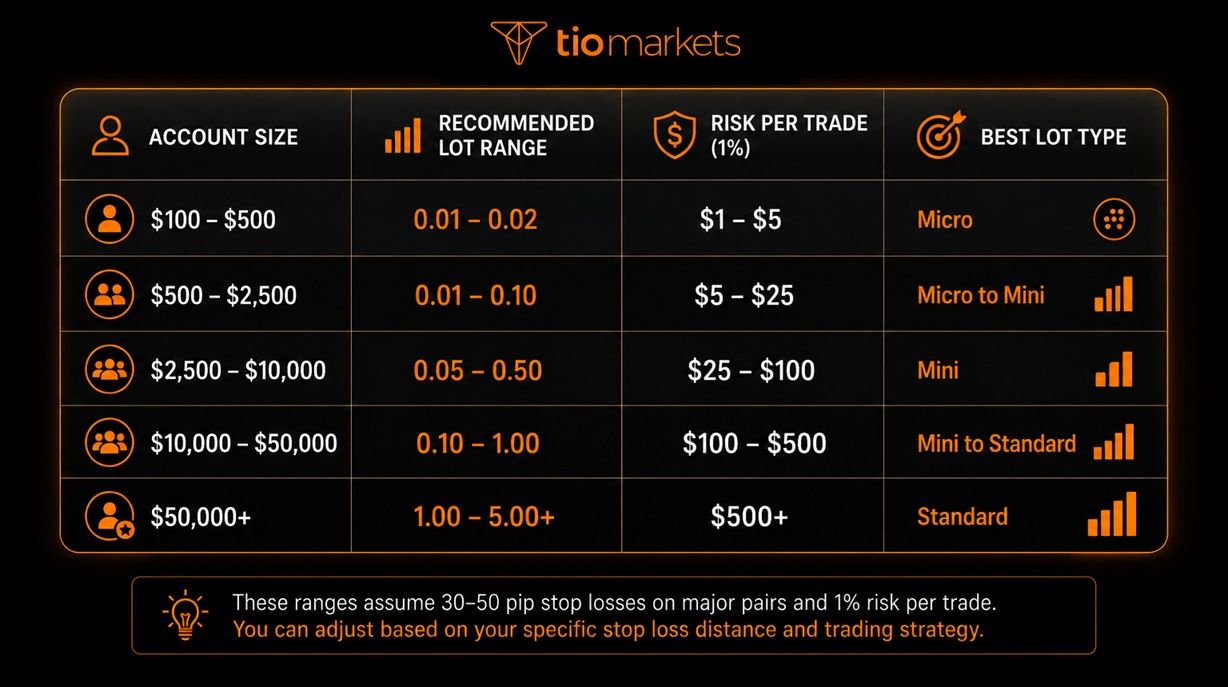
Your account size is the primary driver of appropriate lot sizing. Many traders choose to risk between 1–2% of account equity per trade, although risk tolerance varies. A lot size should be chosen based on calculations that consider your stop loss distance and risk percentage. Smaller lot sizes are not a sign of weakness or inexperience. They're a sign of disciplined risk management.
Recommended Lot Size Ranges by Account Size
Conclusion
Understanding forex lot sizes helps you make more informed position-sizing decisions. You understand that lots are standardised trade sizes ranging from nano (100 units) to standard (100,000 units), each with proportionally different pip values. The key insight is that lot size directly controls your risk.
Now that you understand how forex lots work, the next step is to learn how leverage and margin interact with your position size. You can open a demo account and practise these concepts in a demo environment before trading live.

FAQ
Risk disclaimer: CFDs are complex instruments and come with a high risk of losing money rapidly due to leverage. You should consider whether you understand how CFDs work and whether you can afford to take the high risk of losing your money. Never deposit more than you are prepared to lose. Professional client’s losses can exceed their deposit. Please see our risk warning policy and seek independent professional advice if you do not fully understand. This information is not directed or intended for distribution to or use by residents of certain countries/jurisdictions including, but not limited to, USA & Countries included in the OFAC sanction list. The Company holds the right to alter the aforementioned list of countries at its own discretion.
TIOmarkets offers an exclusively execution-only service. The views expressed are for information purposes only. None of the content provided constitutes any form of investment advice. The comments are made available purely for educational and marketing purposes and do NOT constitute advice or investment recommendation (and should not be considered as such) and do not in any way constitute an invitation to acquire any financial instrument or product. TIOmarkets and its affiliates and consultants are not liable for any damages that may be caused by individual comments or statements by TIOmarkets analysis and assumes no liability with respect to the completeness and correctness of the content presented. The investor is solely responsible for the risk of his/her investment decisions. The analyses and comments presented do not include any consideration of your personal investment objectives, financial circumstances, or needs. The content has not been prepared in accordance with any legal requirements for financial analysis and must, therefore, be viewed by the reader as marketing information. TIOmarkets prohibits duplication or publication without explicit approval.
Join us on social media



Authors BIO

Maria is a writer and content strategist with over 10 years of experience in the finance industry. She specializes in developing research-backed articles that help financial professionals navigate complex market topics with confidence. Her expertise spans forex, stocks, CFDs and global markets, creating insightful content that educates readers and supports informed decision-making.