High Leverage Forex Trading: Meaning, Risks and Margin Explained
BY Panagiotis Philippou
|May 26, 2026High leverage forex trading allows traders to control larger positions with a smaller amount of capital. This is one of the reasons forex trading attracts so much attention. Currency prices often move in small increments, so leverage gives traders the ability to increase their market exposure without needing to deposit the full value of a trade.
But leverage is not a shortcut to better results. It increases both potential profit and potential loss. A position that moves in your favour can create a larger return, but a position that moves against you can reduce your equity quickly. This is why leverage should be treated as a risk management tool, not a way to open bigger trades.
In simple terms, trading with leverage gives you more exposure than your account balance would normally allow. The higher the leverage, the less margin you need to open a position. However, your profit or loss is still based on the full size of the trade, not only the margin used to open it.
For this reason, leveraged forex trading should be approached with a clear understanding of margin, position size, and risk management.
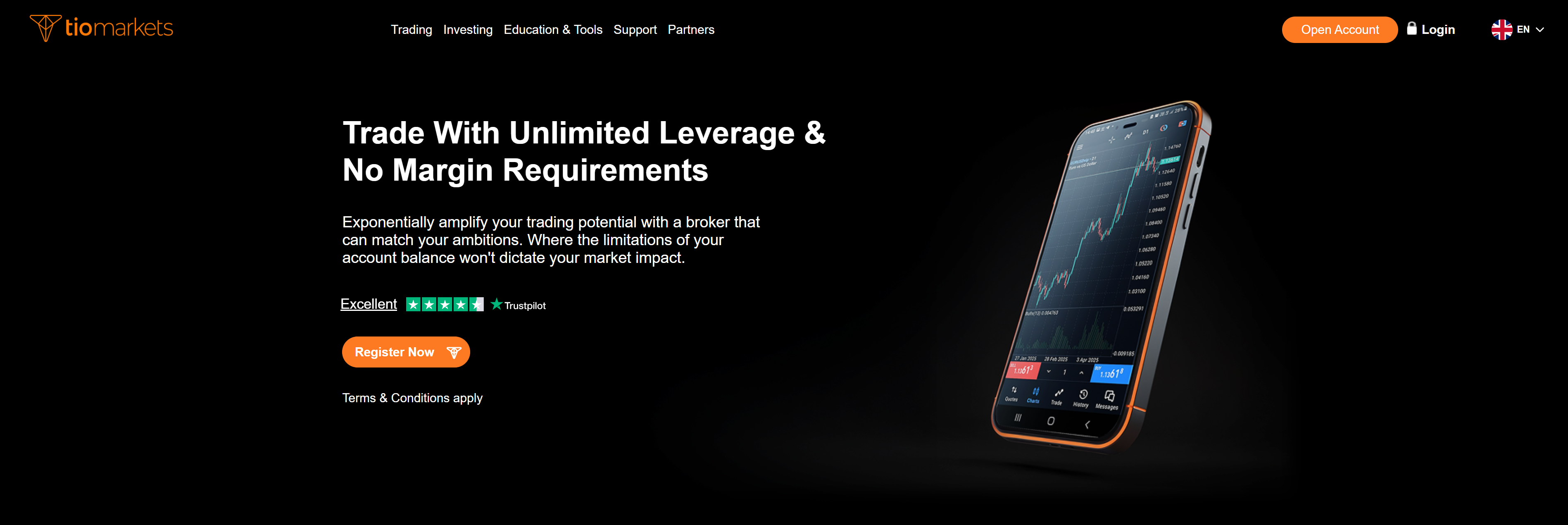
What Is High Leverage Forex Trading?
It means using a leverage ratio that allows you to control a large position with a relatively small amount of margin.
For example, if you trade with 1:100 leverage, every $1 of margin can control $100 of market exposure. With 1:500 leverage, every $1 of margin can control $500 of exposure. Some brokers may offer even higher leverage, depending on the account type, platform, jurisdiction, and trading conditions.
This does not mean the broker gives you the full value of the position as cash. Instead, leverage reduces the amount of margin required to open a trade. The real exposure is still the full trade size.
For example, if you open a $100,000 forex position with 1:100 leverage, the required margin is $1,000. If the same position is opened with 1:500 leverage, the required margin is only $200.
The trade size is the same in both cases. The difference is how much margin is required.
Leverage vs Margin: What Is the Difference?
Leverage and margin are connected, but they are not the same thing.
Leverage is the ratio that determines how much exposure you can control compared with your account balance.
Margin is the amount of money required to open and maintain a leveraged position.
TIOmarkets offers a free Margin Calculator on its website
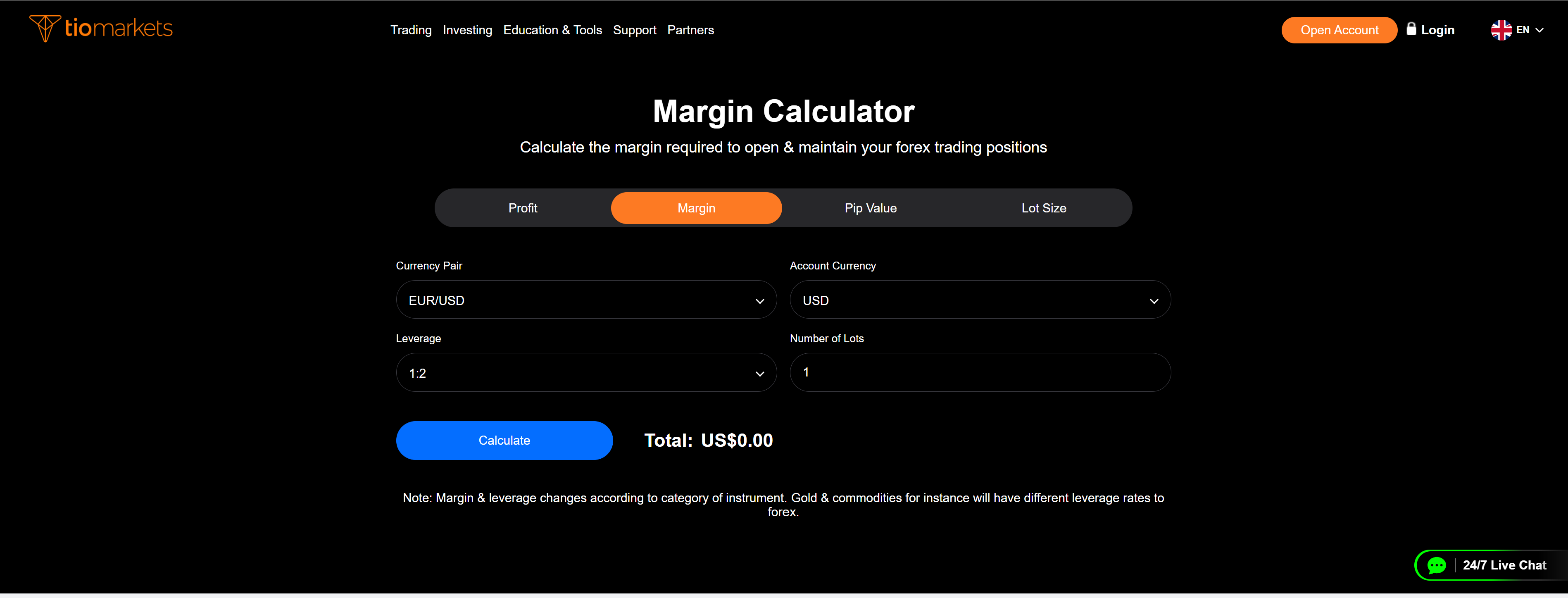
The basic formula is:
Required Margin = Position Size ÷ Leverage
Here is a simple example:
| Position Size | Leverage | Required Margin |
| $100,000 | 1:30 | $3,333.33 |
| $100,000 | 1:100 | $1,000 |
| $100,000 | 1:500 | $200 |
| $100,000 | 1:1000 | $100 |
At first, higher leverage may look attractive because it reduces the amount of money needed to open a trade. But this can be misleading. Lower margin does not mean lower risk. It usually means the trader has more ability to open larger positions, which can increase risk if position size is not controlled.
A trader using 1:500 leverage can still trade conservatively if they use small positions. A trader using lower leverage can still take too much risk if they use most of their account as margin.
The real danger is not only the leverage ratio. The real danger is using that leverage to open positions that are too large for the account.
Why Traders Use Leverage in Forex
Forex prices usually move in smaller percentage terms than many other markets. A currency pair may move by 0.5% or 1% in a day, and that can already be a meaningful move. Leverage allows traders to turn these smaller price movements into more noticeable account changes.
This is one reason leverage is common in forex trading. Without leverage, many traders would need much larger deposits to create meaningful exposure.
High leverage can also give traders more flexibility. Instead of committing a large part of their balance as margin for one trade, they may be able to keep more free margin available. This can help them manage several smaller positions, absorb normal market movement, or use capital more efficiently.
However, this only works when the trader controls position size. If high leverage is used simply to open the biggest possible trade, it becomes dangerous very quickly.
Leverage can support a strategy, but it cannot replace one. A trader still needs an entry plan, an exit plan, a stop-loss, a realistic position size, and a clear understanding of how much money is at risk.
What Counts as High Leverage?
There is no single definition of high leverage. It depends on the trader, the broker, the product, and the regulatory environment.
For some traders, 1:50 may already feel high. For others, 1:500 may be normal. In some regions, retail leverage is restricted by regulation, while in others brokers may offer much higher leverage.
A practical definition is better:
High leverage is any leverage level that allows a trader to open positions large enough that normal market movement can quickly affect account equity.
That means the same leverage ratio can be reasonable for one trader and excessive for another. A trader with a large account, small position sizes, and strict risk management may use leverage carefully. A trader with a small account and oversized positions may face serious losses even with lower leverage.
The question is not only “how much leverage is available?” The better question is “how much exposure can my account safely handle?”
High Leverage and Position Size
One of the biggest mistakes when trading with high leverage is confusing available leverage with sensible position size.
Just because a broker offers high leverage does not mean a trader should use the maximum available exposure. Leverage is the facility. Position size is the decision.
For example, two traders may both have access to 1:500 leverage. One trader risks 1% of their account on each trade. The other opens the largest position their margin allows. They technically have the same leverage, but their actual risk is completely different.
This is why position sizing matters more than the headline leverage ratio.
A trader should decide position size based on:
- Account balance
- Risk per trade
- Stop-loss distance
- Market volatility
- Number of open positions
- Correlation between trades
This approach is much safer than opening trades based only on available margin.
Example: How High Leverage Can Affect a Trade
Let’s say a trader has a $1,000 account and opens a $50,000 position on a major currency pair.
With 1:50 leverage, the required margin is:
$50,000 ÷ 50 = $1,000
This uses the full account balance as margin, leaving no real buffer for floating losses.
With 1:100 leverage, the required margin is:
$50,000 ÷ 100 = $500
The trader now has $500 of free margin.
With 1:500 leverage, the required margin is:
$50,000 ÷ 500 = $100
This looks much more flexible. But the position size is still $50,000. If the market moves against the trader, the loss is based on the $50,000 position, not the $100 margin.
If the pip value is around $5 per pip, a 50-pip move against the trade could create a loss of about $250. On a $1,000 account, that is 25% of the account.
This is the part many beginners underestimate. High leverage reduces the margin needed to open the trade. It does not reduce the risk of the trade itself.
Benefits of High Leverage Forex Trading
High leverage can have practical benefits when used with discipline.
The first benefit is capital efficiency. A trader may not need to use a large part of their balance as margin for a single trade. This can leave more free margin available, which may help the account absorb normal price movement.
The second benefit is flexibility. Traders who use short-term strategies may want to trade smaller price movements without needing a very large account balance. Leverage can make this possible, especially in forex markets where price changes are often measured in pips.
The third benefit is access. High leverage can make forex trading accessible to traders with smaller deposits. However, this benefit can become dangerous if the trader uses leverage to take positions that are too large.
The real advantage of leverage is not that it allows traders to gamble bigger. The real advantage is that it gives traders more flexibility in how they use margin and manage exposure.
Risks of High Leverage Trading
The main risk of leveraged trading is that losses are magnified. A small market movement can create a large account impact if the position is too big.
This risk becomes even greater during volatile market conditions. Economic data, central bank decisions, geopolitical events, market openings, and low-liquidity periods can all cause sharp price movements. Spreads may widen, slippage may occur, and stop-loss orders may be executed at a worse price than expected.
High leverage can also create emotional pressure. When a position is too large, every small price movement feels important. Traders may close winning trades too early, hold losing trades too long, move their stop-loss, or enter revenge trades after a loss.
Another major risk is margin pressure. If equity falls too far compared with used margin, the account may receive a margin call or reach stop out. At that point, positions may be closed automatically.
This is why high leverage must be used with strict risk control. Without that, it can cause fast and serious losses.
Margin Call and Stop Out Explained
A margin call happens when account equity falls to a level where the broker warns that the account may not have enough margin to keep positions open.
A stop out happens when equity falls further and the broker automatically closes open positions. This is usually done to prevent the account from falling below required margin levels.
The key calculation is margin level:
Margin Level = Equity ÷ Used Margin × 100
For example, if a trader has $1,000 in equity and $500 used margin, the margin level is:
$1,000 ÷ $500 × 100 = 200%
If losses reduce equity to $500 while used margin remains $500, the margin level becomes:
$500 ÷ $500 × 100 = 100%
The lower the margin level, the closer the account gets to margin call or stop out. Exact levels depend on the broker, platform, and account type.
This is why free margin is important. If a trader uses too much margin to open positions, there may be very little room for normal market movement.
High Leverage and Small Accounts
High leverage is often most attractive to traders with small accounts, but that is also where it can be most dangerous.
A small account has less room to absorb losses. If a trader with $100 opens a position where each pip is worth $5 or $10, even a small move can damage the account. The trader may be correct about the general market direction but still lose money because the position was too large.
This does not mean small accounts cannot trade forex. It means small accounts need smaller lot sizes, lower risk per trade, and more realistic expectations.
A small account should not be treated as a shortcut to fast profits. It should be treated as a place to build process, discipline, and experience. The aim should be to survive long enough to learn, not to force the account to grow through oversized leverage.
Risk Per Trade Matters More Than Leverage
One of the best ways to manage leverage is to define risk before opening a trade.
Many traders use a fixed percentage model, such as risking 1% or 2% of account equity per trade. This does not guarantee profits, but it can help prevent one bad trade from causing serious damage.
For example, if a trader has a $1,000 account and risks 1% per trade, the maximum planned loss is $10.
If the stop-loss is 20 pips away, the trader needs a position size where 20 pips equals about $10. That means each pip should be worth about $0.50.
This process starts with risk, not leverage. The trader first decides how much they are willing to lose if the trade fails. Then they calculate the position size. After that, they check the required margin.
That is a much better process than starting with “how big can I trade?”
High Leverage Forex Trading During News Events
High leverage becomes especially risky around major news events.
Forex markets can move sharply after inflation reports, employment data, central bank decisions, GDP releases, retail sales numbers, or unexpected geopolitical headlines. These events can increase volatility and reduce liquidity.
During these periods, spreads may widen and stop-loss orders may not be filled at the exact expected price. A trade that looks controlled before the event can become much riskier during the release.
Some brokers may also apply temporary leverage restrictions during major data releases or over the weekend. TIOmarkets, for example, states that its unlimited leverage conditions include specific trading restrictions, including reduced leverage around high-impact news events and over weekends.
For traders, the lesson is simple. High leverage and major news events can be a dangerous combination. If you do not fully understand the risk, reducing position size or staying out of the market may be the better decision.
Unlimited Leverage in Forex Trading
Unlimited leverage is an extreme form of high leverage. It does not mean risk disappears. It means that, under specific conditions, margin requirements may be significantly reduced compared with standard leverage structures.
TIOmarkets offers unlimited leverage on the Standard account, subject to terms and conditions. Its unlimited leverage page states that the feature is available on the Standard account and that the account has variable spreads, zero commission, leverage up to unlimited, and a minimum deposit starting from $20 or equivalent depending on currency.
TIOmarkets also states that unlimited leverage is available on the Standard account on MT5 only, and not on Raw or VIP Black accounts or MT4.
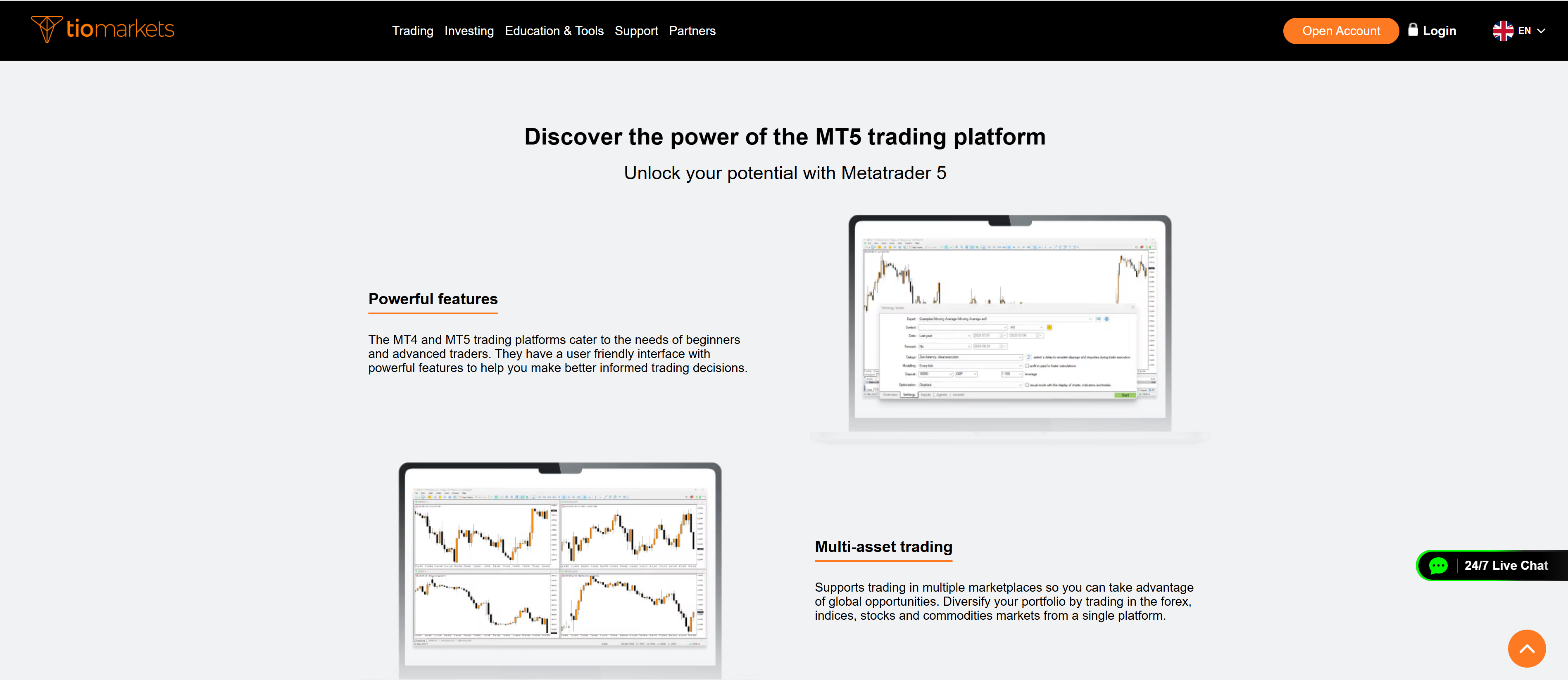
This should be presented carefully. Unlimited leverage can be a powerful trading condition, but it is not suitable for every trader. It increases exposure potential and can lead to rapid losses if position size is not controlled.
A better way to frame unlimited leverage is as flexibility for experienced traders who understand risk. It should never be positioned as an easy way to make more money.
Common Mistakes When Using High Leverage
High leverage often causes problems when traders use it without a clear plan.
One common mistake is opening the largest position available. This leaves very little room for floating losses and can cause margin pressure quickly.
Another mistake is trading without a stop-loss. Some traders avoid stop-losses because they do not want to be closed out by short-term volatility. But with high leverage, an unprotected losing trade can become difficult to manage very quickly.
A third mistake is adding to losing positions. This increases exposure at the same time the trade is already moving against the trader. Unless this is part of a tested strategy with strict risk limits, it can accelerate losses.
Overtrading is another major problem. High leverage makes it easy to open many positions at once. But if those trades are correlated, the account may be more exposed than it appears. For example, several USD-related trades may all move against the trader if the US dollar suddenly strengthens or weakens.
Finally, many traders ignore costs. Spreads, swaps, commissions, and slippage matter more when position sizes are large relative to the account.
High Leverage and Trading Costs
Trading costs are important in every strategy, but they become even more important with high leverage.
If a trader opens a larger position, the spread has a larger monetary impact. For example, if a position has a pip value of $10, a 1-pip spread costs around $10. On a $1,000 account, that is already 1% of the account before the market has moved in the trader’s favour.
Swaps can also matter if a trade is held overnight. A position that looks attractive during the day may become less attractive if it is held for several days and negative swap charges apply.
High leverage does not remove trading costs. It can make them more significant because position sizes are often larger compared with account equity.
Before opening a leveraged position, traders should understand the full cost of the trade, not just the margin requirement.
How to Use High Leverage More Responsibly
The safer way to approach high leverage forex trading is to treat leverage as flexibility, not permission to oversize.
A trader should first decide how much they are willing to risk. Then they should calculate the correct position size based on the stop-loss. Only after that should they check the required margin.
A simple process looks like this:
- Decide your maximum risk per trade.
- Choose a logical stop-loss level.
- Calculate position size based on that risk.
- Check the required margin.
- Make sure enough free margin remains.
- Avoid unnecessary exposure around major news events.
This process helps keep leverage under control. It also reduces the chance of opening a trade simply because margin is available.
Good leverage management is not about always using low leverage. It is about using position sizes that match the account, the strategy, and the risk.
Is High Leverage Good or Bad?
High leverage is neither good nor bad by itself. It depends on how it is used.
For an experienced trader with a clear strategy and strict risk management, leverage can be useful. It can provide flexibility and allow better use of available margin.
For a beginner or emotional trader, high leverage can be dangerous. It makes it easy to trade too large, lose too quickly, and make poor decisions under pressure.
The honest answer is that high leverage exposes discipline. If a trader is disciplined, leverage can be managed. If a trader is impulsive, leverage can make the damage happen faster.
That is why education, demo practice, and risk management are essential before using high leverage on a live account.
High Leverage Forex Trading with TIOmarkets
TIOmarkets provides access to forex and CFD trading through MT4 and MT5, with different account types available depending on the trader’s needs.
For traders interested in high leverage forex trading, the Standard account is the main account type linked to unlimited leverage. TIOmarkets states that unlimited leverage is available on the Standard account on MT5 only, subject to terms and conditions.
This means traders should check the account type, platform, eligible instruments, leverage conditions, and risk rules before opening positions. Not every account or instrument will have the same leverage conditions.
The key point is that high leverage should be used carefully. It can provide flexibility, but it also increases exposure. Traders should use position sizing, stop-losses, and proper risk controls before trading with real funds.
Final Thoughts
Ultimately, high leverage forex trading is not about using the highest leverage available. It is about understanding how much exposure your account can realistically handle.
High leverage forex trading can give traders more flexibility, but it also increases risk. The lower margin requirement may make a trade easier to open, but the exposure is still real. If the position is too large, even a small market movement can lead to a large loss.
The best way to use leverage is to start with risk. Decide how much you can afford to lose on a trade, calculate the correct position size, understand the margin requirement, and leave enough free margin for normal market movement.
Leverage can support a trading strategy, but it cannot replace one. Used carefully, it can be a useful tool. Used carelessly, it can quickly damage a trading account.
Ready to get started? Start your trading journey with TIOmarkets
Trading is risky. Leveraged products can result in losses. Make sure you understand how leverage, margin, and stop out levels work before trading.
FAQ
Risk disclaimer: CFDs are complex instruments and come with a high risk of losing money rapidly due to leverage. You should consider whether you understand how CFDs work and whether you can afford to take the high risk of losing your money. Never deposit more than you are prepared to lose. Professional client’s losses can exceed their deposit. Please see our risk warning policy and seek independent professional advice if you do not fully understand. This information is not directed or intended for distribution to or use by residents of certain countries/jurisdictions including, but not limited to, USA & Countries included in the OFAC sanction list. The Company holds the right to alter the aforementioned list of countries at its own discretion.
TIOmarkets offers an exclusively execution-only service. The views expressed are for information purposes only. None of the content provided constitutes any form of investment advice. The comments are made available purely for educational and marketing purposes and do NOT constitute advice or investment recommendation (and should not be considered as such) and do not in any way constitute an invitation to acquire any financial instrument or product. TIOmarkets and its affiliates and consultants are not liable for any damages that may be caused by individual comments or statements by TIOmarkets analysis and assumes no liability with respect to the completeness and correctness of the content presented. The investor is solely responsible for the risk of his/her investment decisions. The analyses and comments presented do not include any consideration of your personal investment objectives, financial circumstances, or needs. The content has not been prepared in accordance with any legal requirements for financial analysis and must, therefore, be viewed by the reader as marketing information. TIOmarkets prohibits duplication or publication without explicit approval.
Join us on social media



Authors BIO

Panagiotis is an online trading specialist with extensive experience in forex, indices, and commodities. He enjoys sharing his experience to help traders better understand global financial markets.