


Best Way to Grow a Small Trading Account
BY Panagiotis Philippou
|June 9, 2026The best way to grow a small trading account is to protect your capital first, trade small, manage risk carefully and focus on building consistent habits before trying to make large returns.
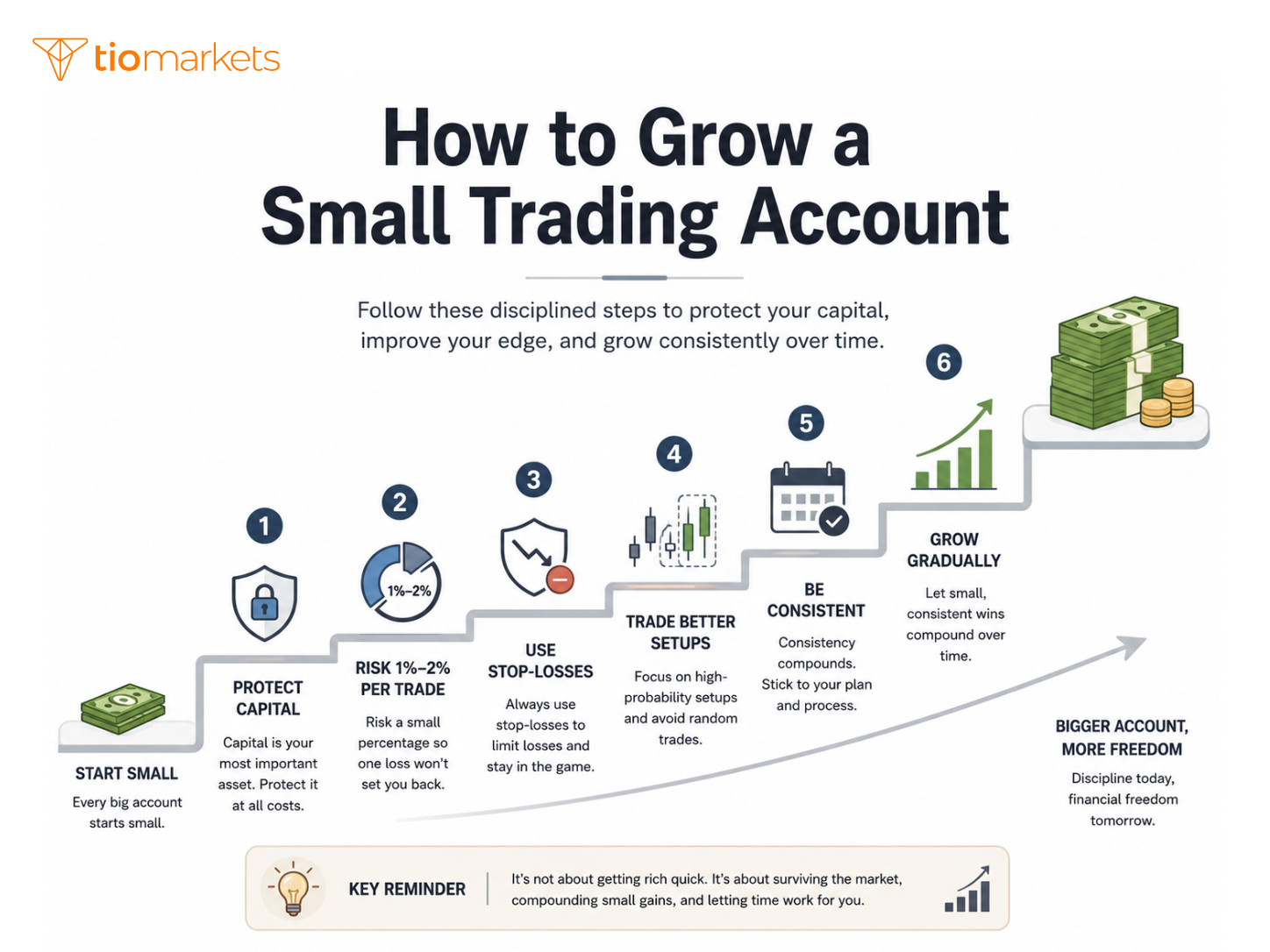
A small trading account gives you less room for error. One oversized trade, one emotional decision or one losing streak can damage the account quickly. That is why beginners should focus less on “flipping” a small account and more on learning how to trade without blowing it up.
For beginners, the simple answer is this: grow a small trading account by risking a small percentage per trade, using stop-losses, choosing liquid markets, avoiding overtrading and increasing size only after you have built consistency.
Why Small Trading Accounts Are Hard to Grow
Small trading accounts are difficult because every mistake matters more.
If your account is small, you may feel pressure to make money quickly. This can lead to larger position sizes, too much leverage and emotional trading. But taking bigger risks does not automatically make the account grow faster. It can also make losses grow faster.
Another challenge is cost. Spreads, commissions, platform costs and data fees can matter more when the account is small.
The goal at the beginning should be simple: stay in the game long enough to improve.
Start with Risk Management
Risk management is the most important part of growing a small trading account.
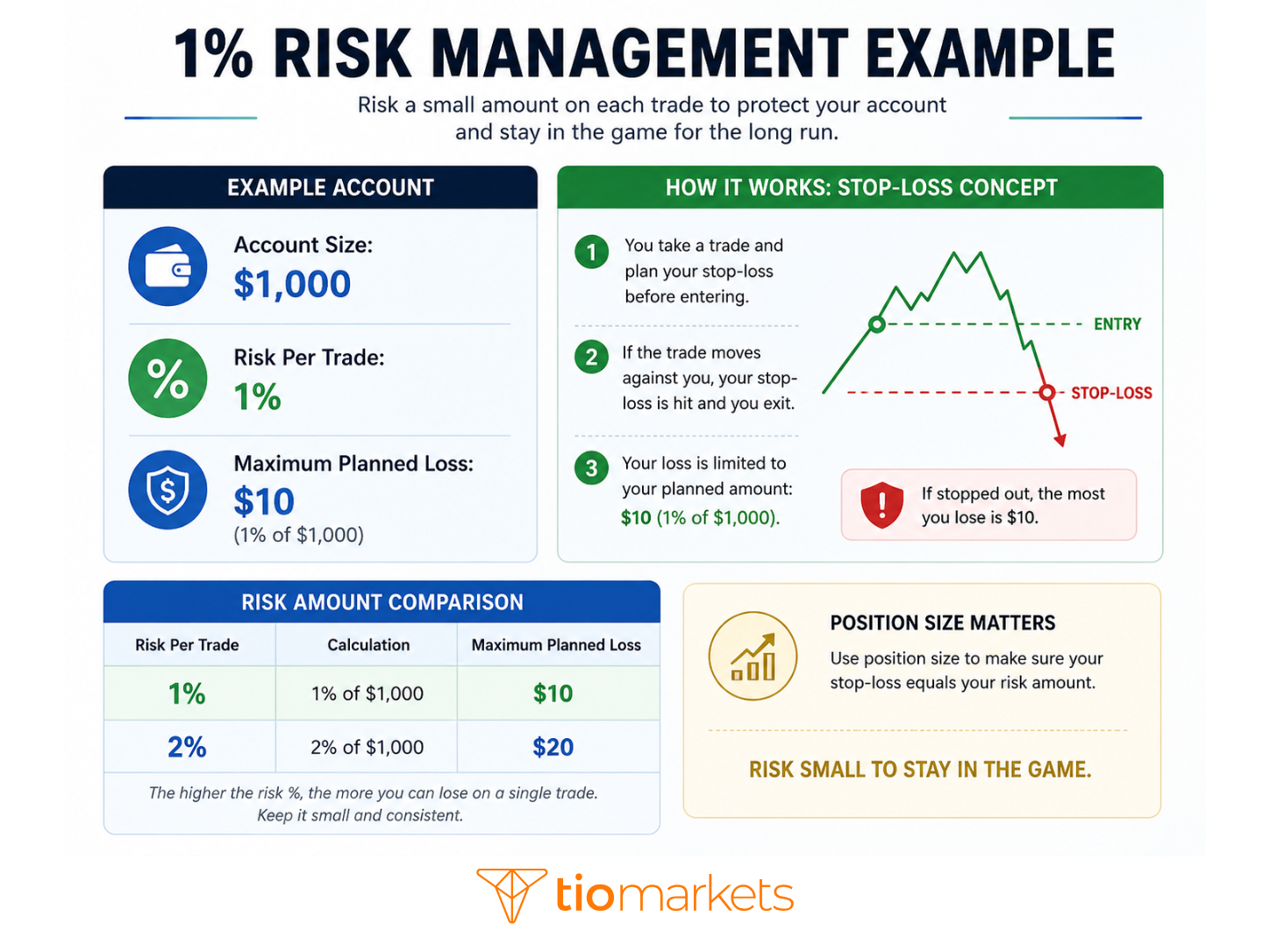
A common beginner rule is to risk only a small percentage of the account on each trade. For example, if you have a $1,000 account and risk 1% per trade, your maximum planned loss on one trade is $10.
| Account Size | 1% Risk Per Trade | 2% Risk Per Trade |
| $500 | $5 | $10 |
| $1,000 | $10 | $20 |
| $2,000 | $20 | $40 |
| $5,000 | $50 | $100 |
The exact percentage depends on the trader, strategy and market, but the idea is the same: do not risk so much that one trade can seriously damage your account.
Use Stop-Losses Before Thinking About Profit
A stop-loss is an order or level that defines where a trade should be closed if the market moves against you.
For small accounts, this matters because you cannot afford to let one losing trade become a major account loss. A stop-loss does not guarantee perfect execution, especially in fast markets, but it gives the trade a clear risk limit.
Before entering a trade, a beginner should know:
- Where the entry is
- Where the stop-loss is
- How much money is at risk
- Where the target is
- Whether the potential reward is worth the risk
If you cannot define the risk, the trade is probably not ready.
Focus on Risk-to-Reward
Risk-to-reward compares how much you are risking with how much you are trying to make.
For example, if you risk $10 to try to make $20, the trade has a 1:2 risk-to-reward ratio.
| Risk | Target | Risk-to-Reward |
| $10 | $10 | 1:1 |
| $10 | $20 | 1:2 |
| $10 | $30 | 1:3 |
A good risk-to-reward ratio does not guarantee success. But it helps prevent a situation where you need many winning trades just to recover from one loss.
Choose Markets That Fit a Small Account
The best market for a small account is not always the market with the biggest moves. It is usually the market where you can control position size, manage costs and avoid taking too much risk.
Beginners should look for:
- Liquid markets
- Reasonable spreads
- Flexible position sizes
- Clear trading hours
- Products they understand
- Costs that do not overwhelm the account
Forex and CFD trading may allow smaller position sizes, but leverage must be used carefully. High leverage can make it possible to open larger positions with less capital, but it can also magnify losses.
The priority is not to find the most exciting market. The priority is to find a market where your risk can be controlled.
Trade Fewer, Better Setups
A small account does not need many trades. In fact, overtrading is one of the fastest ways to damage it.
A beginner should avoid entering trades just because the market is moving. Instead, focus on setups that are clear and repeatable.
A better setup usually has:
- A clear reason for entry
- A defined stop-loss
- A realistic target
- Acceptable risk-to-reward
- Enough liquidity
- No major news risk that you are ignoring
Build a Simple Trading Routine
A small trading account grows best when the trader follows a process.
A simple routine could look like this:
- Check major market news.
- Mark important support and resistance levels.
- Choose the markets you want to watch.
- Wait for a clear setup.
- Calculate position size before entering.
- Place the trade only if the risk makes sense.
- Record the trade in a journal.
The routine matters because it reduces emotional decisions. If every trade is random, it becomes difficult to know what is working and what needs to improve.
Keep a Trading Journal
A trading journal helps you track your decisions.
You do not need anything complicated. A simple spreadsheet can include:
| Item to Track | Why It Matters |
| Market traded | Shows where you perform best |
| Entry and exit | Helps review timing |
| Stop-loss and target | Shows if risk was planned |
| Risk per trade | Helps control account exposure |
| Reason for trade | Shows whether you followed a setup |
| Result | Helps measure performance |
| Notes | Helps identify emotional mistakes |
After 20, 50 or 100 trades, the journal can show patterns. You may discover that you trade better at certain times, on certain markets or with certain setups.
Avoid Trying to Flip the Account Quickly
Many beginners search for the best way to grow a small trading account because they want fast results. That is understandable, but it is also dangerous.
Trying to double or triple a small account quickly usually means taking oversized risks. Even if it works once, it can create bad habits. The same behaviour that grows the account quickly can also destroy it quickly.
The better goal is to build skill, protect capital and increase size gradually.
Example: Growing a Small Account Safely
Imagine a beginner has a $1,000 trading account.
Instead of risking $100 on one trade, they decide to risk 1%, or $10, per trade.
They look for trades where the possible reward is at least twice the risk. That means if they risk $10, they aim for a reasonable target of around $20 or more.
If they lose, the account is still mostly intact. If they win, they grow slowly. Over time, the goal is to build a record of disciplined trades rather than rely on one lucky trade.
This approach may feel slow, but it helps beginners survive long enough to improve.
Common Mistakes When Growing a Small Trading Account
Risking too much per trade
A small account can be damaged quickly if each trade risks too much capital.
Using too much leverage
Leverage can increase exposure, but it can also magnify losses. Beginners should be especially careful with position size.
Overtrading
More trades do not always mean more growth. Poor-quality trades can drain the account through losses, spreads and emotional mistakes.
Ignoring costs
Spreads, commissions and overnight fees can matter more when the account is small.
Moving the stop-loss
Moving a stop-loss further away because you “hope” the trade will recover can turn a small planned loss into a large unplanned loss.
Expecting fast results
Small account growth takes time. Unrealistic expectations often lead to emotional trading.
Small Account Trading Checklist
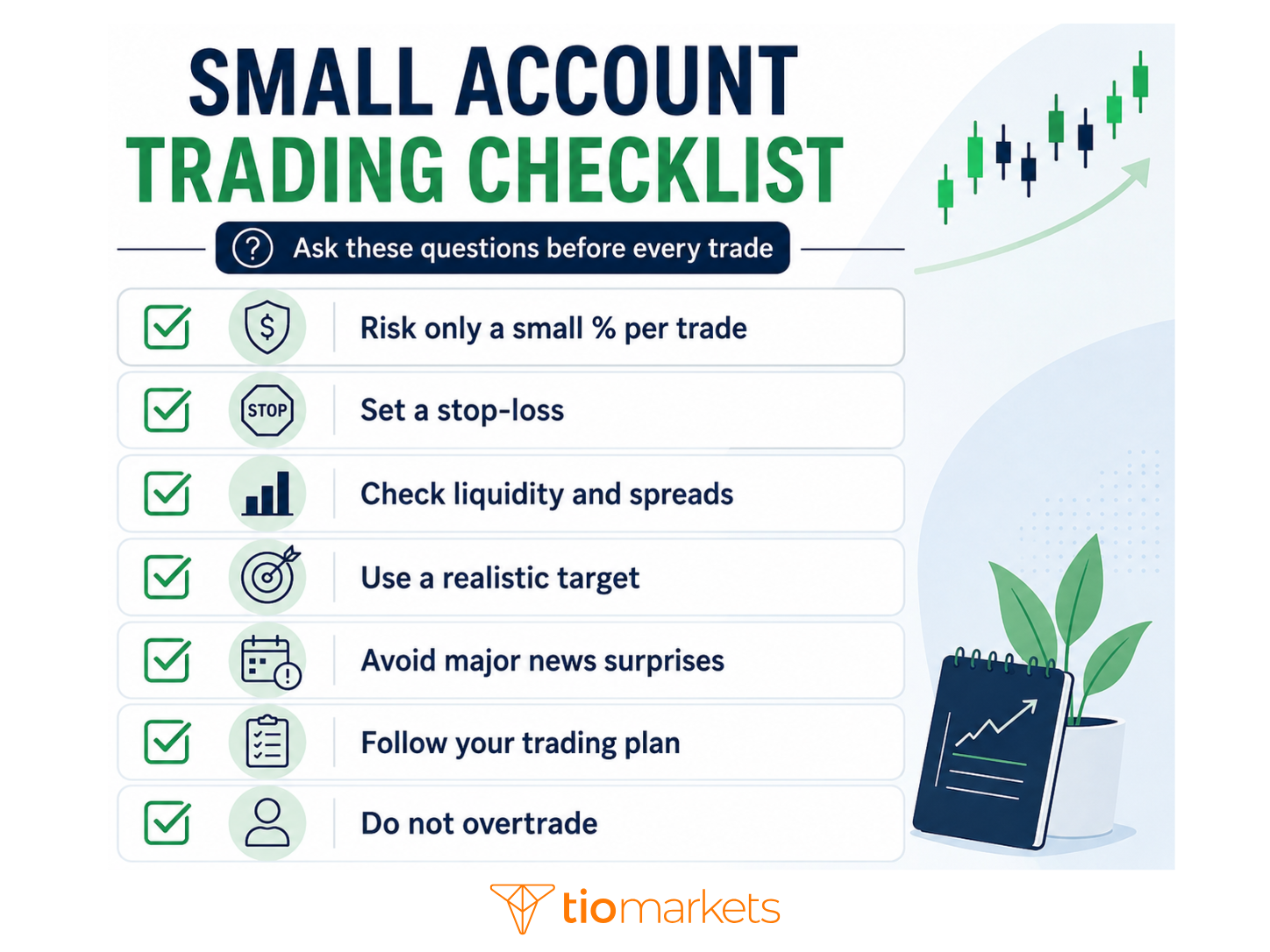
Before placing a trade, ask:
| Question | Why It Matters |
| Am I risking only a small percentage of the account? | Protects capital |
| Do I know where my stop-loss is? | Defines the risk |
| Is the market liquid enough? | Helps reduce spread and execution issues |
| Is the risk-to-reward reasonable? | Helps avoid poor setups |
| Am I following my trading plan? | Reduces emotional decisions |
| Is there major news coming? | Helps avoid unexpected volatility |
| Will this trade damage my account if it loses? | Keeps risk realistic |
If the answer to the final question is yes, the trade is probably too large.
Final Thoughts
The best way to grow a small trading account is not to chase fast profits. It is to protect your capital, manage risk, trade better setups and build discipline.
A small account can grow, but it usually grows through patience and consistency rather than aggressive risk-taking. Beginners should focus on learning the process, limiting losses and avoiding the mistakes that cause accounts to fail.
The key idea is simple: survive first, grow second. Ready to put what you learned to practise? Open your TIOmarket trading account now
Trading is risky. Losses can occur, and no strategy can guarantee account growth.

FAQ
Risk disclaimer: CFDs are complex instruments and come with a high risk of losing money rapidly due to leverage. You should consider whether you understand how CFDs work and whether you can afford to take the high risk of losing your money. Never deposit more than you are prepared to lose. Professional client’s losses can exceed their deposit. Please see our risk warning policy and seek independent professional advice if you do not fully understand. This information is not directed or intended for distribution to or use by residents of certain countries/jurisdictions including, but not limited to, USA & Countries included in the OFAC sanction list. The Company holds the right to alter the aforementioned list of countries at its own discretion.
TIOmarkets offers an exclusively execution-only service. The views expressed are for information purposes only. None of the content provided constitutes any form of investment advice. The comments are made available purely for educational and marketing purposes and do NOT constitute advice or investment recommendation (and should not be considered as such) and do not in any way constitute an invitation to acquire any financial instrument or product. TIOmarkets and its affiliates and consultants are not liable for any damages that may be caused by individual comments or statements by TIOmarkets analysis and assumes no liability with respect to the completeness and correctness of the content presented. The investor is solely responsible for the risk of his/her investment decisions. The analyses and comments presented do not include any consideration of your personal investment objectives, financial circumstances, or needs. The content has not been prepared in accordance with any legal requirements for financial analysis and must, therefore, be viewed by the reader as marketing information. TIOmarkets prohibits duplication or publication without explicit approval.
Join us on social media



Authors BIO

Panagiotis is an online trading specialist with extensive experience in forex, indices, and commodities. He enjoys sharing his experience to help traders better understand global financial markets.