


Traits of Successful Traders
BY Panagiotis Philippou
|June 16, 2026Quick Answer: What Are the Traits of Successful Traders?
The most important traits of successful traders are discipline, strict risk management, patience, emotional control, adaptability, consistency and the ability to learn from mistakes.
Successful traders do not rely on luck, emotion or random trade ideas. They usually follow a defined trading plan, manage their risk carefully, accept losses as part of the process and review their performance over time.
No trait can guarantee trading success. However, these habits can help traders make more objective decisions and avoid common mistakes such as overtrading, revenge trading, chasing the market or risking too much on one position.
What Makes a Trader Successful?
A successful trader is not simply someone who wins one big trade. Trading success is usually built through consistency, risk control and better decision-making over many trades.
Markets are uncertain, so even strong setups can fail. This is why successful traders focus less on being right every time and more on following a process that protects their capital when they are wrong.
That process usually includes knowing when to enter, when to exit, how much to risk and when to stay out of the market completely. It also includes reviewing past trades and adapting when market conditions change.
In other words, successful trading is not only about predicting price direction. It is about managing decisions before, during and after each trade.
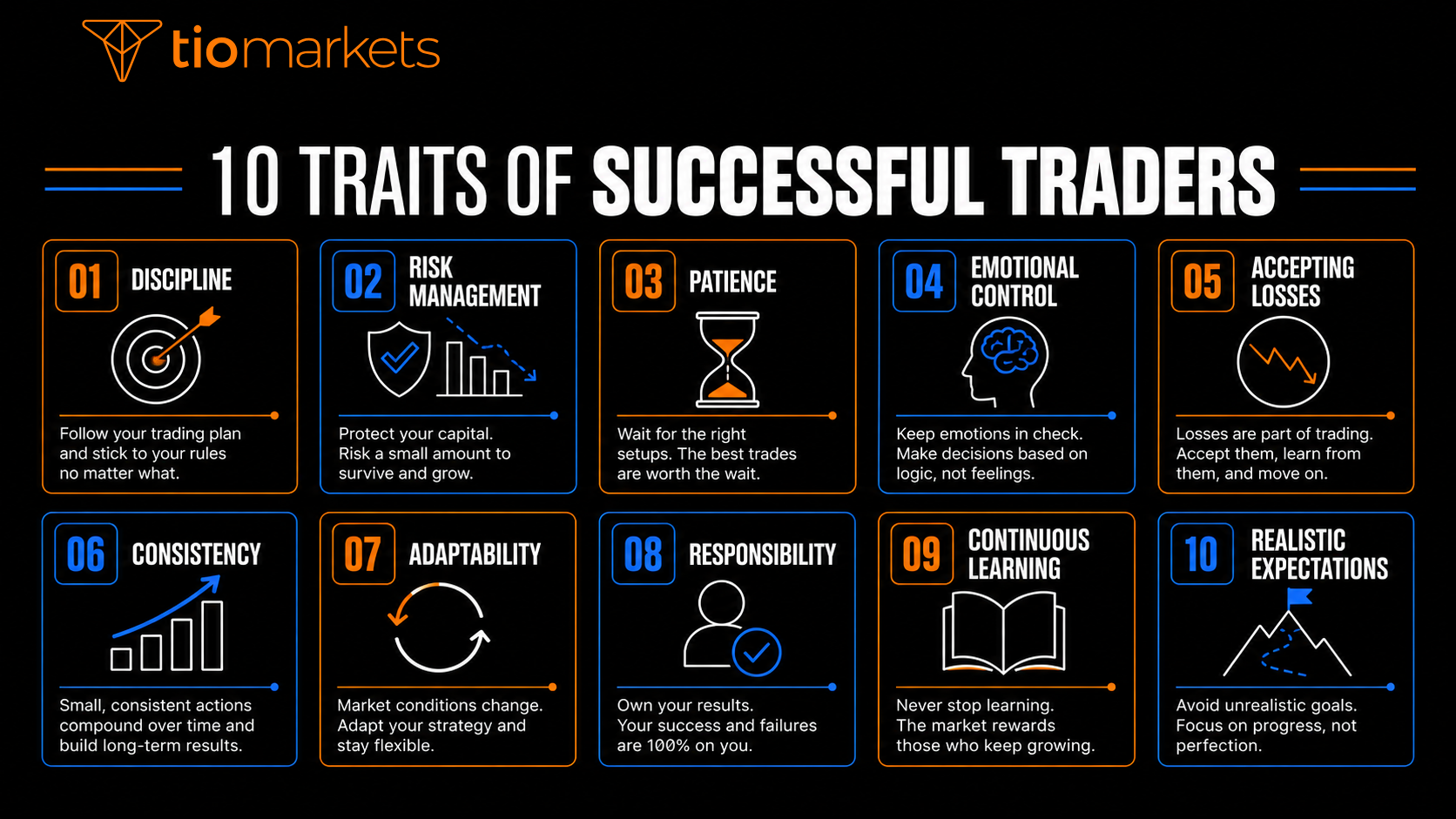
10 Key Traits of Successful Traders
1. Discipline
Discipline is one of the most important traits of successful traders.
A disciplined trader follows a plan instead of reacting emotionally to every price movement. They know what kind of setup they are looking for before entering a trade, and they avoid opening positions just because the market is moving.
This matters because many trading mistakes come from impulse. A trader may chase price after a strong move, move a stop-loss because they do not want to accept a loss, or increase their position size after a losing trade. Discipline helps reduce these emotional decisions.
A trading plan is only useful if the trader has the discipline to follow it.
2. Strong Risk Management
Successful traders usually understand that protecting capital is more important than being right on every trade.
Risk management means deciding how much capital to risk before opening a position. It also means understanding what could go wrong before thinking about what could go right.
This may include using a stop-loss, controlling position size, avoiding excessive leverage and checking whether the potential reward justifies the risk. These are not just technical details. They are part of the trader’s survival plan.
A trader can have several winning trades and still lose money if one large loss wipes out previous gains. This is why risk management is usually one of the biggest differences between consistent traders and emotional traders.
3. Patience
Patience helps traders wait for better opportunities instead of forcing trades.
Markets move constantly, but not every move is worth trading. A patient trader understands that staying out of the market can sometimes be the best decision. They wait for conditions that match their strategy instead of entering because they are bored, frustrated or afraid of missing out.
Patience is not about being slow. It is about waiting until there is a valid reason to act.
4. Emotional Control
Trading can trigger strong emotions because money is directly involved.
Fear can make a trader close a position too early. Greed can make them risk too much. Hope can make them hold a losing trade for too long. Frustration can lead to revenge trading after a loss.
Successful traders do not remove emotions completely. That is unrealistic. Instead, they try to stop emotions from controlling their decisions.
This is why rules, routines and risk limits matter. They give the trader structure when emotions are high.
5. Ability to Accept Losses
Losses are part of trading.
Successful traders understand that a losing trade does not automatically mean they made a bad decision. A trade can follow the plan and still lose because markets are uncertain.
The key is to separate the outcome from the process. A planned trade that loses within the defined risk may still be acceptable. A random trade that wins because of luck may still be a bad decision.
This mindset helps traders avoid taking losses personally. Instead of trying to be right all the time, they focus on making good decisions repeatedly.
6. Consistency
Consistency means applying the same process over time.
A consistent trader does not change strategy after every loss or jump from one method to another every few days. They give their approach enough time and data before judging whether it works.
This applies to trade selection, position sizing, entries, exits, journaling and review routines. Without consistency, it becomes difficult to know whether a trader is improving or simply reacting randomly to short-term results.
7. Adaptability
Markets change, and traders need to recognise when conditions are different.
A strategy that works well in a trending market may struggle in a sideways market. A setup that performs well during calm conditions may become riskier when volatility increases.
Adaptability does not mean changing strategy every day. It means understanding when the market environment has changed enough to require caution. Sometimes that means reducing position size. Sometimes it means waiting. Sometimes it means accepting that a setup is no longer as strong as it looked at first.
Successful traders do not try to force the market to fit their opinion. They adjust their behaviour to the conditions in front of them.
8. Personal Responsibility
Successful traders take responsibility for their decisions.
They do not blame every loss on bad luck, the broker, the market or other traders. Unexpected events can happen, but the trader is still responsible for their risk, position size, entry, exit and preparation.
Personal responsibility matters because it shifts the focus from blame to improvement. Instead of asking why the market moved against them, a trader can ask whether they followed their plan, managed risk properly and made a decision they would be willing to repeat.
Traders cannot control the market. They can only control their process.
9. Continuous Learning
Successful traders usually keep learning.
This does not only mean reading more articles or watching more market commentary. It also means learning from personal trading data.
A trader who reviews their trades may notice patterns that are not obvious in real time. For example, they may perform better during certain market sessions, make more mistakes after a losing trade, or lose money when they enter without confirmation.
This is where a trading journal can help. It turns trading from a series of emotional decisions into something that can be reviewed and improved.
10. Realistic Expectations
Successful traders tend to have more realistic expectations than beginners.
They understand that trading is not a shortcut to easy money. Markets can be unpredictable, and even experienced traders face losing streaks.
Unrealistic expectations can lead to oversized positions, overleveraging, impatience and frustration. A trader who expects fast results may abandon a strategy too early or take unnecessary risks to recover losses.
A realistic trader understands that progress usually comes from building skill, discipline and experience over time.
Successful Traders vs Struggling Traders
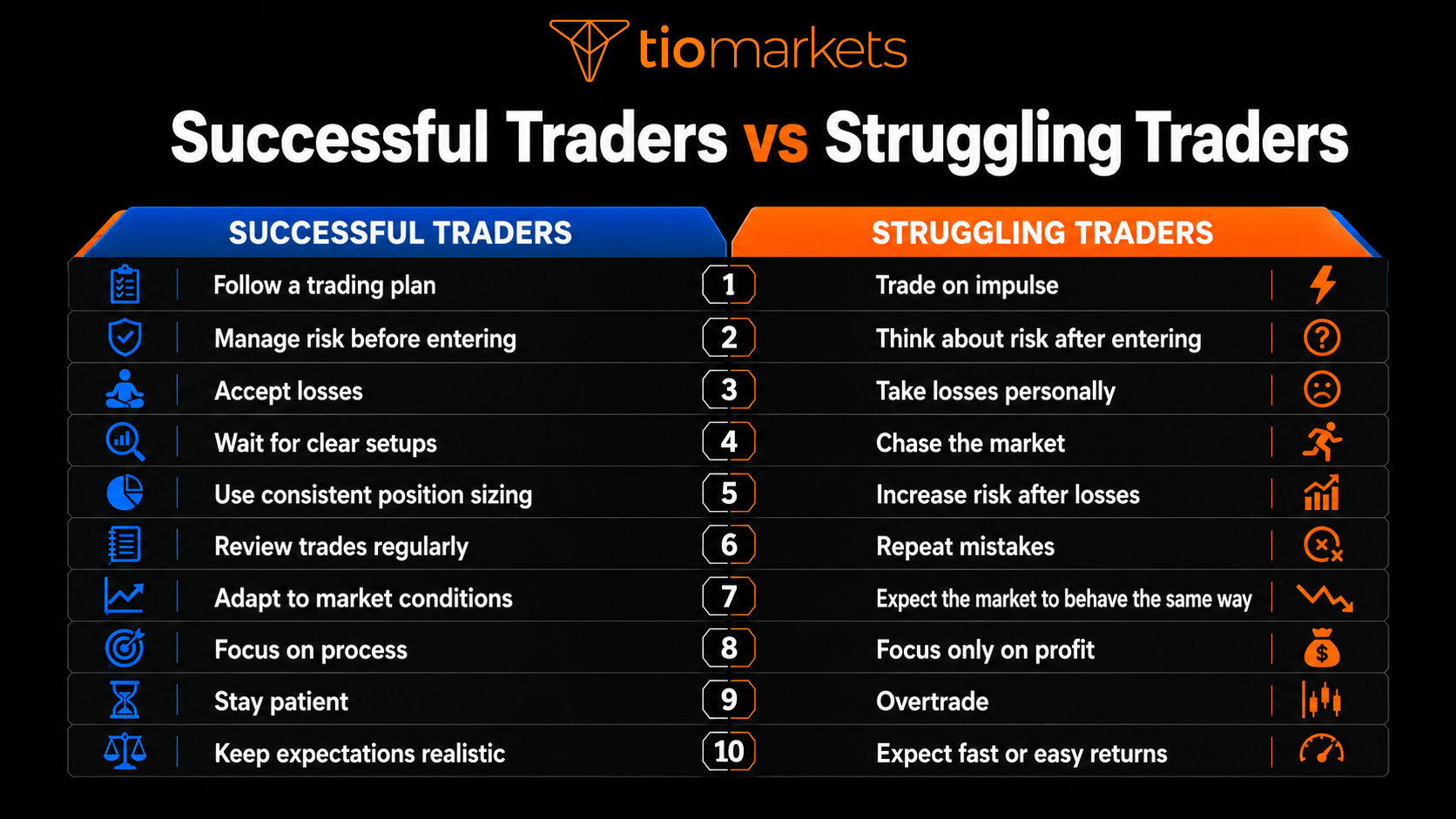
| Successful Traders | Struggling Traders |
| Follow a trading plan | Trade based on emotion or impulse |
| Manage risk before entering | Think about risk after the trade goes wrong |
| Accept losses as part of trading | Take losses personally |
| Wait for clear setups | Chase the market |
| Use consistent position sizing | Increase risk after losses |
| Review trades regularly | Repeat the same mistakes |
| Adapt to market conditions | Expect the market to behave the same way every time |
| Focus on process | Focus only on profit |
| Stay patient | Overtrade |
| Keep expectations realistic | Expect fast or easy returns |
Why Risk Management Matters More Than Being Right
Many beginners believe successful trading is mostly about predicting the market correctly.
In reality, being right is only one part of trading. A trader also needs to manage how much they lose when they are wrong and how much they can potentially gain when they are right.
For example, a trader may win often but still struggle if their losing trades are much larger than their winning trades. Another trader may win less often but perform better because losses are controlled and stronger trades are allowed to develop.
This is why risk-to-reward, stop-loss discipline and position sizing are so important.
The goal is not to avoid losses completely. The goal is to keep losses controlled enough that one bad trade does not heavily damage the account.
The Role of a Trading Plan
A trading plan gives structure to decision-making.
It defines what the trader is looking for, how much they are willing to risk and what conditions need to be present before they enter a trade. It can also define when the trader should stay out of the market.
The plan does not need to be complicated. In fact, a simple plan is often easier to follow. What matters is that the trader has clear rules and reviews whether they are following them.
Without a plan, every market movement can feel like a decision that needs to be made in the moment. That is where emotion usually takes over.
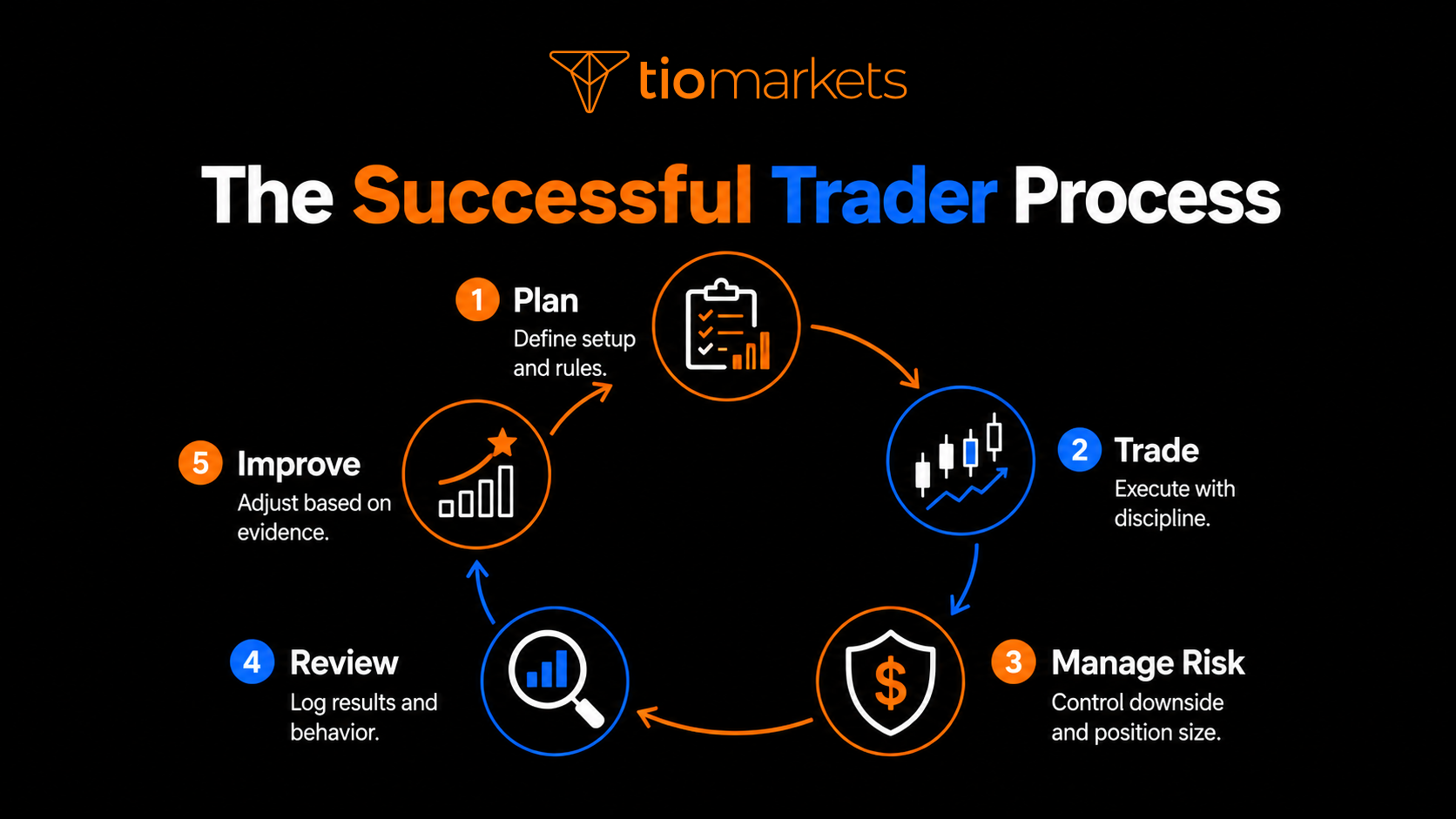
The Role of a Trading Journal
A trading journal helps traders identify patterns in their behaviour.
It can include the reason for each trade, the entry and exit, the result, the emotional state of the trader and any lesson learned. Over time, this record can show whether the trader is following their plan or repeating the same mistakes.
A journal may reveal that a trader performs better when they wait for confirmation, avoids trading during major news events, or uses smaller position sizes. It may also show that most mistakes happen after a loss, during boredom, or when the trader tries to force a setup.
This kind of review is uncomfortable, but useful. It gives traders evidence instead of relying on memory or emotion.
Common Mistakes Successful Traders Try to Avoid
Even experienced traders make mistakes. The difference is that successful traders usually try to recognise and correct them.
Some of the most common mistakes include trading without a plan, risking too much, moving stop-losses, revenge trading, overtrading, chasing price after a strong move and using too much leverage.
These mistakes usually come from emotion, poor preparation or unrealistic expectations. Avoiding them does not guarantee success, but it can reduce unnecessary losses and help traders make more consistent decisions.
Can Anyone Become a Successful Trader?
Not everyone will become a successful trader, and it is important to be honest about that.
Trading requires time, emotional control, risk awareness and the ability to handle uncertainty. Some people enjoy that challenge, while others may find it stressful or unsuitable.
However, many of the traits that support better trading decisions can be developed. Discipline, patience, risk control and emotional awareness can improve with practice and review.
The key is to treat trading as a skill-building process, not as a quick way to make money.
Final Thoughts
The most important traits of successful traders are discipline, risk management, patience, emotional control, adaptability and consistency.
Successful traders do not need to win every trade. They need a process that helps them manage losses, protect capital and make decisions based on rules rather than emotion.
The biggest difference between successful and struggling traders is often not intelligence or market knowledge. It is behaviour.
A trader with a simple strategy, strong risk management and emotional discipline may be in a better position than someone with a complex strategy but no control over risk or decision-making. Ready to put what you learned to practise? Open your trading account with TIOmarkets and start your trading journey
FAQ
Risk disclaimer: CFDs are complex instruments and come with a high risk of losing money rapidly due to leverage. You should consider whether you understand how CFDs work and whether you can afford to take the high risk of losing your money. Never deposit more than you are prepared to lose. Professional client’s losses can exceed their deposit. Please see our risk warning policy and seek independent professional advice if you do not fully understand. This information is not directed or intended for distribution to or use by residents of certain countries/jurisdictions including, but not limited to, USA & Countries included in the OFAC sanction list. The Company holds the right to alter the aforementioned list of countries at its own discretion.
TIOmarkets offers an exclusively execution-only service. The views expressed are for information purposes only. None of the content provided constitutes any form of investment advice. The comments are made available purely for educational and marketing purposes and do NOT constitute advice or investment recommendation (and should not be considered as such) and do not in any way constitute an invitation to acquire any financial instrument or product. TIOmarkets and its affiliates and consultants are not liable for any damages that may be caused by individual comments or statements by TIOmarkets analysis and assumes no liability with respect to the completeness and correctness of the content presented. The investor is solely responsible for the risk of his/her investment decisions. The analyses and comments presented do not include any consideration of your personal investment objectives, financial circumstances, or needs. The content has not been prepared in accordance with any legal requirements for financial analysis and must, therefore, be viewed by the reader as marketing information. TIOmarkets prohibits duplication or publication without explicit approval.
Join us on social media



Authors BIO

Panagiotis is an online trading specialist with extensive experience in forex, indices, and commodities. He enjoys sharing his experience to help traders better understand global financial markets.