Types of Financial Markets Explained for Beginners
BY Panagiotis Philippou
|June 15, 2026Quick Answer: What Are the Types of Financial Markets?
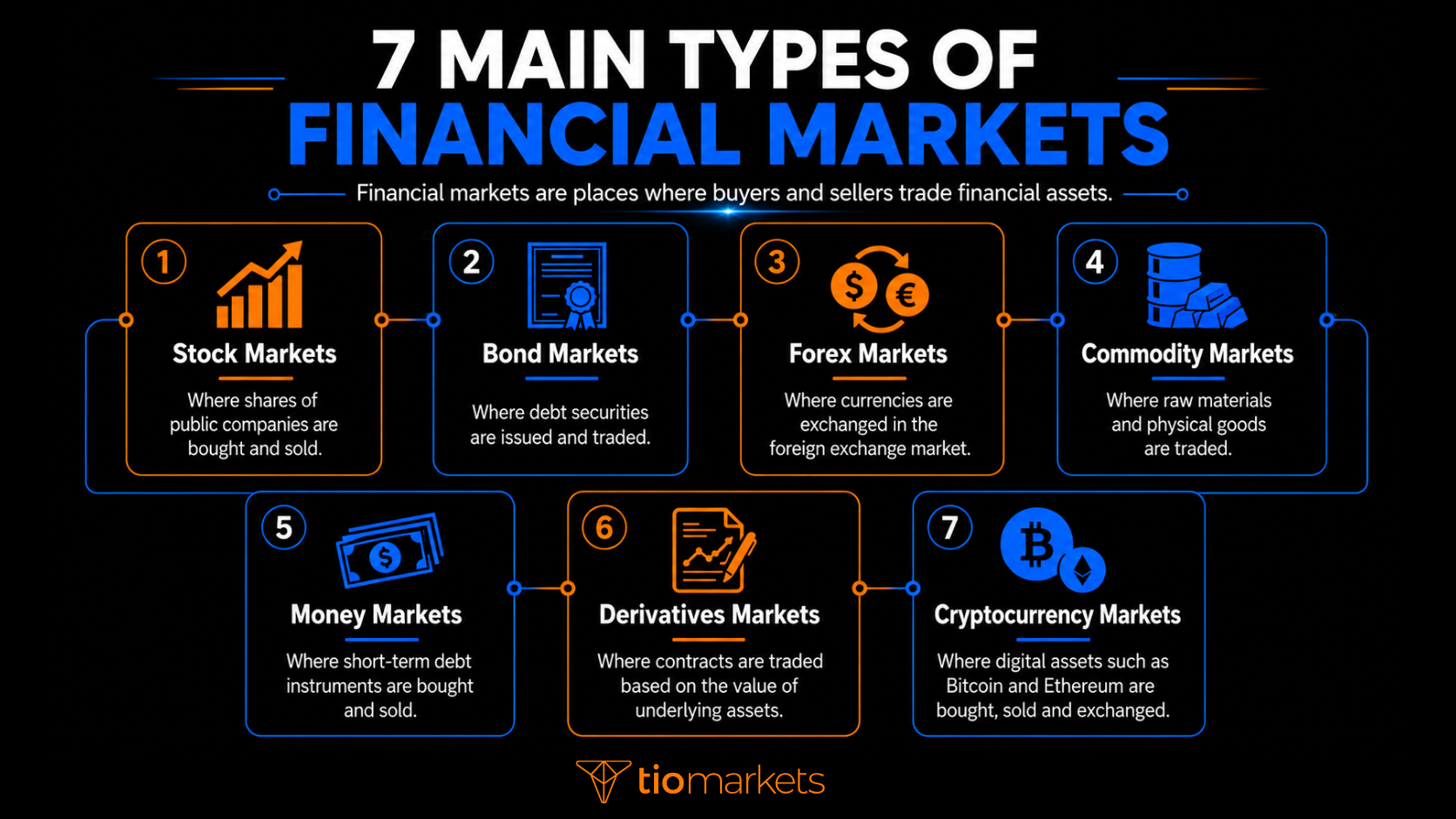
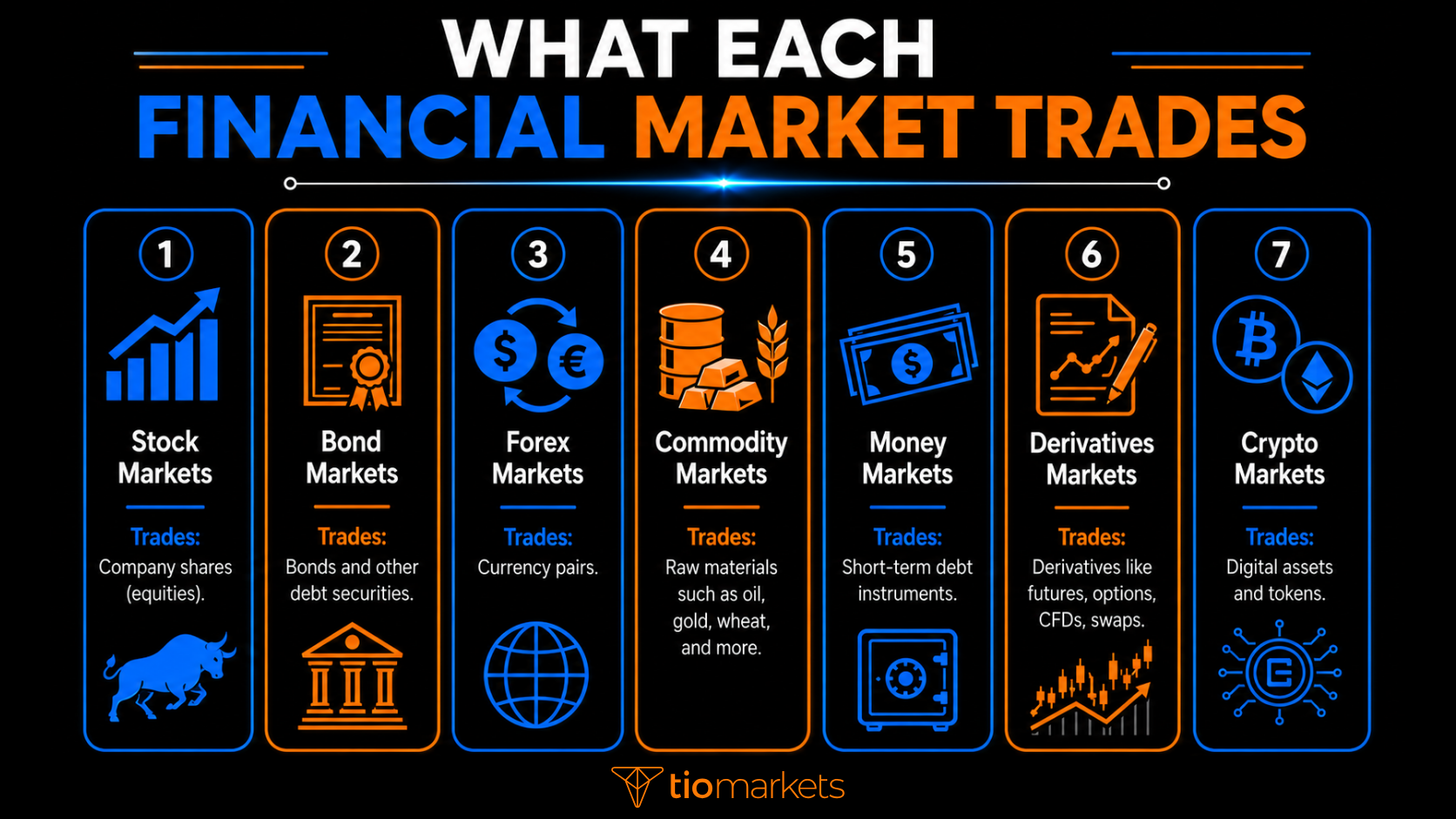
The main types of financial markets are stock markets, bond markets, forex markets, commodity markets, money markets, derivatives markets and cryptocurrency markets.
Each market has a different purpose. Some help companies raise money. Some help governments borrow funds. Others allow traders and investors to speculate on price movements, exchange currencies, hedge risk or access short-term funding.
In simple term, financial markets are places where buyers and sellers trade financial assets.
What Are Financial Markets?
Financial markets are systems where people, companies, banks, governments and investors buy and sell financial instruments.
These instruments can include:
- shares
- bonds
- currencies
- commodities
- derivatives
- cryptocurrencies
- short-term debt instruments
Financial markets can operate through formal exchanges, such as stock exchanges, or through decentralised networks where trades happen electronically between participants.
Their main role is to connect those who need capital with those who have capital to invest. They also help create liquidity, price assets and support economic activity.
Why Are Financial Markets Important?
Financial markets are important because they help money move through the economy.
They allow:
- companies to raise capital
- governments to borrow funds
- investors to seek returns
- traders to speculate on price movements
- businesses to manage currency, commodity or interest-rate risk
- buyers and sellers to exchange assets more efficiently
Without financial markets, it would be much harder for businesses to grow, governments to finance projects, or investors to access different opportunities.
The 7 Main Types of Financial Markets
1. Stock Markets
Stock markets are where shares of publicly listed companies are bought and sold.
When someone buys a share, they are buying partial ownership in a company. If the company performs well, the value of its shares may rise. Some companies may also pay dividends to shareholders.
Companies use stock markets to raise capital, while investors use them to participate in potential company growth.
Examples of stock markets
- New York Stock Exchange
- Nasdaq
- London Stock Exchange
- Euronext
Simple example
If a company lists its shares on an exchange, investors can buy and sell those shares during market hours. The share price moves based on supply and demand, company performance, investor sentiment and wider market conditions.
2. Bond Markets
Bond markets are where debt securities are issued and traded.
A bond is essentially a loan. Investors lend money to a government, company or institution. In return, the bond issuer usually agrees to pay interest and repay the original amount at a future date.
Bond markets are also known as debt markets or fixed-income markets.
Common bond issuers
- governments
- municipalities
- corporations
- financial institutions
Simple example
A government may issue bonds to fund public spending. Investors buy those bonds and receive interest payments over time.
Bond prices can move due to interest rates, inflation expectations, credit risk and economic conditions.
3. Forex Markets
The forex market is where currencies are exchanged.
Forex stands for foreign exchange. It is the market where currency pairs such as EUR/USD, GBP/USD or USD/JPY are traded.
This market is used by banks, businesses, governments, investors and traders. Businesses may use forex markets to exchange currencies for international trade, while traders may speculate on currency price movements.
Key features of forex markets
- highly liquid
- global
- decentralised
- active 24 hours a day, five days a week
- influenced by interest rates, inflation, central banks and economic data
Simple example
If a trader believes the euro may strengthen against the US dollar, they may buy EUR/USD. If the euro rises compared to the dollar, the value of that trade may increase.
4. Commodity Markets
Commodity markets are where raw materials and physical goods are traded.
These markets include products such as gold, silver, oil, natural gas, wheat, coffee and sugar.
Commodity markets are important because they influence the prices of everyday goods, energy costs, production costs and inflation.
Main types of commodities
| Commodity Type | Examples |
| Metals | Gold, silver, copper, platinum |
| Energy | Oil, natural gas |
| Agriculture | Wheat, corn, coffee, sugar |
| Livestock | Cattle, hogs |
Simple example
Oil prices may rise if supply is disrupted or demand increases. This can affect fuel prices, transport costs and inflation.
Traders can access commodities through futures, options, CFDs or other derivative products, depending on the platform and jurisdiction.
5. Money Markets
Money markets deal with short-term borrowing and lending.
These markets usually involve instruments with short maturities, often less than one year. They are commonly used by banks, governments, corporations and large institutions to manage short-term funding needs.
Examples of money market instruments
- Treasury bills
- certificates of deposit
- commercial paper
- short-term government debt
Simple example
A government may issue short-term Treasury bills to raise funds. Investors buy them and receive repayment after a short period, usually with a small return.
Money markets are generally considered lower risk than many other financial markets, but returns are usually lower too.
6. Derivatives Markets
Derivatives markets are where contracts are traded based on the value of an underlying asset.
A derivative does not have value on its own. Its value comes from something else, such as a stock, currency pair, commodity, index or interest rate.
Common types of derivatives
- futures
- options
- forwards
- swaps
- CFDs
Derivatives can be used for speculation, hedging or risk management.
Simple example
An airline may use oil derivatives to manage the risk of rising fuel prices. A trader may use a gold CFD or futures contract to speculate on the price of gold without owning physical gold.
Derivatives can be complex and may involve leverage, which increases both potential gains and potential losses.
7. Cryptocurrency Markets
Cryptocurrency markets are where digital assets are bought, sold and exchanged.
These markets include cryptocurrencies such as Bitcoin, Ethereum and other digital tokens.
Crypto markets can operate through centralised exchanges, decentralised exchanges or peer-to-peer networks. They are known for high volatility and can move sharply in short periods.
Simple example
A trader may buy Bitcoin if they expect its price to rise. If demand increases, the price may move higher. If sentiment turns negative, the price may fall quickly.
Crypto markets can offer opportunity, but they also carry significant risk due to volatility, regulation, security concerns and market sentiment.
Other Ways to Classify Financial Markets
The seven categories above are the most common way to explain financial markets. However, markets can also be grouped by how they operate, when assets are issued, or how long the instruments last.
Primary vs Secondary Markets
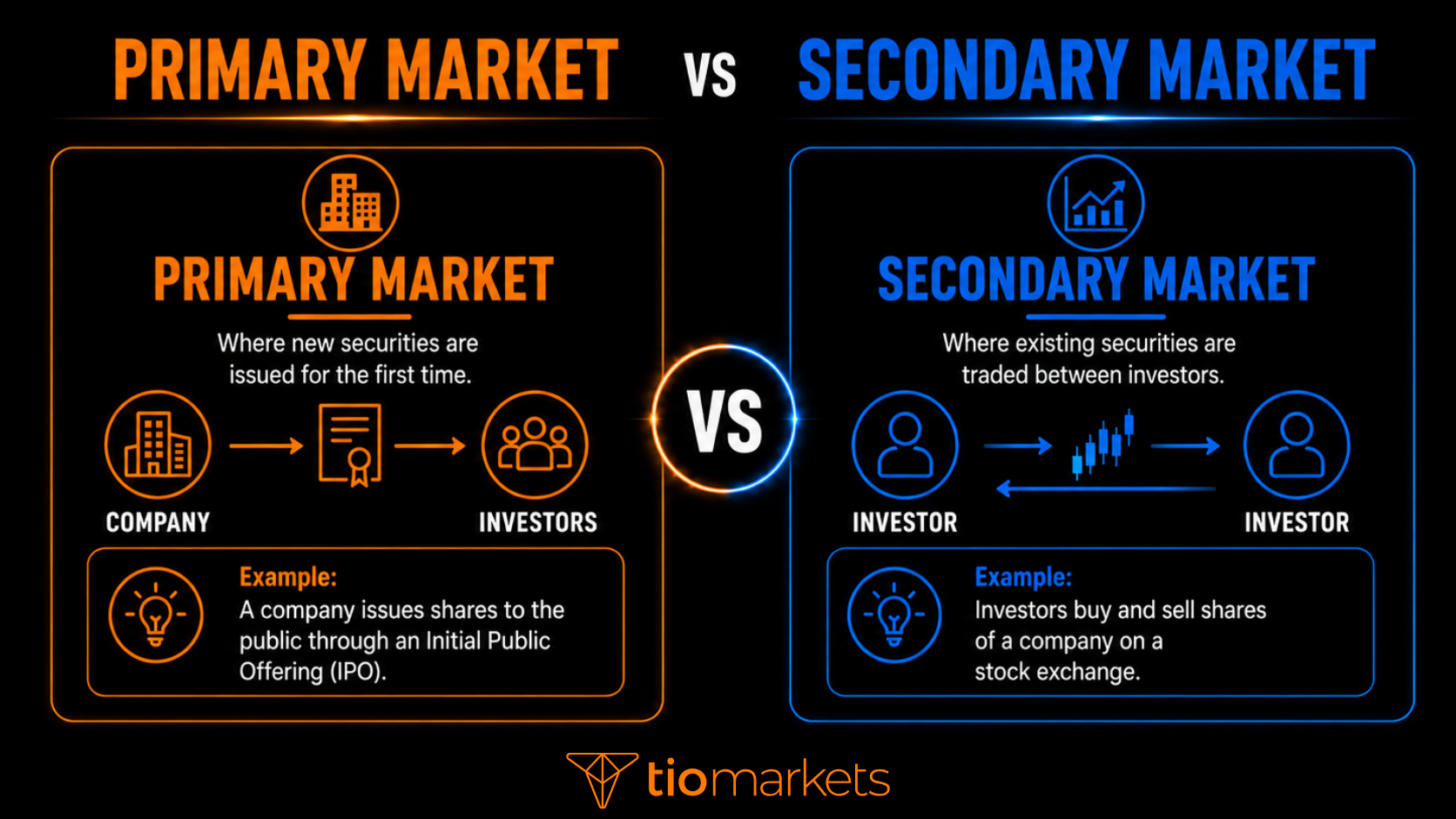
Primary market
The primary market is where a financial asset is issued for the first time.
For example, when a company sells shares to the public through an initial public offering, that happens in the primary market.
Secondary market
The secondary market is where existing assets are traded between investors.
For example, when investors buy and sell shares on a stock exchange after the company has already listed, that happens in the secondary market.
Exchange-Traded vs Over-the-Counter Markets
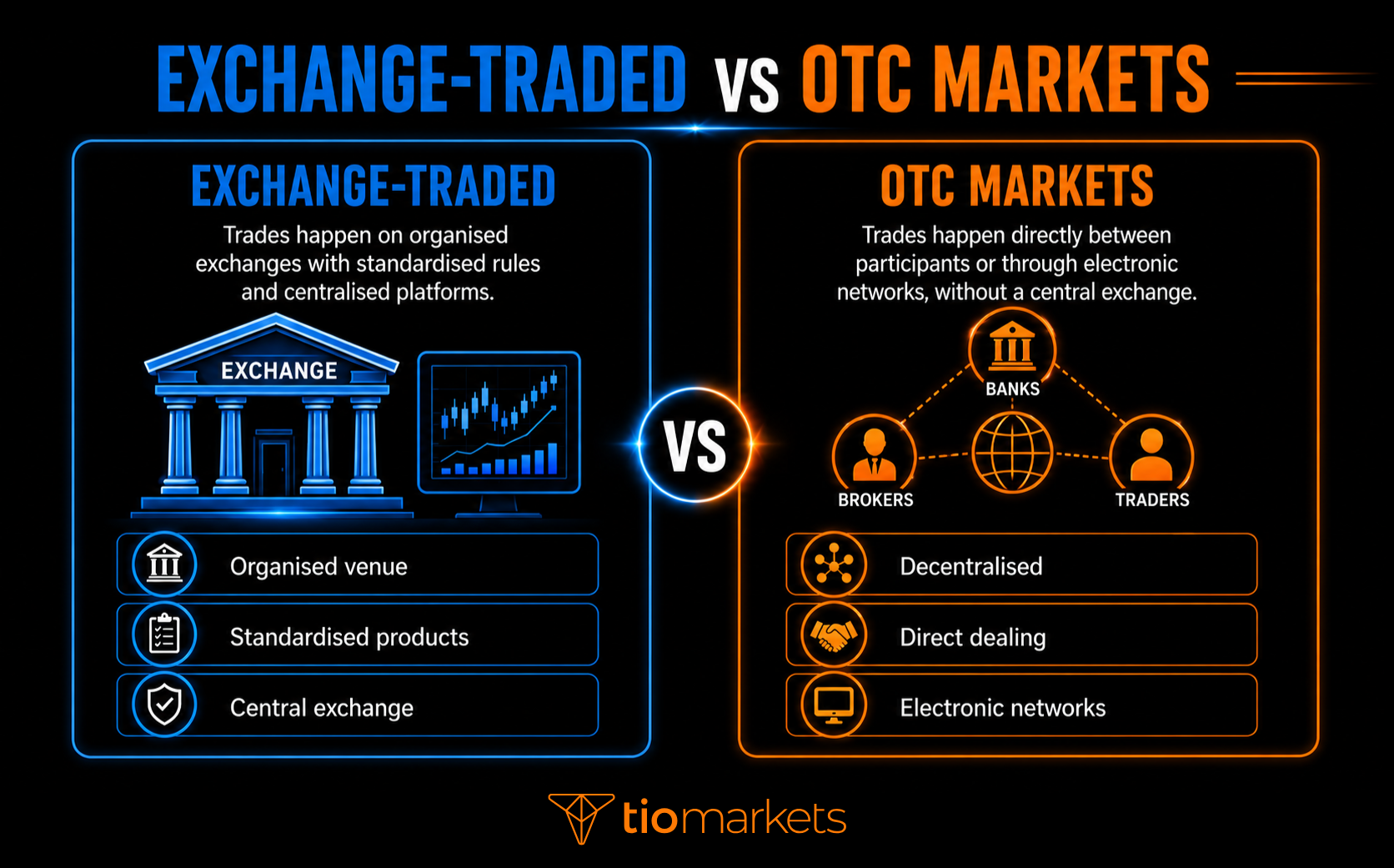
Exchange-traded markets
Exchange-traded markets operate through organised exchanges. These exchanges usually have clear rules, standardised products and centralised trading systems.
Examples include major stock exchanges and futures exchanges.
Over-the-counter markets
Over-the-counter, or OTC, markets are decentralised. Trades happen directly between participants or through electronic networks rather than through a central exchange.
Forex and many derivative products often operate through OTC structures.
Spot vs Derivatives Markets
Spot markets
Spot markets are where assets are bought and sold for near-immediate delivery.
For example, buying a currency at the current exchange rate is a spot transaction.
Derivatives markets
Derivatives markets involve contracts based on the future or changing value of an underlying asset.
For example, a futures contract on oil allows participants to trade based on oil prices without immediately exchanging the physical commodity.
Capital Markets vs Money Markets
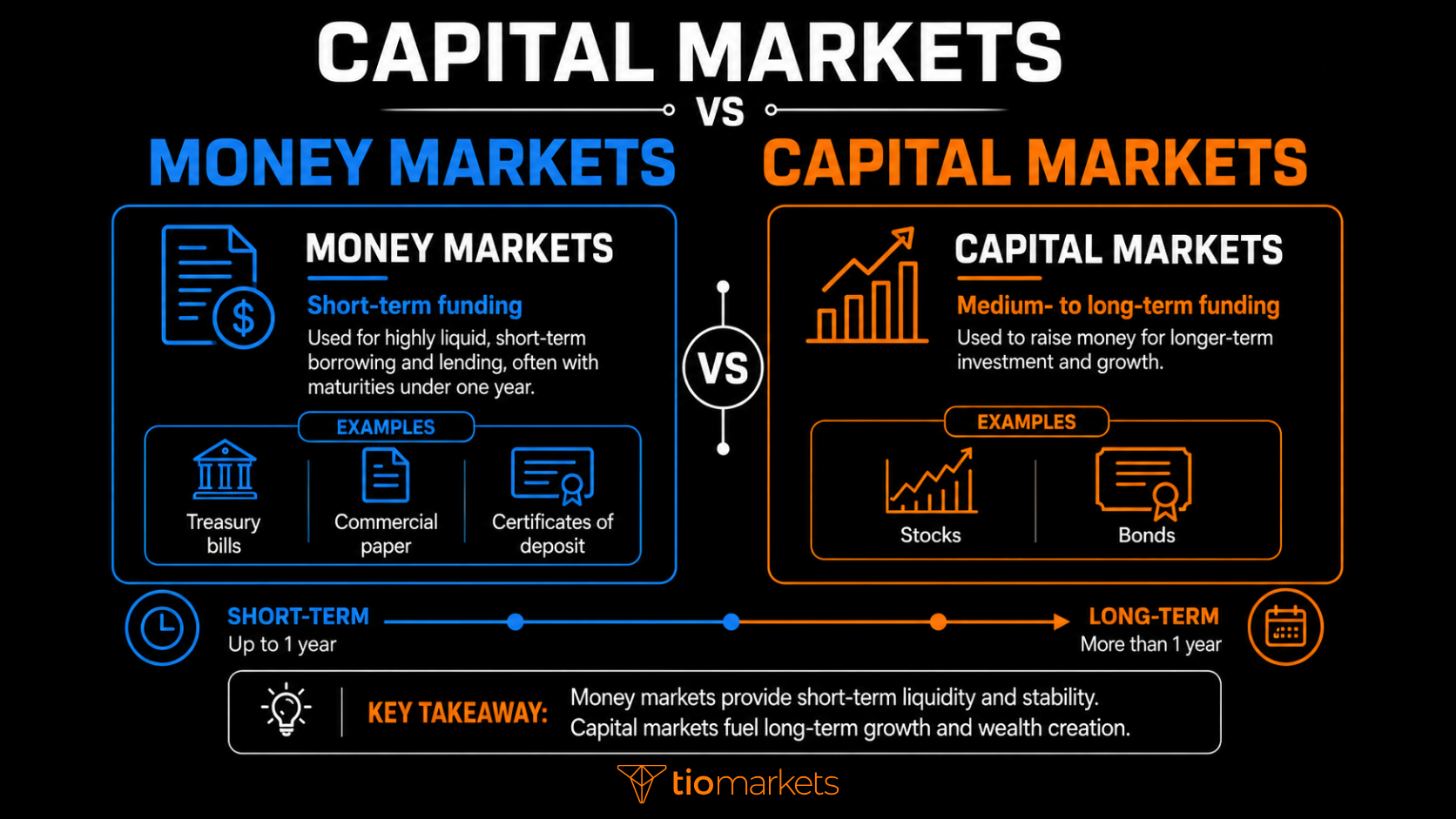
Capital markets
Capital markets focus on medium- to long-term funding. Stock and bond markets are common examples.
Companies and governments use capital markets to raise money for growth, investment or long-term projects.
Money markets
Money markets focus on short-term funding. They are often used by institutions to manage liquidity and short-term cash needs.
Types of Financial Markets Compared
| Market Type | What Is Traded | Main Purpose | Common Participants |
| Stock market | Shares | Company ownership and capital raising | Investors, traders, companies, funds |
| Bond market | Debt securities | Borrowing and lending | Governments, corporations, institutions, investors |
| Forex market | Currencies | Currency exchange and speculation | Banks, businesses, traders, central banks |
| Commodity market | Raw materials | Trading physical goods or related contracts | Producers, consumers, traders, investors |
| Money market | Short-term debt | Short-term funding and liquidity | Banks, governments, institutions |
| Derivatives market | Contracts based on assets | Hedging, speculation and risk management | Traders, institutions, corporations |
| Cryptocurrency market | Digital assets | Trading and exchanging crypto assets | Retail traders, investors, crypto platforms |
Which Financial Market Is Best for Beginners?
There is no single best financial market for every beginner.
It depends on your goals, risk tolerance, time, knowledge and available capital.
For example:
- Stock markets may suit people who want to understand company investing.
- Forex markets may appeal to traders interested in currencies and macroeconomic events.
- Commodity markets may suit those who follow gold, oil or agricultural products.
- Bond markets may suit investors focused on income and lower volatility.
- Derivatives may suit experienced traders who understand leverage and risk.
- Crypto markets may suit those comfortable with high volatility and digital assets.
Beginners should start by learning how each market works before risking real money.
What Moves Financial Markets?
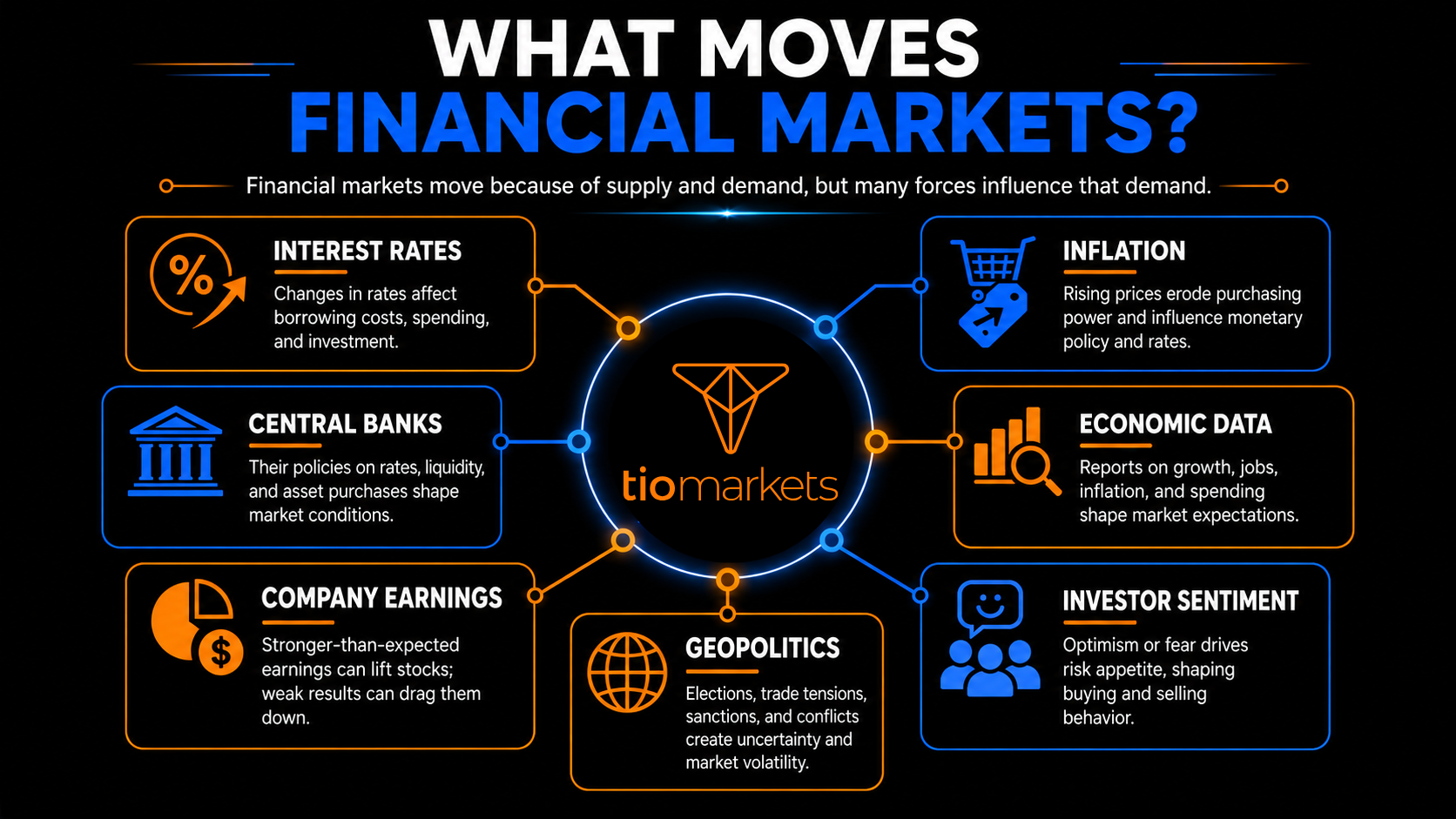
Financial markets move because of supply and demand.
However, many factors can influence that supply and demand, including:
- interest rates
- inflation
- economic data
- central bank decisions
- company earnings
- geopolitical events
- commodity supply and demand
- investor sentiment
- market liquidity
- regulation
- global risk appetite
Different markets react to different drivers. For example, forex markets often react strongly to central bank decisions, while stock markets may react to earnings, growth expectations and investor sentiment.
Final Thoughts
Financial markets are not just stock exchanges. They include several different markets, each with its own purpose, structure and risks.
The main types of financial markets are stock, bond, forex, commodity, money, derivatives and cryptocurrency markets. Together, they help capital move through the economy, allow investors and traders to access opportunities, and support risk management across businesses, governments and institutions.
For beginners, the most important step is understanding what each market trades, why it exists and what risks are involved before deciding where to participate.

FAQ
Risk disclaimer: CFDs are complex instruments and come with a high risk of losing money rapidly due to leverage. You should consider whether you understand how CFDs work and whether you can afford to take the high risk of losing your money. Never deposit more than you are prepared to lose. Professional client’s losses can exceed their deposit. Please see our risk warning policy and seek independent professional advice if you do not fully understand. This information is not directed or intended for distribution to or use by residents of certain countries/jurisdictions including, but not limited to, USA & Countries included in the OFAC sanction list. The Company holds the right to alter the aforementioned list of countries at its own discretion.
TIOmarkets offers an exclusively execution-only service. The views expressed are for information purposes only. None of the content provided constitutes any form of investment advice. The comments are made available purely for educational and marketing purposes and do NOT constitute advice or investment recommendation (and should not be considered as such) and do not in any way constitute an invitation to acquire any financial instrument or product. TIOmarkets and its affiliates and consultants are not liable for any damages that may be caused by individual comments or statements by TIOmarkets analysis and assumes no liability with respect to the completeness and correctness of the content presented. The investor is solely responsible for the risk of his/her investment decisions. The analyses and comments presented do not include any consideration of your personal investment objectives, financial circumstances, or needs. The content has not been prepared in accordance with any legal requirements for financial analysis and must, therefore, be viewed by the reader as marketing information. TIOmarkets prohibits duplication or publication without explicit approval.
Join us on social media



Authors BIO

Panagiotis is an online trading specialist with extensive experience in forex, indices, and commodities. He enjoys sharing his experience to help traders better understand global financial markets.