Copy Trading Guide: How to Get Started as a Beginner
BY Panagiotis Philippou
|March 31, 2026Copy trading makes the financial markets accessible to beginners, allowing you to automatically replicate the forex and CFD trades of experienced traders to potentially profit while learning the markets. This guide will explain what copy trading is, how it works, the benefits, risks, and practical steps to get started, including how to choose traders and manage risk. While it offers an accessible entry point, remember that you can lose money just as easily as you can profit. The key is approaching it with realistic expectations and proper risk management.
What is Copy Trading?
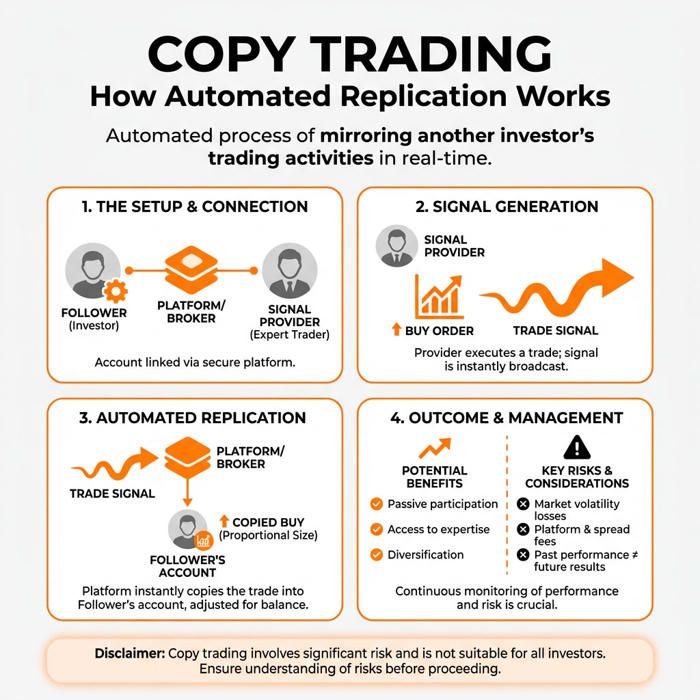
Copy trading is a method that allows you to automatically replicate the trades of experienced traders in your own account. When the trader you copy opens or closes a position, the same action occurs instantly and automatically in your account, requiring no manual intervention from you. This differs from traditional trading, where you must manually analyze markets and execute every trade. In practice, you allocate a portion of your capital to copy one or more traders, and their trading activity is proportionally mirrored in your account. You still own your funds, control your account, and can stop copying at any time.
How Copy Trading Works
This copy trading guide will teach you what you need to know about copy trading. The process involves six key steps to get you set up and managing your replicated trades. Choose a Platform: Select a regulated copy trading broker based on reputation, the number of available traders, performance data transparency, fees, and minimum deposit requirements.
- Register and Fund: Register your account, complete verification checks, and fund your account. You can start copy trading with TIOmarkets with $100
- Browse Traders: Browse trader profiles, reviewing detailed statistics like performance history, win rate, average return, and risk level. Take your time, compare multiple profiles, and understand their approach.
- Select Traders to Copy: Choose one or more traders and decide how much capital to allocate to each. Diversification across multiple traders with different strategies is a better approach than copying a single trader.
- Automatic Trade Replication Begins: The platform automatically opens a proportional position in your account whenever the copied trader opens a trade. If the trader opens a position worth 10% of their account, your account opens a trade worth 10% of your allocated capital. All subsequent actions, like closing positions or adjusting stop losses, are mirrored proportionally.
- Monitor and Adjust Settings: Copy trading is not "set it and forget it." Regularly monitor your copied traders' performance and be ready to adjust settings, stop copying a trader, or reallocate funds at any time. You can also set risk management parameters, such as maximum loss limits.
Benefits of Copy Trading
Copy trading is an attractive option for beginners seeking exposure to financial markets, primarily because it removes the need for extensive expertise. Use this copy trading guide to learn more.
Accessibility for Beginners
You can participate in markets by leveraging experienced traders' skills, bypassing the need for years of experience or complex technical analysis. This is a practical entry point for those overwhelmed by the traditional trading learning curve.
Time-Saving Approach
Copy trading automates the entire process, eliminating the need to constantly monitor markets, analyze price movements, and execute trades yourself. This is ideal for busy professionals or students who want market exposure without the time commitment of active trading.
This makes copy trading ideal for busy professionals, students, or anyone who wants market participation without the time commitment of active trading.
Learning Opportunity
By observing expert traders' reactions to market conditions, position management, and stop-loss settings in real time, you gain valuable practical exposure. This observation, often supplemented by trader commentary, accelerates learning and can help you eventually trade independently.
Diversification Potential
Most platforms allow you to copy multiple traders simultaneously, enabling you to spread risk across different trading styles, strategies, and markets (e.g., forex, commodities, indices). This helps balance your account if one trader experiences a losing period. This is called diversification
Emotional Distance from Trading Decisions
Copy trading provides the benefit of experienced traders' discipline and emotional control, minimizing the risk of poor decisions caused by fear, greed, or panic. The automated nature removes the temptation to make impulsive, manual adjustments.
Risks and Disadvantages of Copy Trading
While copy trading provides accessibility, it is not a path to guaranteed profits. It is crucial to understand the risks and limitations involved. This copy trading guide will help you navigate the dangers of copy trading
Potential for Significant Losses
Copy trading carries the same market risk as any other trading. When the copied trader loses money, you lose money proportionally. All traders, even successful ones, have losing periods, and past performance is not a guarantee of future results. You can lose some or all of your invested capital, so only invest money you can afford to lose.
Dependency on Other Traders' Performance
Your results rely entirely on the decisions and performance of the traders you follow, over which you have no control. If a trader changes their strategy (e.g., from conservative to aggressive), makes poor decisions, or stops trading suddenly, your account will suffer the consequences or face disruption. You are placing significant trust in another person's judgment.. With this copy trading guide you will learn to be able to judge if a trader is someone you may be able to trust.
Market Risk Remains Unchanged
Copy trading only transfers the decision-making; it does not eliminate or reduce market risk. Volatile market events, such as economic or geopolitical developments, can cause rapid movements and losses that affect both the trader you copy and your account. Therefore, risk management is still essential.
Red Flags to Avoid
Use this copy trading guide to learn about what traders you should be wary of:
- Extremely high returns with no significant drawdowns. If a trader claims 100% annual returns with only 5% drawdowns, that's almost certainly unsustainable. Either they've been extremely lucky, or the data isn't accurate. Sustainable trading success comes from consistent, disciplined strategies—not from taking excessive risks or getting lucky.
- Very short track records. A trader with only a few weeks or months of history hasn't proven their strategy works over time. Wait for at least six months of consistent performance before considering copying them.
- Inconsistent trading patterns. If a trader's style or risk level changes dramatically over time, that's a red flag. You want consistency and discipline, not erratic behavior.
- Recently changed strategy. If a trader suddenly shifts from conservative to aggressive trading, or changes their market focus entirely, their historical performance might not reflect their current approach.
Remember, if something looks too good to be true, it probably is. Sustainable trading success comes from consistent, disciplined strategies—not from taking excessive risks or getting lucky in the short term. Choose traders whose performance you can understand and whose approach makes sense to you.
Getting Started with Copy Trading
Using this copy trading guide will help you understand the basics. From there you will then be able to evaluate traders, here are the practical steps to begin as a beginner:
Step 1: Select a Copy Trading Platform
Choose a broker or platform that offers copy trading services. Prioritize:
- Regulation and security: Ensure the platform is regulated by a reputable financial authority.
- Available traders to copy: Look for enough choices to match your risk tolerance.
- Fee structure: Understand all costs, including spreads, commissions, and performance fees.
- User interface: It should be easy for beginners to browse traders and manage settings.
Step 2: Register and Verify Your Account
Complete the registration form and verify your identity (with a government ID) and address (with a recent utility bill or bank statement). You must also complete required questionnaires about your experience and goals for compliance.
Step 3: Understand Initial Capital Requirements
Minimum deposits vary (some start at $100-$200, others $500-$1,000 or more).
Step 4: Start with a Demo Account (If Available)
Use virtual funds to familiarize yourself with the platform, test the copying process, observe trader performance without risk, and experiment with allocation amounts.
Step 5: Fund Your Account
Choose a convenient payment method, such as bank transfer (cost-effective but slow), credit/debit card (fast but may have fees), e-wallets, or cryptocurrency (if accepted).
Step 6: Research and Select Traders to Copy
Using the evaluation criteria we discussed earlier in this copy trading guide, research the available traders and select one or more to copy. Here's how to approach this:
- Start conservatively. Begin with one or two traders rather than trying to copy many at once. This keeps things manageable while you're learning and allows you to focus on understanding how copy trading works.
- Choose traders with consistent, moderate returns rather than those with extreme performance. A trader making 3-5% per month consistently is often a better choice than one who made 50% one month and lost 20% the next.
- Select traders whose risk profile matches your tolerance. If you're uncomfortable with large drawdowns, choose conservative traders even if their returns are lower. Your peace of mind and ability to stick with your strategy matters more than chasing the highest returns.
- Allocate only a portion of your total capital initially. Don't put all your funds into copy trading right away. Start with 50-70% of your deposit and keep the rest in reserve. This gives you flexibility to adjust your allocations or add new traders later.
Step 7: Configure Your Copy Trading Settings
Before you activate the copy relationship, you'll need to configure several settings. These vary by platform, but typically include:
- Allocation amount determines how much capital you're dedicating to copying this specific trader. This might be a fixed dollar amount or a percentage of your account balance.
- Copy ratio determines whether you copy trades at the same proportion as the trader or at a different ratio. Most beginners should use a 1:1 ratio, which means if the trader risks 2% of their account on a trade, you'll risk 2% of your allocated amount.
- Stop loss settings allow you to set a maximum loss you're willing to accept before automatically stopping the copy relationship. For example, you might set a 20% stop loss, which means if your copied trades lose 20% of your allocated capital, the platform will automatically stop copying that trader.
- Copy open positions determines whether you want to copy trades the trader already has open, or only new trades they open after you start copying them. Copying existing positions gives you immediate exposure to their current strategy, but you might be entering trades at less favorable prices.
Take your time with these settings. They determine your risk exposure and how the copying process works. If you're unsure, start with conservative settings—you can always adjust them later as you gain experience.
Step 8: Activate Copying and Monitor Performance
After activating, monitor your account at least weekly. Watch for sudden changes in trading patterns or performance deterioration, and be prepared to stop copying if necessary. Keep emotions in check; don't panic after a few losing trades.
Step 9: Keep Records for Future Reference
Document which traders you copy, start dates, allocations, and any changes made. This record helps you track performance and improve your decision-making over time.
Copy Trading Strategies and Best Practices
Success in copy trading isn't just about selecting good traders—it's also about implementing sound strategies and following best practices that protect your capital and optimize your results. Use this copy trading guide as a cheat sheet for what strategies to look out for.
Diversification Approaches
- Don't put all your capital with a single trader. Diversification is one of the most important risk management principles in copy trading.
- Copy multiple traders rather than just one. Aim for three to five traders if your capital allows it. This spreads your risk so that poor performance from one trader doesn't devastate your entire account.
- Diversify across different strategies. Combine traders with different approaches—maybe one scalper, one day trader, and one swing trader. Different strategies perform better in different market conditions, so this diversification can help smooth your overall returns.
- Diversify across various markets. Consider copying traders who focus on different instruments. One might specialize in major forex pairs, another in commodities like gold and oil, and a third in stock indices. This market diversification reduces your exposure to any single market's volatility.
- Balance different risk levels. Don't copy only aggressive traders or only conservative ones. A mix of risk profiles can provide both stability and growth potential. You might allocate more capital to conservative traders and less to aggressive ones, creating a balanced portfolio.
The exact allocation depends on your total capital and risk tolerance, but as a general guideline, don't allocate more than 30-40% of your copy trading capital to any single trader. This ensures that even if one trader performs poorly, the majority of your capital is protected.
Common Mistakes to Avoid
Even with a solid understanding of copy trading, beginners often make predictable mistakes that can be costly. Being aware of these pitfalls helps you avoid them and protect your capital. Use this copy trading guide as a companion piece as you make your next steps
Copying Too Many Traders at Once
While diversification is important, copying too many traders creates several problems:
Your capital becomes too thinly spread across too many traders, which limits the potential impact of any single trader's good performance. If you're copying ten traders with equal allocations, even if one of them has exceptional returns, it only affects 10% of your capital.
Monitoring becomes overwhelming and unmanageable. Keeping track of ten or more traders, understanding their strategies, and staying on top of their performance is difficult. You're more likely to miss important changes or warning signs when you're trying to watch too many traders at once.
Transaction costs multiply across multiple traders. Each trader you copy generates trades in your account, and each trade involves spreads or commissions. The more traders you copy, the more these costs add up, which can significantly reduce your net returns.
Strategies may conflict with each other. One trader might be buying EUR/USD while another is selling it, which means their positions offset each other in your account. You're paying transaction costs on both sides while the positions cancel each other out.
Start with one or two traders when you're beginning. As you gain experience and your account grows, you can gradually expand to three to five traders. This provides adequate diversification without becoming unmanageable.
Copying Too Few Traders
The opposite mistake is putting all your capital with a single trader. This creates excessive concentration risk—if that trader has a bad period, your entire account suffers proportionally.
Even the best traders experience drawdowns and losing streaks. Markets change, strategies that worked in one environment might struggle in another, and no trader wins every trade. If you're copying only one trader, you have no protection against their inevitable losing periods.
Diversifying across at least two or three traders helps smooth out your performance. When one trader is struggling, others might be performing well, which balances your overall results. This doesn't guarantee profits, but it does reduce the impact of any single trader's poor performance on your account.
Chasing Recent Performance
One of the most common and costly mistakes is selecting traders based solely on recent exceptional returns. A trader who made 50% last month might have simply gotten lucky, caught a favorable market trend, or taken excessive risks that aren't sustainable.
Recent performance often doesn't continue. In fact, traders with extreme short-term returns often experience significant drawdowns shortly after. This is called regression to the mean—extreme results tend to move back toward average over time.
Traders who show consistent, moderate returns over longer periods typically provide better long-term results than those with spectacular short-term gains. A trader making 3-5% per month consistently for two years is usually a better choice than one who made 50% in the last month but has a shorter or more erratic track record.
Focus on consistency and long-term performance rather than recent hot streaks. This approach might feel less exciting, but it's more likely to protect your capital and provide sustainable returns.
Ignoring Risk Metrics
Beginners often focus exclusively on returns while ignoring risk indicators like maximum drawdown, volatility, or position sizing. This is a critical mistake because returns without context are meaningless.
A trader with 30% annual returns but a 40% maximum drawdown is taking enormous risks. This means at some point, their account declined by 40% from its peak. Could you handle a 40% loss in your account? For most people, the answer is no.
A trader with 15% annual returns and a 10% maximum drawdown might be the better choice for most investors, even though the returns are lower. The risk-adjusted returns are better, and you're less likely to experience losses that force you to stop copying them.
Always evaluate risk alongside returns. Choose traders whose risk profile matches your tolerance, not just those with the highest returns. This approach helps you stay in the game long-term rather than getting knocked out by a single large drawdown. This copy trading guide recommends placing huge importance on your risk metrics
Not Setting Stop-Loss Limits
Many copy trading guides will not mention this, but failing to set maximum loss limits is a critical mistake that can lead to catastrophic losses. Without predetermined stop-loss settings, you might hold on to losing positions far longer than you should, hoping for a recovery that may never come.
Set clear limits before you start copying:
- Maximum loss per trader determines when you'll stop copying a specific trader. For example, you might decide to stop copying if your allocation to that trader loses 20%. This protects you from holding on too long to a trader whose strategy isn't working.
- Maximum total portfolio loss determines when you'll pause all copy trading. For example, if your overall copy trading account loses 30%, you might stop all copying to reassess your approach.
- Maximum drawdown tolerance determines how much decline from peak you're willing to accept. This is different from total loss because it measures decline from the highest point your account reached.
These limits protect you from catastrophic losses and force disciplined decision-making. They remove emotion from the equation—when the limit is reached, you stop copying automatically rather than hoping things will improve.
Conclusion
Copy trading offers beginners an accessible entry point into the financial markets, providing an opportunity to potentially profit from experienced traders' expertise without requiring years of personal trading experience. By automatically replicating the trades of skilled traders, you can participate in forex, commodities, indices, and other markets while learning about trading in real time.
However, it's essential to understand that copy trading is not a guaranteed path to profits. It carries the same market risks as any other form of trading, and you can lose money just as easily as you can profit. The traders you copy will have losing periods, strategies that worked in the past might not work in the future, and past performance never guarantees future results. Hopefully this copy trading guide helped start you on your journey to copy trading. Once you are ready, you can open your trading account here

FAQ
Risk disclaimer: CFDs are complex instruments and come with a high risk of losing money rapidly due to leverage. You should consider whether you understand how CFDs work and whether you can afford to take the high risk of losing your money. Never deposit more than you are prepared to lose. Professional client’s losses can exceed their deposit. Please see our risk warning policy and seek independent professional advice if you do not fully understand. This information is not directed or intended for distribution to or use by residents of certain countries/jurisdictions including, but not limited to, USA & Countries included in the OFAC sanction list. The Company holds the right to alter the aforementioned list of countries at its own discretion.
TIOmarkets offers an exclusively execution-only service. The views expressed are for information purposes only. None of the content provided constitutes any form of investment advice. The comments are made available purely for educational and marketing purposes and do NOT constitute advice or investment recommendation (and should not be considered as such) and do not in any way constitute an invitation to acquire any financial instrument or product. TIOmarkets and its affiliates and consultants are not liable for any damages that may be caused by individual comments or statements by TIOmarkets analysis and assumes no liability with respect to the completeness and correctness of the content presented. The investor is solely responsible for the risk of his/her investment decisions. The analyses and comments presented do not include any consideration of your personal investment objectives, financial circumstances, or needs. The content has not been prepared in accordance with any legal requirements for financial analysis and must, therefore, be viewed by the reader as marketing information. TIOmarkets prohibits duplication or publication without explicit approval.
Join us on social media



Authors BIO

Panagiotis is an online trading specialist with extensive experience in forex, indices, and commodities. He enjoys sharing his experience to help traders better understand global financial markets.