


Dividend vs Interest Rates: Key Differences
BY TIOmarkets
|November 13, 2026A dividend is a discretionary payment that a company's board makes to shareholders out of profits, while interest is a contractual payment that a borrower owes to its lenders or depositors. Comparing dividend vs interest rates therefore sets a payout that can change or stop against an obligation fixed in advance, even though both are quoted as an annual percentage.
The article explains the legal difference between the two payments, how dividend yield is calculated and why it moves with the share price, and how changes in policy and bond rates reach dividend-paying shares, using dated US data. It is written for traders and investors who set a share's yield beside a savings, bond or policy rate.
Dividend vs Interest Rates: Why the Comparison Matters
Both figures express a year's income as a share of the money committed. On paper, a hypothetical savings account paying 4% a year and a hypothetical share priced at $50 that pays $2.00 a year in dividends, a dividend yield of 4%, return the same income per dollar.
The resemblance ends at the percentage, because the two numbers rest on different claims. The savings rate is the bank's commitment to pay interest on a deposit whose nominal value does not change. The dividend yield is a payment the board may raise, cut or suspend, divided by a share price that changes every trading session. A dividend yield vs interest rate comparison that stops at the headline figure therefore omits two risks: a fall in the share price and a reduction in the dividend. The same comparison is also one route by which changes in rates reach the prices of dividend-paying shares.
What Is the Difference Between Dividend and Interest?
The difference between dividend and interest is legal before it is financial. A bond issuer must make timely payments of interest and principal; a company has no similar obligation to pay dividends. Bond interest is set by the coupon rate, the annual interest fixed at issue as a percentage of face value, and a missed payment constitutes a default.
A dividend, by contrast, exists only once the board of directors declares it. When the board of one NYSE-listed produce company approved a quarterly cash dividend of $0.30 per share, its earnings release stated that there could be no assurance future dividends would be declared, since each requires board approval after a review of financial performance and cash needs.
The legal nature of the payment also determines who is paid first when a company fails. In a bankruptcy, creditors, including bondholders, suppliers and employees, rank ahead of holders of common stock, who are last in line. A bondholder therefore holds a prior claim to a fixed payment, and a shareholder a residual claim to a variable one.
How to Calculate Dividend Yield
Dividend yield is the annual dividend per share divided by the current share price, expressed as a percentage. For a hypothetical share, the calculation takes five steps:
- Find the annual dividend per share. On a trailing basis, this is the total paid over the past 12 months, for example four quarterly payments of $0.50, or $2.00.
- Take the current share price, in this case $50.
- Divide the annual dividend by the price: $2.00 ÷ $50 = 0.04.
- Multiply by 100 to express the result as a percentage, giving a dividend yield of 4%.
- Recalculate when the price moves. If the share falls 20% to $40 while the dividend stays at $2.00, the yield rises to 5%.
The higher yield in the last step comes from a lower price, not a larger payment, and a holder who bought at $50 has lost 20% of the capital. The calculation also assumes the dividend continues at its current rate, a commitment no board makes in advance.
Published yields are quoted on two bases. A trailing yield uses dividends already paid over the past 12 months, the basis on which S&P 500 factor measures define the dividend. An indicated, or forward, yield annualises the latest declared payment, so a quarterly dividend of $0.30 indicates $1.20 a year. The payout ratio, dividends divided by earnings, adds what neither yield shows: how much of the profit the payment absorbs.
Dividend Income vs Interest Income: Side by Side
Set against the same points, dividend income vs interest income differs at almost every stage, from who decides the payment to who is repaid first if the issuer fails.
| Point | Dividend (shares) | Interest (bonds and deposits) |
| Who sets the payment | The company's board, one declaration at a time | The contract: a bond's coupon rate or a deposit's stated rate |
| Contractual obligation | No: the company has no obligation to pay | Yes: the issuer must pay interest and principal on time |
| What happens to the capital | The share price moves every session and can fall below the purchase price | Bond prices move before maturity; face value is repaid at maturity unless the issuer defaults |
| Order of claims in insolvency | Last in line, after all creditors | Bondholders rank ahead of shareholders in claims on assets |
| How the payment changes | Can be raised, cut or suspended at each declaration | Fixed for a fixed-rate bond; set by the bank on a variable-rate deposit |
| What moves the yield | The dividend and the share price | The coupon and, for a traded bond, its market price |
Why Do Dividend Stocks Fall When Interest Rates Rise?
The link between dividends and interest rates runs through two channels. The first is competition for income. A higher central bank policy rate, the main lever described in the role of central banks, lifts the rates on savings and newly issued bonds. A share yielding less than those alternatives attracts fewer buyers at its current price, and the price can fall until the yield again compensates for the additional risk.
The second channel is valuation. The dividend discount model, set out in 1938, values a share as the sum of its future cash flows, each discounted to the present. The discount rate is the company's cost of equity: the risk-free rate plus the equity risk premium, the extra return investors require for holding shares. When the risk-free rate rises, the same stream of dividends is worth less today. That is the valuation side of how interest rates affect dividend stocks.
Together, the two channels explain why dividend stocks can fall when rates rise, and they can weigh most on shares with steady, high payouts and modest growth, such as those in the utilities sector and real estate investment trusts (REITs). These are often called bond proxies, because investors value them chiefly for their income.
The 2022–2023 US tightening cycle shows the scale of the change. The Federal Reserve's Federal Open Market Committee (FOMC) raised the target range for the federal funds rate at every meeting from March 2022 to May 2023. The first increase was 25 basis points, a basis point being one hundredth of a percentage point. Increases of 75 basis points followed in June, July, September and November 2022, and on 2 November 2022 the range reached 3-3/4 to 4 percent. In June 2023 the committee held it at 5 to 5-1/4 percent. The effective federal funds rate, the rate banks pay each other for overnight funds, traces the cycle.
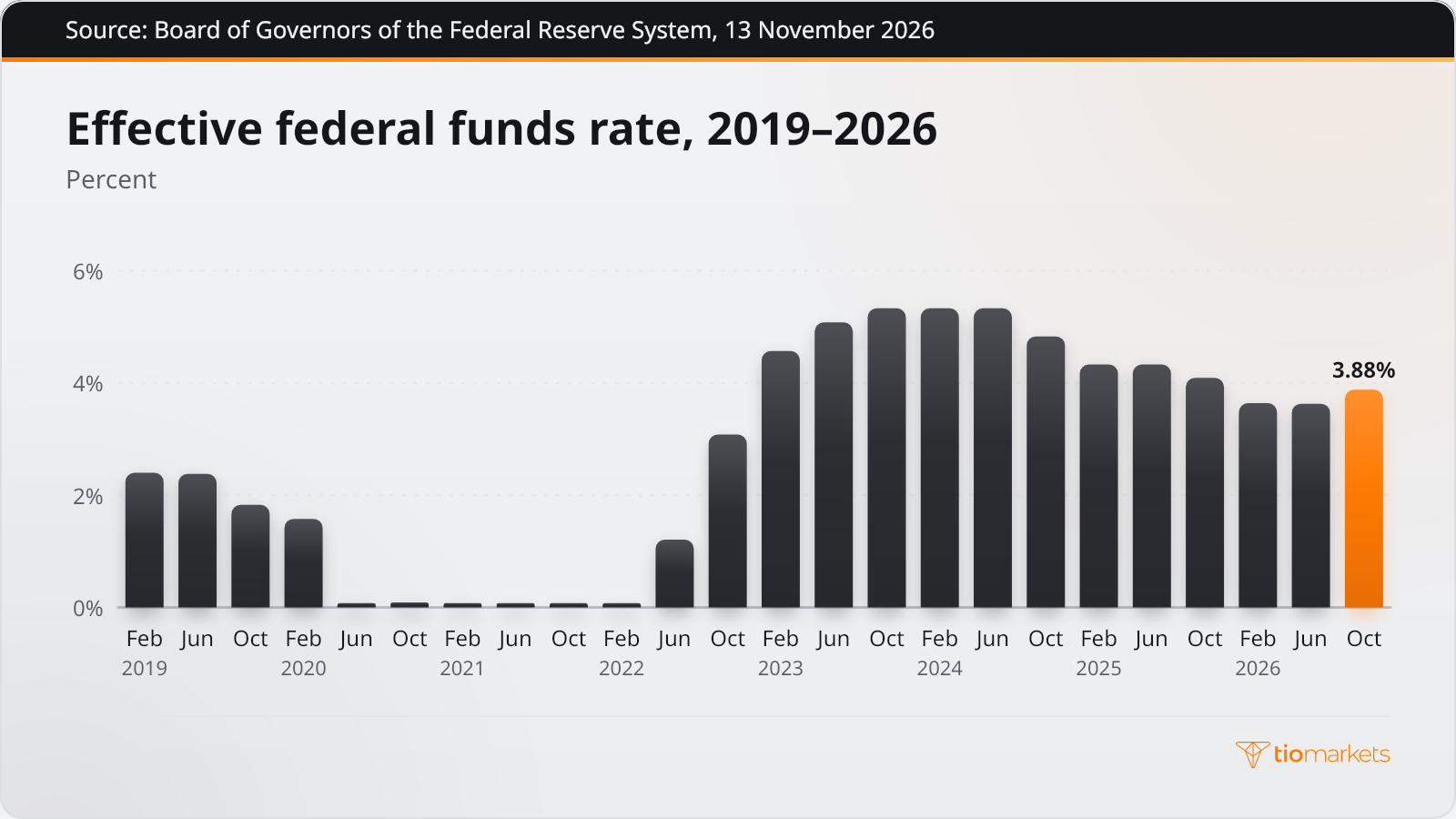
The payments themselves did not shrink. Net indicated dividend increases for US common stocks, increases less decreases, came to $68.2 billion in 2022 and $36.5 billion in 2023. With payouts rising alongside policy rates, any adjustment in dividend-paying shares ran through prices and yields rather than through dividends. Past dividend increases are not a reliable indicator of future payments.
Dividend Yield vs Bond Yield: What the Gap Measures
Dividend yield vs bond yield is the index-level form of the same comparison. The S&P 500 dividend yield is commonly set against the 10-year Treasury yield, a constant-maturity figure interpolated from the daily Treasury yield curve, so that a 10-year yield exists even when no security has exactly 10 years left to maturity.
The 10-year Treasury yield averaged 4.99% in September 2026 and stood at 4.98% on 10 November 2026. The US large-cap dividend yield was 1.16% in the fourth quarter of 2025, or 1.39% for dividend-paying issues only; among payers, mid-caps yielded 2.24% and small-caps 2.88%. The bond and dividend readings are almost a year apart, so they indicate the order of the gap rather than its value at a single date.
The spread between an index dividend yield and a government bond yield is often read as a rough gauge of the equity risk premium, but the gauge is incomplete. The bond's coupon is fixed, whereas dividends can grow or shrink and the index price can fall as well as rise.
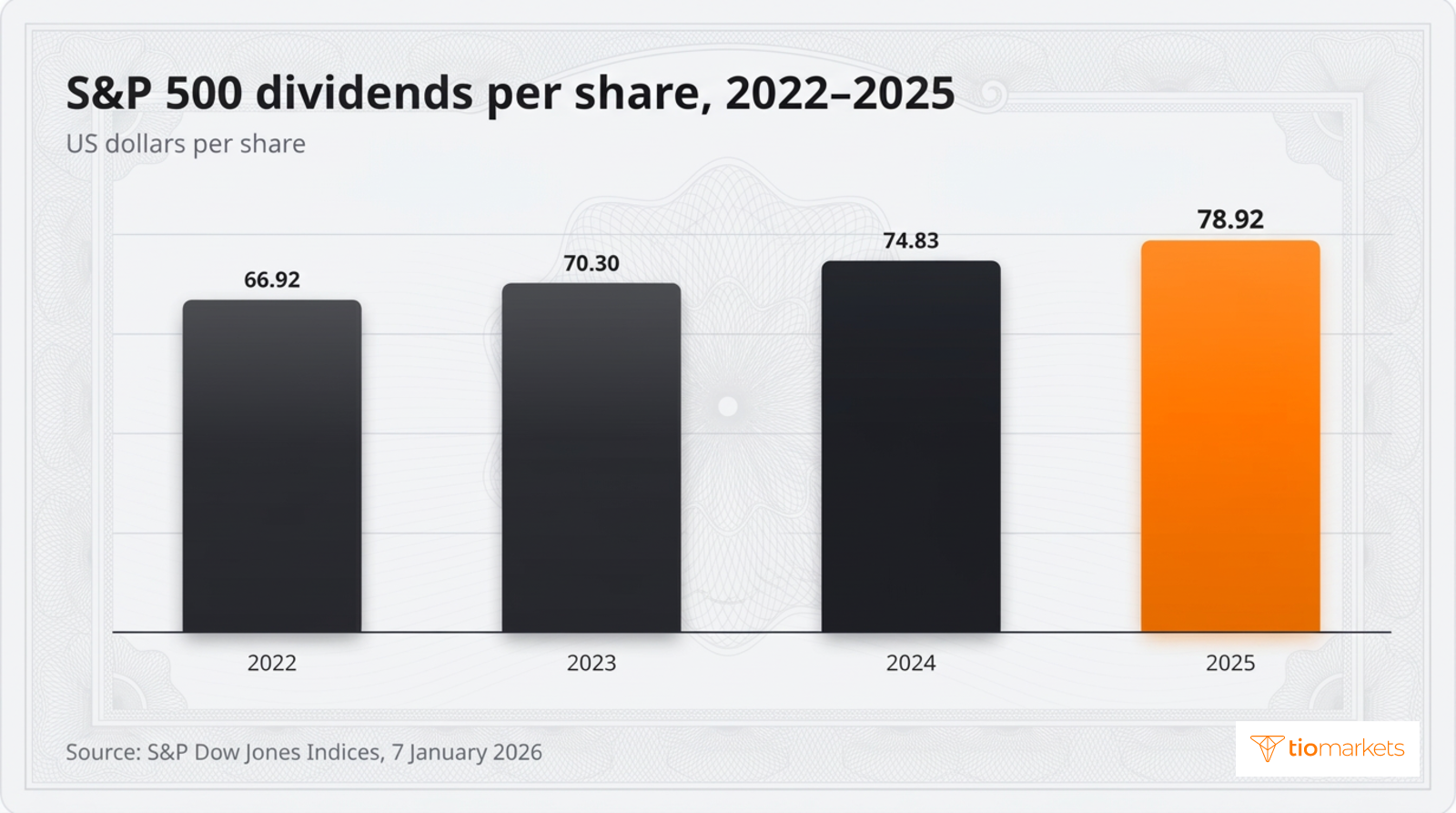
Dividend growth is the larger omission. S&P 500 dividends were $66.92 per share in 2022, $70.30 in 2023 and $74.83 in 2024, then a record $78.92 in 2025, a 5.5% increase and the 16th consecutive annual rise. A fixed coupon cannot grow in that way, although past dividend growth is not a reliable indicator of future dividends or returns.
There is no single good dividend yield compared to interest rates. A yield carries meaning only when read against the share's payout ratio, its record of payments and the rates on savings and bonds at the same date, and it describes a present ratio, not a future payment.
Common Mistakes When Comparing Dividends and Interest
The usual errors share one source: reading a dividend yield as though it carried the terms of an interest rate.
- Treating the dividend as guaranteed. A company can reduce or stop its payment at the next declaration. In 2020 net indicated US dividends changed by -$40.8 billion and 43 S&P 500 issues suspended their payments; in 2025, 176 issues decreased their dividends, against 132 in 2024.
- Chasing a yield created by a falling price. A yield that has risen because the share price dropped reflects a capital loss already incurred, and where the payout ratio is high it can precede a dividend cut.
- Comparing figures on different bases. Trailing, indicated and bond yields are measured differently, and an index yield that includes non-paying companies is lower than that of the payers alone.
- Ignoring tax and timing. Dividends and interest are often taxed differently, so equal headline rates can produce different net income. Timing matters too: a buyer must own the share before its ex-dividend date, the first day on which a new buyer is no longer entitled to the declared payment.
These points weigh more over a long holding period than over a short one, a contrast explored in the difference between investing and trading. A trader holding a share for a few days is exposed mainly to its price.
Conclusion
Dividend vs interest rates is a comparison between two claims that share a format. Interest is owed under a contract and ranks ahead of shareholders; a dividend yield is a board's discretionary payout divided by a price that moves every session. Setting one percentage beside the other hides that difference, and the same comparison is one route by which rising policy and bond rates can reach the prices of dividend-paying shares, whether or not the payments themselves change.
The comparison has limits. A yield is a ratio at one moment: it says nothing about whether the next dividend will be declared or what the share will be worth when it is paid. A holder of dividend-paying shares can lose part or all of the capital invested, a sharp rise in interest rates can push those prices down quickly, and a dividend cut can remove the income the yield appeared to offer.
Trade S&P 500 with TIOmarkets
Take your position on global markets via CFDs. Enjoy tight spreads, fast execution, and fast, flexible funding options.
Trading is risky
FAQ
Risk disclaimer: CFDs are complex instruments and come with a high risk of losing money rapidly due to leverage. You should consider whether you understand how CFDs work and whether you can afford to take the high risk of losing your money. Never deposit more than you are prepared to lose. Professional client’s losses can exceed their deposit. Please see our risk warning policy and seek independent professional advice if you do not fully understand. This information is not directed or intended for distribution to or use by residents of certain countries/jurisdictions including, but not limited to, USA & Countries included in the OFAC sanction list. The Company holds the right to alter the aforementioned list of countries at its own discretion.
TIOmarkets offers an exclusively execution-only service. The views expressed are for information purposes only. None of the content provided constitutes any form of investment advice. The comments are made available purely for educational and marketing purposes and do NOT constitute advice or investment recommendation (and should not be considered as such) and do not in any way constitute an invitation to acquire any financial instrument or product. TIOmarkets and its affiliates and consultants are not liable for any damages that may be caused by individual comments or statements by TIOmarkets analysis and assumes no liability with respect to the completeness and correctness of the content presented. The investor is solely responsible for the risk of his/her investment decisions. The analyses and comments presented do not include any consideration of your personal investment objectives, financial circumstances, or needs. The content has not been prepared in accordance with any legal requirements for financial analysis and must, therefore, be viewed by the reader as marketing information. TIOmarkets prohibits duplication or publication without explicit approval.
Join us on social media


Authors BIO

Behind every blog post lies the combined experience of the people working at TIOmarkets. We are a team of dedicated industry professionals and financial markets enthusiasts committed to providing you with trading education and financial markets commentary. Our goal is to help empower you with the knowledge you need to trade in the markets effectively.





