


RBA Rate Decision: Hike Expected, Yet AUD Slips Toward 0.70
BY Ahmed Osama
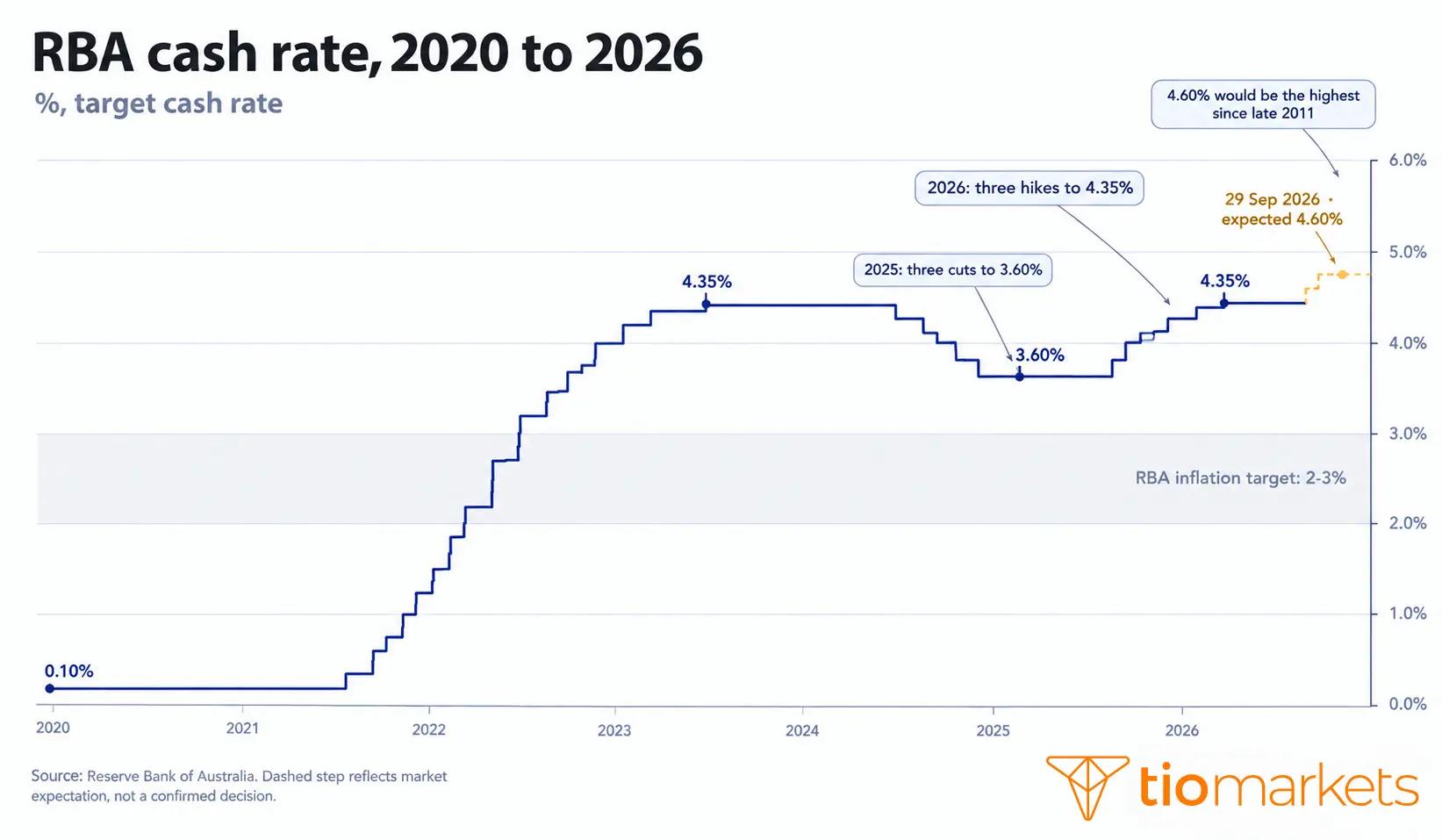
|September 28, 2026The Reserve Bank of Australia is widely expected to raise its cash rate by 25 basis points to 4.60% on Tuesday 29 September, its fourth increase of 2026. Yet the Australian dollar has slipped toward 0.70 against the US dollar, its weakest level since early August. For traders, the RBA's guidance on what comes next may matter more than the hike itself.
RBA Rate Decision Insights
- The RBA announces its decision at 04:30 UTC on Tuesday 29 September, followed by Governor Michele Bullock's media conference at 05:30 UTC.
- Market pricing points to roughly a 90% to 95% chance of a 25-basis-point rise to 4.60%, with some measures showing the move fully priced. Before the July inflation release on 26 August, the probability was below one in three.
- Underlying inflation, measured by the trimmed mean, held at 3.6% in July, above the RBA's 2–3% target. Headline CPI eased to 3.5%.
- Unemployment rose to 4.6% in August, and the RBA already judges financial conditions to be tighter after three increases this year.
- AUD/USD has been trading in the 0.6950–0.7100 area, down from above 0.72 earlier in September, as a stronger US dollar outweighed Australia's rising rate advantage.
- Because a hike is heavily priced, the biggest market reaction may come from the vote, the wording on further tightening and Bullock’s assessment of inflation risks.
What to expect from the RBA rate decision
The RBA's Monetary Policy Board meets on 28–29 September and publishes its decision at 04:30 UTC on Tuesday, with the media conference at 05:30 UTC. Times are shown in UTC, as on our economic calendar.
The cash rate has stood at 4.35% since May, after three increases earlier in 2026, in February, March and May. The Board then held it unchanged at its June and August meetings. Another quarter-point increase would lift the cash rate to 4.60%, its highest level since late 2011.
Expectations have shifted quickly. Market pricing for a September move was below one in three before the July inflation release on 26 August. By the week before the meeting, measures based on interest-rate futures and swaps pointed to roughly a 90% to 95% chance of a rise, with some showing it fully priced. All four major Australian banks also moved to forecast a September increase, and ANZ expects a second rise in November that would take the cash rate to 4.85%.
Consensus is not certainty. A well-anticipated decision can still move markets if its reasoning changes expectations for November and beyond.
Why markets expect the RBA to hike again
Inflation remains the main argument for tighter policy. The Australian Bureau of Statistics reported that annual headline CPI slowed from 3.8% in June to 3.5% in July. The more important signal for the RBA was less reassuring: trimmed-mean inflation held at 3.6% for a second month, still above the 2–3% target range. Higher fuel costs, linked to elevated world oil prices, added to the pressure.
The RBA's August statement said inflation was not expected to return to around the midpoint of the target range until late 2027, and that the risks were tilted to the upside, including from energy costs and the conflict in the Middle East. The Board also said it could raise the cash rate further if those upside risks materialised.
Recent comments suggest that condition is being met. Governor Michele Bullock said in mid-September that some of the upside inflation risks appeared to be materialising, pointing to persistent excess demand and elevated energy prices. Assistant Governor Sarah Hunter said in a 22 September podcast that inflation had been too high for too long and risked becoming embedded in how businesses set prices.
The global backdrop points the same way. Several major central banks tightened in September: the Federal Reserve raised its target range to 3.75%–4.00% on 16 September, the European Central Bank lifted its deposit rate to 2.50% on 10 September, and the Bank of Japan also raised rates. At 4.35%, the RBA's cash rate already sits above the upper end of the Fed's range. Our Fed rate decision preview covers the US side of that picture.
The policy squeeze: sticky prices, softer jobs
The case is not one-sided. Australia’s unemployment rate rose from 4.5% in July to 4.6% in August in seasonally adjusted terms. Employment still increased by 39,500, but that gain was concentrated in part-time work: full-time employment fell by 6,300 while part-time employment rose by 45,800. The participation rate increased to 67.1%, which helps explain why employment and unemployment rose together.
The ABS cautioned that the August Labour Force release coincided with methodology changes and recommended using trend estimates to judge the underlying direction. Even so, the trend unemployment rate was also 4.6%. That is slightly above the RBA’s August forecast of 4.5% for the December quarter, although one monthly observation does not by itself establish a lasting overshoot.
Growth is also losing momentum. Real GDP rose 0.4% in the June quarter and 2.1% over the year, and wage growth has moderated, with the Wage Price Index up 3.2% over the year, down from 3.4% a year earlier.
This creates the RBA’s dilemma. A hike would respond to inflation persistence and the risk that elevated price growth becomes embedded. A hold would give the Board more time to observe the lagged impact of earlier tightening on jobs, spending and housing. The RBA's own August assessment was that financial conditions had tightened and that the economy appeared to be slowing as expected.
What could move markets after the RBA rate decision
When a rate rise is priced at around 90% or more, much of the adjustment may already be reflected in short-term interest rates and the Australian dollar. A 25-basis-point increase with neutral, data-dependent guidance could therefore produce a smaller reaction than the size of the move suggests. Three signals may matter more:
- The vote. The major banks disagree here: CBA expects a unanimous decision with hawkish language, while Westpac expects a split vote. A split would suggest the Board is less united on the path ahead.
- The wording. Whether the statement says upside inflation risks have materialised, and whether 4.60% is described as enough or as part of a continuing tightening cycle.
- Bullock's media conference at 05:30 UTC. Her answers on November, energy prices and the labour market could reshape expectations for the 3 November meeting.
The timing adds another layer. August household spending data are due at 01:30 UTC on decision day, three hours before the announcement. The August CPI then follows at 01:30 UTC on Wednesday 30 September, so markets may reassess the policy path again within 21 hours of the decision.
What the RBA rate decision could mean for AUD/USD
Higher interest rates usually support a currency, because they raise the return on holding it. September has shown that this is not automatic.
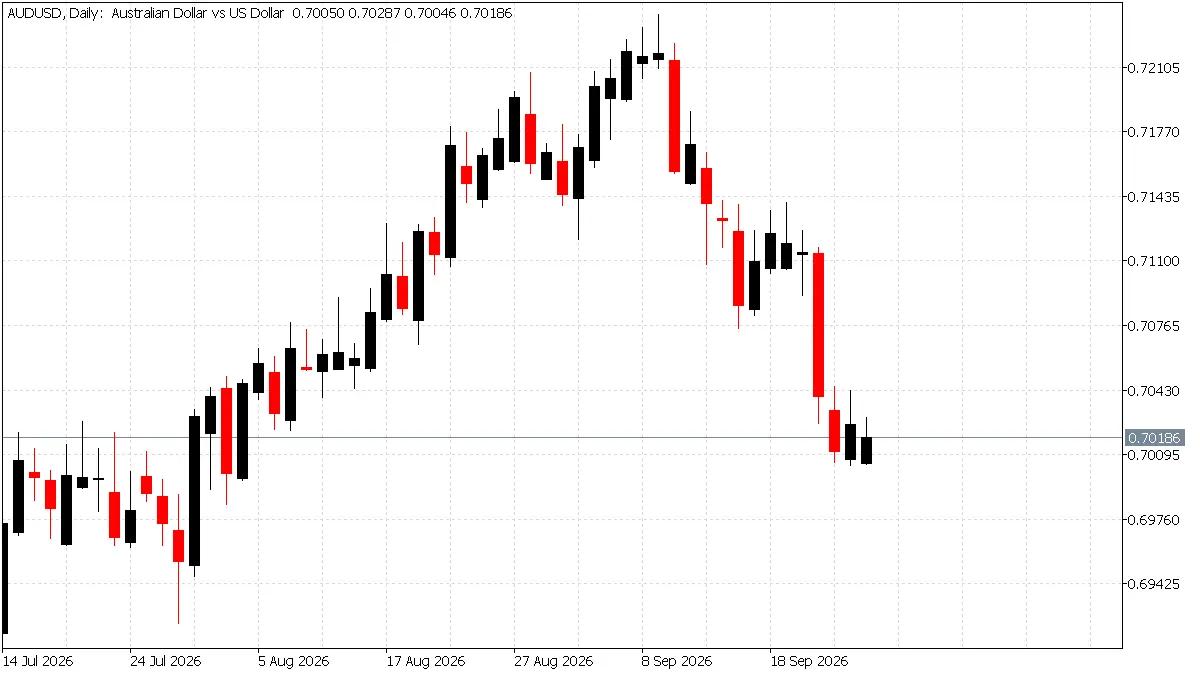
AUD/USD fell from above 0.72 earlier in the month to near 0.70, touching its weakest level since 4 August, even as expectations for an RBA hike rose. The US dollar strengthened on rising US Treasury yields and growing bets on further Federal Reserve increases, and that outweighed Australia's widening rate advantage.
AUD/USD has been trading in the 0.6950–0.7100 area. Reference levels traders are watching:
- 0.7000: the round-number level the pair has been holding just above
- 0.7100: the area the pair traded above in the previous week
- 0.7200: the zone reached earlier in September
- 0.6950: the first reference below 0.70
These are context markers, not entry or exit levels, and should be checked against a live price feed.
Because the hike is widely expected, a hold would be the bigger surprise for the Australian dollar. A hawkish hike could offer support, but US dollar strength and US yields may continue to dominate the pair. The Australian dollar is also sensitive to China, Australia's largest trading partner, so news on US-China trade can move it independently of the RBA.
Trade Global Currency Markets
Access AUD/USD and over 950 financial instruments with TIOmarkets. Benefit from competitive conditions, advanced platforms, and dedicated support.
Trading is risky
Three scenarios for AUD, bonds and Australian shares
These are conditional market scenarios, not predictions or trading recommendations. Reactions can be overridden by global risk sentiment, commodity prices and moves in US interest rates.
| Scenario | Policy trigger | Possible market implication | What to monitor | What weakens it |
| Expected hike with balanced guidance | +25 bp to 4.60%; statement stays data-dependent and recognises labour-market cooling | AUD reaction may be limited; short-term yields could consolidate; Australian shares may react in a mixed way because the move is priced | Vote, language on further increases, Bullock's media conference | A clear signal that another near-term hike is likely |
| Hawkish hike | +25 bp with emphasis on persistent inflation and a clear willingness to tighten again | AUD and short-dated yields could rise; rate-sensitive shares, property-linked stocks and highly leveraged sectors could face pressure | November pricing, inflation-risk wording, treatment of energy and services prices | Greater concern about jobs, household spending or housing |
| Hold | Cash rate stays at 4.35% while the Board waits for more data | AUD and short-dated yields could fall initially; rate-sensitive shares may receive relief, though a strongly hawkish statement could limit the move | Reason for waiting, vote split, whether November remains live | Guidance that a rise is only delayed rather than less likely |
Risks and uncertainties
The principal uncertainty is how the Board weighs evidence that arrives at different speeds. Inflation is above target and underlying measures remain sticky, but employment, housing and household cash flow can weaken before that weakness becomes fully visible in inflation. Monthly data are volatile and subject to revision or methodological caveats.
External shocks could also change the market response. Oil prices, the Middle East conflict, China’s growth outlook, US yields and global risk sentiment can all move the Australian dollar and Australian assets independently of the RBA. Market-implied probabilities are snapshots based on futures prices, not guarantees of the decision or of the subsequent price reaction.
Conclusion
The September RBA meeting is best understood as a test of how much weight the Board places on persistent underlying inflation relative to emerging evidence of economic cooling. A 25-basis-point increase to 4.60% is the clear market expectation, but it is also largely priced. That makes the policy statement, the vote and Bullock’s description of the next step crucial for AUD, bond yields and rate-sensitive Australian shares.
Whatever the decision, the debate will not end at the rate decision. Household spending arrives before the announcement, August CPI follows the next morning and the November meeting is already coming into view.

Risk disclaimer: CFDs are complex instruments and come with a high risk of losing money rapidly due to leverage. You should consider whether you understand how CFDs work and whether you can afford to take the high risk of losing your money. Never deposit more than you are prepared to lose. Professional client’s losses can exceed their deposit. Please see our risk warning policy and seek independent professional advice if you do not fully understand. This information is not directed or intended for distribution to or use by residents of certain countries/jurisdictions including, but not limited to, USA & Countries included in the OFAC sanction list. The Company holds the right to alter the aforementioned list of countries at its own discretion.
TIOmarkets offers an exclusively execution-only service. The views expressed are for information purposes only. None of the content provided constitutes any form of investment advice. The comments are made available purely for educational and marketing purposes and do NOT constitute advice or investment recommendation (and should not be considered as such) and do not in any way constitute an invitation to acquire any financial instrument or product. TIOmarkets and its affiliates and consultants are not liable for any damages that may be caused by individual comments or statements by TIOmarkets analysis and assumes no liability with respect to the completeness and correctness of the content presented. The investor is solely responsible for the risk of his/her investment decisions. The analyses and comments presented do not include any consideration of your personal investment objectives, financial circumstances, or needs. The content has not been prepared in accordance with any legal requirements for financial analysis and must, therefore, be viewed by the reader as marketing information. TIOmarkets prohibits duplication or publication without explicit approval.
Join us on social media



Authors BIO

An experienced financial analyst and educator with over 8 years of expertise covering gold, forex, and global financial markets. Ahmed specializes in blending price action analysis with macroeconomic data to accurately interpret market movements, providing readers with comprehensive educational insights into trading and the financial world.