BoJ Rate Decision: Hike Priced In, But Fed Widens the Gap
BY Ahmed Osama
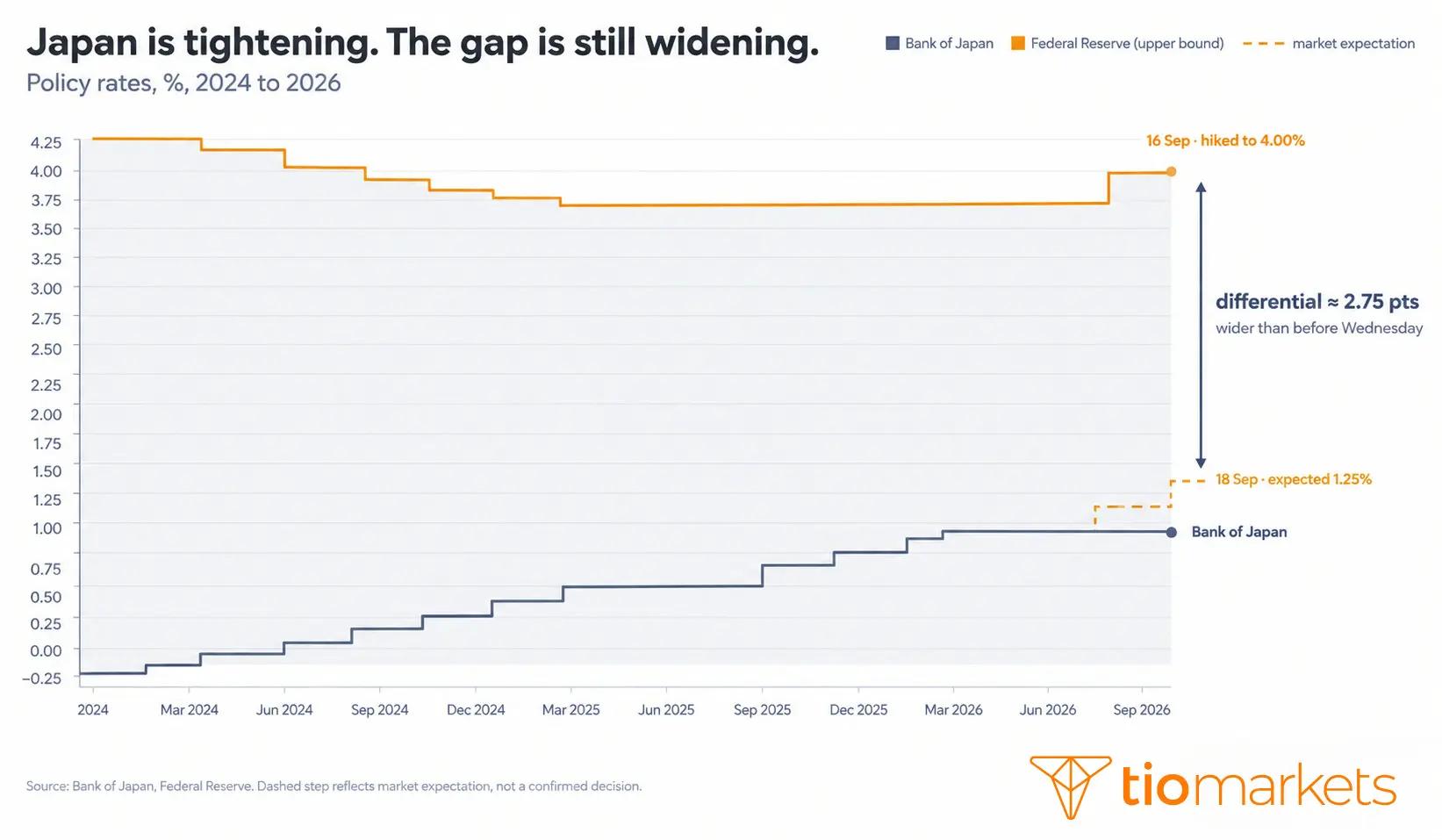
|September 17, 2026The Bank of Japan is widely expected to raise its policy rate to 1.25% on Friday. But the Federal Reserve raised its own range to 3.75%–4.00% on Wednesday, meaning the rate gap that drives the yen is wider than it was 48 hours ago. The vote split, Governor Kazuo Ueda's guidance and an inflation report released hours earlier may matter more for JPY than the hike itself.
BoJ Meeting Insights
- The BoJ's September meeting concludes on 18 September; the policy statement has no fixed release time, though statements typically appear between 02:30 and 03:30 UTC, while Governor Ueda's press conference is scheduled for 06:30 UTC.
- A Reuters poll conducted on 1–8 September found that 66 of 68 economists expected a 25-basis-point hike from 1.0% to 1.25%.
- The policy case is mixed but increasingly hawkish: July core CPI was 1.8%, yet real wages rose 2.4% year on year and the BoJ expects core inflation to move clearly above 2% in the second half of fiscal 2026.
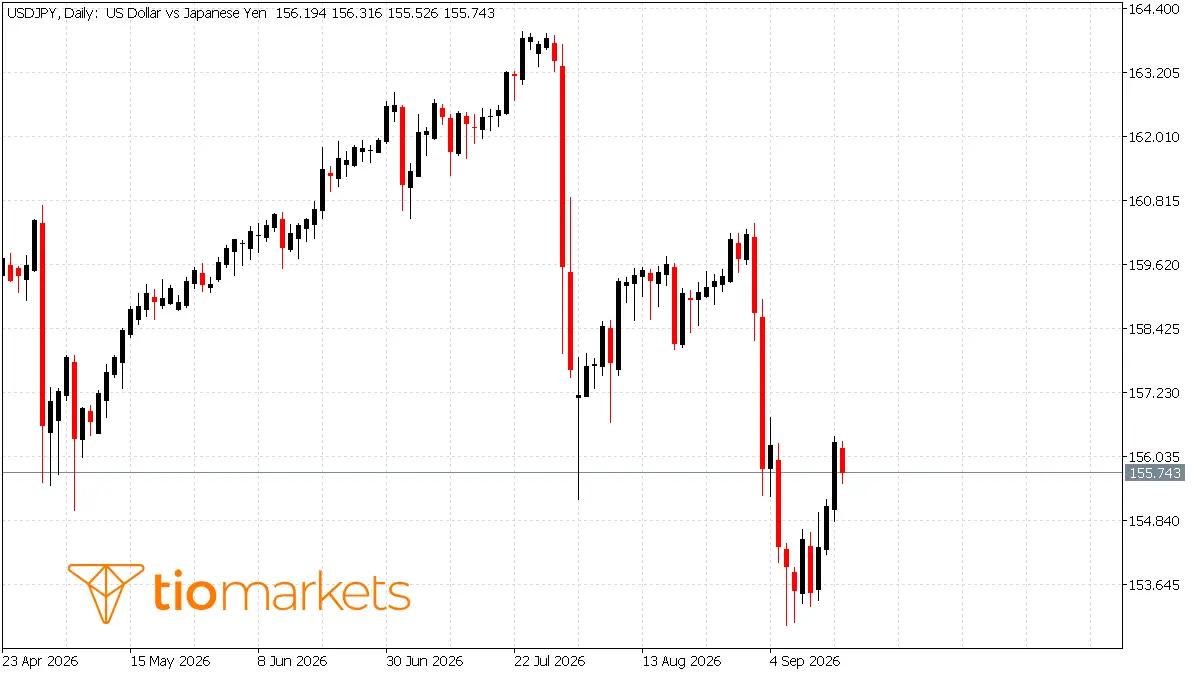
- USD/JPY has been trading in the 154.00 - 157.00 area, after Japan disclosed a record ¥15.3993 trillion of intervention from 30 July to 26 August in an operation the United States is reported to have joined.
- The Federal Reserve raised its target range to 3.75%–4.00% on 16 September in a unanimous 12–0 vote. Even a BoJ move to 1.25% would restore the differential to roughly 2.75 percentage points, matching where it stood before Wednesday rather than narrowing it.
- Because a hike is widely expected, the yen’s reaction may depend on the vote, the tone on future tightening and whether Ueda treats currency-driven inflation as an ongoing risk.
What is the BoJ interest rate decision on Friday?
The Bank of Japan’s Policy Board meets on Thursday and Friday, 17–18 September 2026. The BoJ lists the policy statement's release time as "undecided", which is standard for its meetings, though statements typically appear between 02:30 and 03:30 UTC. Governor Kazuo Ueda is due to speak at 06:30 UTC, giving markets a second opportunity to reassess the decision.
The policy rate is currently 1.0%. The BoJ raised it from 0.75% in June, then held it unchanged on 31 July by an 8–1 vote. The dissent was important: board member Hajime Takata proposed 1.25%, arguing for a more nimble response to upside price risks and changing overseas financial conditions.
That July split now looks less isolated. In a Reuters poll reported on 10 September, all but two of 68 economists forecast another quarter-point increase on 18 September. The survey therefore makes a rise to 1.25% the clear consensus outcome, although consensus is not a guarantee.
Why the yen may react to the message, not the interest rate
When an outcome is heavily anticipated, the first market move can be driven by how the decision differs from expectations rather than by the decision in isolation. A 25-basis-point hike accompanied by cautious language may produce a different JPY response from the same hike paired with concern about persistent inflation and a willingness to move again.
Three details could shape that gap. First is the vote. A broad majority for 1.25% would suggest that July’s dissent developed into a shared judgment. New opposition to the hike, by contrast, would show more concern about growth or the lagged effects of previous tightening.
Second is guidance. The July Outlook Report said the BoJ would continue raising rates if activity, prices and financial conditions evolved in line with its outlook. Markets will look for any change to the phrases “timing and pace” and “upside risks”, as well as Ueda’s description of financial conditions after a move to 1.25%.
Third is the yen itself. The BoJ does not target an exchange rate, but officials have repeatedly said currency moves can influence activity, import prices and underlying inflation. That matters because the pass-through from a weaker yen to prices may be stronger when companies are already more willing to raise wages and selling prices.
The data case: softer current inflation, firmer forward pressure
Japan’s latest national consumer-price data look relatively calm on the surface. In July, headline inflation was 1.9% year on year, inflation excluding fresh food was 1.8%, and inflation excluding fresh food and energy was 1.9%, according to the Statistics Bureau. August national CPI is scheduled for 23:30 UTC on Thursday 17 September, several hours before the BoJ statement appears, and could alter the market's interpretation ahead of the decision.
Tokyo’s August reading offered a useful lead: inflation excluding fresh food was 1.8%, while the measure excluding fresh food and energy rose 2.0%. Government measures held down energy prices, so policymakers are likely to look beyond the headline number to service prices, non-fresh food and evidence of persistent pass-through.
Wages strengthen the case for gradual normalisation. Provisional July data showed total cash earnings up 4.7% from a year earlier and real wages up 2.4%. The latter was the seventh consecutive positive month. A durable wage-price cycle would make inflation more persistent than a temporary shock from imported energy or food.
Growth has not collapsed under higher rates. The Cabinet Office’s second estimate showed real GDP expanding 0.4% quarter on quarter, or 1.4% at an annualised rate, in April–June. Consumption was flat and business investment declined, however, leaving the BoJ with a genuine balance to strike between inflation risk and domestic demand.
The Fed moved first, and Tokyo's hike only catches up
On 16 September the Federal Open Market Committee raised its target range to 3.75%–4.00% in a unanimous 12–0 vote, its first increase since July 2023.
That timing matters for the arithmetic behind the yen. The differential widened to roughly 3.00 percentage points on Wednesday, from 2.75 before it. A Boj move to 1.25% on Friday would bring it back to 2.75 points. The point is what does not achieve. Tokyo would be spending its hike to return the gap where it already was ,not to narrow it. For a currency whose weakness is driven by that differential, restoring the status could lead to a weaker outcome than the headline suggests.
USD/JPY has been trading in the 154.00 to 157.00 area, well below the 160.20–22 level the BoJ recorded at 08:00 UTC on 31 July.
Trade JPY Pairs with TIOmarkets
Central bank decisions can lead to price fluctuations in currency pairs like USD/JPY. Access the forex market with TIOmarkets by opening a Standard account with a minimum deposit of just $20, and experience fast execution and tight spreads.
Trading is risky
A record intervention, and an unusual partner
Japan's Ministry of Finance disclosed ¥15.3993 trillion of foreign-exchange intervention between 30 July and 26 August, a record. Reporting indicates the United States participated in a coordinated yen-buying effort, a rare step.For scale, Japan had already deployed a then-record ¥11.73 trillion across April and May 2026. August exceeded it.
The effect faded faster than the operation
The August intervention briefly pushed USD/JPY from above 163 to 156.34. Within roughly two weeks, about half that move had been retraced.
One consequence ran against the intention
Japanese investors net bought more than ¥5 trillion of foreign equities and long-term bonds in the two weeks to late August, after intervention had strengthened the yen. A stronger yen gave them a better rate at which to buy overseas assets.
Market commentary at the time described the effect as amplifying carry trades rather than removing the underlying incentive. Japanese investors held roughly $1.1 trillion of US Treasuries as of June, so the flow is large enough to matter.
The pattern is worth understanding. Intervention can change the level quickly. It does not change the rate differential that creates the incentive to sell yen in the first place, and that differential just widened.
This creates a two-sided setup for Friday. A firmer yen may reduce some imported-inflation pressure, but a hike that is already positioned for may produce a limited or short-lived appreciation unless the guidance changes the expected policy path.
Three scenarios after the BoJ interest rate decision
| Scenario | Trigger | Possible market implication | Evidence / invalidation |
| Hike + firmer path | Rate rises to 1.25%; broad vote; Ueda stresses upside risks or leaves the door open to another near-term move. | JPY could strengthen; short-dated JGB yields may rise; exporters may face an FX headwind while banks may benefit from higher rates. | Watch the vote, “timing and pace” language and Ueda’s inflation assessment. A sharp global risk-off dollar rally could weaken the JPY response. |
| Hike + balanced guidance | Rate rises to 1.25%, but the BoJ emphasises data dependence, lagged effects and uncertainty. | Initial JPY gains could fade; the JGB curve may respond more to guidance than the hike; equities could split between financials and rate-sensitive sectors. | This is closest to the survey consensus. It weakens if the statement materially shifts toward faster normalisation or flags a prolonged pause. |
| Hold / dovish surprise | Rate remains at 1.0%, or a hike is paired with language suggesting a long pause. | JPY could weaken and short-dated yields could fall; equities may initially rise, but renewed currency weakness could increase intervention and imported-inflation concerns. | Watch whether a hold is tied to growth, market stability or fresh CPI data. Strongly hawkish guidance could offset the initial dovish signal. |
Watch whether a hold is tied to growth, market stability or fresh CPI data. Strongly hawkish guidance could offset the initial dovish signal.
These are analytical scenarios, not forecasts or trading recommendations. Cross-asset reactions can be reversed by global rates, risk sentiment, energy prices or position adjustments.
What to watch on Friday
- August national CPI is scheduled for 23:30 UTC on Thursday 17 September, several hours before the BoJ statement appears, and could alter the market's interpretation ahead of the decision.
- Policy statement timing: the BoJ does not fix a release time, though statements typically appear between 02:30 and 03:30 UTC.
- 06:30 UTC - Governor Ueda's press conference: listen for how he characterises 1.25% still accommodative, closer to neutral, or a reason to slow the pace.
- USD/JPY reference areas: the 154.00 to 157.00 band the pair has been trading in; 156.34, the trough reached during the August intervention; and 160.20–22, the BoJ's 31 July reference. These are context markers, not entry or exit levels.
- Cross-asset confirmation: two-year and ten-year JGB yields, bank shares, exporters and the broader Nikkei/TOPIX response can help show whether markets interpret the decision as a one-off move or a change in the policy path.
Risks and uncertainties
The decision lands amid substantial external uncertainty. Oil prices and the Middle East can affect Japan through both inflation and real-income channels. Global AI investment supports parts of Japanese exports and capital spending, but a reversal in technology demand could weaken that support. Changes in US rates and the dollar may also dominate the yen’s response even if the BoJ meets expectations.
Domestic data are not one-directional. Positive real wages and a tight labour market support consumption over time, yet second-quarter consumption was flat and business investment fell. Government price-relief measures also make headline CPI a less complete guide to underlying inflation.
There is also a political dimension. Prime Minister Sanae Takaichi has reportedly expressed reservations about further rate increases, and the government nominated two reflationist academics to the Policy Board. Board composition and political positioning can influence how quickly a tightening path develops, independently of the data. Intervention has become less durable with each operation. August moved USD/JPY sharply, then roughly half the move reversed within two weeks. Each operation that fades faster than the last reduces the credibility of the next one, which is a constraint on the Ministry of Finance rather than on the BoJ.
Finally, foreign-exchange intervention can change short-term price action without settling the longer-term policy debate. The BoJ sets monetary policy for price stability, while the Ministry of Finance is responsible for intervention decisions.
Conclusion
A move to 1.25% would be historically notable, but it would not close the gap that drives the yen. The Federal Reserve moved first on Wednesday, and Tokyo's potential quarter-point move on Friday would only bring the gap back to where it started the week.
That is why the guidance matters more than the rate. With a hike widely expected, the more informative signals are the vote, the BoJ's view of underlying inflation, and Ueda's description of what comes next. Friday's same-day CPI release adds one more variable to an event in which the message may matter more than the headline.

FAQ
Risk disclaimer: CFDs are complex instruments and come with a high risk of losing money rapidly due to leverage. You should consider whether you understand how CFDs work and whether you can afford to take the high risk of losing your money. Never deposit more than you are prepared to lose. Professional client’s losses can exceed their deposit. Please see our risk warning policy and seek independent professional advice if you do not fully understand. This information is not directed or intended for distribution to or use by residents of certain countries/jurisdictions including, but not limited to, USA & Countries included in the OFAC sanction list. The Company holds the right to alter the aforementioned list of countries at its own discretion.
TIOmarkets offers an exclusively execution-only service. The views expressed are for information purposes only. None of the content provided constitutes any form of investment advice. The comments are made available purely for educational and marketing purposes and do NOT constitute advice or investment recommendation (and should not be considered as such) and do not in any way constitute an invitation to acquire any financial instrument or product. TIOmarkets and its affiliates and consultants are not liable for any damages that may be caused by individual comments or statements by TIOmarkets analysis and assumes no liability with respect to the completeness and correctness of the content presented. The investor is solely responsible for the risk of his/her investment decisions. The analyses and comments presented do not include any consideration of your personal investment objectives, financial circumstances, or needs. The content has not been prepared in accordance with any legal requirements for financial analysis and must, therefore, be viewed by the reader as marketing information. TIOmarkets prohibits duplication or publication without explicit approval.
Join us on social media



Authors BIO

An experienced financial analyst and educator with over 8 years of expertise covering gold, forex, and global financial markets. Ahmed specializes in blending price action analysis with macroeconomic data to accurately interpret market movements, providing readers with comprehensive educational insights into trading and the financial world.