


Cocoa Trading: How to Trade Cocoa Online
BY Maria K.
|September 14, 2026Cocoa trading involves buying and selling contracts based on cocoa bean prices on global terminal markets and physical exchanges. Online traders can access the cocoa market through standardized futures contracts on regulated exchanges or through derivative instruments such as contracts for difference (CFDs) offered by online brokers, like TIOmarkets.
The global cocoa market is valued at approximately $2.1 billion, with trading occurring on major exchanges including ICE Futures US in New York and ICE Futures Europe in London. Therefore, cocoa represents one of the most actively traded soft commodities in global financial markets, as significant price volatility creates opportunities - and risks - for market participants.
This article explains all about cocoa commodity trading, including how cocoa prices are determined, how to trade cocoa CFDs, trading strategies, risk factors, and the distinction between US cocoa vs London cocoa contracts.
What Is Cocoa Trading
Cocoa trading is the practice of speculating on or hedging against price movements in cocoa beans, which are primarily used to produce chocolate and cocoa-based products. Traders access cocoa markets through standardized futures contracts or derivative instruments without handling physical beans.
Understanding Cocoa as a Commodity
Cocoa belongs to the category of soft commodities, which includes agricultural products that are grown rather than extracted or mined from the earth. The cocoa bean has served as a valuable commodity for centuries, with historical records indicating its use as currency as far back as 600 AD. European traders began exporting it from Central America around 1585, establishing the foundations of international cocoa commerce that continues today.
In contemporary markets, it finds applications across multiple industries, including confectionery, pharmaceuticals, and cosmetics. This diversified demand contributes to the commodity's ongoing market relevance and trading volume.
Physical Cocoa Market vs Financial Cocoa Market
The physical cocoa market involves actual transactions of beans between producers, traders, processors, and manufacturers who require the underlying commodity.
The financial cocoa market operates through cocoa derivatives contracts that derive their value from underlying prices without requiring physical delivery. Futures contracts, options, and CFDs enable market participants to gain exposure to cocoa price movements for speculation or hedging purposes. Traders can choose between UK and US contracts depending on their preferred trading currency and exchange specifications.
Why Does Cocoa Origin Matter to Your Trading
Approximately 70% of global production comes from West Africa, with Côte d'Ivoire producing 1.45 million tonnes annually and Ghana producing 840,000 tonnes. This geographic concentration means that weather events, political developments, or agricultural challenges in these regions can significantly impact global supply and consequently affect prices across all cocoa trading instruments. For retail traders, this concentration creates both volatility opportunities and risk factors that require monitoring of region-specific news and developments.
Reading Supply Signals: What Traders Need to Monitor
Traders can benefit from understanding cocoa supply and demand dynamics - especially how production conditions in West Africa and Latin America, combined with weather patterns, drive price movements.
The concentration of cocoa production in a limited geographic area means that localized events can have outsized impacts on global prices, creating potential trading opportunities for those who monitor supply conditions closely. Historical examples include price spikes following poor harvests, disease outbreaks affecting cocoa trees, and political instability disrupting supply chains in major producing countries.
Traders typically monitor supply news through sources including the International Cocoa Organization reports, agricultural weather services covering West Africa, government harvest estimates from major producing countries, and industry publications covering market developments. Understanding seasonal harvest patterns helps contextualize production data and anticipate potential supply constraints.
Read more on what drives cocoa trading prices in the section below.
What Factors Influence Cocoa Trading Prices?
Cocoa prices respond to supply and demand fundamentals, with major influences including weather patterns in West Africa, crop diseases, political stability in producing countries, currency fluctuations (particularly GBP and USD), processing demand, and inventory levels at major exchanges.
Supply Factors
As with coffee trading, weather conditions represent the primary supply-side influence on prices, with adequate rainfall during growing seasons essential for healthy crop development and bean quality. Climate patterns can significantly alter precipitation levels in West African growing regions, affecting harvest outcomes and future supply expectations. Crop diseases and pest infestations pose ongoing threats to production. Production forecasts issued by government agricultural departments and industry organizations provide forward-looking supply estimates that influence futures pricing throughout the growing season.
Demand Factors
Global chocolate consumption trends drive the majority of demand, with consumption patterns varying seasonally and geographically across consumer markets in Europe, North America, and increasingly in emerging economies. Processing demand, measured through grinding statistics published by industry associations, serves as a leading indicator of commercial requirements. Health perceptions of chocolate products or periodic research findings influence consumer behavior and consequently cocoa demand. Emerging market demand growth, particularly in Asia, represents a significant factor in long-term demand projections.
Market-Specific Factors
Exchange inventory levels at ICE-monitored warehouses provide visible supply data that influences market sentiment and price discovery in cocoa futures markets. Currency movements affect prices because the commodity trades in multiple currencies, with USD-denominated US cocoa and GBP-denominated London cocoa contracts responding differently to exchange rate fluctuations. Political stability in producing regions affects both current supply flows and future production expectations, with governance challenges in West African nations historically contributing to cocoa price volatility.
Recent Price Movements
The cocoa market experienced significant price movements in 2024, with prices reaching record highs driven by supply concerns from West African producing regions. These price levels represented substantial year-over-year increases and highlighted the commodity's potential for significant volatility during periods of supply uncertainty. Seasonal price patterns typically reflect harvest cycles, with main crop harvests occurring from October through March and mid-crop harvests from May through August in West African producing countries.
Current 2026 Cocoa Prices
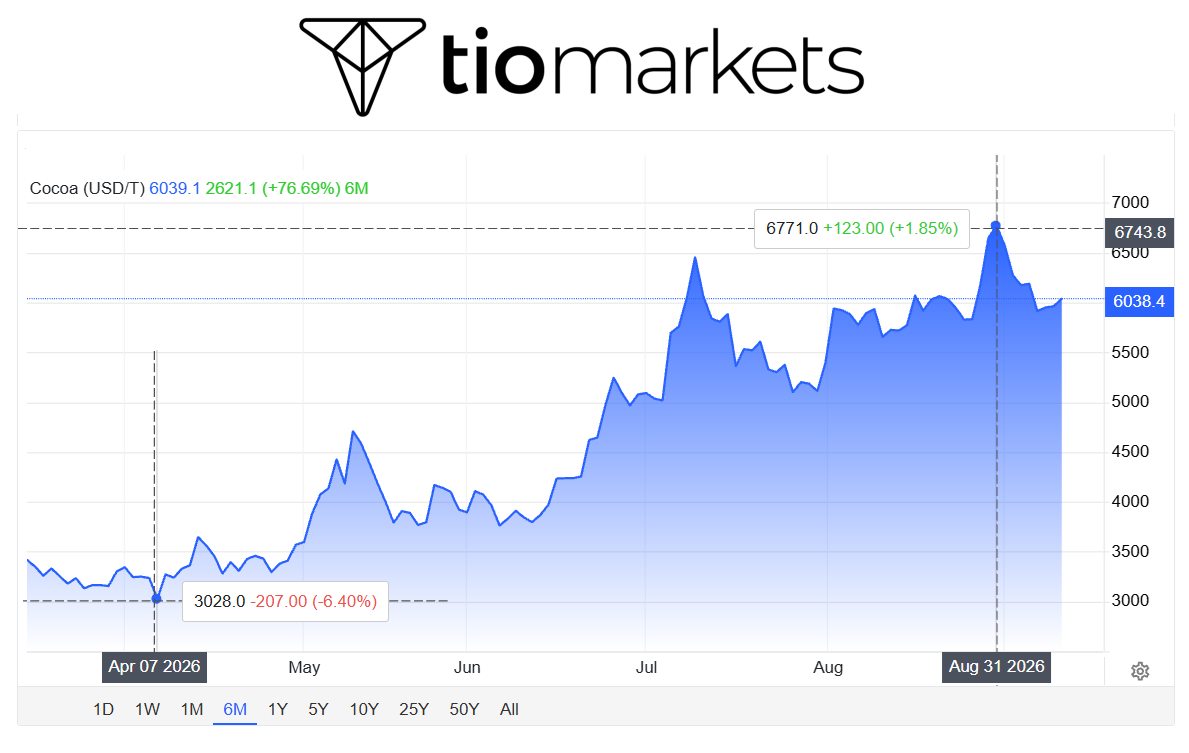
Over the six months shown, cocoa prices have experienced a substantial rally, climbing from around 3,000 USD per metric ton in April 2026 to over 6,700 USD per metric ton by the end of August 2026, representing an increase of more than 110%. Such significant price movements illustrate the volatility characteristic of cocoa markets and highlight why understanding supply-demand fundamentals remains important for market participants.
How Does Cocoa Trading Work?
As mentioned, cocoa trading takes place primarily through futures markets, where standardized contracts trade on regulated exchanges such as ICE New York, ICE London, and CME Europe. Each standard futures contract represents 10 metric tonnes of beans.
For retail traders, CFDs offer an accessible alternative to full futures contracts. These derivative products track benchmark futures prices without requiring the same capital commitment, allowing smaller participants to speculate on cocoa price movements. More on cocoa CFD trading in the section that follows.
But first, it is good to understand an important distinction between the two main contract types. US contracts are priced in USD, while London contracts are priced in GBP or EUR. For reference, at current levels, US Cocoa CFDs trade around $5,940 per metric ton while London Cocoa CFDs trade near £4,150 per metric ton, though these prices fluctuate continuously during market hours.
What Are Cocoa CFDs?
Cocoa CFDs allow traders to speculate on cocoa price movements without owning futures contracts or physical beans. CFDs offer flexible position sizes, the ability to go long or short, and typically require lower initial capital than futures trading.
Cocoa CFD Trading Characteristics
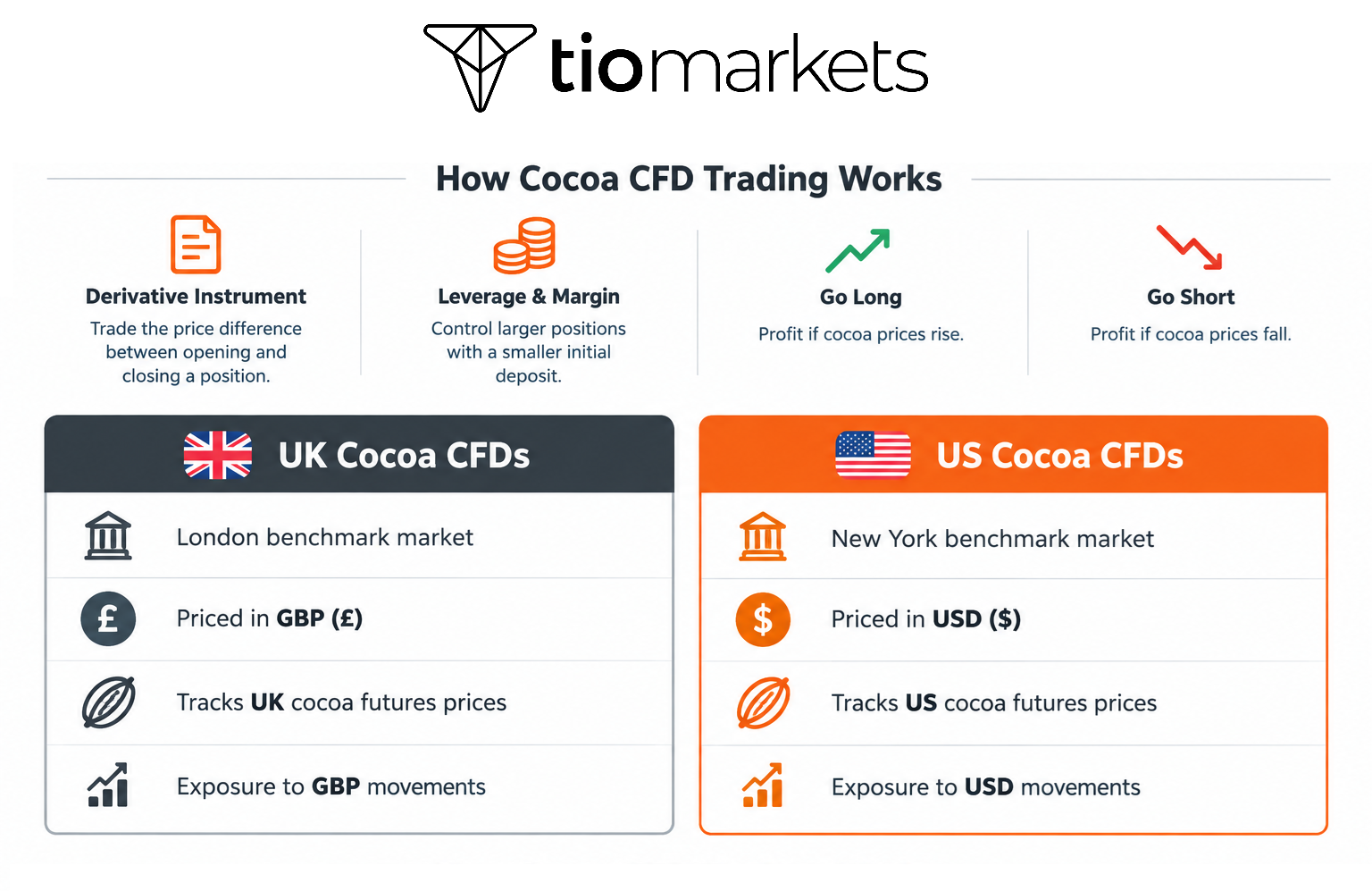
Contracts for difference are derivative instruments where traders exchange the difference in an asset's price between the opening and closing of a position. UK cocoa CFDs track London-based benchmark prices denominated in British pounds, while US cocoa CFDs track New York benchmark prices denominated in US dollars.
CFD trading involves leverage and margin, meaning traders can control larger position sizes with smaller capital outlays, though this amplifies both potential gains and losses. Long positions profit from rising prices while short positions profit from falling prices, providing flexibility to trade in either market direction.
CFD Advantages and Considerations
CFDs typically require lower capital commitments compared to futures contracts, making cocoa trading more accessible to retail market participants. Flexible contract sizes allow traders to adjust position sizes based on their account capital and risk tolerance rather than being constrained to standard futures contract sizes.
For example, TIOmarkets offers the possibility to trade commodity CFDs; with the UK and US Cocoa ones featuring minimum volume requirements of just 0.01 lots, enabling traders to open positions worth a fraction of standard futures contracts. With contract sizes of 30 (GBP) for UK Cocoa and 10 (USD) for US Cocoa, traders can precisely calibrate their exposure to match their risk management requirements.
While CFDs offer flexible trading hours, overnight financing costs apply to positions held beyond the trading day. Counterparty risk exists because CFDs are agreements with the issuing broker rather than exchange-traded contracts. Regulatory frameworks for CFD trading vary across jurisdictions, affecting available leverage levels and investor protections.
Why Trade Cocoa CFDs with TIOmarkets
TIOmarkets provides an accessible entry point for cocoa trading with competitive conditions on both UK and US Cocoa CFDs. Traders can start with positions as small as 0.01 lots, making it ideal for beginners or those testing new strategies. Low margin requirements of just 2% for US Cocoa and 3% for UK Cocoa mean less capital is tied up in each trade. With the flexibility to choose between GBP-denominated UK Cocoa or USD-denominated US Cocoa contracts, traders can select the market that best suits their trading preferences and currency exposure.
See below the UK and US Cocoa CFDs specifications, including contract size, minimum volume in lots and margin percentage requirements.
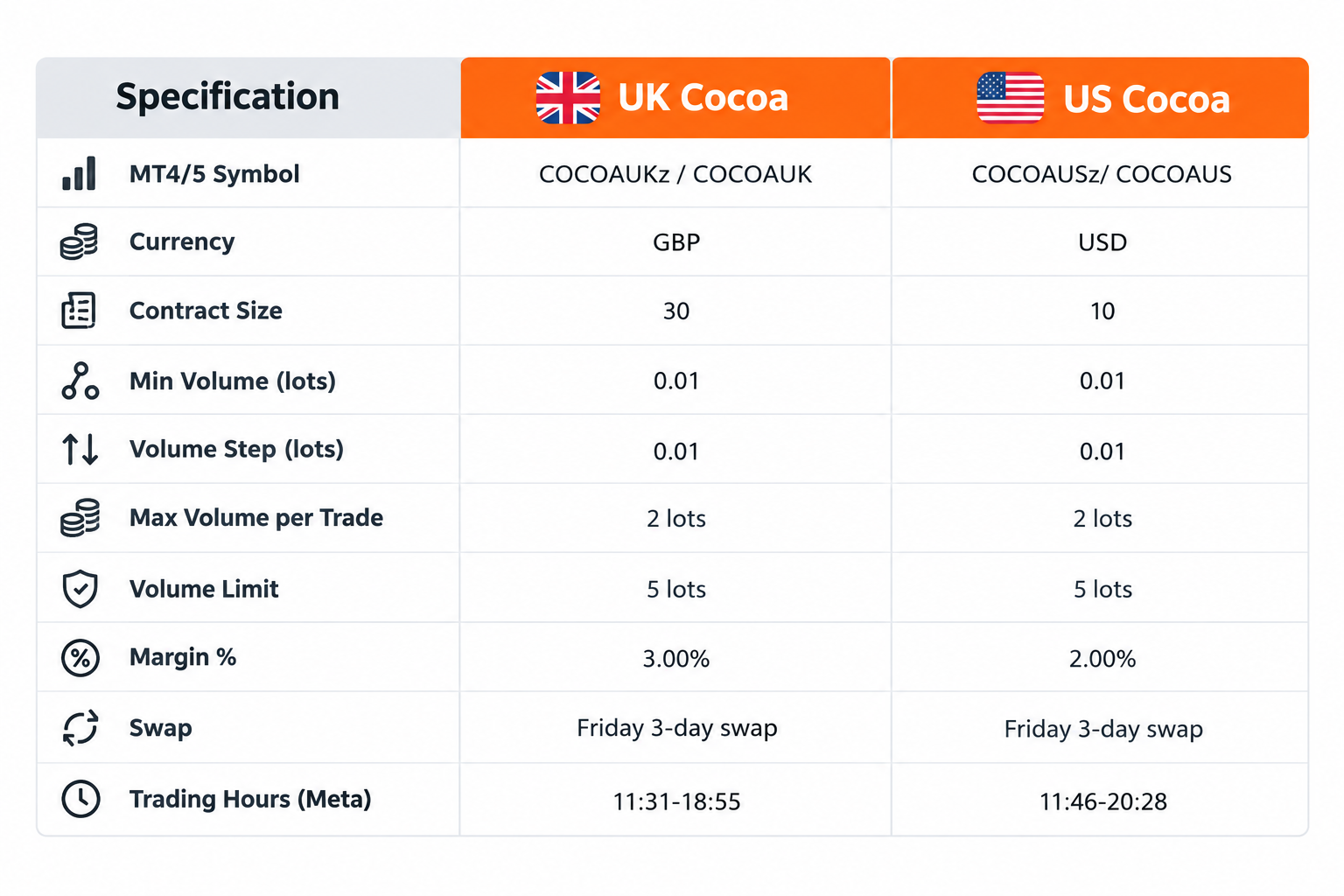
UK Cocoa and US Cocoa offer similar trading conditions, but they differ in pricing currency, contract size, margin requirements, and trading hours. Traders may choose between them based on their preferred currency exposure, capital requirements, and trading schedule.
Cocoa CFDs vs Cocoa Futures Comparison
| Feature | Cocoa CFDs | Cocoa Futures |
| Contract Size | Flexible, often fractional | Standardized (10 metric tonnes) |
| Capital Required | Lower margin requirements | Higher margin requirements |
| Trading Venue | Through CFD broker | Regulated exchange (ICE) |
| Position Direction | Long or short | Long or short |
| Physical Delivery | Never | Possible at expiration |
| Overnight Costs | Financing charges apply | No financing charges |
How to Start Trading Cocoa CFDs
Step 1: Choose a Regulated Broker
Selecting a regulated broker provides important protections for retail traders entering the cocoa market through CFD instruments. TIOmarkets operates as a regulated cocoa CFD broker offering trading through two types of cocoa CFDs, with trading conditions and execution speed designed to support retail trading requirements. Traders can choose between four trading account types to match their trading preferences and capital levels.
Step 2: Understand Contract Specifications (US vs UK Cocoa)
Before placing trades, understanding the specific contract details for each cocoa instrument - as presented above for TIOmarkets - helps traders calculate position sizes, margin requirements, and potential profit or loss scenarios accurately.
Step 3: Fund Your Account and Set Leverage
TIOmarkets provides multiple deposit options for funding trading accounts, with the ability to begin trading with an unverified profile for up to 14 days. Leverage options include high leverage levels, though traders should understand that leverage amplifies both gains and losses. Appropriate risk management practices become increasingly important when using higher leverage settings.
Step 4: Place Your First Trade
Trading platforms MT4 and MT5 support cocoa CFD trading with standard order types for entering long or short positions. For detailed guidance on executing commodity trades, traders can reference the guide on how to trade commodities on MT4 and MT5.
What Are Common Cocoa Trading Strategies?
Common cocoa trading strategies include fundamental analysis based on supply-demand factors, technical analysis using price patterns and indicators, and seasonal strategies aligned with harvest cycles. No single approach guarantees results, and market conditions determine which methods may be more relevant at different times.
Fundamental Analysis Approaches
Fundamental analysis in cocoa trading involves assessing supply and demand factors to form expectations about future price direction. Weather pattern monitoring in West African producing regions provides insights into potential crop outcomes and supply availability.
Crop report analysis from government agencies and industry organizations offers data on production estimates, while ICCO publications provide comprehensive market statistics. Geopolitical event evaluation helps traders understand factors that might disrupt supply chains or affect production in major cocoa-producing countries.
Technical Analysis Methods
Technical analysis applies chart-based methods to identify potential trading opportunities based on price patterns, trends, and market behavior indicators. Support and resistance identification helps traders recognize price levels where buying or selling pressure may emerge.
Trend analysis in cocoa prices examines directional movements over various timeframes, while volume analysis provides context about market participation levels at different price points. Technical indicators commonly applied to commodities include moving averages, relative strength measures, and momentum oscillators.
Seasonal Considerations
Cocoa markets exhibit seasonal patterns related to harvest cycles in producing regions, with the main crop typically harvested from October through March and the mid-crop from May through August. Historical price patterns during crop seasons may provide context for current market conditions, though past patterns do not guarantee future results.
Demand seasonality around holidays, particularly chocolate-consuming occasions in major markets, can influence cocoa grinding demand and prices in preceding months.
Risk Management Practices
Position sizing relative to account capital helps manage exposure to adverse price movements in volatile commodity markets. Stop-loss placement considerations involve balancing protection against losses with allowance for normal price fluctuations.
Diversification across commodities may reduce concentration risk, though correlations between agricultural markets can increase during certain market conditions. Volatility assessment helps traders adjust position sizes and risk parameters to account for changing market conditions.
What Are the Risks in Cocoa Trading
Cocoa trading carries multiple risks including price volatility, leverage risk, liquidity risk, and geopolitical risk. Cocoa can experience significant price swings due to weather and supply disruptions, while futures and CFDs amplify both gains and losses through leverage.
- Market Volatility: Cocoa has historically exhibited significant price volatility compared to some other commodities, with weather-related supply disruptions capable of causing rapid price movements.
- Leverage and Margin: Leveraged trading products amplify both potential profits and potential losses, meaning adverse price movements can result in losses.
- Fundamental and Geopolitical Risks: Weather-related production shocks or political instability can rapidly shift supply expectations and prices.
Conclusion
Key Takeaways
- Cocoa is a volatile soft commodity with prices heavily influenced by West African weather and production conditions.
- Traders can access cocoa markets through futures or CFDs, with CFDs offering lower capital requirements and flexible position sizing.
- US Cocoa trades in USD while UK Cocoa trades in GBP; choice is based on currency preference and trading schedule.
- TIOmarkets offers both UK and US Cocoa CFDs with minimum volumes of 0.01 lots and margin requirements as low as 2%.
- Effective risk management is critical given cocoa's price volatility and the leverage involved in CFD trading.

FAQ
Risk disclaimer: CFDs are complex instruments and come with a high risk of losing money rapidly due to leverage. You should consider whether you understand how CFDs work and whether you can afford to take the high risk of losing your money. Never deposit more than you are prepared to lose. Professional client’s losses can exceed their deposit. Please see our risk warning policy and seek independent professional advice if you do not fully understand. This information is not directed or intended for distribution to or use by residents of certain countries/jurisdictions including, but not limited to, USA & Countries included in the OFAC sanction list. The Company holds the right to alter the aforementioned list of countries at its own discretion.
TIOmarkets offers an exclusively execution-only service. The views expressed are for information purposes only. None of the content provided constitutes any form of investment advice. The comments are made available purely for educational and marketing purposes and do NOT constitute advice or investment recommendation (and should not be considered as such) and do not in any way constitute an invitation to acquire any financial instrument or product. TIOmarkets and its affiliates and consultants are not liable for any damages that may be caused by individual comments or statements by TIOmarkets analysis and assumes no liability with respect to the completeness and correctness of the content presented. The investor is solely responsible for the risk of his/her investment decisions. The analyses and comments presented do not include any consideration of your personal investment objectives, financial circumstances, or needs. The content has not been prepared in accordance with any legal requirements for financial analysis and must, therefore, be viewed by the reader as marketing information. TIOmarkets prohibits duplication or publication without explicit approval.
Join us on social media



Authors BIO

Maria is a writer and content strategist with over 10 years of experience in the finance industry. She specializes in developing research-backed articles that help financial professionals navigate complex market topics with confidence. Her expertise spans forex, stocks, CFDs and global markets, creating insightful content that educates readers and supports informed decision-making.