What Are Penny Stocks? Definition, Trading and Considerations
BY Maria K.
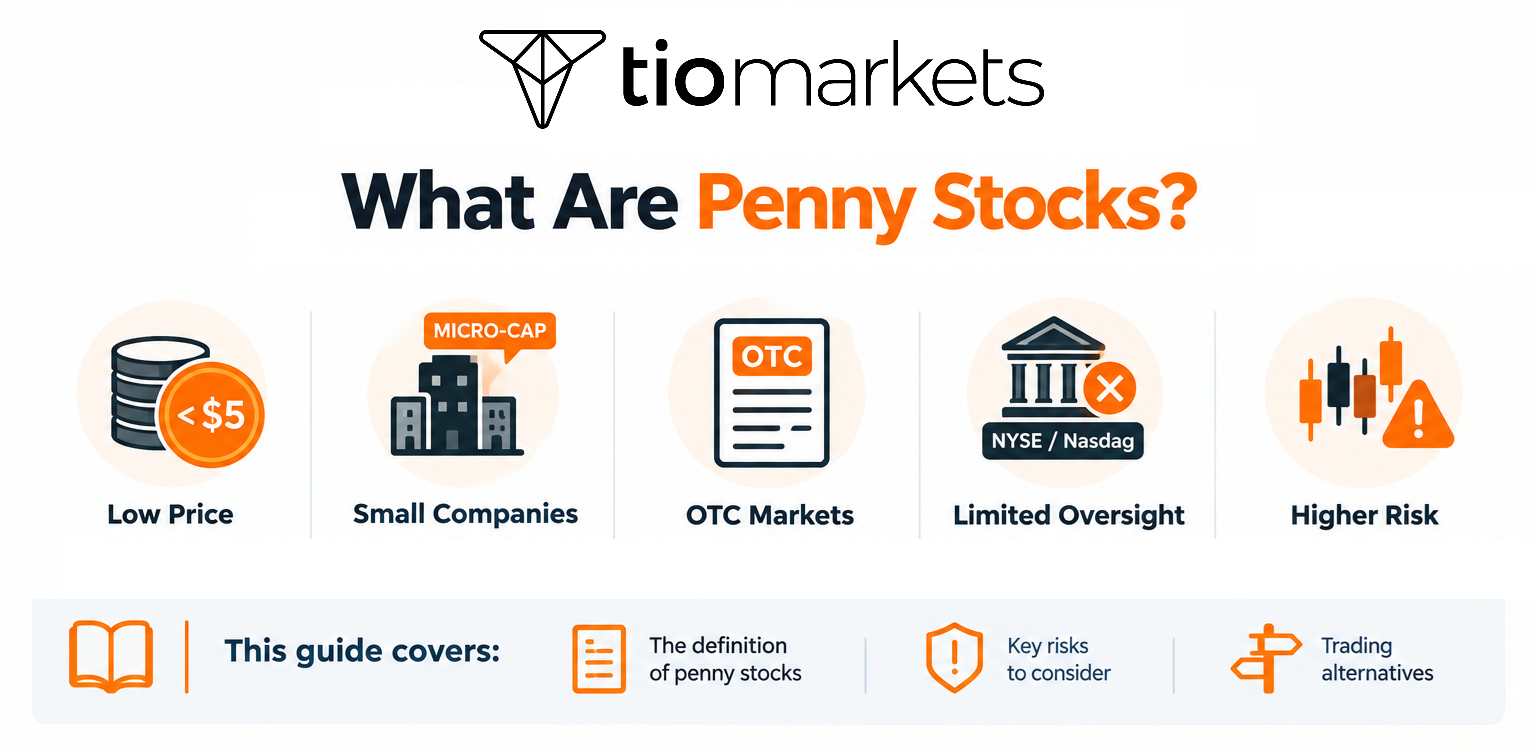
|September 17, 2026Penny stocks are shares of small companies that typically trade for less than $5 per share, according to the U.S. Securities and Exchange Commission. These low-priced stocks often represent micro-cap companies with market capitalizations below $300 million and frequently trade on over-the-counter markets rather than major exchanges like the NYSE or Nasdaq.
| Penny stocks definition: Shares of small companies trading below $5 per share (SEC definition), typically on over-the-counter (OTC) markets with limited regulatory oversight. |
This guide answers the question "what are penny stocks" comprehensively, covering definitions, risks, and trading alternatives. Understanding what are penny stocks, how they trade, and what distinguishes them from regular stocks can help traders make informed decisions about whether these securities align with their financial goals and risk tolerance.
What Are Penny Stocks?
Penny stocks are shares of small companies trading below $5 per share under SEC definitions, typically on over-the-counter markets with limited regulatory oversight and reduced disclosure requirements.
The U.S. Securities and Exchange Commission defines penny stocks as equity securities trading below $5 per share that don't meet specific exemptions, such as being listed on a national exchange. This is a regulatory definition for classifying these securities in the US, though the term historically referred to stocks trading for literal pennies.
Market capitalization characteristics typically place penny stock companies in micro-cap territory, generally below $300 million in total market value. This small size contributes to many of the distinctive features associated with penny shares, including limited trading volume and reduced analyst coverage.
The distinction between price-based and market-cap-based definitions matters for regulatory purposes. Some exchange-listed stocks may trade below $5 without being classified as penny stocks due to their listing status and disclosure compliance.
International variations exist in how different regulatory bodies define penny stocks. The UK, for example, uses different thresholds and terminology, often referring to these securities as "penny shares."
Micro-cap stocks attract traders for various reasons, including perceived accessibility and the mathematical potential for percentage gains, though these characteristics come with corresponding risks.
What Makes Penny Stocks Different From Regular Stocks?
Penny stocks differ from exchange-listed stocks primarily in regulatory requirements, liquidity levels, information availability, and volatility patterns, with companies facing fewer disclosure obligations and typically receiving less analyst coverage.
Regulatory and Disclosure Differences
SEC reporting requirements vary significantly between exchange-listed companies and OTC-traded penny stocks. Major exchange listings require quarterly and annual reports with audited financials, while many penny stock issuers face reduced obligations.
Exchange listing standards include minimum shareholder equity, market capitalization, and governance requirements that OTC stocks generally don't need to meet. Financial disclosure variations mean investors may access incomplete or outdated information, creating investor protection gaps.
Liquidity and Trading Differences
Average daily trading volumes for penny stocks often measure in thousands of shares rather than the millions typical of exchange-listed stocks, significantly impacting order execution.
Order size can directly move prices, and wide bid-ask spreads, sometimes 5% to 50% of share price, represent hidden trading costs. Market maker dependency means liquidity can effectively disappear without active dealers.
Where to Trade Penny Stocks?
To fully understand what are penny stocks, traders must also know where these securities trade. Penny stocks primarily trade on over-the-counter markets through electronic quotation systems, with the OTC Markets Group operating tiered platforms featuring different disclosure requirements, while some low-priced stocks trade on major exchanges.
Over-the-Counter Stocks Market Structure
The OTC Markets Group operates three primary tiers—OTCQX, OTCQB, and Pink—each with different disclosure standards. Unlike centralized exchanges, OTC trading occurs through broker-dealer networks with market makers providing liquidity.
Exchange-Listed Low-Priced Stocks
NYSE and Nasdaq maintain minimum price requirements, typically around $1 per share, for listing compliance. Companies falling below these thresholds face potential delisting if they cannot restore share prices within specified timeframes, often using reverse stock splits to maintain compliance.
The stocks available for CFD trading with TIOmarkets are exchange-listed securities, meaning they meet these minimum listing standards and regulatory requirements, offering greater transparency than OTC penny stocks.
What Are the Characteristics of Penny Stock Companies?
Typical characteristics of penny stock companies:
- Market cap: Below $300 million (micro-cap)
- Operating history: Limited or unproven track record
- Business model: Often unproven or speculative
- Revenue: Minimal or no operating revenue
- Profitability: Most operate at a loss
- Industries: Junior mining, cannabis, early-stage biotech
Knowing what are penny stocks extends beyond price: it includes understanding the companies behind them. Companies behind penny stocks typically have market capitalizations below $300 million, limited operating histories, unproven business models, and restricted access to capital, with many operating in early-stage industries or representing businesses in financial distress.
Types of Companies Issuing Penny Stocks
- Early-stage companies in growth sectors frequently issue penny stocks to raise capital when traditional financing isn't available.
- Established companies experiencing financial difficulties may see their shares relegated to penny stock status after delisting from major exchanges.
- Shell companies, which have little or no operations, also trade in penny stock markets for various purposes.
- Industry sector distribution patterns among penny stock companies tend to cluster in speculative areas like junior mining, cannabis, and early-stage biotechnology.
Financial Profile of Penny Stock Companies
Typical revenue ranges for penny stock companies often prove minimal, with many reporting limited or no operating revenue. Profitability patterns show that most penny stock companies operate at a loss. Cash position and burn rate considerations become critical when evaluating these companies, as many depend on continued financing to maintain operations.
These financial factors contribute to increased investment risk, as companies may face going-concern questions or eventual dissolution.
Why Are Penny Stocks Considered Volatile?
Penny stocks experience higher volatility than exchange-listed stocks due to low liquidity, smaller market capitalizations, limited public information, and susceptibility to price manipulation, with small absolute price changes representing large percentage movements.
The mathematical reality of penny stock volatility becomes apparent when examining percentage moves. A $0.10 price change on a $1.00 stock represents a 10% move, while the same absolute change on a $100 stock equals just 0.1%. For example, a stock moving from $0.50 to $0.75 represents a 50% gain, but the reverse move from $0.75 back to $0.50 means a 33% loss - illustrating how quickly gains can evaporate in penny stock markets.
Trading volume directly impacts price stability in penny stock markets. When few shares change hands daily, individual transactions can disproportionately affect market prices in ways rarely seen with liquid exchange-listed stocks.
Market manipulation vulnerabilities exist partly because small capital amounts can move prices significantly. Company-specific risk factors including limited revenue, cash burn rates, and uncertain business prospects add additional volatility sources.
Gap risk between trading sessions can prove particularly pronounced in penny stock investing, where after-hours news may trigger substantial opening price changes. Some traders are attracted to this volatility despite the associated risks. Understanding what are penny stocks means accepting that volatility is an inherent characteristic, not an exception.
What Risks Are Associated With Penny Stocks?
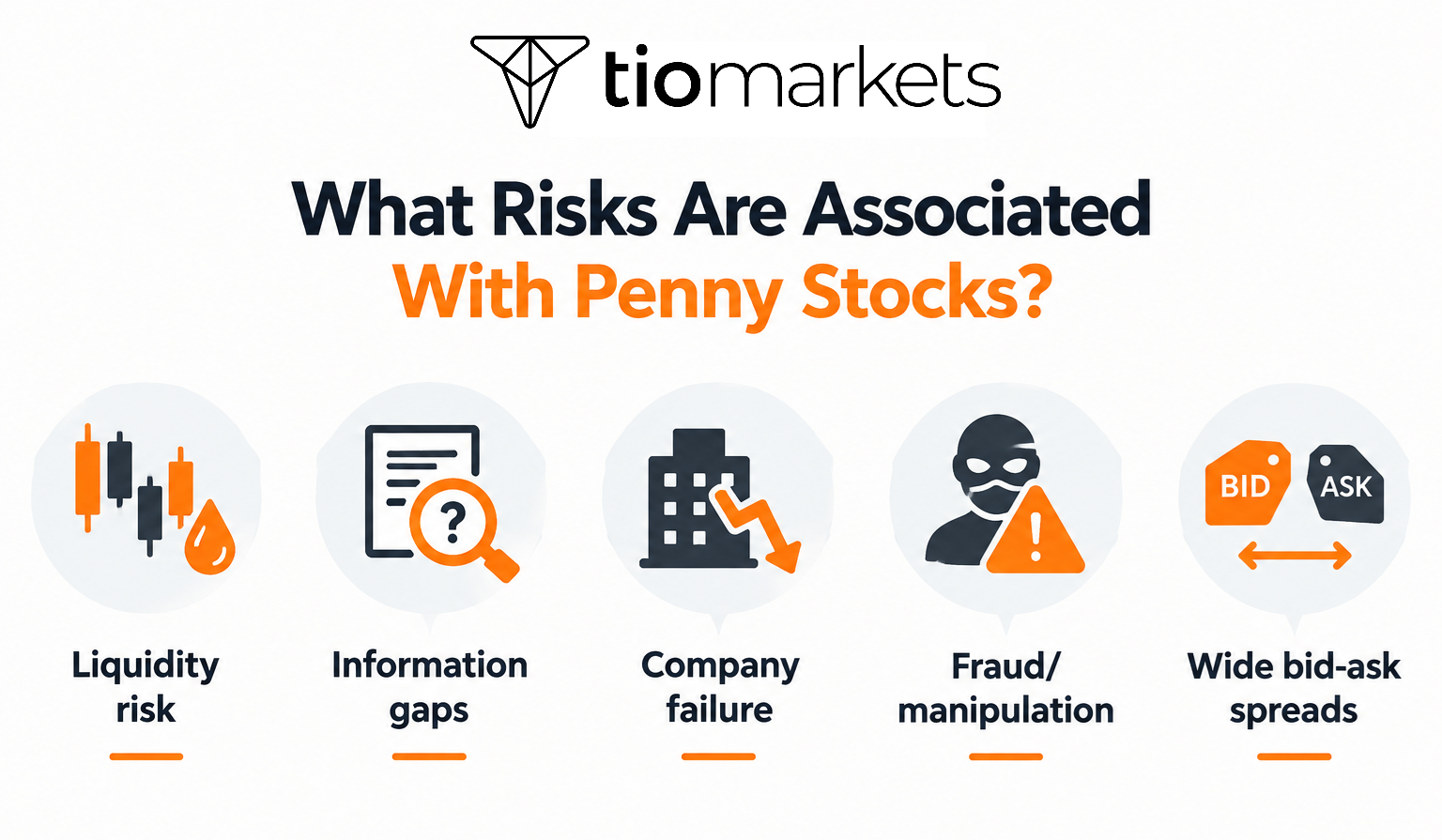
Understanding what are penny stocks also means recognising the elevated risks they carry. These include high volatility, low liquidity, limited regulatory oversight, information scarcity, susceptibility to fraud, and company failure rates that exceed those of exchange-listed stocks.
Liquidity and Execution Risk
Exiting positions at desired prices can prove difficult in penny stock markets. Wide bid-ask spreads may consume significant portions of any potential gains before traders even establish positions.
Larger orders can move prices against the trader, making it costly to build or liquidate meaningful positions. Market maker withdrawal can leave shareholders with no practical exit option.
There's no guarantee that buyers will exist when a trader wants to sell, potentially trapping capital in illiquid positions.
Information and Transparency Risk
Limited financial disclosure requirements mean traders may make decisions with incomplete data. The absence of analyst coverage removes an information source that exchange-listed stock traders typically access.
Verifying business operations and claims can prove challenging without site visits or independent confirmation. Information may be outdated, missing, or presented selectively.
Distinguishing between promotional material and factual reporting requires careful evaluation of sources and motivations.
Company Failure Risk
High failure rates characterize penny stock companies, with many eventually ceasing operations entirely. The transition rate from OTC markets to major exchanges remains low historically.
Historical return patterns suggest most penny stocks lose value over extended periods. Total capital loss represents a realistic outcome for many penny stock investments.
What Potential Benefits Do Penny Stocks Offer?
When exploring what are penny stocks, traders discover these low-priced shares provide low-cost entry to stock ownership and exposure to early-stage companies. They also offer the mathematical possibility of high percentage returns, though these potential benefits must be weighed against substantial risks and low probability of success.
- Accessibility with limited capital | The ability to purchase many shares at low prices creates psychological appeal, even if total dollar exposure remains similar to buying fewer shares at higher prices.
- Exposure to emerging sectors | Some penny stocks represent early-stage companies developing novel technologies or business models not available through major exchange listings.
- Percentage return potential | While a stock doubling from $0.50 to $1.00 produces a 100% gain, historical data suggests such outcomes occur infrequently relative to losses.
- Diversification across small positions | Some traders spread risk across multiple penny stocks, though this doesn't eliminate systematic risks affecting the asset class broadly.
The characteristics that attract traders to penny stocks like low capital requirements, volatility potential, and possible opportunities may also be accessible through alternative approaches with different risk profiles.
For example, trading stock CFDs offers exposure to price movements of exchange-listed securities without requiring ownership of the underlying shares. TIOmarkets provides access to CFDs on stocks listed on major exchanges, including some trading below $5 per share.
What Are Common Misconceptions About Penny Stocks?
Common misconceptions include beliefs that penny stocks always offer quick profits, that low prices automatically mean good value, and that these markets are easy to navigate.
- "Get rich quick" narrative | Statistical reality shows most penny stock positions lose value; circulated success stories often represent survivor bias rather than typical outcomes.
- Low price doesn't equal good value | A stock at $0.50 isn't automatically "cheap" if the underlying company has no revenue, significant liabilities, or an unsustainable business model.
- Easy profits myth | Penny stock trading requires careful research, risk management, and a clear strategy to navigate the volatility these securities present.
Understanding what are penny stocks, and the misconceptions around them, helps traders evaluate alternatives like stock CFDs on exchange-listed shares with realistic expectations and proper risk management strategies. Read more below to better grasp the main differences and what alternatives TIOmarkets offers.
Stock CFDs vs. Penny Stocks: A Comparison
Now that we've answered what are penny stocks, traders may wonder if alternatives exist. Stock CFDs (Contracts for Difference) allow traders to speculate on stock price movements without owning underlying shares, offering flexibility including both long and short positions with lower capital outlay.
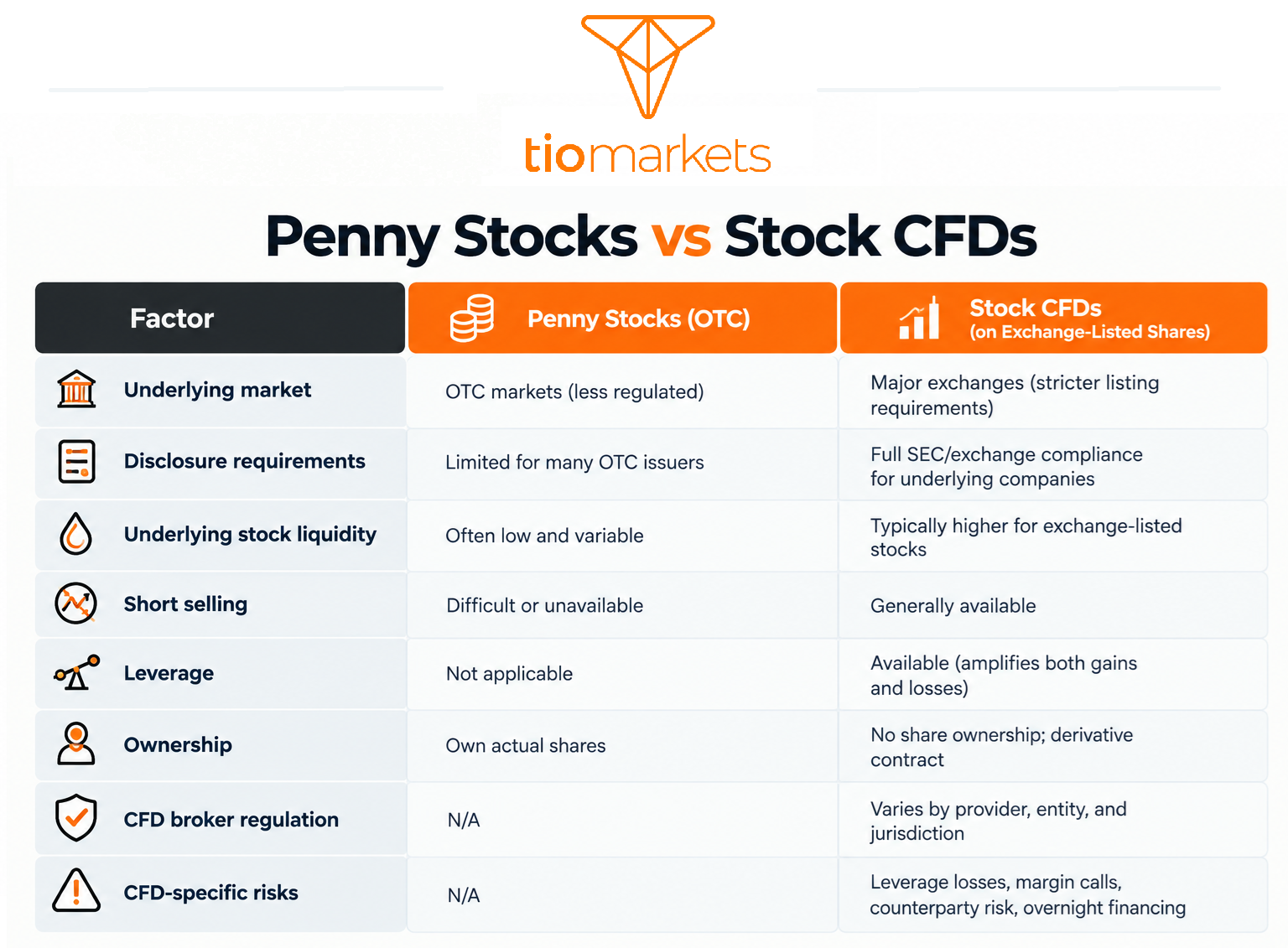
When comparing CFDs to penny stocks, traders should note that some differences relate to the underlying securities - such as disclosure requirements and typical liquidity of exchange-listed stocks versus OTC penny stock. Other differences relate to the trading mechanism itself, such as leverage and short selling. CFD broker regulation is a separate consideration from the regulatory requirements applying to the underlying stocks.
What Are Stock CFDs?
Stock CFDs are derivative contracts that reflect the price movements of underlying stocks without requiring ownership of actual shares. Traders can potentially profit from both rising and falling prices, depending on their positions’ direction.
Leverage in CFD trading amplifies market exposure with smaller capital outlay, though this also amplifies potential losses proportionally. CFDs are available through brokers such as TIOmarkets - with regulatory status depending on the specific entity and jurisdiction. CFDs offer an alternative approach to stock market participation for traders who prefer derivatives over direct share ownership.
CFDs are leveraged products that carry a high level of risk so ensure you fully understand the risks before trading.
Key Differences at a Glance
Both penny stocks and stock CFDs offer access to the stock market with relatively low capital requirements, but they operate very differently. Penny stocks are typically low-priced shares of smaller companies, often traded in less regulated markets with limited liquidity and transparency. Stock CFDs, on the other hand, allow traders to speculate on the price movements of established listed companies, often with access to leverage and short selling. Spreads and pricing depend on the specific broker and the liquidity of the underlying stock.
The infographic below highlights key differences between penny stocks and stock CFDs. Note that some factors - such as liquidity and information availability - relate to the underlying shares rather than the CFD product itself. Others, such as leverage and short selling, are features of CFD trading. Regulatory protections for CFD traders depend on the broker, entity, and jurisdiction.
Accessing Low-Priced Stocks Through CFDs
Many established, exchange-listed companies trade below $5 per share while maintaining full regulatory compliance and disclosure standards. TIOmarkets offers 800+ stock CFDs across global markets, providing access to diverse trading opportunities.
Over 20 stock CFDs available through TIOmarkets represent shares currently trading below $5, offering exposure to low-priced stocks from regulated, listed companies. This approach provides low entry points without the specific risks associated with OTC markets.
Because these CFDs are based on exchange-listed companies with full disclosure requirements, traders typically have access to more comprehensive financial information compared to many OTC penny stock issuers.
Getting Started with Stock CFD Trading
Traders interested in low-priced stock exposure through CFDs can access global markets through regulated brokers, with TIOmarkets offering 800+ stock CFDs with competitive conditions, including stocks currently trading below $5 per share. Do note that CFDs are leveraged products that carry a high level of risk so make sure you fully understand the risks before trading.
Choosing a CFD broker is an important first step for traders considering this approach. Traders should verify the regulatory status of their chosen broker, which varies by entity and jurisdiction. Note that broker regulation is separate from the regulatory requirements applying to the underlying exchange-listed stocks, which include disclosure standards that many OTC penny stock issuers do not meet.
Understanding leverage and margin requirements helps traders manage exposure appropriately. Learning how to calculate lot sizes for stock CFDs ensures traders can control their position sizes effectively based on account size and risk tolerance. Risk management tools including stop-loss orders and position sizing strategies can help limit potential losses.
Demo accounts allow practice without risking real capital, providing opportunity to understand platform functionality and test trading approaches. This preparation can prove valuable before committing actual funds.
TIOmarkets offers 800+ stock CFDs from global markets, including over 20 stock CFDs on shares currently priced below $5. These CFDs are based on exchange-listed securities that meet listing requirements and disclosure standards. Regulatory protections for traders depend on the TIOmarkets entity and jurisdiction through which they trade.
Explore TIOmarkets' stock CFD offering to evaluate whether this approach aligns with your trading objectives.
Conclusion
This article has addressed what are penny stocks from multiple angles: definition, characteristics, risks, and trading alternatives.
Penny stocks are low-priced securities trading primarily on over-the-counter markets, characterized by low liquidity, high volatility, limited information availability, and substantial risk. While they attract traders seeking low-capital entry points and high-potential returns, the risks and common misconceptions associated with these securities need to be clarified in advance.
For traders drawn to low-priced stocks, stock CFDs offer an alternative approach worth considering. CFDs based on exchange-listed companies - including those trading below $5 per share - provide exposure to securities that typically have greater liquidity than OTC penny stocks and are subject to stricter disclosure requirements. CFDs also offer trading flexibility including the ability to take short positions. Regulatory protections depend on the specific broker, entity, and jurisdiction.
TIOmarkets offers 800+ stock CFDs, including over 20 stocks currently priced below $5. Before risking actual capital, you can open a demo account to explore stock CFD trading risk-free.

FAQ
Risk disclaimer: CFDs are complex instruments and come with a high risk of losing money rapidly due to leverage. You should consider whether you understand how CFDs work and whether you can afford to take the high risk of losing your money. Never deposit more than you are prepared to lose. Professional client’s losses can exceed their deposit. Please see our risk warning policy and seek independent professional advice if you do not fully understand. This information is not directed or intended for distribution to or use by residents of certain countries/jurisdictions including, but not limited to, USA & Countries included in the OFAC sanction list. The Company holds the right to alter the aforementioned list of countries at its own discretion.
TIOmarkets offers an exclusively execution-only service. The views expressed are for information purposes only. None of the content provided constitutes any form of investment advice. The comments are made available purely for educational and marketing purposes and do NOT constitute advice or investment recommendation (and should not be considered as such) and do not in any way constitute an invitation to acquire any financial instrument or product. TIOmarkets and its affiliates and consultants are not liable for any damages that may be caused by individual comments or statements by TIOmarkets analysis and assumes no liability with respect to the completeness and correctness of the content presented. The investor is solely responsible for the risk of his/her investment decisions. The analyses and comments presented do not include any consideration of your personal investment objectives, financial circumstances, or needs. The content has not been prepared in accordance with any legal requirements for financial analysis and must, therefore, be viewed by the reader as marketing information. TIOmarkets prohibits duplication or publication without explicit approval.
Join us on social media



Authors BIO

Maria is a writer and content strategist with over 10 years of experience in the finance industry. She specializes in developing research-backed articles that help financial professionals navigate complex market topics with confidence. Her expertise spans forex, stocks, CFDs and global markets, creating insightful content that educates readers and supports informed decision-making.