EUR/USD Market analysis: 1.1700 Holds Before Warsh's Jackson Hole Debut
BY Eleni Antoniou
|August 24, 2026EUR/USD opens the week near 1.1670, close to its best level since June but having failed again beneath 1.1700 on Friday. That level has now rejected the pair on more than one attempt.
The distinction matters for this EUR/USD forecast. The pair sits at a three-month high because the dollar index has fallen to around 98.80, its lowest since May, not because the euro has strengthened on its own account.
And the week ahead is unusually concentrated. Three scheduled catalysts land within seventy-two hours, culminating in Kevin Warsh's first Jackson Hole keynote on Friday.
The Setup at a Glance
- EUR/USD near 1.1670, having repeatedly failed to close above 1.1700
- The dollar index sits near 98.80, its lowest level since May, after dipping into the 98.50s
- The decline followed the Treasury's announcement that it will at least double long-bond buybacks, reportedly to at least $32 billion a quarter from early next month
- September hike odds have fallen to roughly 32% to 35%, from close to evenly split before the July data
- US July PCE lands Wednesday 26 August, with core forecast to accelerate to 0.3% monthly
- ECB accounts of the 23 July meeting publish Thursday 27 August, the clearest euro-area catalyst
- Warsh speaks Friday 28 August at 10:00 ET, alongside the BLS preliminary payroll benchmark revision
Why the pair keeps failing at 1.1700
The rejection is the technically significant event, and it has a straightforward explanation.
The advance is dollar-driven
EUR/USD has climbed from roughly 1.14 in late July to the high 1.16s. Over the same period the dollar index fell from above 99.40 to around 98.80.
The euro side contributed comparatively little. The European Central Bank held its three key rates on 23 July, leaving the deposit facility at 2.25%, flagged volatile energy prices, and declined to pre-commit to any path. Euro-area annual inflation was 2.9% in July.
A one-legged advance tends to stall at round numbers because it lacks the second source of demand that carries a pair through resistance. That is a reasonable reading of what 1.1700 has been demonstrating.
What actually moved the dollar
Two developments, neither of them monetary policy in the conventional sense.
First, the Treasury intervened at the long end. With the 30-year Treasury yield reaching its highest level since 2007, the Treasury announced it would at least double its bond buyback programme, reportedly to at least $32 billion a quarter starting early next month. Long-dated yields fell sharply on the announcement and the dollar weakened.
Second, the data cycle turned. Softer payrolls, cooling inflation readings, weak retail sales and a GDP miss have collectively repriced Federal Reserve expectations. Futures pricing now implies roughly a 32% to 35% probability of a September increase, against something close to an even split before the July releases.
The Fed itself has not turned dovish. The July minutes, released 19 August, showed a Committee more concerned about persistent price pressures, and the 29 July decision carried three dissents in favour of a hike. The dollar fell regardless.
The week ahead: three catalysts in seventy-two hours
Wednesday 26 August: US July PCE
The Federal Reserve's preferred inflation measure arrives alongside the second estimate of second-quarter GDP.
Core PCE is forecast to accelerate to 0.3% month-on-month, which would pair firmer inflation with a downward GDP revision. Commentary ahead of the release has flagged roughly 3.3% year-on-year as the threshold above which the case for further tightening strengthens, and below 3.2% as reinforcing the case for a September hold.
Nvidia also reports after the US close, which may add cross-asset volatility on Thursday morning.
Thursday 27 August: ECB accounts
The European Central Bank publishes the account of its 23 July meeting. This is the clearest euro-area catalyst of the week, offering the first detailed view of how the Governing Council reached its decision to hold, and whether that decision was as unanimous as the statement implied.
Jackson Hole opens the same day.
Friday 28 August: the double-header
Two significant releases land within hours of each other.
Warsh delivers his Jackson Hole keynote at 10:00 ET, his first since taking office on 22 May 2026. The Kansas City Fed hosts the symposium from 27 to 29 August under the theme Financial Innovation: Implications for Payments and Policy.
The BLS publishes its preliminary annual benchmark revision to nonfarm payrolls. This deserves more attention than it typically receives: the September 2025 preliminary benchmark indicated a downward revision of 911,000, and the final figure in February remained at 862,000 on a non-seasonally-adjusted basis. A large revision would carry genuine information about the labour market rather than being a statistical footnote.
France and Spain also publish flash August inflation, the earliest euro-area-wide signal ahead of the ECB's 10 September meeting, with the full euro-area flash estimate following on 1 September.
What analysts expect from Warsh, and why it may not be what markets want
Worth setting out carefully, because these are third-party views rather than our own.
Several analysts have noted that Warsh is unlikely to address the current policy setting directly. Commentary published ahead of the speech suggests he may instead critique the framework of modern central banking, and has previously raised the possibility of reducing the number of FOMC meetings per year. Marc Chandler wrote that it would be unreasonable to expect him to address current monetary policy.
His known positions complicate the reading further. Warsh has argued for policy regime reform, criticised the 2020 flexible average inflation targeting framework, and suggested the artificial intelligence investment boom could prove disinflationary. Those positions do not map cleanly onto a hawkish or dovish label.
On volatility, Goldman Sachs has noted that Jackson Hole historically amplifies currency volatility, citing the hawkish 2022 tone that coincided with a sharp equity decline and the dovish 2024 and 2025 pivots that pressured the dollar. TD Securities has similarly flagged elevated dollar volatility risk around the event.
The practical implication for EUR/USD: the pair is positioned on faded hike expectations at a level it has repeatedly failed to clear. An event that could resolve that in either direction, or fail to resolve it at all, arrives on Friday.
EUR/USD technical analysis
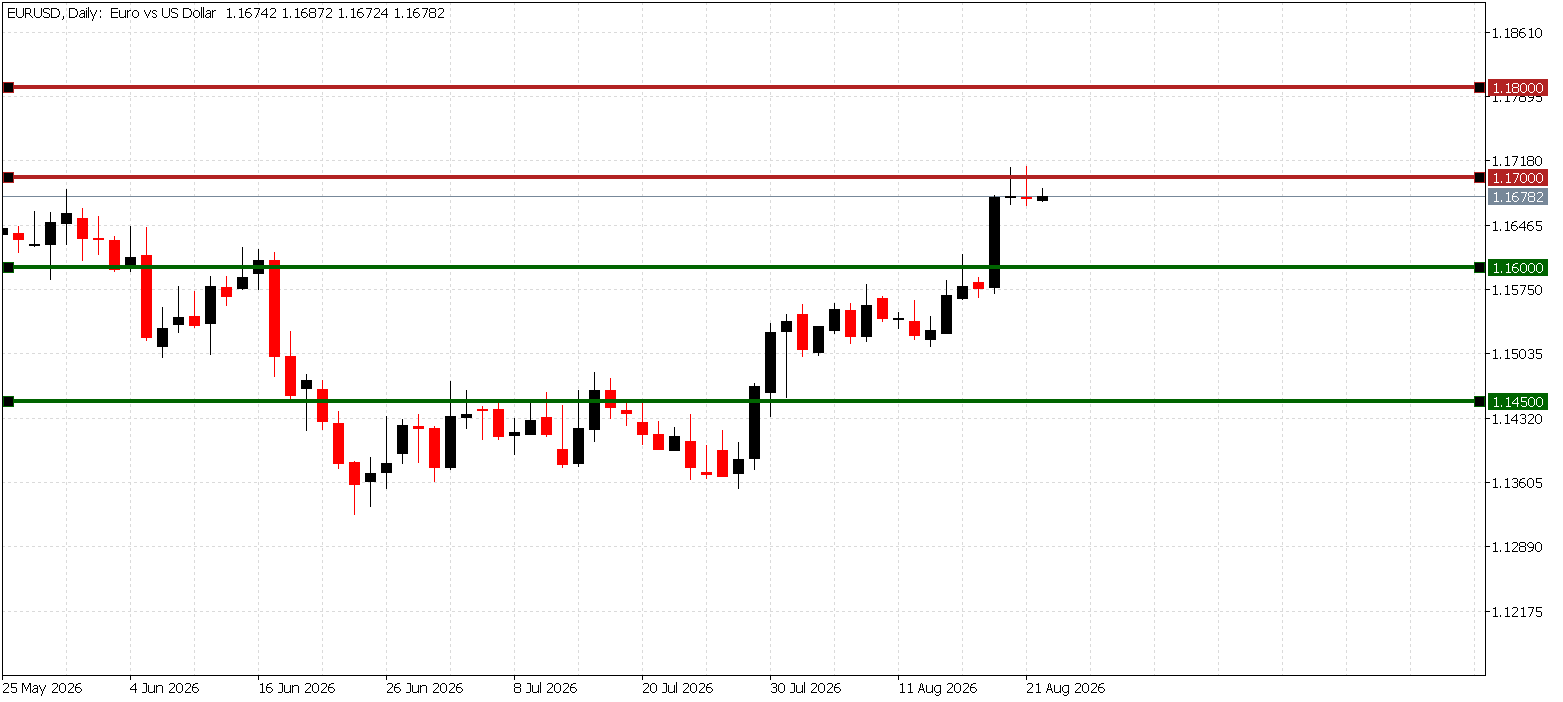
Source: TIOmarkets MT5 live EUR/USD chart
The daily structure has improved materially since the late-July lows near 1.14. The pair reclaimed 1.1550, then 1.1600, and has spent recent sessions consolidating in the high 1.16s.
But the advance has stalled. Repeated approaches to 1.1700 have not produced a daily close above it, which establishes that zone as genuine supply rather than a level the market has simply not reached.
Resistance levels to watch:
- 1.1700: the immediate pivot and the level that has rejected the pair more than once. A sustained daily close above it would confirm the breakout
- 1.1800: the next round-number objective on a confirmed break
Support levels to watch:
- 1.1600: the first retracement zone
- 1.1550: the more important near-term structure level, aligning with the early-August trading zone and the prior breakout region
- 1.1450 to 1.1400: the late-July range, relevant only on a pronounced decline
The structural read is constructive while the pair holds above 1.1550. But the repeated failures at 1.1700 mean the burden of proof now sits with the buyers.
A daily close above 1.1700 would be the confirmation to watch. A return beneath 1.1600 would suggest the August advance is consolidating rather than extending.
Bullish scenario: 24 August to 4 September
This bullish EUR/USD forecast scenario may strengthen if core PCE comes in beneath expectations on Wednesday, the ECB accounts read less unanimous than the July statement implied, and Friday's events do not revive dollar demand.
A sustained daily close above 1.1700, followed by the ability to hold that area on a retest, could bring 1.1800 into focus.
Supporting factors include a large downward payroll benchmark revision, further declines in Treasury yields, and continued dollar weakness across majors.
Invalidation: a brief break above 1.1700 followed by a return beneath 1.1600 would suggest a false breakout rather than an extension.
Bearish scenario: 24 August to 4 September
The bearish case may strengthen if core PCE surprises to the upside, particularly at or above roughly 3.3% year-on-year, reviving the case for a September increase and lifting yields.
A rejection at 1.1700 followed by a break beneath 1.1600 would raise the risk of a test of 1.1550. A sustained close beneath 1.1550 would shift attention back toward the 1.1450 to 1.1400 area.
Supporting factors include a hawkish reading of the Jackson Hole address, firmer euro-area disinflation in the French and Spanish flash prints, or a broad shift toward risk aversion.
Invalidation: a decisive close above 1.1700 would challenge this view.
A note on market mechanics. The pair is priced on the absence of expected Fed tightening rather than on positive euro developments, and its proximate driver has been a Treasury operation rather than a monetary decision. Positioning of that construction can unwind quickly when the underlying assumption is tested, which is precisely what makes the Friday double-header consequential.
Key levels and catalysts
| Item | Detail |
| Resistance | 1.1700, then 1.1800 |
| Support | 1.1600, then 1.1550, then 1.1450 to 1.1400 |
| Tuesday 25 August | German IFO survey and final Q2 GDP; US consumer confidence |
| Wednesday 26 August | US July PCE and second-estimate Q2 GDP; Nvidia earnings after the close |
| Thursday 27 August | ECB accounts of the 23 July meeting; Jackson Hole opens |
| Friday 28 August | Warsh keynote at 10:00 ET; BLS preliminary payroll benchmark revision; France and Spain flash CPI |
| 1 September | Euro-area August flash inflation estimate |
| 4 September | US August Employment Situation |
| 10 September | ECB meeting |
| 15-16 September | 15-16 September FOMC meeting |
Conclusion
This EUR/USD forecast describes a pair at a three-month high that has nonetheless failed repeatedly at a single level.
The construction explains the stall. The advance has been carried by dollar weakness, itself driven more by Treasury action and a soft data cycle than by any shift at the Federal Reserve, whose July minutes leaned hawkish. A move with one supporting leg tends to meet resistance at round numbers.
Confirmation matters more than prediction here. A daily close above 1.1700 would establish that the breakout is real; a return beneath 1.1600 would indicate consolidation. Wednesday's inflation print and Friday's double-header of Warsh and the payroll benchmark revision are the events most capable of settling which it is.
This article is market commentary for educational purposes only. It does not constitute investment advice, does not guarantee future market performance, and contains no forecast of central bank or government policy decisions.

Risk disclaimer: CFDs are complex instruments and come with a high risk of losing money rapidly due to leverage. You should consider whether you understand how CFDs work and whether you can afford to take the high risk of losing your money. Never deposit more than you are prepared to lose. Professional client’s losses can exceed their deposit. Please see our risk warning policy and seek independent professional advice if you do not fully understand. This information is not directed or intended for distribution to or use by residents of certain countries/jurisdictions including, but not limited to, USA & Countries included in the OFAC sanction list. The Company holds the right to alter the aforementioned list of countries at its own discretion.
TIOmarkets offers an exclusively execution-only service. The views expressed are for information purposes only. None of the content provided constitutes any form of investment advice. The comments are made available purely for educational and marketing purposes and do NOT constitute advice or investment recommendation (and should not be considered as such) and do not in any way constitute an invitation to acquire any financial instrument or product. TIOmarkets and its affiliates and consultants are not liable for any damages that may be caused by individual comments or statements by TIOmarkets analysis and assumes no liability with respect to the completeness and correctness of the content presented. The investor is solely responsible for the risk of his/her investment decisions. The analyses and comments presented do not include any consideration of your personal investment objectives, financial circumstances, or needs. The content has not been prepared in accordance with any legal requirements for financial analysis and must, therefore, be viewed by the reader as marketing information. TIOmarkets prohibits duplication or publication without explicit approval.
Join us on social media



Authors BIO

Eleni is a financial markets enthusiast contributing to content covering forex, indices, commodities, and global market developments. She is passionate about researching market-related topics and helping make financial information more accessible to traders.