EUR/USD Market Analysis: CPI Tests 1.1575
BY Eleni Antoniou
|August 10, 2026EUR/USD entered the week of 10th August near 1.1550, with the euro recovering from late-July lows as a weak U.S. employment report softened the dollar. The immediate question is whether U.S. inflation and spending data confirm a cooling economy or revive expectations that the Federal Reserve may need to stay restrictive for longer.
EUR/USD market overview
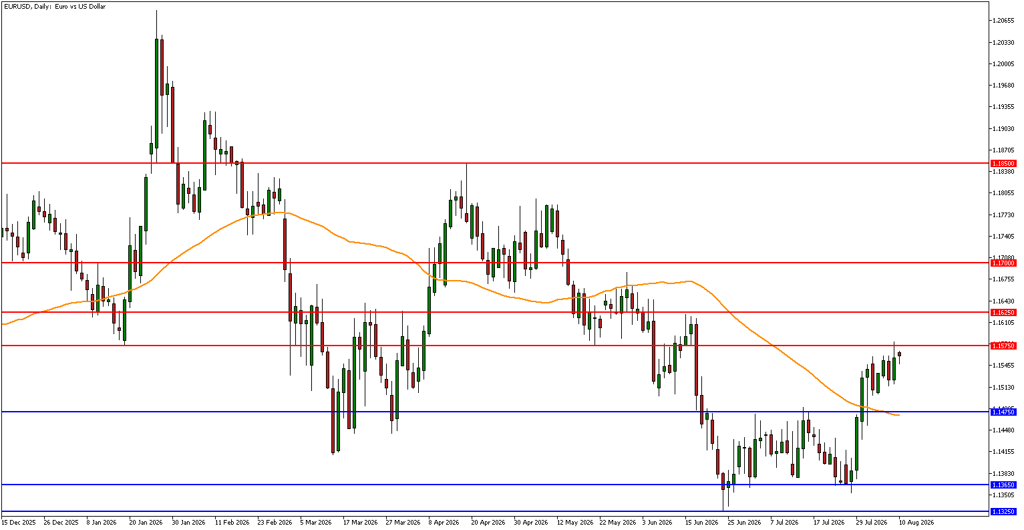
EUR/USD ended 7 August around 1.1560, the highest daily close of the first week of August. The pair rose from approximately 1.1369 on 27th July and finished above 1.1500 for six consecutive days from 30th July through 7 August. That rebound has improved the short-term trading outlook, but the pair remains below the 1.1575 resistance area.
The latest advance is primarily a dollar story. U.S. nonfarm payrolls fell by 23,000 in July, while May and June payrolls were revised down by a combined 103,000. The unemployment rate edged down to 4.1%, but the decline partly reflected a smaller labour force. Treasury yields fell after the release and expectations of a near-term Fed rate increase were pared back, giving EUR/USD room to recover.
The euro side of the equation is more mixed. The euro-area economy expanded by 0.4% quarter on quarter in the preliminary estimate for the second quarter, beating modest expectations and reversing the first-quarter contraction. However, energy-price uncertainty and the risk of renewed inflation pressure remain important constraints on growth and ECB policy.
Latest EUR/USD market news
The Federal Reserve kept the federal funds target range at 3.50%–3.75% on 29th July. Its statement described activity as expanding at a solid pace but said inflation remained elevated, partly because of supply shocks and energy prices. Three policymakers dissented in favour of a 25-basis-point increase, underlining that the Committee remains divided and that incoming inflation data can still materially shift rate expectations.
The weak July jobs report subsequently complicated that hawkish signal. A negative payroll reading and substantial downward revisions point to softer labour demand, even though the 4.1% unemployment rate remains low by historical standards. For EUR/USD, that combination reduces immediate dollar support from rate expectations, but it does not establish a durable bearish dollar trend unless inflation also eases.
The European Central Bank left its three key interest rates unchanged on 23th July after raising rates in June. The deposit facility rate remains 2.25%. The ECB stressed that the full inflationary effects of the energy shock have not yet appeared and retained a meeting-by-meeting approach. Euro-area inflation slowed to 2.8% year on year in June from 3.2% in May, while core inflation eased to 2.4%. These figures reduce the urgency for another immediate increase, but inflation is still above the ECB's 2% target.
EUR/USD technical analysis
The daily structure has improved since EUR/USD formed a late-July low around 1.1365. Price reclaimed 1.1475, and closed the latest week closer to 1.1575. The 50-day moving average is close to 1.1475, so the pair is trading about one cent above its recent mean.
The first significant support zone is 1.1475, which contains the 31st July pullback and retest. Holding above this area would potentially keep the recovery structure intact. Below it, and the moving-average region around 1.1475 could potentially change the outlook.
Initial resistance sits at 1.1575. A sustained daily close above that level could strengthen the breakout case and expose 1.1625. Failure to clear 1.1625 after the recent rally could instead favour a period of range trading or another deeper retest of 1.1475.
Fundamental and macro drivers
Interest-rate expectations remain the dominant EUR/USD driver. The Fed's nominal policy-rate advantage over the ECB is still substantial, which ordinarily supports the dollar. Yet the direction of that gap matters more than its level over a one-to-two-week horizon. A softer U.S. labour market combined with benign inflation would encourage expectations that the Fed can remain on hold, while persistent inflation would revive the July meeting's hawkish message.
U.S. CPI on 12th August is the most important scheduled catalyst. June headline inflation was 3.5% year on year, and the July report will show whether the energy shock is broadening into core goods and services. U.S. PPI follows on 13 August, while retail sales and preliminary University of Michigan consumer sentiment arrive on 14 August. Strong inflation and spending data would tend to lift U.S. yields and the dollar; softer readings would reinforce the post-payroll decline in yields.
For the euro, the 14 August euro-area GDP and employment flash update will test the resilience shown by the preliminary 0.4% quarterly GDP estimate. A confirmation of better growth would support the euro, particularly if employment remains firm. However, the euro area remains more exposed than the United States to energy-supply disruption. A renewed rise in oil and gas prices could simultaneously worsen the region's growth outlook and keep the ECB cautious about inflation, creating an ambiguous or negative euro response.
EUR/USD bullish scenario: break above 1.1600
A bullish scenario may gain support if U.S. CPI and PPI are softer than feared, retail sales lose momentum, and euro-area GDP is confirmed near the preliminary 0.4% quarterly pace. Under those conditions, U.S. yields could extend their post-payroll decline and EUR/USD may achieve a sustained daily close above 1.1625.
A break could put 1.1700 in to focus over the next one to two weeks, if momentum remains orderly and risk sentiment is stable. The bullish structure would weaken if price breaks back below 1.1475, and such a reversal would suggest that the breakout lacked macro confirmation.
EUR/USD bearish scenario: rejection below 1.1600
A bearish scenario may develop if U.S. inflation is sticky or retail sales remain strong enough to restore expectations of a more hawkish Fed path. A renewed energy price surge or broader risk-off move would add dollar support. In this case, repeated failure below 1.1575 - 1.1625, would expose the 50-day moving average near 1.1475.
If 1.1475 fails, attention would shift to the lows of the June - July consolidation base. A decisive close below 1.1325 would potentially invalidate the late-July recovery. The bearish case would weaken if EUR/USD holds above 1.1475.
Key EUR/USD levels and catalysts to watch
- Support: 1.1475, 1.1365, then 1.1325
- Resistance: 1.1575, 1.1625, then 1.1700
- Catalysts: U.S. CPI and core CPI for July on 12th August. U.S. PPI and weekly jobless claims on 13th August. U.S. retail sales and sentiment; euro-area GDP and employment update on 14th August.
Conclusion
The EUR/USD price forecast is cautiously constructive while the pair holds above 1.1475. Weak U.S. payrolls have reduced immediate dollar support, and euro-area growth has shown resilience, yet both central banks remain focused on inflation and the Fed still offers the higher interest rate.
The next one to two weeks are therefore likely to be data-driven. Softer U.S. inflation combined with firm euro-area growth could support a move higher. Sticky U.S. inflation, resilient spending, or renewed risk aversion would increase the chance of a pullback. This is general market commentary, intended for your educational purposes only.

Risk disclaimer: CFDs are complex instruments and come with a high risk of losing money rapidly due to leverage. You should consider whether you understand how CFDs work and whether you can afford to take the high risk of losing your money. Never deposit more than you are prepared to lose. Professional client’s losses can exceed their deposit. Please see our risk warning policy and seek independent professional advice if you do not fully understand. This information is not directed or intended for distribution to or use by residents of certain countries/jurisdictions including, but not limited to, USA & Countries included in the OFAC sanction list. The Company holds the right to alter the aforementioned list of countries at its own discretion.
TIOmarkets offers an exclusively execution-only service. The views expressed are for information purposes only. None of the content provided constitutes any form of investment advice. The comments are made available purely for educational and marketing purposes and do NOT constitute advice or investment recommendation (and should not be considered as such) and do not in any way constitute an invitation to acquire any financial instrument or product. TIOmarkets and its affiliates and consultants are not liable for any damages that may be caused by individual comments or statements by TIOmarkets analysis and assumes no liability with respect to the completeness and correctness of the content presented. The investor is solely responsible for the risk of his/her investment decisions. The analyses and comments presented do not include any consideration of your personal investment objectives, financial circumstances, or needs. The content has not been prepared in accordance with any legal requirements for financial analysis and must, therefore, be viewed by the reader as marketing information. TIOmarkets prohibits duplication or publication without explicit approval.
Join us on social media



Authors BIO

Eleni is a financial markets enthusiast contributing to content covering forex, indices, commodities, and global market developments. She is passionate about researching market-related topics and helping make financial information more accessible to traders.