


Three Fed Officials Voted to Hike. The Dollar Is Still Falling.
BY Ahmed Osama Hassanien
|July 31, 2026The most divided FOMC vote since 2016 should have been dollar-positive. Two sessions later, markets are still moving the other way.
Last updated: Friday, July 31, 2026, 07:30 GMT
The Federal Reserve did something on Wednesday 29th July that, on paper, reads as hawkish. Three of its own policymakers formally broke ranks and voted to raise interest rates, the most unified dissent the central bank has produced in almost a decade.
The dollar has been falling ever since.
That apparent contradiction is the most instructive thing about this meeting, and it explains more about current market positioning than the decision itself. By Friday morning in Europe the euro had climbed to a two-week high above 1.1500, gold was holding comfortably above the $4,000 level it was testing before the decision, and the Treasury curve had steepened in a way that suggests bond investors are not treating the hold as reassurance.
Key takeaways
- The FOMC voted 9-3 to hold the federal funds target range at 3.50% to 3.75%, a fifth consecutive meeting without a move.
- Cleveland's Beth Hammack, Minneapolis' Neel Kashkari and Dallas' Lorie Logan each preferred a quarter-point hike. It is the first triple dissent in a single direction since September 2016.
- Despite the hawkish optics, EUR/USD has pushed above 1.151, its highest in roughly two weeks, and gold is holding near $4,070.
- The Treasury curve steepened, with the 2-year yield closing near 4.28% while the 30-year pushed past a multi-year high.
- Futures pricing implies roughly a 63% probability of a September hike.
- Big Tech earnings split sharply, with Microsoft up around 15% and Meta down about 9% in the same session.
- Eurozone flash inflation for July is released later today, the euro's first independent catalyst in two weeks.
What the Fed actually did
The Committee left the target range for the federal funds rate at 3.50% to 3.75%. The statement noted that economic activity is expanding at a solid pace despite elevated uncertainty tied in part to the conflict in the Middle East, and that productivity growth and capital investment are strong.
The dissent is where it gets interesting. All three "no" votes came from regional Fed presidents. None came from Washington-appointed governors, who typically align with the chair. Hammack, Kashkari and Logan had each argued publicly that inflation, now above the Fed's 2% target for more than five years, requires a firmer response.
Logan had been the most explicit, saying rates should be "modestly" higher. Hammack had said the Fed might need to consider a hike. Kashkari's vote was a surprise, and market participants had not positioned themselves for it. His inclusion signals that the hawkish bloc inside the Committee is wider than outsiders assumed.
EUR/USD: the euro has cleared 1.15
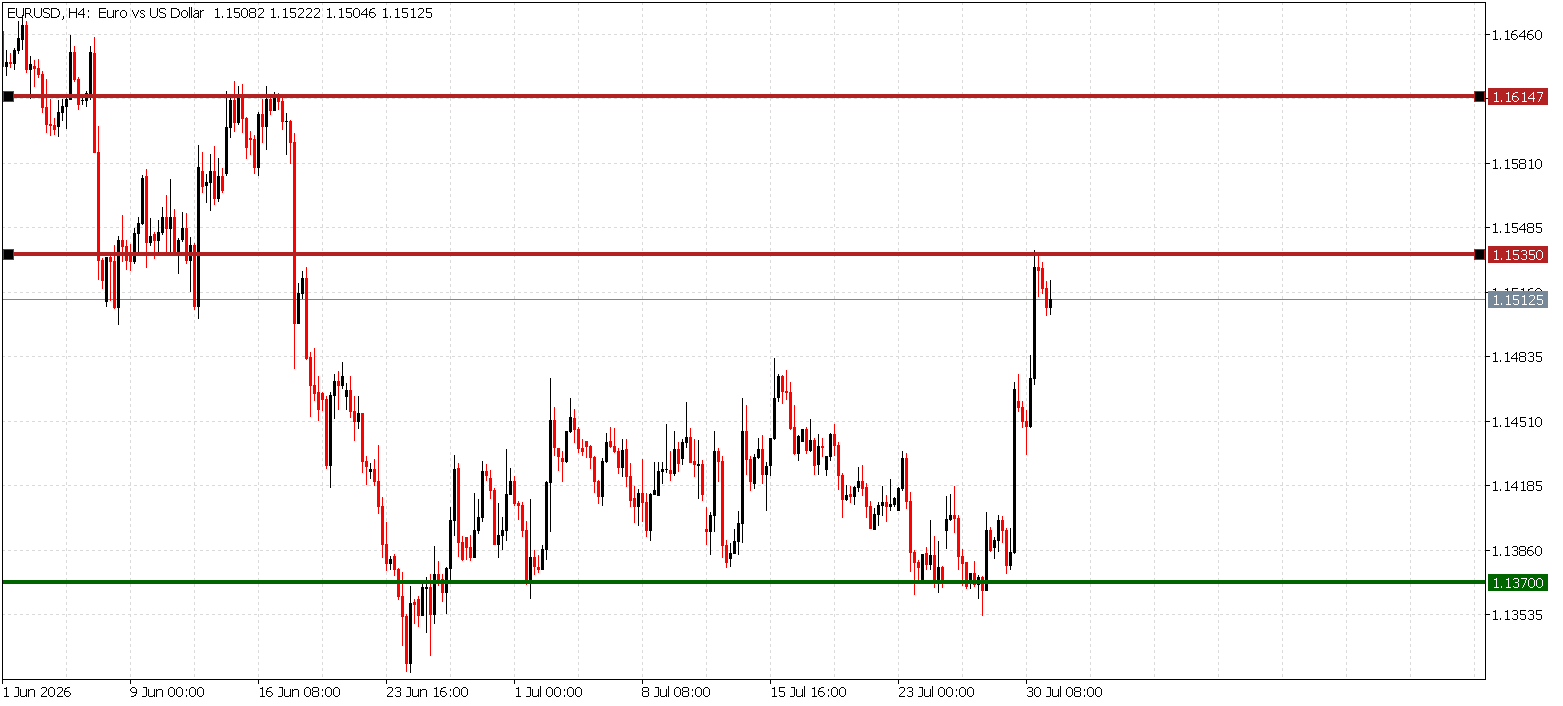
The clearest expression of the dollar's post-meeting weakness is in the euro, and the move has extended rather than faded.
EUR/USD spent last week capped in the 1.1440s, trading around 1.1386 on July 28 as the dollar sat near a one-month high. It spiked through that ceiling within hours of the Fed decision, settled around 1.1450 to 1.1458 on Thursday, and has pushed on again to trade near 1.1513 by Friday morning in Europe, its strongest level in about two weeks.
Two things are worth separating here.
The first is that almost none of this has been about the euro. The European Central Bank held rates on July 23, leaving the deposit facility at 2.25%, and eurozone inflation cooled to 2.8% in June from 3.2% in May. The single currency entered this week without a catalyst of its own and simply inherited the dollar's direction.
The second is that today is the final trading day of July. Month-end rebalancing flows routinely amplify currency moves in the final session, as funds adjust hedges against a month in which US equities outperformed. That flow is worth keeping in mind before reading too much directional conviction into the last leg of this move.
The euro finally gets its own catalyst later today. Eurozone flash inflation for July is due from Eurostat, with consensus near 2.8% headline. A hotter reading revives the case for further ECB tightening and gives the pair a reason to hold these gains. A softer one leaves it dependent on the dollar again.
Gold: holding the ground it took
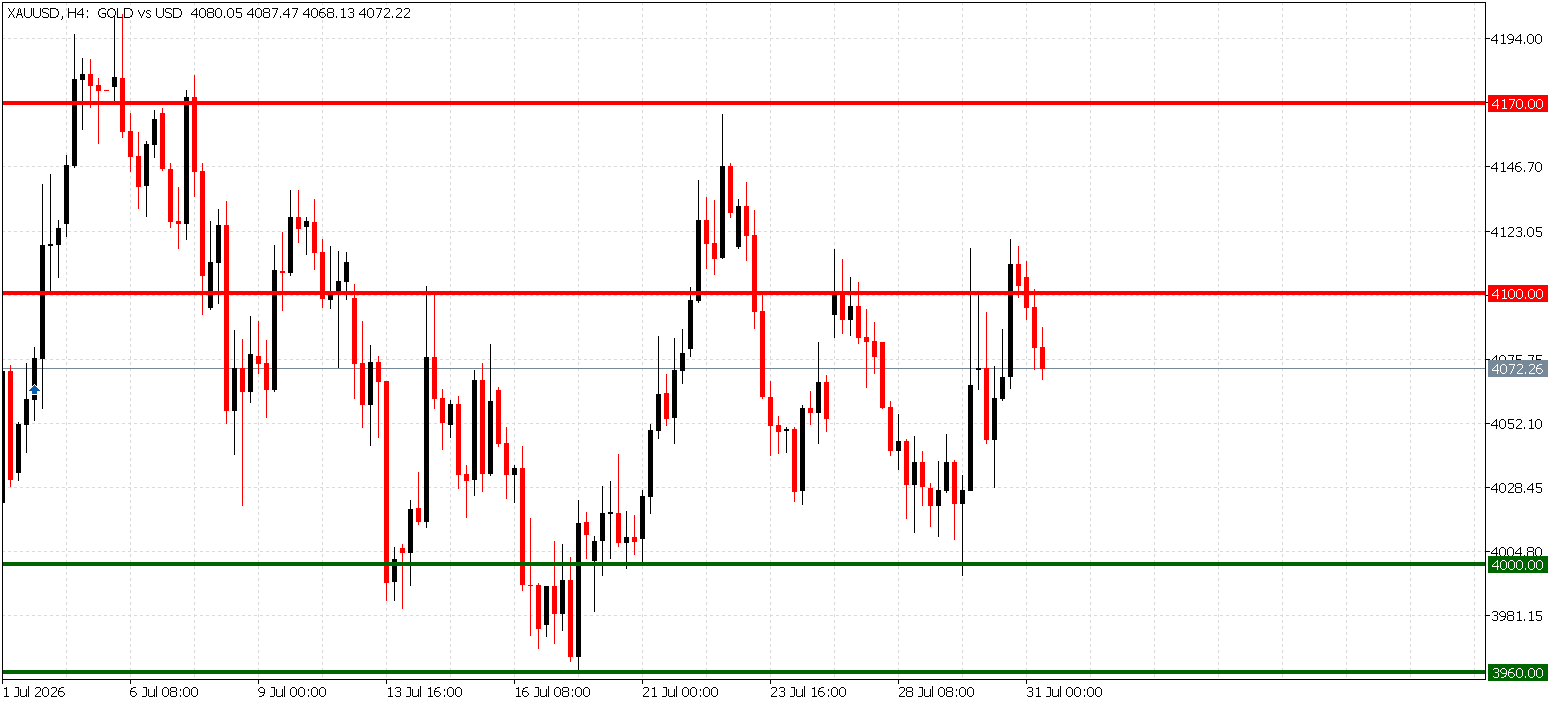
Source: TIOmarkets MT5, 2026.
Gold had been pinned near the $4,000 psychological level going into the decision. It rallied close to $100 in the aftermath, reaching $4,116.26 at its intraday peak on Wednesday, the highest since July 23, and has since settled into a $4,050 to $4,090 range, trading near $4,070 on Friday morning.
The consolidation is the story. Two forces are pulling in opposite directions and roughly cancelling out.
A weaker dollar supports bullion, since it makes gold cheaper for buyers holding other currencies. Softer US PCE inflation data works the same way, by easing the pressure for immediate tightening. Against that, rising long-end Treasury yields are a headwind, because a non-yielding asset competes poorly when the alternative pays more.
Fresh US strikes on Iranian targets have added a safe-haven bid while simultaneously complicating the inflation picture the Fed hawks are citing, which is a fair summary of why gold is going sideways rather than breaking out.
The metal is on course for its first monthly gain since February, though it remains well below the record above $5,590 set in late January. Traders are watching $4,000 as support and $4,200 as the next meaningful resistance.
Dow Jones: the quiet outperformer
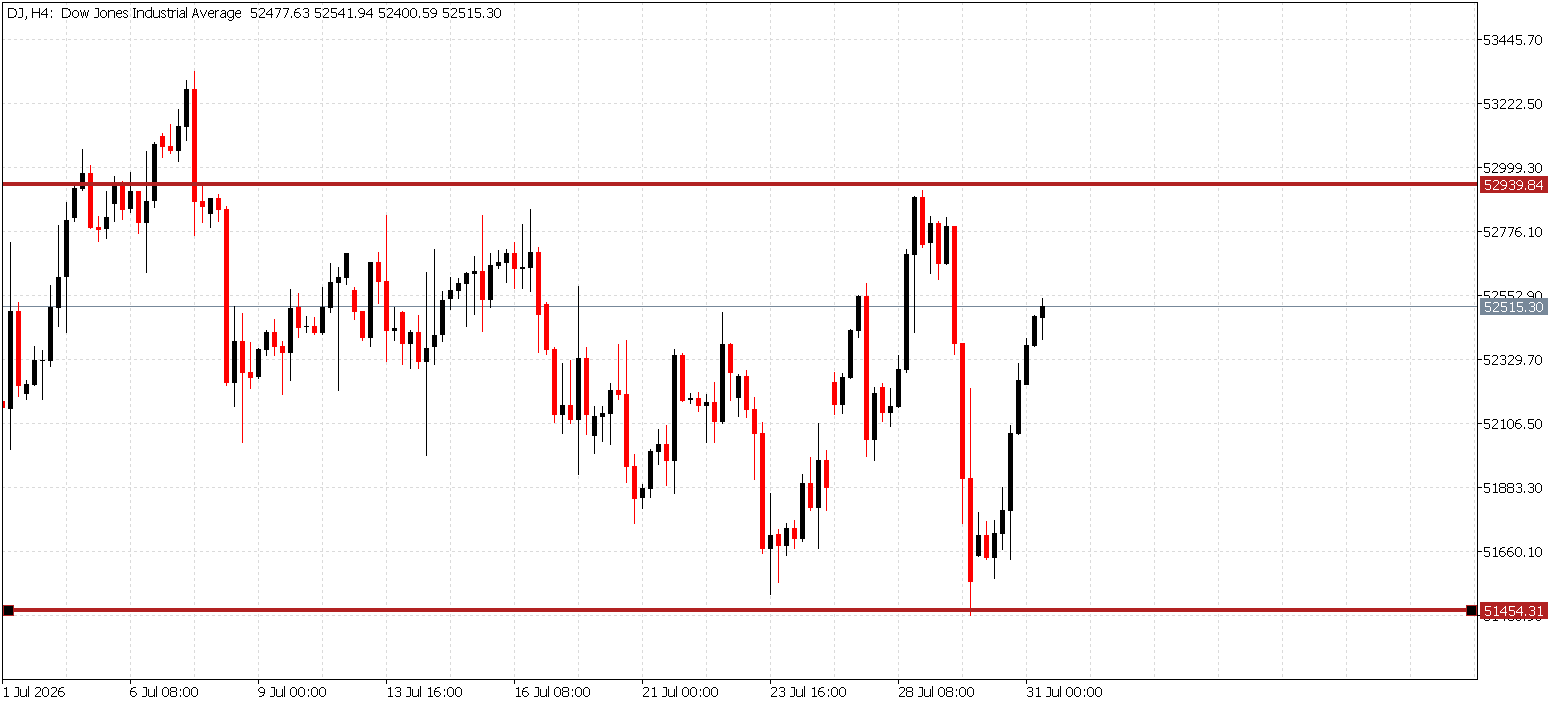
The Dow closed Thursday at around 51,935, up roughly 340 points or 0.66%, with the equivalent US30 contract near 51,943. The US cash market is closed as this is published and reopens at 13:30 GMT.
That gain looks modest next to the S&P 500's 1.21% and the Nasdaq's 2.49%, and the reason is composition. The Dow's blue-chip, value-tilted membership gave it less exposure to the AI capital expenditure debate that dominated the week, and less benefit from the technology surge that followed Microsoft's results.
The index has been holding a broad 51,500 to 52,000 range through the week. Whether it breaks that range is likely to depend less on the Fed and more on whether the earnings rotation broadens beyond technology. Asian markets pointed higher into Friday after the megacap technology rebound, which suggests the appetite is there.
Big Tech split the market in two
The single most striking feature of Thursday's session was how sharply the mega-cap results diverged.
| Stock | Move | Driver |
| Microsoft (MSFT) | Up around 15% | Revenue of $90.01bn beat the $87.62bn estimate. Azure grew 43% at constant currency against a 40.2% forecast, and Azure revenue passed $100bn for the fiscal year for the first time. |
| Meta (META) | Down around 9% | EPS of $6.18 missed by $1.04. Q3 revenue guidance of $61bn to $64bn came in below the $63.15bn consensus at the midpoint. |
| Amazon (AMZN) | Up around 3.9% | Beat on earnings. |
| Tesla (TSLA) | Up around 3.5% | Recovering from last week's post-earnings selloff. |
| Apple (AAPL) | Down around 1.4% | Slipped despite the broader technology rally. |
| Alphabet (GOOG) | Down around 0.6% | Little changed. |
The information technology sector added close to 5% on Thursday, its best single day since 2025 and the strongest of the eleven S&P 500 sectors.
The pattern matters more than any individual print. Investors rewarded Microsoft for showing that AI spending is converting into cloud revenue, and punished Meta for raising spending without a matching revenue signal. That is the same test Alphabet, Tesla and Intel faced last week, when all three beat estimates and all three fell.
Beating expectations is no longer sufficient. Companies now have to demonstrate a return on the capital they are deploying.
Context worth keeping: analysts estimate S&P 500 second-quarter earnings growth of 23.2% year on year, above the five-year average of 16.4%. This is a strong season being judged by an unusually demanding market.
Why is the dollar falling on hawkish news?
Because the market had already paid for the hawkishness.
Heading into the meeting, futures pricing had assigned roughly a one-in-three chance to an outright hike, and the dollar had been trading near a one-month high. When the Committee held, even with three dissents attached, traders positioned for a surprise tightening had nothing to hold onto. The dissents were hawkish in substance but not in outcome.
This is a textbook illustration of a dynamic that catches out retail traders repeatedly: what was priced in before the event usually matters more than what the event delivers. A decision can be hawkish relative to fundamentals and dovish relative to positioning at the same time. On Wednesday, positioning won, and the follow-through has continued into Friday.
The same logic explains gold. A hike would have been a headwind for a non-yielding asset. The absence of one, combined with a softer dollar and cooler PCE data, gave bullion room to hold its gains, even though the dissents arguably strengthen the case for higher rates later in the year.
The signal in the bond market
Equities and the dollar told one story. The Treasury curve told another, and it is the more revealing one.
The 2-year yield, the maturity most sensitive to near-term policy, initially dropped more than ten basis points to as low as 4.22% before recovering to finish around 4.28%, close to unchanged. The 30-year went the other way, rising more than ten basis points to push past its multi-year high.
A steepening of that shape typically reflects investors demanding more compensation for holding long-dated debt in an environment where inflation is not convincingly beaten. Put differently: the short end accepted that the Fed is on hold, while the long end questioned whether that hold is sustainable.
That is not a reassuring combination for a central bank entering its sixth meeting without a move.
Warsh's first real test
This was only the second meeting chaired by Kevin Warsh, who has deliberately removed forward guidance from the Committee's post-meeting communication. That choice raises the stakes of every meeting. With no road map, markets price policy from data and dissents alone, which is precisely what happened this week.
Asked at the press conference whether inflation data justified tightening, Warsh pushed back on the framing of urgency. "This FOMC, this board, has been in business for eight and a half weeks," he said. "The impatience that households and businesses feel has been going for 63 months."
He also rejected the idea that the hold reflected passivity. "There was nothing inertial about that discussion," he said, describing an "active, robust discussion about what's in the full range of what we can do and might want to do in the period ahead."
The practical consequence of removing forward guidance is that each data release now carries more weight, not less. When a central bank declines to signal, markets fill the vacuum by over-reacting to every print.
What to watch next
- Eurozone inflation, today. July flash CPI arrives later this morning, with consensus near 2.8% headline. It is the euro's first independent catalyst in two weeks and the immediate test of whether EUR/USD holds above 1.15.
- Month-end flows, today. The final session of July carries rebalancing activity that can distort currency and equity moves into the close.
- US inflation and jobs data. With three officials already voting to hike, the bar for the hawks to win a majority in September is visibly lower than it looked a week ago.
- The August 19 minutes. The vote tells you three officials dissented. The minutes tell you how many more were close to joining them, which is the number that actually determines September.
- Energy and geopolitics. Renewed US strikes on Iranian targets have reduced the odds of near-term de-escalation. Oil feeds directly into the inflation expectations the hawks are citing.
Follow these markets as they move
Open a free demo account and watch EUR/USD, gold and the US indices react to the next data release in real time, using the same MT5 charts featured in this article.
Trading is risky
The risks in reading too much into this
Three dissents are a signal, not a commitment. A dissenting vote is a formal statement of preference at one meeting, not a pledge to vote the same way at the next.
One month of data is likewise not a trend. June PCE prices fell 0.1% month on month with core rising 0.1%, and second-quarter GDP grew at a 1.5% annualised rate against 2.1% in the first quarter. But the same release showed real final sales to private domestic purchasers, a cleaner read on underlying private demand, rising 3.9% against 1.7%. The headline slowdown and the domestic demand acceleration point in different directions.
The advance GDP estimate is also exactly that: advance, built on incomplete source data and subject to revision.
And as noted above, month-end flows can exaggerate the final leg of a currency move. The euro's push above 1.15 deserves confirmation next week before it is treated as a clean break.
Bottom line
The July decision was a hold with an asterisk. Rates did not move, but the composition of the vote moved the conversation, and two sessions later the market is still repricing it.
For traders, the operative question is no longer whether the Fed is finished. It is whether inflation cools quickly enough to stop a visibly divided Committee from tightening again, and whether the long end of the curve believes it will. Until the August minutes and the next inflation print, every major US data release carries more weight than usual for the dollar, gold, Treasury yields and equity indices.

Risk disclaimer: CFDs are complex instruments and come with a high risk of losing money rapidly due to leverage. You should consider whether you understand how CFDs work and whether you can afford to take the high risk of losing your money. Never deposit more than you are prepared to lose. Professional client’s losses can exceed their deposit. Please see our risk warning policy and seek independent professional advice if you do not fully understand. This information is not directed or intended for distribution to or use by residents of certain countries/jurisdictions including, but not limited to, USA & Countries included in the OFAC sanction list. The Company holds the right to alter the aforementioned list of countries at its own discretion.
TIOmarkets offers an exclusively execution-only service. The views expressed are for information purposes only. None of the content provided constitutes any form of investment advice. The comments are made available purely for educational and marketing purposes and do NOT constitute advice or investment recommendation (and should not be considered as such) and do not in any way constitute an invitation to acquire any financial instrument or product. TIOmarkets and its affiliates and consultants are not liable for any damages that may be caused by individual comments or statements by TIOmarkets analysis and assumes no liability with respect to the completeness and correctness of the content presented. The investor is solely responsible for the risk of his/her investment decisions. The analyses and comments presented do not include any consideration of your personal investment objectives, financial circumstances, or needs. The content has not been prepared in accordance with any legal requirements for financial analysis and must, therefore, be viewed by the reader as marketing information. TIOmarkets prohibits duplication or publication without explicit approval.
Join us on social media



Authors BIO

محلل وخبير تعليمي في الأسواق المالية، يمتلك خبرة تتجاوز 8 سنوات في تغطية أسواق الذهب، العملات، والأسواق المالية العالمية. يتخصص أحمد في دمج تحليل السلوك السعري مع البيانات الاقتصادية، لتفسير تحركات السوق بدقة وتزويد القراء برؤية تعليمية شاملة حول التداول والأسواق المالية.