Sept 2026 Fed Meeting: Navigating a Priced-In Rate Hike
BY Ahmed Osama
|September 14, 2026The Federal Reserve announces its interest rate decision on Wednesday 16 September at 2:00 p.m. New York time, and markets have already made up their mind about the headline.
The federal funds rate is forecast to rise to 4.00% from 3.75%, a quarter-point increase. CME FedWatch put the probability at roughly 86% to 90% after the August inflation release on 11 September, up from around 70% the day before.
Here is the part that matters for anyone with a position open. When an outcome is that heavily priced, the decision itself rarely moves markets much. What tends to move them is everything around it: the vote count, the updated rate projections, and how Chair Kevin Warsh answers questions thirty minutes later.
This Fed rate decision preview covers what to actually watch, and what each outcome could mean for gold, the dollar and equity indices.
Fed Meeting Insights
- Decision at 2:00 p.m. ET (18:00 GMT) Wednesday 16 September, press conference at 2:30 p.m. ET
- The federal funds rate is forecast to rise to 4.00% from 3.75%
- CME FedWatch showed a roughly 86% to 90% probability after the 11 September inflation release, up from around 70% a day earlier
- August inflation came in at 3.4% annually, with core at 0.3% monthly and 2.4% annually
- Consensus has moved to two increases this year, with TD Securities forecasting three
- The updated projections and the vote count are likely to matter more than the rate itself
- This is a projection meeting, so the dot plot is released alongside the statement
What exactly happens on Wednesday
Three things arrive in a thirty-minute window, and they carry different weights.
2:00 p.m. New York time (18:00 GMT): the policy statement, the new target range, and the Summary of Economic Projections. This last item only appears at four meetings a year, and September is one of them.
Also at 2:00 p.m.: the dot plot. If you are new to this, it is a chart where each Fed official marks where they think the interest rate should be at the end of this year, next year, and beyond. Each dot is one anonymous official. It is the closest thing markets get to seeing inside the committee.
2:30 p.m. New York time (18:30 GMT): Chair Kevin Warsh takes questions from reporters for about an hour. This is often where the largest moves happen, because it is unscripted.
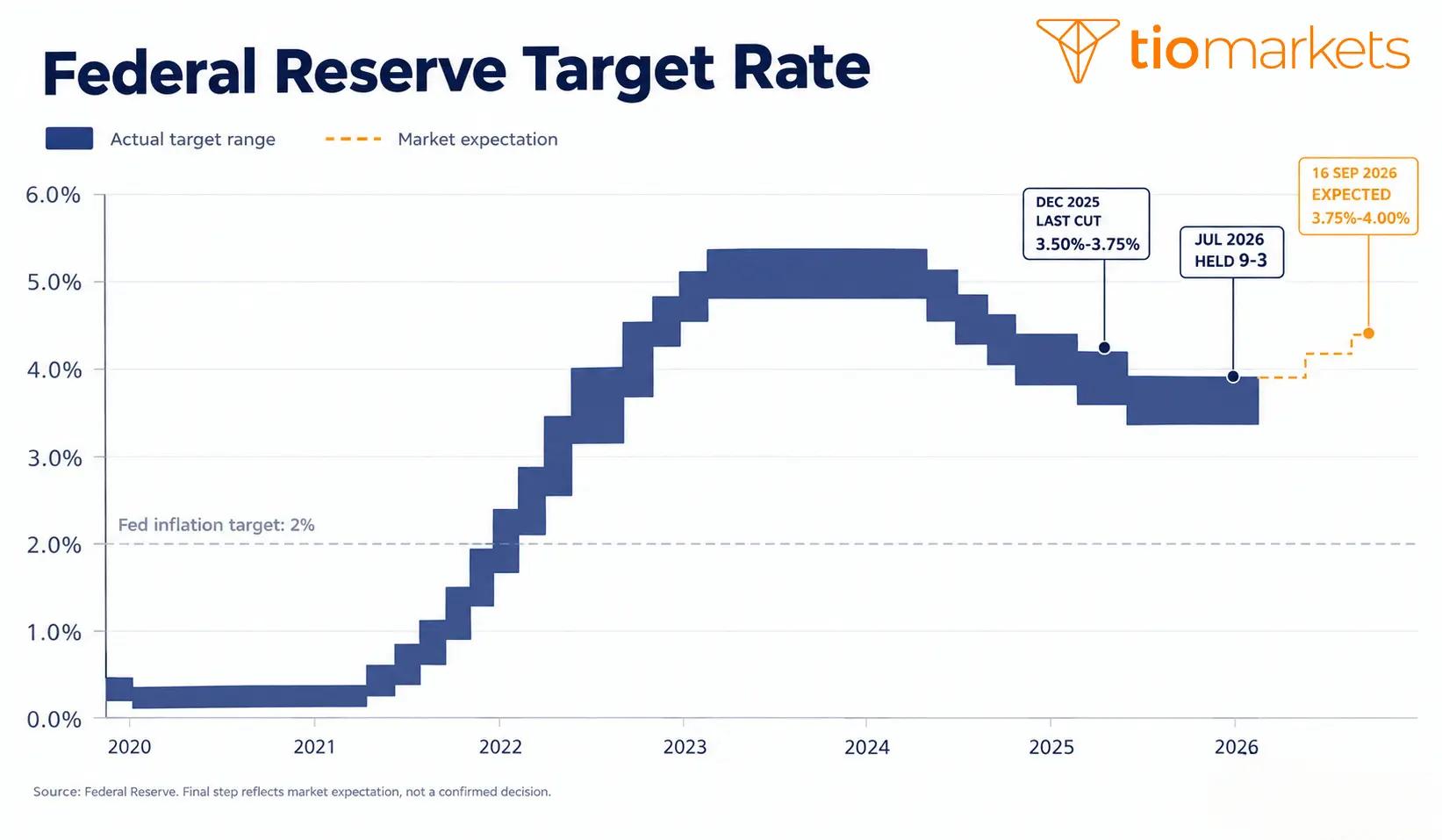
A note on the numbers. Economic calendars quote the federal funds rate as a single figure, currently 3.75%, rising to 4.00% if the Fed hikes. Technically the Fed sets a target band rather than one rate, and that band would move from 3.50%-3.75% to 3.75%-4.00%. Both descriptions refer to the same decision; the headline figure is the upper bound.
How the Fed got here
To understand why Wednesday matters, it helps to know which direction the Fed was travelling before this.
It was cutting. The last policy move was a rate cut in December 2025, which brought the target range to 3.50%-3.75%. The range has stayed there ever since.
Then it stopped. Through 2026 the committee held, meeting after meeting, as inflation proved stickier than expected. The July meeting produced a 9-3 vote to hold, with three officials already pushing for an increase.
A hike on Wednesday would therefore be a reversal, not a continuation. As KPMG's chief economist put it, the Fed would be "poised to take back what it gave in cuts last year."
That framing matters for how markets read it. A central bank continuing an existing cycle is predictable. A central bank turning around is telling you its assessment of the economy has changed, and that is a larger signal than a quarter point.
Why the Fed is expected to raise rates
The case rests on three things happening at the same time.
Inflation has not come down enough. August consumer prices rose 0.4% from July and 3.4% from a year earlier. Core inflation, which strips out food and energy because those swing wildly, rose 0.3% on the month and 2.4% over the year.
The annual core figure edged lower, which is the encouraging part. The monthly figure did not, which is the part that concerns policymakers.
Producer prices told a similar story. Wholesale prices rose 0.4% in August and 5.4% over the year, with energy up sharply within that.
The job market has not given the Fed a reason to wait. August payrolls rose 162,000 against a forecast near 56,000, unemployment held at 4.1%, and wages rose 3.1% annually. When employment is that solid, the committee has room to focus on prices.
Oil is making it harder. Crude has pushed above $100 a barrel, which feeds directly into headline inflation and, over time, into expectations.
The reaction from economists has been decisive
The inflation reading did not just move probabilities. It moved forecasts.
Consensus has settled on two increases this year, in September and December, according to reporting following the CPI release.
EY-Parthenon changed its call outright, moving from a hold to a quarter-point hike. Its chief economist wrote that some officials would likely argue the pace of disinflation is not satisfactory.
TD Securities took the most aggressive view, telling clients it expects three increases in this cycle, with the next two in October and January.
KPMG's chief economist raised a different point, suggesting the vote could be unanimous and that unanimity would help the Fed's credibility on inflation.
Bank and economist views in this section are as reported by Yahoo Finance and CBS News on 12 September 2026, following the August CPI release.
The three things to actually watch
The rate itself is the least informative part of Wednesday. These three carry the real signal.
1. The vote count
In July, the committee voted 9-3 to hold. Three officials wanted a hike then: Beth Hammack, Neel Kashkari and Lorie Logan.
The interesting question now runs the other way. If the Fed hikes, how many dissent against it? A unanimous vote signals a committee that has genuinely converged. Two or three dissents in the other direction would signal a divided one, and a divided committee is a less predictable committee.
2. The 2027 dots, not the 2026 dots
The 2026 projection is largely settled. In June, the median official projected an end-2026 rate of 3.8%, up from 3.4% in March. A single hike takes the midpoint of the new range to 3.875%, which rounds to 3.9%. That is close to where June already pointed. Nine officials had already pencilled in at least one hike this year.
So 2026 tells us little we do not know. 2027 is where the message lives.
- If the 2027 dots stay put, markets can read September as a one-off adjustment
- If they shift meaningfully higher, the message is higher for longer, and that is a different trade entirely
3. Warsh's language on "restrictive"
Central bankers use the word restrictive to mean policy is actively slowing the economy. If Warsh says rates are now sufficiently restrictive, he is signalling a pause. If he avoids the word, or says financial conditions remain loose, he is keeping the door open.
At Jackson Hole in August he said the Fed would "have work to do" if inflation did not fade. Whether he repeats that framing after hiking is the single most useful sentence to listen for.
What this could mean for your positions
None of the following is a prediction. These are the mechanical relationships that usually apply, and each can break down.
Gold. Gold pays no income, so when expected rates rise, the cost of holding it rises too. A hawkish outcome typically pressures it. But gold also responds to inflation fear and geopolitical risk, and both are currently elevated, so the two forces can offset.
The dollar. A higher expected rate path usually supports the dollar against currencies whose central banks are moving more slowly. But much of the hike is already in the price, so the reaction may depend on the projections rather than the decision.
Equity indices. Higher rates raise the discount applied to future earnings, which typically weighs most on high-growth technology shares. Banks can react differently depending on what happens to the shape of the yield curve.
Treasury yields. The two-year yield is the one to watch, because it tracks near-term policy expectations most closely. It moved sharply after the inflation data and would likely move again on a surprise in the projections.
A practical point on timing. Spreads typically widen and liquidity thins in the minutes around the announcement and during the press conference. That is worth factoring into position sizing regardless of which way you lean.
Three scenarios for the Fed rate decision
Scenario 1: Hike with balanced guidance (the base case)
What it looks like: the rate moves to 4.00%, the statement acknowledges inflation, but the projections show limited further tightening and Warsh avoids committing to more.
Possible market reaction: an initial move higher in the dollar and short-dated yields that fades as traders conclude this was a measured step rather than the start of a cycle.
What would confirm it: a narrow vote split, an unchanged 2027 median, and language describing policy as approaching sufficiently restrictive.
Scenario 2: Hike plus a higher-for-longer signal
What it looks like: the same rate move, but the 2027 dots shift up and Warsh emphasises that inflation pressure is broad and financial conditions are not tight enough.
Possible market reaction: short-dated yields and the dollar firmer, with pressure on rate-sensitive equities and gold.
What would confirm it: upward revisions to 2027 rates or inflation projections, a unanimous or near-unanimous vote, and explicit language that further firming may be appropriate.
Scenario 3: Hold
What it looks like: the rate stays at 3.75%, with the committee pointing to the cooling annual core rate and arguing that energy-driven inflation will fade.
Possible market reaction: an immediate drop in short-dated yields and a softer dollar, with relief in rate-sensitive equities.
The complication: a hold paired with hawkish projections could reverse that reaction quickly, because markets would read it as a delayed hike rather than a cancelled one.
Track markets in ral-time
Monitor US Dollar and Gold price action during Chair Warsh's press conference from your mobile.
Trading is risky
Key times and numbers
- 2:00 p.m. ET / 18:00 GMT, 16 September: statement, target range and projections
- 2:30 p.m. ET / 18:30 GMT: Warsh's press conference
- 4.00%: the forecast federal funds rate after a quarter-point increase
- 3.9%: the midpoint that one hike would imply in the Fed's projections
- 2% versus 3.7%: the Fed's inflation target against the most recent annual PCE reading available before the meeting
- 30 September: August PCE inflation, the Fed's preferred measure
- 27-28 October: the next scheduled FOMC meeting
The bottom line
A quarter-point increase on Wednesday is the market's strong base case, with probabilities between roughly 80% and 90%.
Because it is that well priced, the decision alone is unlikely to be the story. The vote count tells you how united the committee is. The 2027 dots tell you whether this is one adjustment or the start of a path. Warsh's language tells you how he wants markets to read both.
Those three things, not the headline number, are what the dollar, gold, bonds and indices will trade on.
This article is market commentary for educational purposes only. It does not constitute investment advice, does not guarantee future market performance, and contains no forecast of the Federal Reserve's decision or of future price direction

FAQ
Risk disclaimer: CFDs are complex instruments and come with a high risk of losing money rapidly due to leverage. You should consider whether you understand how CFDs work and whether you can afford to take the high risk of losing your money. Never deposit more than you are prepared to lose. Professional client’s losses can exceed their deposit. Please see our risk warning policy and seek independent professional advice if you do not fully understand. This information is not directed or intended for distribution to or use by residents of certain countries/jurisdictions including, but not limited to, USA & Countries included in the OFAC sanction list. The Company holds the right to alter the aforementioned list of countries at its own discretion.
TIOmarkets offers an exclusively execution-only service. The views expressed are for information purposes only. None of the content provided constitutes any form of investment advice. The comments are made available purely for educational and marketing purposes and do NOT constitute advice or investment recommendation (and should not be considered as such) and do not in any way constitute an invitation to acquire any financial instrument or product. TIOmarkets and its affiliates and consultants are not liable for any damages that may be caused by individual comments or statements by TIOmarkets analysis and assumes no liability with respect to the completeness and correctness of the content presented. The investor is solely responsible for the risk of his/her investment decisions. The analyses and comments presented do not include any consideration of your personal investment objectives, financial circumstances, or needs. The content has not been prepared in accordance with any legal requirements for financial analysis and must, therefore, be viewed by the reader as marketing information. TIOmarkets prohibits duplication or publication without explicit approval.
Join us on social media



Authors BIO

An experienced financial analyst and educator with over 8 years of expertise covering gold, forex, and global financial markets. Ahmed specializes in blending price action analysis with macroeconomic data to accurately interpret market movements, providing readers with comprehensive educational insights into trading and the financial world.