


Forex Trading Terms Explained: 40 Essential Definitions
BY TIOmarkets
|November 11, 2026Forex trading terms are the standard vocabulary for how a currency pair is quoted, how large a position is, how much margin it needs, how orders are filled and what a trade costs. Most of them are links in a single calculation: the lot size sets the pip value, leverage sets the margin, and equity divided by margin gives the margin level that decides when positions are closed.
Forty core terms are grouped here by the stage of a trade at which each appears, and one illustrative EUR/USD trade connects them for retail traders new to the market. The same chain carries the risk: leverage magnifies losses as well as gains, losses can build quickly, and a trader can lose all the money deposited.
What Are the Basic Forex Trading Terms?
The basic terms follow the sequence of a trade: reading a quote, sizing a position, committing margin, placing an order and paying costs. Margin level, the figure that decides a closure, comes last because it rests on equity and used margin, which in turn rest on lot size and leverage. Leverage enlarges a loss as much as a gain, losses can build quickly, and a trader can lose the entire deposit.
What Is a Base and Quote Currency?
A currency pair prices one currency in terms of another: in EUR/USD the euro is the base currency and the US dollar the quote currency. Major pairs join the dollar to another heavily traded currency, as in GBP/USD and USD/JPY; minor pairs, or crosses, such as EUR/GBP, leave the dollar out, and exotic pairs include the currency of a smaller or emerging economy.
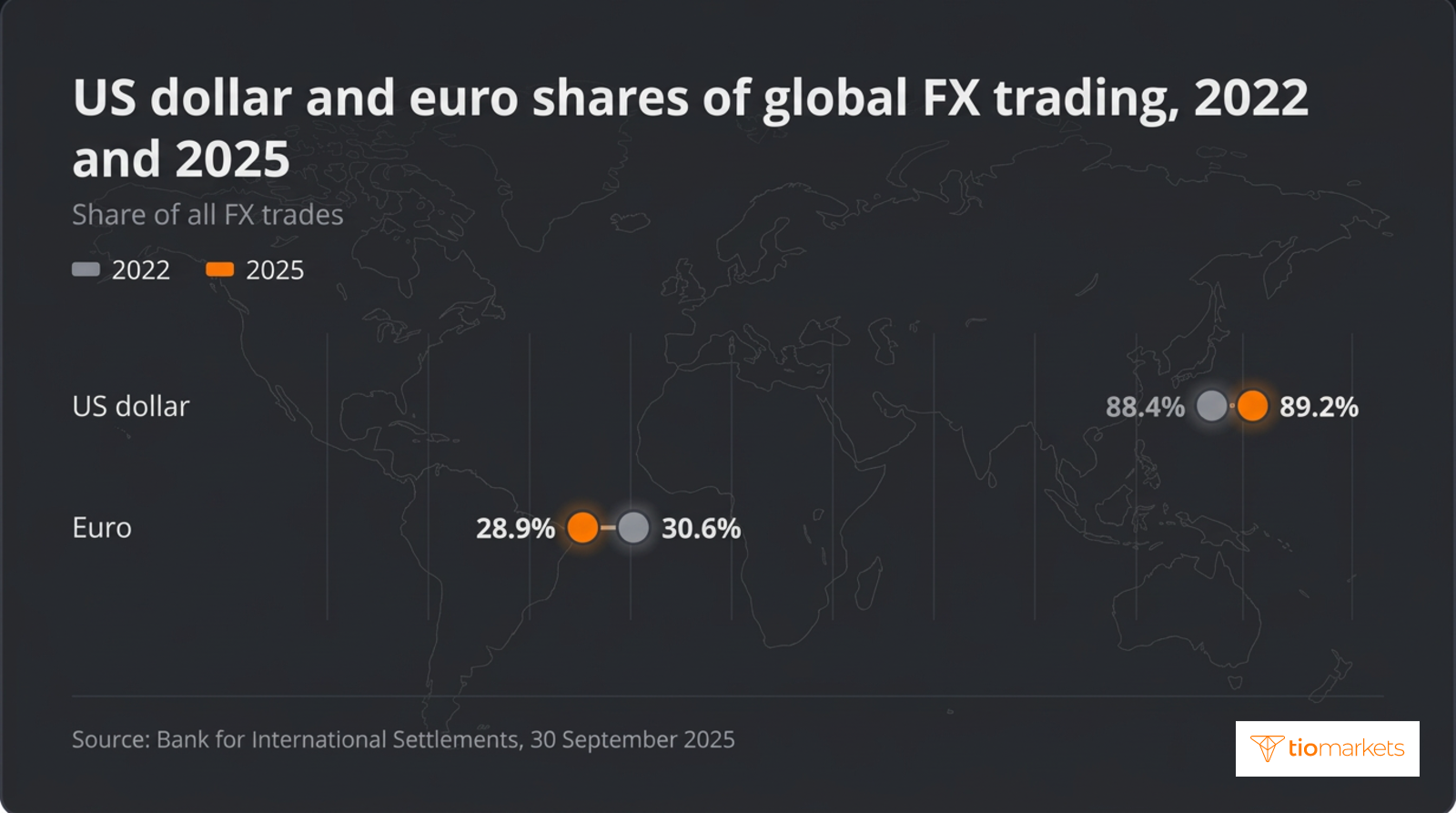
The dollar's place in the majors reflects turnover: in April 2025 it was on one side of 89.2% of all foreign exchange trades, up from 88.4% in 2022, while the euro's share fell to 28.9% from 30.6%. Each trade involves two currencies, so it counts towards both shares.
Every quote has two sides, the bid and ask price in forex. The bid is the price at which a trader can sell the base currency, the ask is the price at which a trader can buy it, and the spread is the difference between them. In an illustrative quote of 1.10000/1.10010, the bid price is 1.10000, the ask price 1.10010 and the spread 0.00010, or 1.0 pip.
A pip is the smallest standard price move: 0.0001 on most pairs and 0.01 on yen pairs, so a USD/JPY move from 109.62 to 109.63 is one pip. A pipette, one tenth of a pip, is the fifth decimal on most pairs and the third on yen pairs, a digit many brokers added as trading technology advanced. The word's origin is disputed: “percentage in point”, “price interest point” and the British word for a small fruit seed are all cited.
What Is a Lot in Forex Trading?
A lot is a standardised block of currency units, each size ten times the one below it. Among standard, mini and micro lots, the standard lot is 100,000 units of the base currency, the mini lot 10,000 and the micro lot 1,000. A long position buys the base currency and gains if the pair rises; a short position sells it and gains if the pair falls, and either loses when the price moves the other way.
Pip value, the worth of a one-pip move, depends on lot size rather than on price. On EUR/USD, which is quoted in dollars, it equals units multiplied by pip size: $10 for a standard lot (100,000 × 0.0001), $1 for a mini lot and $0.10 for a micro lot. A 100-pip move against one standard lot is a $1,000 loss before costs; a larger lot magnifies losses as it magnifies gains, those losses can accumulate quickly, and a trader can lose all the money deposited.
Difference Between Margin and Leverage
Leverage is the ratio between a position's size and the deposit needed to open it; margin is that deposit, held for as long as the position stays open. Leverage is neither extra money nor credit. Seeing how margin and leverage work together shows how much of an account a single position ties up.
In 2018 the European Securities and Markets Authority (ESMA) capped leverage for retail clients trading CFDs, contracts for difference that settle price moves without ownership of the asset, at 30:1 on major currency pairs. It also required providers to close out positions once an account fell to 50% of minimum initial required margin, so that retail clients across the EU received the same baseline of protection. The UK Financial Conduct Authority (FCA) made equivalent restrictions permanent in 2019.
MetaTrader 4 and MetaTrader 5 report the account in the Trade tab of the Terminal window. Comparing balance vs equity in forex shows the result of open trades: balance is cash after closed trades, while equity adds the floating P&L, the unrealised result of open positions. Free margin is equity minus used margin, and margin level, as the margin level in MT4 is calculated, is equity divided by used margin, times 100%: $1,000 of equity against $400 of used margin gives 250%.
A margin call is the margin level at or below which no new positions can be opened, a warning rather than a closure. A stop-out is a separate, later event: the stop-out level is the margin level at which the platform closes positions automatically.
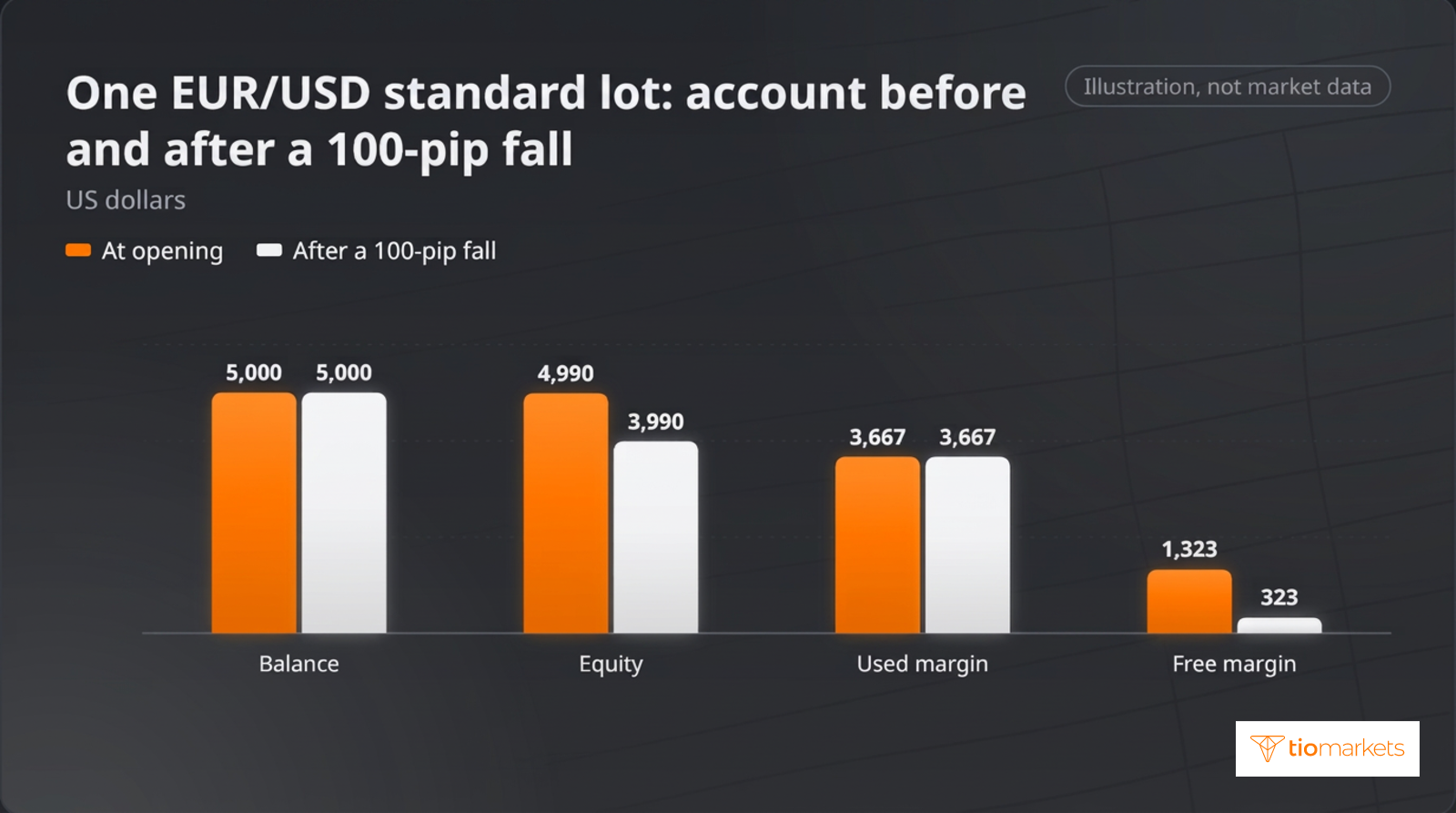
On an illustrative $5,000 account, one standard lot of EUR/USD bought at 1.10010 is worth $110,010, so at 30:1 the used margin is $3,667. After the 1.0-pip spread, equity is $4,990, free margin $1,323 and the margin level 136.1%, while the balance stays at $5,000. A 100-pip fall in the bid cuts equity to $3,990, free margin to $323 and the margin level to 108.8%. Under a 50% close-out rule, positions would close at equity of $1,833.50, a loss of $3,166.50. Leverage enlarges losses as much as gains, a sharp move can drive the margin level down quickly, and a trader can lose all of the money deposited.
Forex Order Types and Execution Terms
A market order fills at the best available price. A limit order opens a trade at a set price or better, and a stop order opens one once the price reaches a set level beyond the current one. A stop loss closes a losing trade at a preset price, a take profit closes a profitable one, and a trailing stop follows a favourable move at a fixed distance.
Slippage is a fill at a different price from the one requested; a requote is a new price offered when the requested one is no longer available. Across a price gap, such as one between Friday's close and Monday's open, a triggered stop loss becomes a market order. With a stop 50 pips below a long EUR/USD entry and the market reopening 20 pips beyond it, one standard lot loses at least $700 rather than $500. Leverage magnifies losses as well as gains, a gap can carry them past the stop in a single move, and the whole deposit can still be lost.
Trading Costs and Market Conditions in Forex
The spread is the first cost, because a long position opens at the ask but is valued at the bid. A commission is a fixed charge per lot; a swap or rollover is the overnight financing charge or credit, set by the interest-rate difference between the two currencies. Liquidity, how easily a trade fills, and volatility, how much prices move, vary across the trading sessions, and spreads can widen when liquidity is thin.
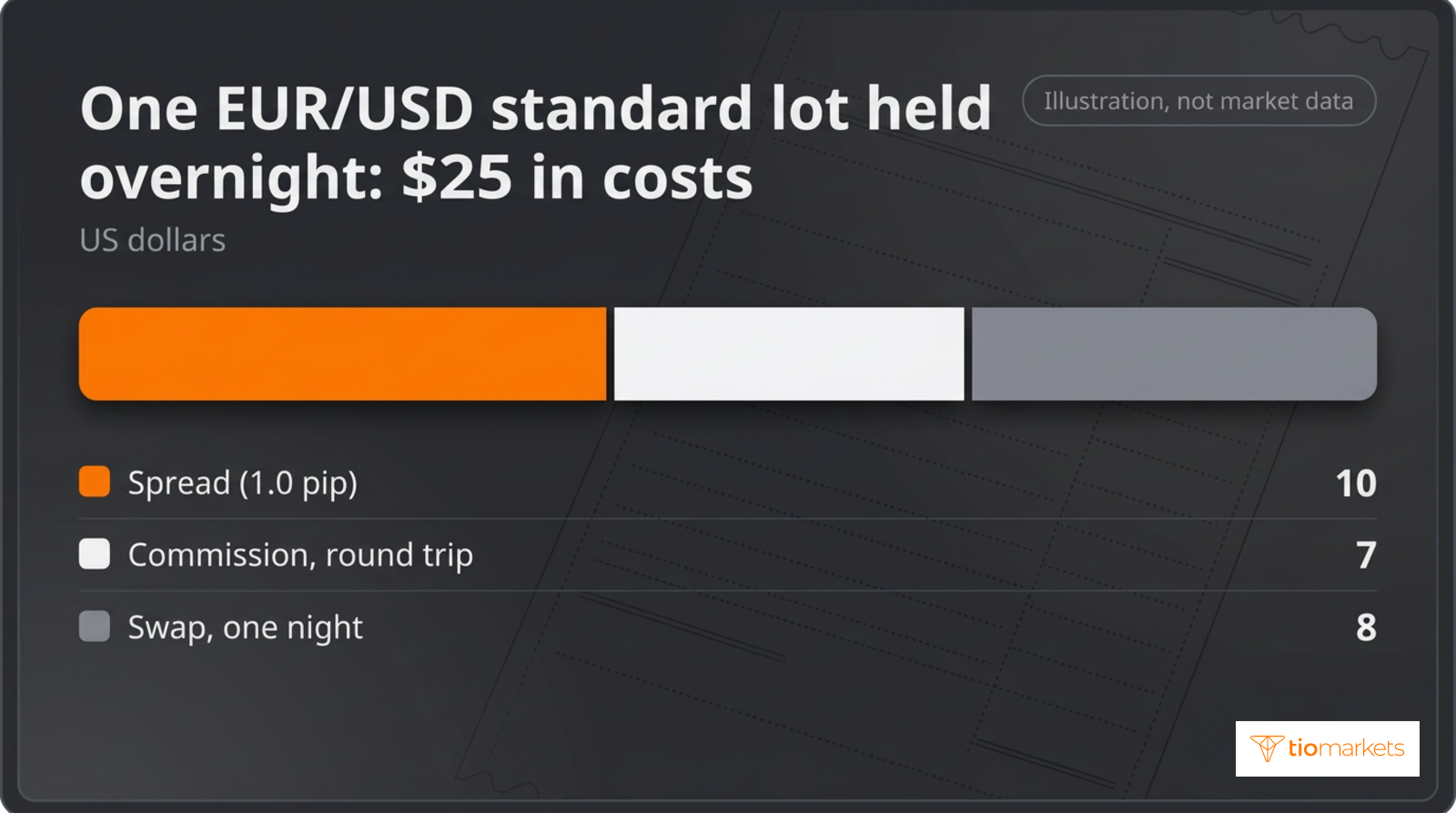
On one standard lot of EUR/USD held for one night, an illustrative 1.0-pip spread costs $10, a round-trip commission $7 and a swap charge $8. The $25 total equals 2.5 pips of favourable movement needed to break even. Costs add to market losses, and leverage enlarges those losses as much as gains: they can mount quickly over a held position and take the full amount deposited.
One EUR/USD Trade Described in Forex Terms
An illustrative long EUR/USD trade on a $5,000 account passes through six stages:
- The quote reads bid 1.10000 and ask 1.10010: a spread of 1.0 pip, with the fifth decimal as the pipette.
- The position is one standard lot of 100,000 euros, bought at the ask.
- Its pip value is 100,000 × 0.0001, or $10 for each pip the bid moves.
- At 30:1 it ties up $3,667 of used margin, leaving $1,323 of free margin and a margin level of 136.1%.
- Any stop loss or take profit is a distance in pips, each worth $10 on this position.
- At the close, a bid 30 pips above entry gives $300 gross and $285 after a $7 commission and an $8 swap; a bid 30 pips below gives a loss of $315.
Costs widen a loss and narrow a gain, so the two outcomes are not symmetrical. Leverage multiplies the loss in the same proportion as the gain, losses can build quickly while the trade is open, and a trader can lose all the money deposited, not only the $3,667 held as margin.
Commonly Confused Forex Terms
Most misreadings of an account summary come from terms that sound alike but measure different things. Because leverage magnifies losses as well as gains, a misread figure can let losses build quickly until all the money deposited is gone.
| Terms | How they differ | Confusion it causes |
| Pip and pipette | A pip is 0.0001 (0.01 on yen pairs); a pipette is a tenth of a pip, the fifth or third decimal | Reading the pipette digit as pips overstates a spread or a stop distance tenfold |
| Margin and leverage | Margin is the deposit held; leverage is the ratio of position size to that deposit | Treating leverage as extra money rather than the ratio that sets margin |
| Balance and equity | Balance excludes open positions; equity adds their floating P&L | Reading the balance as available money while an open position is losing |
| Margin call and stop-out | A margin call blocks new positions; a stop-out closes open positions | Assuming a margin call closes trades, or that a stop-out only warns |
Conclusion
Forex vocabulary is easier to retain as one calculation than as 40 separate definitions. The quote gives the spread and the pip, the lot size converts each pip into money, and leverage converts the position's value into a margin requirement. Equity set against that margin gives the margin level behind a margin call or a stop-out, which shows how much room an open position has before it is closed.
The chain describes a position, not the direction of the price, and a stop loss can fill beyond its level when prices gap. Leverage sets the size of the position relative to the deposit: it magnifies losses as well as gains, losses on a leveraged position can accumulate quickly, and a trader can lose all of the money deposited.
Trade from anywhere with the TIOmarkets Trading and Investing Mobile App
Trade over 950 instruments with built-in TradingView charts and competitive spreads, all from your phone, in real time.
Trading is risky
FAQ
Risk disclaimer: CFDs are complex instruments and come with a high risk of losing money rapidly due to leverage. You should consider whether you understand how CFDs work and whether you can afford to take the high risk of losing your money. Never deposit more than you are prepared to lose. Professional client’s losses can exceed their deposit. Please see our risk warning policy and seek independent professional advice if you do not fully understand. This information is not directed or intended for distribution to or use by residents of certain countries/jurisdictions including, but not limited to, USA & Countries included in the OFAC sanction list. The Company holds the right to alter the aforementioned list of countries at its own discretion.
TIOmarkets offers an exclusively execution-only service. The views expressed are for information purposes only. None of the content provided constitutes any form of investment advice. The comments are made available purely for educational and marketing purposes and do NOT constitute advice or investment recommendation (and should not be considered as such) and do not in any way constitute an invitation to acquire any financial instrument or product. TIOmarkets and its affiliates and consultants are not liable for any damages that may be caused by individual comments or statements by TIOmarkets analysis and assumes no liability with respect to the completeness and correctness of the content presented. The investor is solely responsible for the risk of his/her investment decisions. The analyses and comments presented do not include any consideration of your personal investment objectives, financial circumstances, or needs. The content has not been prepared in accordance with any legal requirements for financial analysis and must, therefore, be viewed by the reader as marketing information. TIOmarkets prohibits duplication or publication without explicit approval.
Join us on social media


Authors BIO

Behind every blog post lies the combined experience of the people working at TIOmarkets. We are a team of dedicated industry professionals and financial markets enthusiasts committed to providing you with trading education and financial markets commentary. Our goal is to help empower you with the knowledge you need to trade in the markets effectively.