


GBP/USD Forecast: Jobs Data Miss Sets Up UK Inflation Test
BY Eleni Antoniou
|August 18, 2026Sterling trades near 1.3520 after UK unemployment held at 4.9% in the three months to June, defying forecasts for a fall to 4.8%. The pair had reached roughly 1.3555 on Monday, its highest level since mid-May, before easing back.
This GBP/USD forecast covers a window in which the pound faces an unusually concentrated run of domestic data. It also covers a shift in rate expectations that much of the current commentary has not caught up with: markets have moved away from pricing Bank of England cuts and toward the possibility of tightening.
Wednesday brings the test that matters. UK inflation is expected to accelerate to a four-month high, and the Federal Reserve's July minutes land the same day.
Key takeaways
- GBP/USD near 1.3520, having peaked around 1.3555 on Monday, a three-month high
- UK unemployment held at 4.9% in the three months to June, against expectations of 4.8%
- Unemployment fell by 36,000 on the quarter but remains 88,000 higher than a year ago
- Rate expectations have shifted from cuts toward possible tightening, though the extent is debated
- UK CPI lands Wednesday 19 August, with headline inflation expected at a four-month high
- Fed minutes also land Wednesday, and Jackson Hole runs 27-29 August
- Labour Force Survey data carries an official reliability caveat this cycle
What the jobs data actually showed
The Office for National Statistics reported that the unemployment rate was unchanged at 4.9% in the three months to June 2026. Consensus had looked for a decline to 4.8%, and at least one major forecaster had expected 4.7%.
The detail was mixed rather than uniformly weak:
- The number of unemployed people fell by 36,000 on the quarter, to 1.772 million
- The decline was concentrated in those unemployed for up to six months
- Unemployment is nonetheless up 88,000 from a year earlier, driven by longer-duration joblessness
- Prior data showed regular pay growth excluding bonuses steady at 3.4%, with total pay at 4.3%
A caveat worth stating. The House of Commons Library notes that Labour Force Survey data is less reliable than usual at present, partly because of a data collection error in May and June. The ONS has advised that survey estimates be read alongside other sources such as PAYE payroll data.
That matters for interpretation. A single unemployment print carrying a known reliability flag is weaker evidence than the headline suggests, which is one reason the market reaction has been contained.
The rate-expectation shift most coverage misses
Here is the point that reframes the outlook, and it is worth stating carefully because market views on the magnitude differ.
Earlier in 2026, markets were positioned for the Bank of England to cut Bank Rate by mid-year. That expectation has reversed. Higher energy costs and their pass-through into broader inflation have moved pricing toward the possibility of tightening instead, with December cited as the most likely meeting for any move.
How firmly that is priced is genuinely contested. Some market commentary describes a December increase as fully discounted, while prediction-market activity has implied materially lower odds of any 2026 hike. Readers should treat the precise probability as uncertain and verify current pricing against live short-sterling futures.
What is not contested is the direction of travel, and that alone changes how the pair should be read:
- Sterling's recovery from the June low near 1.3148 is not simply a weak-dollar story. It carries domestic rate support
- The principal risk to the pound is therefore not that the Bank turns dovish. It is that inflation data erodes the tightening expectation the market has been building
- Those two mechanisms are frequently conflated, and they behave differently
The Bank held Bank Rate at 3.75% in July on a 6-3 vote, and Governor Andrew Bailey described the disinflation process as remaining on track despite persistent external risks.
Wednesday's inflation print is the real test
UK CPI for July is released on 19 August, and headline inflation is expected to accelerate to a four-month high, even as the core rate may ease.
For reference, CPIH inflation eased to 2.8% year-on-year in June from 3.0% in May, with services CPIH at 3.6%.
Two outcomes to consider:
- A firm print, particularly in services inflation, would reinforce the tightening case and support sterling through the rate channel
- A soft print would undermine it and remove domestic support the pound has been drawing on
Services inflation is the component to watch. The Bank has consistently treated it as the clearest read on domestic price persistence, distinct from the imported energy pressure its July report highlighted.
UK retail sales follow on 21 August, alongside US flash PMIs.
GBP/USD technical analysis
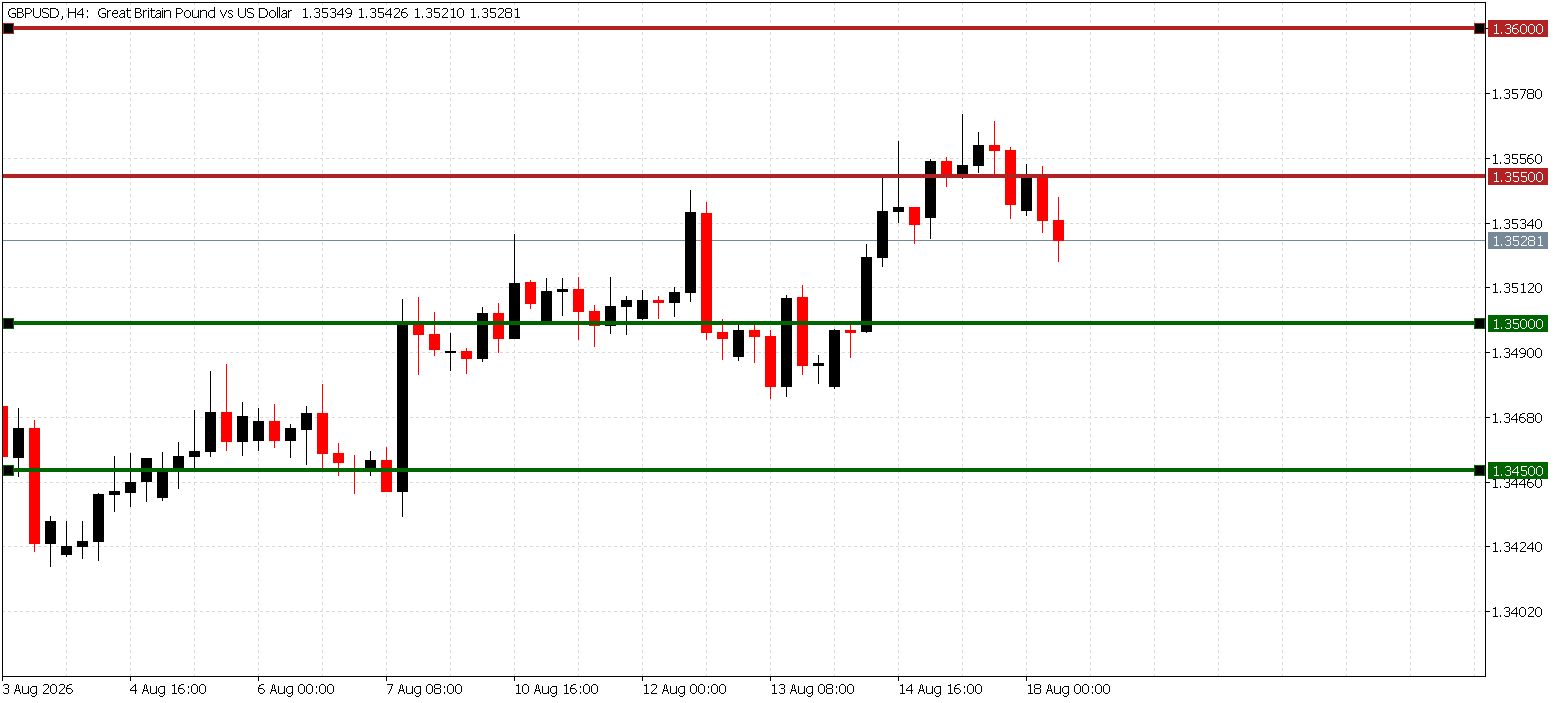
Source: TIOmarkets MT5 live GBP/USD chart
The daily structure has improved steadily since the June low at 1.3148, with the pair reclaiming 1.3500 and reaching a three-month high around 1.3555 on Monday before easing.
Resistance levels to watch:
- 1.3555 to 1.3560: Monday's high and the immediate barrier, now a proven supply area
- 1.3600: the round-number level above it, where a sustained daily close would signal a broader advance
- 1.3640 to 1.3650: the May swing area, the next objective on a confirmed break
Support levels to watch:
- 1.3500: the pivot, and the level the recovery has been building on
- 1.3450: the first support beneath the pivot
- 1.3375: a deeper reference from July price action
- 1.3280 to 1.3300: the late-July reversal zone, relevant only on a pronounced decline
Momentum favours the upside while the pair holds above 1.3500, but Monday's rejection near 1.3555 establishes that zone as genuine supply. At 1.3520 the pair sits between the two, with only 20 pips separating it from the pivot, which means the inflation print will likely determine which side breaks.
The dollar side: Fed minutes and Jackson Hole
The Federal Reserve left its target range at 3.50% to 3.75% on 29 July. The minutes arrive on 19 August, the same day as UK CPI, before the next FOMC meeting on 15-16 September.
Under Kevin Warsh, the Fed has removed forward guidance from its communication. With no road map issued between meetings, the minutes are one of the few available windows into how the Committee is reasoning.
Jackson Hole is the larger event in this window. The Kansas City Fed hosts the symposium from 27 to 29 August, with Warsh delivering the keynote on Friday 28 August, his first since taking office on 22 May 2026.
Reported remarks from the 29 July press conference indicated he had not settled on whether the address would be broad in scope or used to prepare the ground for autumn policy.
For GBP/USD specifically, the two-sided nature of this window is unusual. Both legs of the pair face scheduled catalysts capable of repricing rate expectations, which raises the probability of a decisive move rather than continued range trading.
Bullish scenario: 18-28 August
This bullish GBP/USD forecast scenario may strengthen if Wednesday's inflation data comes in firm, particularly in services, reinforcing the tightening case while US data or the Fed minutes fail to revive expectations of tighter American policy.
A daily close above 1.3560 would improve the technical picture, with 1.3600 the next reference and the 1.3640 to 1.3650 May swing area beyond it.
Supporting factors include continued broad dollar weakness, resilient UK retail sales on Friday, and a Jackson Hole address that markets read as neutral or accommodative.
Invalidation: a return below 1.3500 would weaken this scenario, particularly if driven by a soft inflation print.
Bearish scenario: 18-28 August
The bearish case may strengthen if UK inflation undershoots and erodes the tightening expectation the market has built, or if the Fed minutes and US survey data lift American yields and support the dollar.
Note the mechanism here. The near-term risk to sterling is the withdrawal of expected tightening, not the arrival of easing expectations. Those two are frequently conflated, and they produce different magnitudes of move.
A sustained break below 1.3500 would put 1.3450 in focus, and a break of that zone would raise the risk of a retest toward 1.3375.
Supporting factors include a firmer dollar on rising yields, weak UK retail sales, or a Jackson Hole address read as leaning against current market pricing.
Invalidation: a decisive move above 1.3600 would reduce the near-term bearish case.
Key levels and catalysts
| Item | Detail |
| Support | 1.3500, then 1.3450, then 1.3375, then 1.3280 to 1.3300 |
| Reference low | 1.3148 (June 2026) |
| 19 August | UK July CPI, and FOMC minutes from the 29 July meeting |
| 27-29 August | Jackson Hole symposium |
| 28 August | Warsh keynote, his first as Fed chair |
| 15-16 September | Next FOMC meeting |
| December | BoE meeting most cited for any policy move |
Conclusion
This GBP/USD forecast describes a pair sitting just below the top of its recent range, supported by a shift in domestic rate expectations rather than by dollar weakness alone.
Today's labour data was a modest miss rather than a turning point, and its reliability caveat limits how much weight it can carry. The decisive input arrives on Wednesday.
The structural point concerns positioning. With expectations having moved from cuts toward possible tightening, sterling's vulnerability lies in that shift being reversed, not in easing being introduced. An inflation print that supports the tightening case keeps the recovery intact toward 1.3600, while one that undermines it removes support the market has already begun to count.
This article is market commentary for educational purposes only. It does not constitute investment advice, does not guarantee future market performance, and contains no forecast of central bank decisions.

Risk disclaimer: CFDs are complex instruments and come with a high risk of losing money rapidly due to leverage. You should consider whether you understand how CFDs work and whether you can afford to take the high risk of losing your money. Never deposit more than you are prepared to lose. Professional client’s losses can exceed their deposit. Please see our risk warning policy and seek independent professional advice if you do not fully understand. This information is not directed or intended for distribution to or use by residents of certain countries/jurisdictions including, but not limited to, USA & Countries included in the OFAC sanction list. The Company holds the right to alter the aforementioned list of countries at its own discretion.
TIOmarkets offers an exclusively execution-only service. The views expressed are for information purposes only. None of the content provided constitutes any form of investment advice. The comments are made available purely for educational and marketing purposes and do NOT constitute advice or investment recommendation (and should not be considered as such) and do not in any way constitute an invitation to acquire any financial instrument or product. TIOmarkets and its affiliates and consultants are not liable for any damages that may be caused by individual comments or statements by TIOmarkets analysis and assumes no liability with respect to the completeness and correctness of the content presented. The investor is solely responsible for the risk of his/her investment decisions. The analyses and comments presented do not include any consideration of your personal investment objectives, financial circumstances, or needs. The content has not been prepared in accordance with any legal requirements for financial analysis and must, therefore, be viewed by the reader as marketing information. TIOmarkets prohibits duplication or publication without explicit approval.
Join us on social media



Authors BIO

Eleni is a financial markets enthusiast contributing to content covering forex, indices, commodities, and global market developments. She is passionate about researching market-related topics and helping make financial information more accessible to traders.