


How Can I Start Trading? A Step-by-Step Beginner's Guide
BY Maria K.
|September 30, 2026You can start trading by opening a brokerage account, learning market fundamentals, practicing with demo accounts, and developing a risk management plan before committing real capital.
This guide answers the question: “how can I start trading” by covering the practical steps for getting started, from selecting your first market, i.e. trading instrument, to executing your initial trade. The focus remains on what beginners actually need to know rather than complex theory.
Trading involves buying and selling financial assets, like CFDs, aiming to profit from price movements. Before this can happen, traders must be aware that the trading journey requires patience, education, and realistic expectations about the learning curve involved.
What Is Online Trading
Starting to trade means actively buying and selling financial instruments to profit from short-term price changes, which differs from long-term investing where assets are held for years.
Anyone asking how can I start trading needs to understand that online trading is different from investing. Trading and investing both involve purchasing financial assets, but the timeframe and approach differ significantly. Trading focuses on short-term price movements. Investors generally review their holdings quarterly or annually, while traders make frequent decisions and actively monitor markets throughout the day. The time commitment and skill requirements vary considerably between these two approaches.
Main types of trading
- Day trading involves opening and closing all positions within a single trading session, requiring constant attention during market hours.
- Swing trading holds positions for several days to weeks, allowing for employment or other commitments alongside trading activity.
- Position trading maintains positions for months, though this style begins to overlap with traditional investing approaches.
What Do You Need to Start Trading?
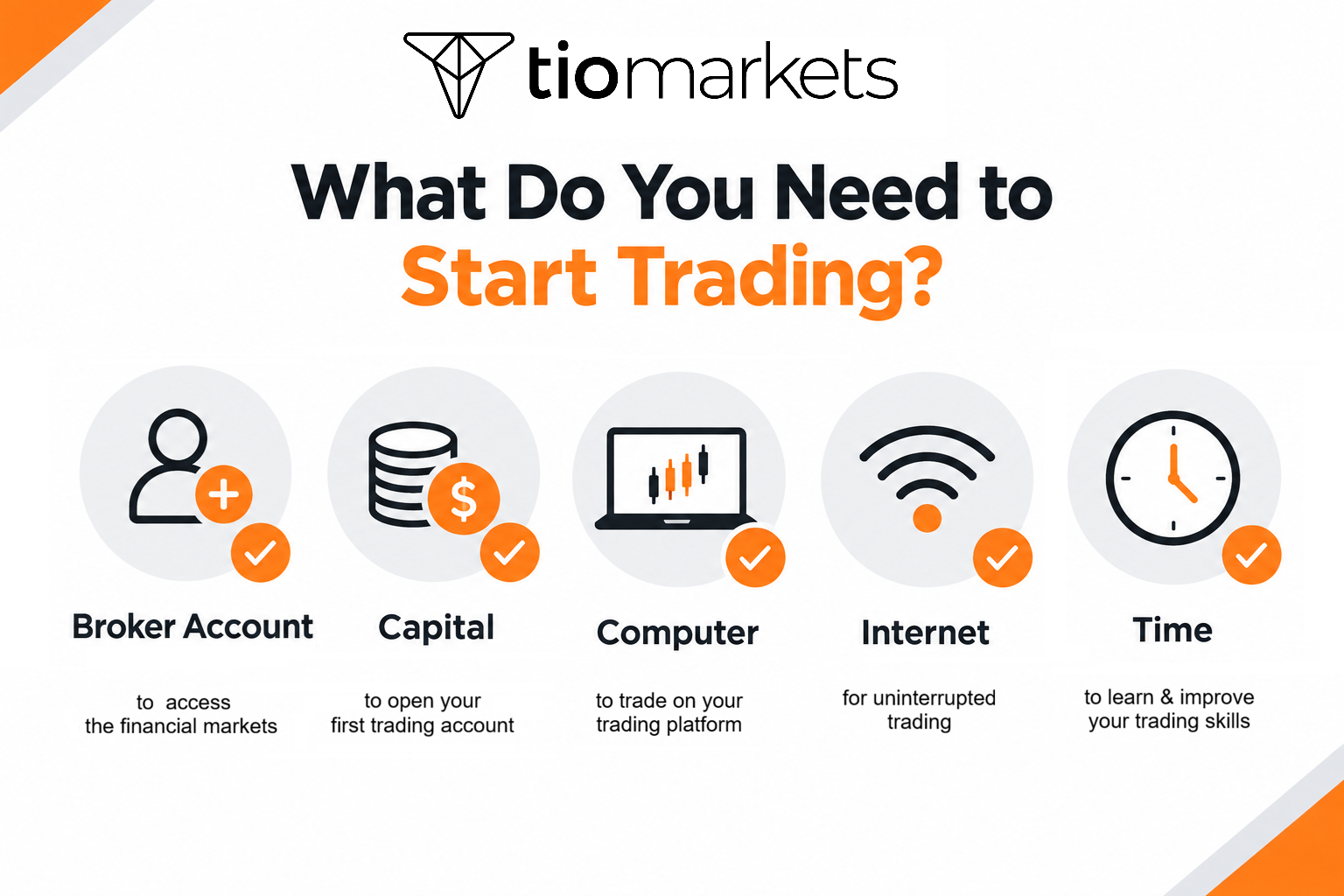
Most adults can open a trading account, but it typically requires capital, time, emotional discipline, and willingness to learn market mechanics thoroughly.
When asking how can I start trading, you should know that it requires several elements beyond just money in your account. You need a computer or smartphone with reliable internet access, a brokerage account with a regulated provider, starting capital you can afford to lose, and dedicated time for learning and monitoring positions.
The learning phase represents a critical period that many beginners attempt to skip entirely. Markets operate according to patterns and principles that require study; jumping into trading without adequate preparation increases the probability of experiencing losses.
How Much Money Do You Need to Start Trading?
The minimum deposit requirement varies by broker but at TIOmarkets the amount is set at $20 for Nano and Standard accounts. Starting capital affects which markets and strategies become practical options for implementation. A low minimum deposit allows beginners to gain real trading experience with minimal financial commitment, though smaller accounts may require more careful position sizing and attention to trading costs.
How Much Time Does Trading Require?
Day trading can require 6-8 hours daily during market hours plus additional preparation time before markets open. Swing trading might need 1-2 hours daily for research and position monitoring. Position trading may only require a few hours weekly for analysis and trade management.
Beginners often underestimate the time needed for education before active trading begins, with learning market basics taking months of dedicated study.
How Can I Start Trading? Step-by-Step Guide
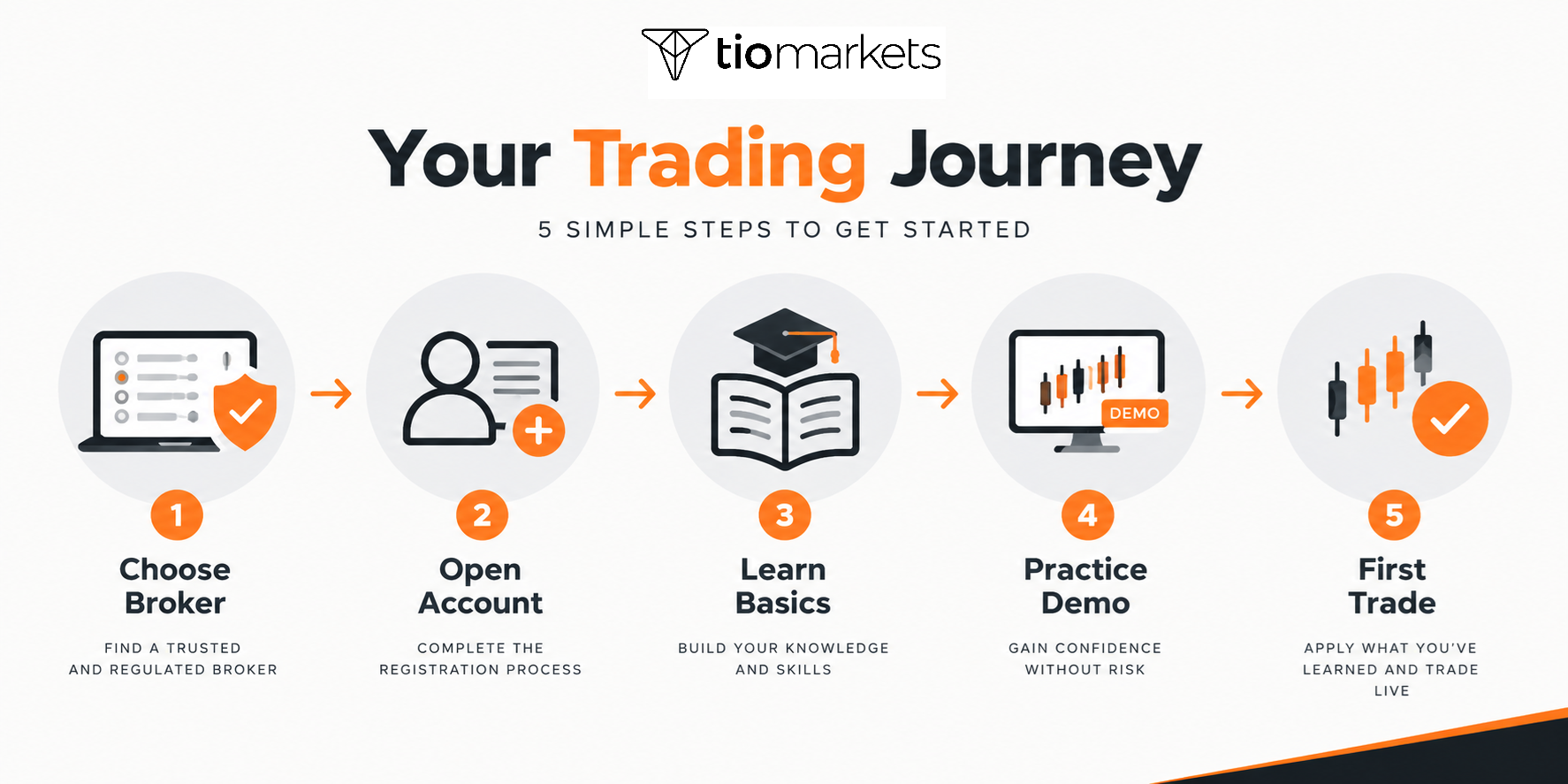
The steps include choosing a regulated broker, opening an account, learning basics, selecting a market, practicing with demos, developing a trading plan, and executing trades with proper risk management.
Step 1 - How Do You Choose a Trading Broker?
Selecting a broker involves comparing a few important factors, but the process is straightforward. Check that the broker is regulated, compare their fees and spreads, and ensure the trading platform is easy to navigate. Reading reviews from independent sources helps, but don't let research overwhelm you, choosing a well-regulated broker with transparent pricing is a solid foundation.
Learn more on choosing the best forex broker for CFD trading here.
Step 2 - How Do You Open a Trading Account?
Opening a trading account is quite simple and only requires personal identification documents, like an ID and a proof of address. Brokers collect this information to comply with financial regulations designed to prevent fraud and money laundering.
Creating your TIOmarkets account actually takes a few minutes. Our streamlined registration process requires the minimum information to get started. Once registered, you'll have access to your secure client area to manage your account and funds. Then, you can fund and start trading immediately with a 14-day grace period to verify your account.
Beginners typically start with standard individual accounts rather than margin accounts, which allow borrowing but significantly increase risk exposure.
Step 3 - What Do Beginners Need to Learn Before Trading?
Core concepts include understanding how markets operate, different order types available, how prices move, and fundamental risk management principles. Understanding these basics helps prevent costly mistakes that commonly affect unprepared traders.
Key terms to understand include bid/ask spreads, market orders versus limit orders, stop-loss orders, position sizing calculations, and leverage mechanics. Keep in mind that online trading features leveraged instruments so understanding leverage and its implications is a vital aspect for anyone asking the crucial question How can I start trading?
Many brokers like TIOmarkets provide educational resources, like daily market analysis and educational articles.
Step 4 - Which Market Should You Trade First?
Markets available for trading include stocks, forex, commodities, indices, and cryptocurrencies, each with distinct characteristics and requirements. Stocks are a common trading instrument among beginners because individual companies can be researched using publicly available information and price movements tend to be less extreme than some alternatives.
Forex offers 24-hour trading access but involves currency pairs that move based on macroeconomic factors that some beginners might find too complicated. For anyone interested in checking how to trade forex on the MT4 and MT5 trading platforms, here is a comprehensive guide.
Step 5 - Should You Practice Before Risking Real Money?
Demo accounts simulate trading with virtual money, allowing practice without any financial risk to your capital. Brokers offer demo accounts featuring the same platform functionality as real trading accounts. Practicing helps develop familiarity with order entry, test strategies without consequences, and build confidence.
Test trading conditions & platforms
Demo accounts help new traders evaluate every important aspect before committing real money.
Trading is risky
Note that demo trading lacks the emotional component present when real money is at risk, which often surprises beginners transitioning to live accounts.
Step 6 - How Do You Create a Trading Plan?
A trading plan documents your approach before entering markets, including which markets you will trade and your entry and exit criteria. The plan should specify position sizing rules and risk management parameters that govern every trade you take. Some traders choose to limit risk to 1-2% of total account value per trade, defining specific conditions for entering positions and predetermined levels for exiting.
Step 7 - How Do You Place Your First Trade?
Placing a trade involves selecting the asset, choosing the appropriate order type, specifying the quantity, and confirming all details before execution. Before clicking the final confirmation button, verify all details including trade direction, quantity, and order type.
Many beginners prefer their first trades to be small to limit potential losses during the initial learning process when mistakes are most likely to occur.
All About Trading Risks & Costs
Trading carries significant risks including potential loss of invested capital, emotional stress, and various costs that can erode returns over time.
How Much Money Can You Lose Trading?
Losses can range from small amounts on individual trades to the entire account balance in severe cases. Leveraged trading can result in serious losses so caution is required. Learning what is a stop loss and using it, as well as proper position sizing are primary tools for limiting potential losses.
Why Beginner Traders Sometimes Lose Money?
Financial regulators across different jurisdictions warn that traders frequently experience losses, with outcomes varying by market and individual circumstances. Common contributing factors include insufficient preparation, inconsistent risk management practices, and emotional responses during periods of market volatility.
Traders - either beginners or experienced - who approach markets seriously, invest time in education, and develop disciplined habits may improve their outcomes compared to those who treat trading casually.
What Are the Costs Involved in Trading?
Beyond obvious commissions, trading involves spreads, overnight financing charges for leveraged positions, transaction fees, and potential inactivity fees. These costs can accumulate over time and can significantly impact profitability.
At TIOmarkets, we are very transparent about our pricing structure; you can read all about it here.
What Trading Strategies Can Beginners Use?
Beginner-friendly strategies include trend following, range trading, and breakout trading, each requiring different skills and suiting different market conditions.
Trend trading involves identifying price direction and taking positions aligned with that movement, assuming trends continue rather than reverse immediately. Range trading works in sideways markets, with traders buying near support levels and selling near resistance. Complex strategies involving multiple positions or algorithmic approaches typically exceed beginner capabilities initially.
Starting with simple strategies allows focus on execution fundamentals and risk management rather than strategy complexity.
How to Manage Trading Risks?
Risk management involves limiting position sizes, using stop-loss orders, diversifying across assets, and maintaining emotional discipline.
Position sizing determines capital allocation per trade, ensuring no single loss significantly damages your account. If an account holds $5,000 and the trader risks 1% per trade, the maximum acceptable loss equals $50 on that position. Stop-loss orders automatically close positions at specified price levels, removing emotional decision-making during losses. Emotions significantly impact trading decisions, with fear causing premature exits and greed leading to excessive position sizes or holding losing trades.
What Mistakes Do Beginners Make When Starting Trading?
Common mistakes include starting with real money before adequate preparation, risking too much per trade, trading without plans, and overtrading.
Overtrading occurs when traders take too many positions, often driven by boredom or desire to recover losses quickly. Quality typically matters more than quantity in trading outcomes. Many beginners start trading with real money before understanding market mechanics or developing risk management skills, treating markets like gambling.
A written trading plan provides structure and accountability, allowing for performance review and continuous improvement over time.
What Resources Help You Start Trading?
Helpful resources include broker educational materials, trading books, demo accounts, reputable online courses, and trading communities focused on education.
Quality trading education focuses on principles and risk management rather than promising quick profits or secret strategies. Demo accounts provide valuable practice opportunities without financial risk. Trading communities can offer support but also contain misinformation, requiring critical evaluation of any advice received.
Conclusion
In this article we answered the question How can I start trading within a few brief paragraphs. But trading requires constant education, practice, capital, time, and emotional discipline developed over months or years of experience.
The steps for how to start trading include choosing a regulated broker, learning market basics, practicing with demo accounts, developing a comprehensive trading plan, and beginning with small position sizes. Risk management through proper position sizing and stop-loss orders helps protect capital during the learning phase.
Trading demands significant time commitment and carries substantial risk of loss. That’s why prioritizing education and risk management over quick profits is essential.
FAQ
Risk disclaimer: CFDs are complex instruments and come with a high risk of losing money rapidly due to leverage. You should consider whether you understand how CFDs work and whether you can afford to take the high risk of losing your money. Never deposit more than you are prepared to lose. Professional client’s losses can exceed their deposit. Please see our risk warning policy and seek independent professional advice if you do not fully understand. This information is not directed or intended for distribution to or use by residents of certain countries/jurisdictions including, but not limited to, USA & Countries included in the OFAC sanction list. The Company holds the right to alter the aforementioned list of countries at its own discretion.
TIOmarkets offers an exclusively execution-only service. The views expressed are for information purposes only. None of the content provided constitutes any form of investment advice. The comments are made available purely for educational and marketing purposes and do NOT constitute advice or investment recommendation (and should not be considered as such) and do not in any way constitute an invitation to acquire any financial instrument or product. TIOmarkets and its affiliates and consultants are not liable for any damages that may be caused by individual comments or statements by TIOmarkets analysis and assumes no liability with respect to the completeness and correctness of the content presented. The investor is solely responsible for the risk of his/her investment decisions. The analyses and comments presented do not include any consideration of your personal investment objectives, financial circumstances, or needs. The content has not been prepared in accordance with any legal requirements for financial analysis and must, therefore, be viewed by the reader as marketing information. TIOmarkets prohibits duplication or publication without explicit approval.
Join us on social media



Authors BIO

Maria is a writer and content strategist with over 10 years of experience in the finance industry. She specializes in developing research-backed articles that help financial professionals navigate complex market topics with confidence. Her expertise spans forex, stocks, CFDs and global markets, creating insightful content that educates readers and supports informed decision-making.