


USD/JPY Slides After Rare U.S. - Japan Yen Intervention
BY Eleni Antoniou
|August 5, 2026The Japanese yen strengthened sharply after Washington and Tokyo confirmed coordinated foreign-exchange intervention, sending USD/JPY tumbling from four-decade highs and putting speculative yen positions under pressure.
The Japanese yen has staged a dramatic recovery against the U.S. dollar after the United States and Japan jointly intervened in the foreign-exchange market to arrest the currency’s prolonged decline.
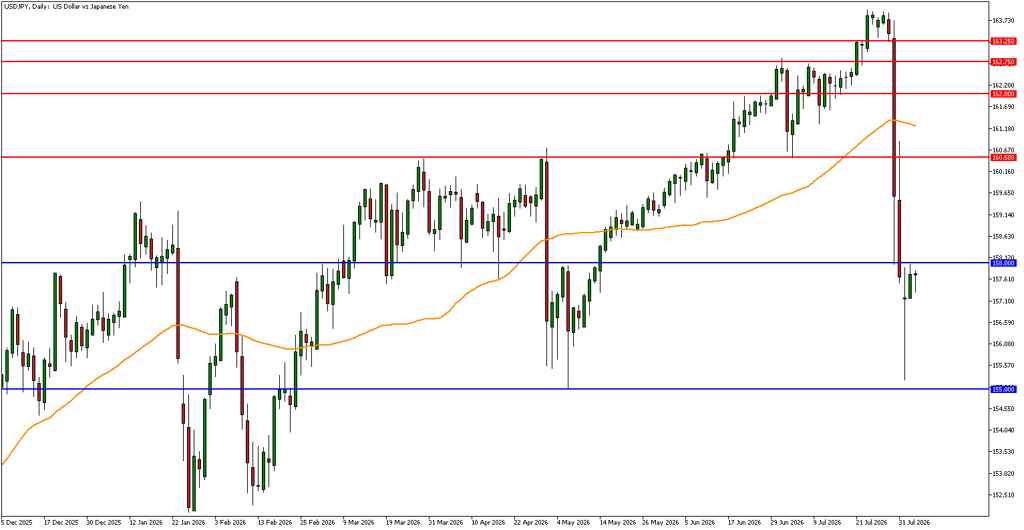
USD/JPY had traded above 163.00 late last week, its highest level in approximately 40 years, before suspected official buying pushed the pair below 160.00. The decline accelerated after both governments confirmed their involvement, briefly driving USD/JPY towards 155.20, an overall fall of nearly 5% from its recent peak.
The move represents one of the most significant episodes of coordinated currency intervention in decades. It has forced traders to reconsider whether persistent yen weakness can continue without provoking further action from Japanese and U.S. authorities.
Why did the U.S. and Japan intervene?
Japan has intervened independently on several occasions to support the yen. Direct U.S. participation, however, is extremely rare.
Japan’s Ministry of Finance confirmed that it had purchased yen in coordination with the U.S. Treasury. Finance Minister Satsuki Katayama also warned that the authorities would not hesitate to intervene jointly again should disorderly market conditions return.
The intervention followed a prolonged period of yen depreciation driven primarily by the wide interest-rate differential between Japan and the United States.
The Bank of Japan’s benchmark interest rate stands at 1%, its highest level in more than three decades but still substantially below the Federal Reserve’s 3.50% - 3.75% target range. The difference has encouraged investors to borrow in low-yielding yen and purchase higher-yielding dollar-denominated assets, a strategy known as the yen carry trade.
As those trades accumulated, demand for dollars increased while the yen weakened.
For Japan, the consequences have become increasingly difficult to ignore. The country imports much of its energy and raw materials, meaning that a weaker currency raises the domestic cost of oil, food and other essential goods. Higher energy prices have intensified the pressure on Japanese households and businesses.
The U.S. also had reasons to support coordinated action. Severe instability in the yen can spill into global bond markets, particularly if Japan needs to sell part of its substantial U.S. Treasury holdings to finance intervention. A weaker dollar against the yen could also make American exports more competitive in Japan.
How currency intervention works
Foreign-exchange intervention occurs when an official authority buys or sells currencies to influence an exchange rate.
To strengthen the yen, Japanese authorities sell foreign-currency assets and use the proceeds to purchase yen. Buying creates additional demand for the Japanese currency, which can push USD/JPY lower.
On the U.S. side, foreign-exchange transactions can be executed by the Federal Reserve Bank of New York under the direction of either the Federal Open Market Committee or the Treasury’s Exchange Stabilization Fund. The New York Fed says intervention may be used to counter disorderly market conditions or signal that an exchange rate has moved away from economic fundamentals.
Reports indicate that the latest coordinated operation was worth approximately ¥14 trillion, equivalent to about $88 billion. The action was also unusual because the U.S. reportedly financed part of its yen purchases by selling euros rather than dollars, limiting the potential impact on already-sensitive U.S. Treasury markets.
Japan had already carried out ¥11.73 trillion of intervention between April 28 and May 27, according to official Ministry of Finance data.
The latest action suggests that authorities concluded unilateral intervention was not producing a sufficiently durable change in market behaviour.
Can the intervention keep USD/JPY falling?
The immediate market response has been substantial.
A move from above 163.00 to the 155.00 region has disrupted momentum strategies and forced some traders to unwind short-yen positions. The unusually public confirmation of the operation may also increase its effectiveness by making market participants more cautious about rebuilding speculative exposure.
However, intervention does not remove the underlying forces that weakened the yen.
The interest-rate advantage remains firmly in favour of the dollar. As long as U.S. rates remain substantially higher than Japanese rates, investors may continue to see value in holding dollar-denominated assets.
Japan’s dependence on imported energy is another source of pressure. Elevated oil prices worsen the country’s trade position by increasing the number of yen needed to pay for dollar-priced energy imports.
Domestic fiscal policy could also complicate the outlook. Proposals for lower food taxes and increased government spending may support Japanese consumers, but larger deficits and additional inflationary pressure could limit the yen’s recovery.
For these reasons, intervention may be more effective at slowing or reversing excessive short-term moves than establishing a permanent direction for the currency.
Key USD/JPY levels traders may watch
Following the intervention-driven sell-off, the 155.00 area has emerged as an important short-term reference point.
A sustained move below this region could encourage further unwinding and expose lower areas around 155.00. The psychologically significant 150.00 level may become particularly important if the authorities continue to signal that additional action is possible.
On the upside, the 158.00 - 160.00 region may now act as resistance. A recovery above 160.00 could test the authorities’ tolerance and revive speculation about another round of yen purchases.
The former peak above 163.00 remains the major upside boundary. A return towards that level would suggest that intervention has failed to overcome the interest-rate and carry-trade forces supporting the dollar.
Because official intervention can occur with little warning, volatility is likely to remain elevated around these levels.
What happens next?
The durability of the yen’s recovery will depend on three main factors: central-bank policy, energy prices and the credibility of further intervention threats.
A more hawkish Bank of Japan could reinforce the intervention by narrowing the yield gap with the United States. Conversely, a cautious Bank of Japan combined with persistently high U.S. interest rates may eventually restore demand for the dollar.
Markets will also monitor the Federal Reserve. Any evidence that U.S. inflation is cooling sufficiently to permit interest-rate cuts could place additional downward pressure on USD/JPY.
Meanwhile, traders must decide whether the latest action marks a temporary shock or a broader change in the currency-policy landscape.
The fact that Washington participated directly is significant. U.S. authorities have intervened in foreign-exchange markets only occasionally since the mid-1990s, making the joint operation a powerful warning against one-sided yen speculation.
USD/JPY outlook
The coordinated U.S. - Japan intervention has changed the near-term balance of risks for USD/JPY.
The pair’s sharp retreat demonstrates that official action can trigger rapid and disorderly reversals, particularly when speculative positioning is heavily concentrated. The threat of additional intervention may continue to discourage aggressive selling of the yen.
Nevertheless, a lasting trend reversal will probably require more than currency purchases. Unless the interest-rate differential narrows, Japan’s energy-import burden eases or the Bank of Japan adopts a more forceful tightening stance, dollar demand could return once the immediate intervention effect fades.
For now, traders face a market in which economic fundamentals continue to favour the dollar, but political and intervention risks increasingly favour the yen.
That combination is likely to keep USD/JPY volatile.

Risk disclaimer: CFDs are complex instruments and come with a high risk of losing money rapidly due to leverage. You should consider whether you understand how CFDs work and whether you can afford to take the high risk of losing your money. Never deposit more than you are prepared to lose. Professional client’s losses can exceed their deposit. Please see our risk warning policy and seek independent professional advice if you do not fully understand. This information is not directed or intended for distribution to or use by residents of certain countries/jurisdictions including, but not limited to, USA & Countries included in the OFAC sanction list. The Company holds the right to alter the aforementioned list of countries at its own discretion.
TIOmarkets offers an exclusively execution-only service. The views expressed are for information purposes only. None of the content provided constitutes any form of investment advice. The comments are made available purely for educational and marketing purposes and do NOT constitute advice or investment recommendation (and should not be considered as such) and do not in any way constitute an invitation to acquire any financial instrument or product. TIOmarkets and its affiliates and consultants are not liable for any damages that may be caused by individual comments or statements by TIOmarkets analysis and assumes no liability with respect to the completeness and correctness of the content presented. The investor is solely responsible for the risk of his/her investment decisions. The analyses and comments presented do not include any consideration of your personal investment objectives, financial circumstances, or needs. The content has not been prepared in accordance with any legal requirements for financial analysis and must, therefore, be viewed by the reader as marketing information. TIOmarkets prohibits duplication or publication without explicit approval.
Join us on social media



Authors BIO

Eleni is a financial markets enthusiast contributing to content covering forex, indices, commodities, and global market developments. She is passionate about researching market-related topics and helping make financial information more accessible to traders.