


AUD/USD Forecast: Aussie Holds Near 10-Week High Despite Jobs Miss
BY Eleni Antoniou
|August 21, 2026AUD/USD trades near 0.7150, holding close to the ten-week high reached on Wednesday, after Australia's July labour report came in materially weaker than expected.
That combination is the point of this AUD/USD forecast. Employment fell 15,800 against forecasts for a 15,000 gain, unemployment rose to 4.5%, and traders promptly pared bets on another Reserve Bank of Australia increase. The Aussie rose anyway.
The explanation is not Australian strength. It is dollar weakness, with the dollar index holding below 99.00.
The Setup at a Glance
- AUD/USD near 0.7150, close to the ten-week high set on Wednesday
- Australian employment fell 15,800 in July against expectations of a 15,000 gain, the first monthly decline since April
- Unemployment rose to 4.5% from 4.4%, above the 4.4% consensus
- Critically, 4.5% matches the RBA's own year-end forecast, so the print was not a surprise to the central bank
- The RBA held the cash rate at 4.35% unanimously on 11 August, its second consecutive hold after 75 basis points of increases since February
- Deputy Governor Hauser warned on 19 August that further tightening may be needed if inflation risks materialise
- The dollar index sits below 99.00, and the pair has gained roughly 1.85% over four weeks
- Australian July CPI lands 26 August, and Jackson Hole runs 27-29 August
Why the Aussie rose on weak jobs data
The headline was clearly soft, but the detail and the context are more mixed than the reaction implied.
What the labour report actually showed
The Australian Bureau of Statistics reported that employment fell 15,800 in July, reversing June's upwardly revised gain of 80,300 and defying forecasts for a 15,000 increase. It was the first monthly decline since April.
The composition was less uniformly weak:
- Full-time employment still rose 16,300, meaning the headline decline came from part-time roles
- Participation slipped to 66.9%
- Total hours worked fell 0.6%, which does point to cooling labour demand
- Unemployment rose to 4.5% from 4.4%
The nuance that matters most: 4.5% is precisely where the RBA had forecast unemployment would end the year. A print that lands on the central bank's own projection is not the shock that a "worse than expected" headline suggests, and that distinction weakens the case for reading it as a decisive policy signal.
The immediate reaction reflected the headline rather than the detail. AUD/USD fell toward 0.7111 on the release before recovering to roughly 0.7126 later in the session, and has since climbed further.
The dollar is doing the work
The pair's resilience owes more to the other side. The dollar index has been holding below 99.00, pressured by a run of soft US data including July payrolls falling 23,000 with unemployment at 4.1%.
Over the past four weeks AUD/USD has gained roughly 1.85%, and over twelve months roughly 10.95%. A move of that shape, against weak domestic data, is a dollar story.
The RBA is still in a tightening cycle
This is the structural point most coverage understates, and it separates the Australian dollar from most of its peers.
The Reserve Bank held the cash rate at 4.35% on 11 August in a unanimous decision, its second consecutive hold. But the Board has raised rates by 75 basis points since February 2026, and its August Statement on Monetary Policy said inflation remains too high and that the Board remains focused on returning it to target.
Officials have kept the tightening option explicitly open. Deputy Governor Andrew Hauser said on 19 August that the Bank will need to raise rates again if upside inflation risks materialise, identifying three specific concerns: the Middle East conflict, the global AI investment boom, and weak productivity. Assistant Governor Christopher Kent separately described policy as only "somewhat restrictive."
The counterweight is wages. Australian wages rose at a moderate pace for a fifth consecutive quarter in the June quarter, with annual private-sector growth slowing to its slowest in four years. Softer wage growth reduces the urgency behind further tightening.
What this means for the pair: unlike most major central banks currently being priced toward easing or neutrality, the RBA retains an active hike bias. That asymmetry supports the Aussie through the rate channel, and 26 August is when it gets tested.
AUD/USD technical analysis
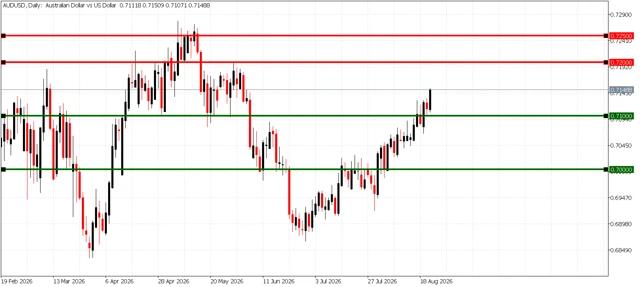
Source: TIOmarkets MT5 live AUD/USD chart
The pair has advanced steadily from the late-July low near 0.6922, building a sequence of higher lows and reclaiming the 0.7100 handle. It now trades above both the nine-period and 50-day exponential moving averages, with the 14-day Relative Strength Index around 63, which is constructive without being stretched.
Resistance levels to watch:
- 0.7200: the psychological barrier and the first meaningful test above current price
- 0.7250: the next reference should the advance extend
Support levels to watch:
- 0.7100: the handle that has anchored the recent advance
- 0.7085 to 0.7090: the nine-period exponential moving average region
- 0.7030 to 0.7050: the 50-period exponential moving average and the earlier pivot
- 0.7000: the psychological floor and the late-July base
The structural read is constructive while the pair holds above 0.7100. The sequence of higher lows, the position above both moving averages, and an RSI in the low 60s all support that.
But note the position. The pair has run roughly 320 pips from the July low without a meaningful correction, and 0.7200 has not yet been tested. A daily close above it would confirm the extension, while a slip back beneath 0.7100 would suggest the advance has outrun its fundamentals.
Bullish scenario: 21 August to 4 September
This bullish AUD/USD forecast scenario may strengthen if the 26 August inflation print comes in firm, reinforcing the RBA's stated concern and keeping the hike option credible, while the dollar remains under pressure.
A daily close above 0.7200 would confirm the extension, with 0.7250 the next reference.
Supporting factors include continued softness in US data, a Jackson Hole address markets read as neutral or accommodative, firm commodity prices, and constructive global risk sentiment.
Invalidation: a return beneath 0.7100 would weaken this scenario, particularly if driven by a soft CPI print.
Bearish scenario: 21 August to 4 September
The bearish case may strengthen if Australian inflation undershoots on 26 August, which would combine with the weak labour print to remove the tightening premium currently supporting the Aussie.
A sustained break beneath 0.7100 would expose the 0.7085 to 0.7090 moving-average region, then 0.7030 to 0.7050, with 0.7000 the deeper reference.
Supporting factors include renewed dollar strength on firmer US data, a hawkish reading of Jackson Hole, weaker commodity prices, or a broad shift toward risk aversion.
Invalidation: a decisive close above 0.7200 would challenge this view.
A note on market mechanics. The current advance is built on dollar weakness rather than Australian strength, and it has occurred despite deteriorating domestic data. Moves with that construction depend on the external leg holding, which makes the pair unusually sensitive to any US catalyst that reverses the dollar's decline.
Key levels and catalysts
| Item | Detail |
| Resistance | 0.7200, then 0.7250 |
| Support | 0.7100, then 0.7030 to 0.7050, then 0.7000 |
| Reference low | 0.6922 (late July 2026) |
| 26 August | Australian July monthly CPI, 11:30am AEST |
| 27-29 August | Jackson Hole symposium |
| 28 August | Warsh keynote, his first as Fed chair |
| 4 September US August | Employment Situation, 8:30am ET |
| 15-16 September | Next FOMC meeting |
| Ongoing | Commodity prices, China demand signals, global risk sentiment |
Conclusion
This AUD/USD forecast describes a pair holding near a ten-week high despite domestic data that argued for the opposite.
The asymmetry is worth stating plainly. Australian employment fell, wages are softening, and traders have pared hike expectations. The Aussie rose because the dollar fell further, not because Australia strengthened.
Two things could settle it. The 26 August inflation print determines whether the RBA's tightening bias survives, and Warsh's Jackson Hole address on 28 August determines whether the dollar's decline extends. A firm CPI with a soft Jackson Hole opens 0.7200. A soft CPI with a hawkish Jackson Hole returns attention to 0.7100 and below.
This article is market commentary for educational purposes only. It does not constitute investment advice, does not guarantee future market performance, and contains no forecast of central bank decisions.

Risk disclaimer: CFDs are complex instruments and come with a high risk of losing money rapidly due to leverage. You should consider whether you understand how CFDs work and whether you can afford to take the high risk of losing your money. Never deposit more than you are prepared to lose. Professional client’s losses can exceed their deposit. Please see our risk warning policy and seek independent professional advice if you do not fully understand. This information is not directed or intended for distribution to or use by residents of certain countries/jurisdictions including, but not limited to, USA & Countries included in the OFAC sanction list. The Company holds the right to alter the aforementioned list of countries at its own discretion.
TIOmarkets offers an exclusively execution-only service. The views expressed are for information purposes only. None of the content provided constitutes any form of investment advice. The comments are made available purely for educational and marketing purposes and do NOT constitute advice or investment recommendation (and should not be considered as such) and do not in any way constitute an invitation to acquire any financial instrument or product. TIOmarkets and its affiliates and consultants are not liable for any damages that may be caused by individual comments or statements by TIOmarkets analysis and assumes no liability with respect to the completeness and correctness of the content presented. The investor is solely responsible for the risk of his/her investment decisions. The analyses and comments presented do not include any consideration of your personal investment objectives, financial circumstances, or needs. The content has not been prepared in accordance with any legal requirements for financial analysis and must, therefore, be viewed by the reader as marketing information. TIOmarkets prohibits duplication or publication without explicit approval.
Join us on social media



Authors BIO

Eleni is a financial markets enthusiast contributing to content covering forex, indices, commodities, and global market developments. She is passionate about researching market-related topics and helping make financial information more accessible to traders.