


Crypto Liquidation Explained: How Positions Close
BY TIOmarkets
|November 10, 2026A crypto liquidation is the forced closure of a leveraged position once the trader's margin falls below the minimum the venue requires to keep it open. That minimum sits above zero, so the venue's engine closes the position at market before the deposit is exhausted. Leverage magnifies losses as well as gains, a modest adverse move can erase the margin within minutes, and traders can lose all the money they deposit.
What follows is crypto liquidation explained for retail traders who hold, or are weighing, leveraged Bitcoin and Ether positions. It sets out how margin fixes a liquidation price and how isolated and cross margin differ. It then turns to the mark price, insurance funds and auto-deleveraging on perpetual futures, and to how a CFD stop-out level compares.
What Does Liquidation Mean in Crypto and Why It Matters
On a crypto derivatives venue, liquidation means the venue's system closes a position because the margin left in it no longer covers what its leverage requires. Initial margin is the deposit needed to open a position; maintenance margin is the smaller amount that must remain for it to stay open. The distinction matters because the close is timed by that maintenance threshold, not by an empty account.
The distance to the threshold is often short. In one commonly cited example, a 10% fall in the asset's price is enough to liquidate a leveraged position, and the exact distance depends on the leverage and the maintenance margin rate. Because leverage magnifies losses as well as gains, a gap that narrow can close within a single session, and traders can lose all the money they deposit.
Crypto Liquidation Explained: How Leverage and Margin Lead to a Forced Close
The procedure is set out in a complaint the US Commodity Futures Trading Commission (CFTC) filed against BitMEX on 1 October 2020. Under the exchange's rules as the filing described them, a margin balance below the maintenance level passed control of the position to the exchange. The exchange then closed it, and the trader forfeited the maintenance margin.
The complaint also relied on the bankruptcy price, the level at which a position's margin is exhausted entirely. A close at a better price than that added the surplus to the exchange's insurance fund. Where the close fell short, the fund absorbed the shortfall, or the exchange could unwind positions held on the other side.
As with maintenance margin in forex, that buffer can be used up within one volatile hour. Leverage magnifies the loss on an adverse move exactly as it magnifies the gain on a favourable one, the margin drains quickly once the move begins, and the trader can lose the whole deposit behind the position.
How to Calculate Liquidation Price
A liquidation price is not the entry price minus the deposit. For an isolated long, a simplified estimate is Liquidation Price ≈ Entry Price × [1 − 1/Leverage + Maintenance Margin Rate]. The maintenance margin rate, the share of position value that must stay in place as margin, moves the trigger towards entry, so the position closes before the initial margin is spent.
The estimate for an isolated long can be worked through in four steps:
- Record the entry price and the leverage of the position.
- Divide 1 by the leverage to express the initial margin as a share of position value.
- Look up the maintenance margin rate the venue applies to that position size and write it as a decimal.
- Subtract the initial margin share from 1, add the maintenance rate, and multiply the result by the entry price.
The result is an approximation. Fees reduce the margin left in the position, and funding payments change it. A venue that uses a mark price also tests the trigger against that reference rather than against its own last trade.
As a worked example, an isolated long opened at 40,000 with 10x leverage has an initial margin share of 0.1. With a maintenance margin rate of 0.5%, or 0.005, the multiplier is 1 − 0.1 + 0.005 = 0.905, which puts the estimate at 36,200. The position therefore closes after a 9.5% fall, not the 10% that leverage alone implies. Holding the entry and rate constant, the estimate is 32,200 at 5x, 38,200 at 20x and 39,400 at 50x.
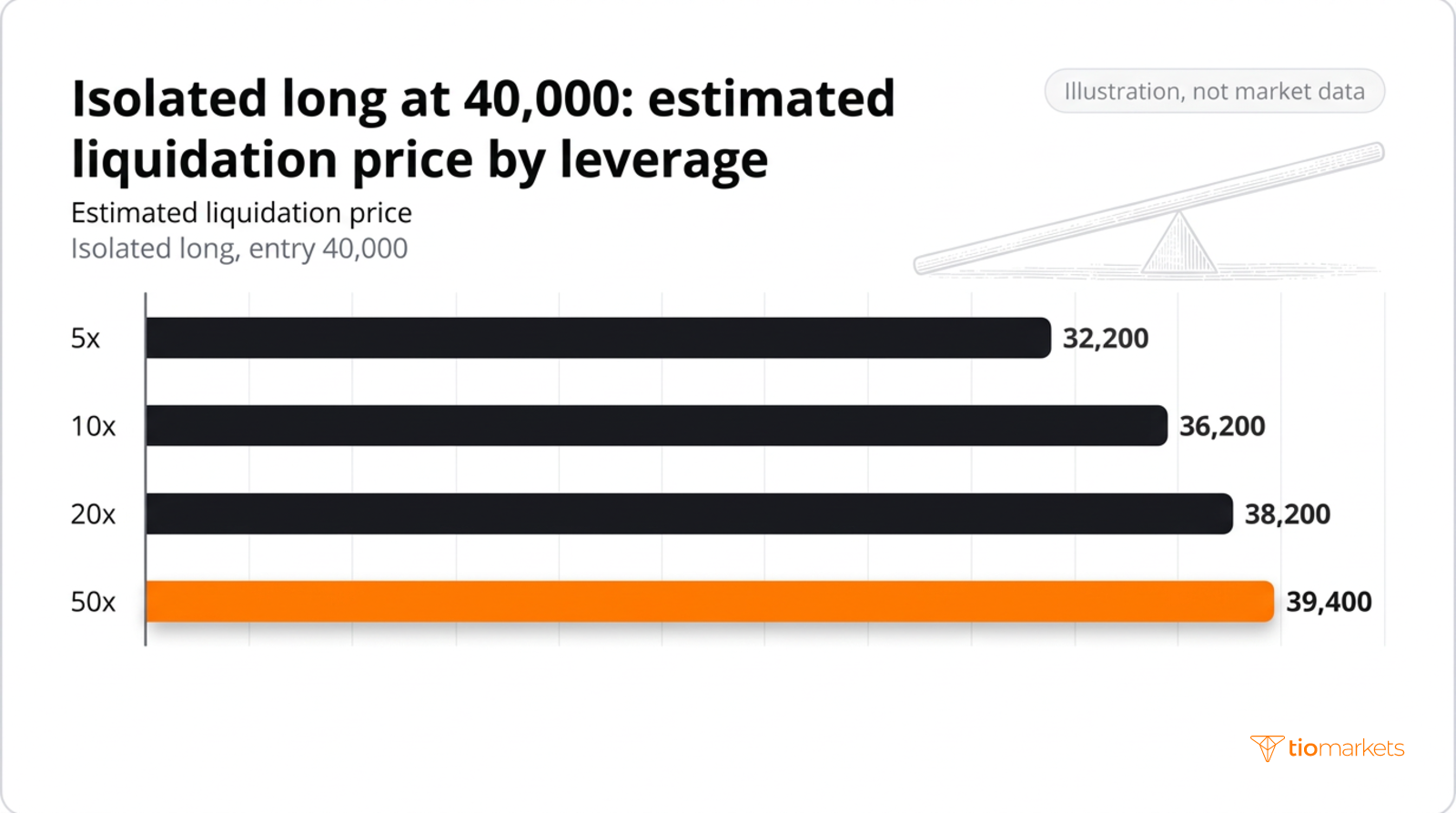
At 50x, a 1.5% fall from entry is enough to close the position. Higher leverage multiplies the loss on each point of price movement just as it multiplies the gain, so losses accumulate quickly and the trader can lose the entire margin deposited.
Isolated vs Cross Margin Liquidation: How Set-Ups Compare
Exchange perpetuals commonly offer two margin models. Under isolated margin, only the collateral allocated to a position backs it, so a liquidation removes that amount and no more. Under cross margin, the venue may draw on any unused wallet balance before closing a losing position. The liquidation price moves further from entry, but the whole balance is exposed, and a single adverse move is more likely to hit several positions at once.
| What the chart or market shows | The approach traders use for it | Main risk |
| A single leveraged position held on its own | Isolated margin: only the margin assigned to that position backs it | Liquidation price sits closer to entry; that margin can be lost in full |
| Several open positions drawing on one balance | Cross margin: the remaining wallet balance supports a losing trade | One loss can consume the whole balance and affect several positions at once |
Cross margin therefore postpones liquidation rather than preventing it. In either model, leverage enlarges losses as much as gains, and a sharp move can drain a shared balance quickly. What differs is the amount at stake: under cross margin, a trader can lose an entire wallet rather than one position's margin.
How Liquidation Works on Perpetual Futures: Mark Price, Insurance Funds and Auto-Deleveraging
These mechanics descend from the perpetual swap, a contract Ben Delo designed and BitMEX brought to market in May 2016; Delo had co-founded the exchange with Arthur Hayes in 2014. The contract never expires, so it can follow an asset's price with no roll date. A daily funding rate, a periodic payment exchanged between holders of long and short positions, held its price near spot.
Liquidation engines do not necessarily use their own last trade as the trigger. One large venue checks margin against a mark price, a reference value built from spot quotations across several exchanges. The aim is that a brief distortion in its own order book does not close positions unfairly. As a result, the trigger can be reached before or after the last traded price touches the calculated level.
Two backstops handle closes that miss the bankruptcy price. The insurance fund builds up from closes at better prices and pays out when a close falls short. Beyond that, the venue may close positions on the opposite side, a process known as auto-deleveraging, so a profitable position can end without its holder placing an order. During the October 2025 crash, a $19 billion liquidation event, trading firms complained that they could not place orders. Others said forced deleveraging came at prices which left no way to hedge.
For the liquidated trader, neither backstop returns the margin already lost. Leverage has magnified that loss as it would have magnified a gain, the close can come within moments, and the deposit behind the position can be lost entirely.
Why Do Liquidations Move the Bitcoin Price? The Liquidation Cascade
Every liquidation reaches the market as a market order, filled against the order book liquidity present at that instant: the bids and offers resting at each price. A liquidated long becomes a sale and a liquidated short a purchase. Open interest, the total of contracts outstanding, indicates how much leveraged exposure could be forced to close in this way.
Clustering is what causes a liquidation cascade. Where many positions share similar liquidation prices, the first forced orders push the price into the next group of triggers, and thin liquidity lets each order travel further. Short liquidations produce the same chain in reverse, with forced buying into a rising market. In both directions, the forced orders add to the move that set them off.
On 9 November 2026, more than $1 billion of leveraged crypto positions were liquidated within 24 hours. Bitcoin touched about $73,761 that day, its lowest level since August, before trading back above $75,000, and Ether went below $2,100 before recovering. Past performance is not a reliable indicator of future results.
A forced order meeting a thin book can also fill well beyond the calculated liquidation price. In a cascade, leverage magnifies losses as well as gains, losses can build faster than the price move suggests, and a trader can lose all the money deposited behind the position in one burst of selling.
What Is the Difference Between Liquidation and Stop Out?
A CFD, or contract for difference, lets a trader take a position on a price such as BTC/USD or ETH/USD without owning the coin. In weighing liquidation vs stop out level, the first difference is what is measured. A CFD account tracks its margin level, equity divided by used margin as a percentage, and closes positions automatically at the stop-out level. A margin call is a separate, earlier warning.
In 2018, the European Securities and Markets Authority (ESMA) introduced temporary restrictions on retail CFDs. They included a 50% account-level margin close-out rule and statutory negative balance protection, under which a retail client's losses cannot exceed the account balance. Leverage on cryptocurrencies was capped at 2:1, against 30:1 for major currency pairs.
| Point | Exchange perpetual futures | Retail CFD account under ESMA's 2018 measures |
| What is measured | Each position's margin, or the wallet under cross margin | Margin level of the whole account |
| Trigger | Margin below maintenance, checked on the mark price where the venue uses one | Stop-out level; the 2018 measures set a 50% close-out rule |
| Shortfall beyond the deposit | Insurance fund, or auto-deleveraging of opposing positions | Negative balance protection under the 2018 measures |
Because the whole account is measured, one losing position can force others to close, and in a fast market a stop-out can fill beyond its trigger. Contract size and leverage govern how far the price can move before that level is reached, as how to calculate lot size for BTCUSD sets out. On a CFD account too, leverage raises losses in step with gains, losses can grow within minutes, and the deposit can be lost entirely.
Conclusion
The level at which a leveraged crypto position closes is set by the venue's rules, not by the size of the deposit. Maintenance margin and fees place the trigger closer to entry than a simple deposit calculation suggests, and where a venue uses a mark price, that reference decides when the trigger is reached. Because the close is a market order into whatever liquidity the book holds, positions clustered near one level can turn an ordinary move into a cascade. A CFD account's stop-out works on a different measure, the margin level of the whole account.
The formula remains an estimate. Venues apply their own maintenance rates, price references and fees, and no calculation fixes where a forced order fills in a disorderly market. Leverage magnifies losses as well as gains, losses can build faster than a trader can respond, and the entire margin, or a whole cross-margin balance, can be lost.
Trade Bitcoin and Ethereum with TIOmarkets
Take your position on global markets via CFDs. Enjoy tight spreads, fast execution, and fast, flexible funding options.
Trading is risky
FAQ
Risk disclaimer: CFDs are complex instruments and come with a high risk of losing money rapidly due to leverage. You should consider whether you understand how CFDs work and whether you can afford to take the high risk of losing your money. Never deposit more than you are prepared to lose. Professional client’s losses can exceed their deposit. Please see our risk warning policy and seek independent professional advice if you do not fully understand. This information is not directed or intended for distribution to or use by residents of certain countries/jurisdictions including, but not limited to, USA & Countries included in the OFAC sanction list. The Company holds the right to alter the aforementioned list of countries at its own discretion.
TIOmarkets offers an exclusively execution-only service. The views expressed are for information purposes only. None of the content provided constitutes any form of investment advice. The comments are made available purely for educational and marketing purposes and do NOT constitute advice or investment recommendation (and should not be considered as such) and do not in any way constitute an invitation to acquire any financial instrument or product. TIOmarkets and its affiliates and consultants are not liable for any damages that may be caused by individual comments or statements by TIOmarkets analysis and assumes no liability with respect to the completeness and correctness of the content presented. The investor is solely responsible for the risk of his/her investment decisions. The analyses and comments presented do not include any consideration of your personal investment objectives, financial circumstances, or needs. The content has not been prepared in accordance with any legal requirements for financial analysis and must, therefore, be viewed by the reader as marketing information. TIOmarkets prohibits duplication or publication without explicit approval.
Join us on social media


Authors BIO

Behind every blog post lies the combined experience of the people working at TIOmarkets. We are a team of dedicated industry professionals and financial markets enthusiasts committed to providing you with trading education and financial markets commentary. Our goal is to help empower you with the knowledge you need to trade in the markets effectively.





