ECB Rate Decision Preview | 25 Basis Point Hike Expected
BY Panagiotis Philippou
|September 9, 2026The European Central Bank is widely expected to raise its deposit facility rate by 25 basis points to 2.50% on Thursday, 10 September 2026. Since that move is already anticipated, the larger market reaction may depend on the ECB's new projections and President Christine Lagarde's guidance on what comes next.
Key takeaways
- All 65 economists in a Reuters poll conducted from 31 August to 3 September forecast a 25 basis point increase in the deposit facility rate, from 2.25% to 2.50%.
- Euro area headline inflation rose to 3.3% in August, driven mainly by a 14.3% annual increase in energy prices. Inflation excluding energy held at 2.2%.
- Euro area GDP grew by 0.6% in the second quarter, but net exports and a sharp rebound in Irish output accounted for much of the strength.
- The rate decision is due at 12:15 UTC, followed by the press conference at 12:45 UTC and the new macroeconomic projections at 13:45 UTC.
Because the expected hike is likely already reflected in market pricing, guidance on inflation and the next policy move may prove more important than the headline decision.
What markets expect from the ECB
The ECB will publish its decision at 12:15 UTC, with the press conference at 12:45 UTC and the new staff projections at 13:45 UTC. The meeting is being hosted in Berlin. These times are confirmed on the ECB press conference page.
The current ECB rates are 2.25% for the deposit facility, 2.40% for the main refinancing operations and 2.65% for the marginal lending facility. If all three rates rise by 25 basis points, they would move to 2.50%, 2.65% and 2.90% respectively. The decision remains unconfirmed until the ECB publishes it.
The five-year rate history puts the expected decision into context. The ECB deposit facility rate rose from negative territory during the previous tightening cycle, declined through 2024 and 2025, and currently stands at 2.25%.
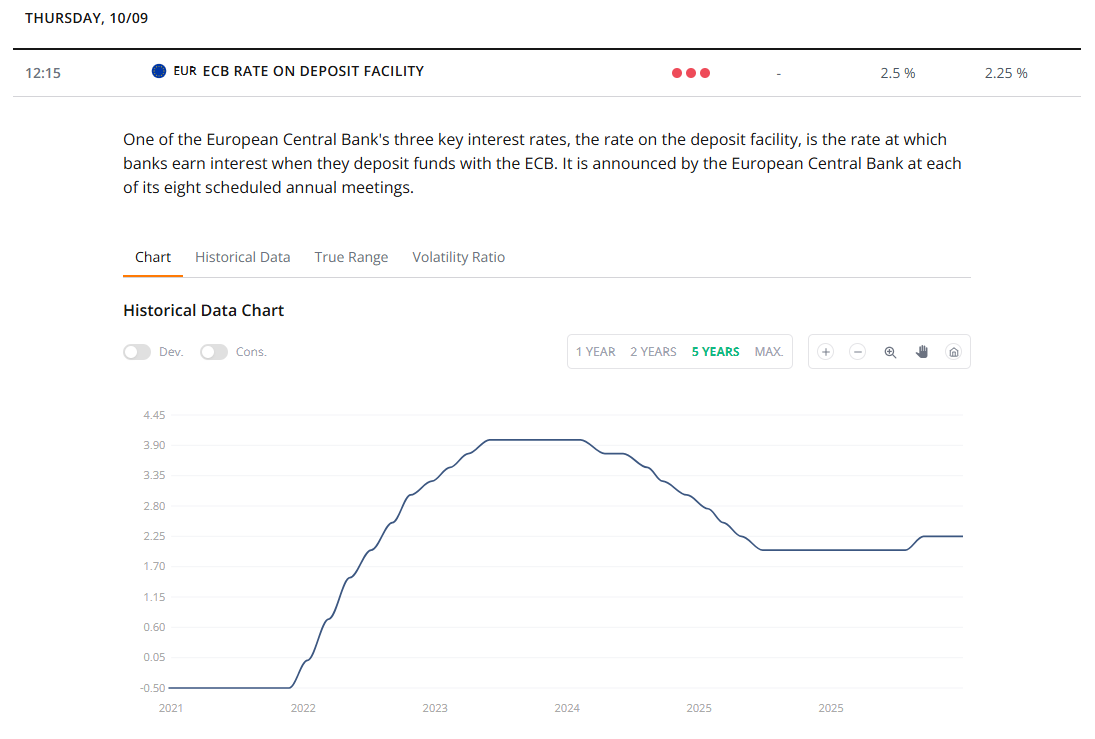
Data taken from the economic calendar
The ECB raised all three policy rates by 25 basis points in June and held them unchanged in July. The account of the July meeting showed that some policymakers would not have opposed another increase. It also said that another hike would likely be necessary unless the inflation outlook improved significantly, while stressing that the ECB had not committed to a September move.
Inflation keeps the focus on energy prices
Eurostat's August flash estimate put annual euro area inflation at 3.3%, up from 2.9% in July and above the ECB's 2% medium-term target. Energy inflation accelerated to 14.3% from 10.3%.
The details were more balanced than the headline. Inflation excluding energy was unchanged at 2.2%, services inflation eased to 3.0% from 3.3%, and inflation excluding energy, food, alcohol and tobacco slowed to 2.4% from 2.5%. The latest increase was therefore concentrated in energy rather than spread evenly across the major categories.
Higher interest rates cannot directly increase oil or gas supply. The ECB will instead be looking for evidence that higher energy costs are feeding into wages, business prices and inflation expectations. In July, policymakers said the full effects of the energy shock had yet to appear, even though underlying inflation and wage indicators remained comparatively contained.
Growth has strengthened but the composition matters
Eurostat's latest estimate showed euro area GDP growing by 0.6% quarter on quarter and 1.2% year on year in the second quarter. That is a firmer backdrop than the ECB's June projection of 0.8% average growth for 2026, although quarterly and annual-average figures are not directly comparable.
The composition tempers the headline strength. Net exports added 0.9 percentage points to quarterly growth, while inventories subtracted 0.5 points. Ireland recorded a 10.2% quarterly increase, highlighting how multinational activity can make aggregate euro area figures volatile. Household consumption added 0.2 points, while fixed investment made a negligible contribution.
The labour market remains stable rather than rapidly tightening. The euro area unemployment rate was 6.4% in July, unchanged from June and slightly above 6.3% a year earlier. At the July meeting, the ECB's wage tracker pointed to moderate negotiated wage growth averaging around 2.6% in 2026, although policymakers continued to monitor the risk of energy costs affecting future wage demands.
Why an expected hike can still move markets
A widely expected decision can still trigger sharp price moves if the ECB's projections or guidance differ from what investors have priced in. Three parts of Thursday's communication deserve particular attention.
- The 2027 inflation forecast. The June projections put headline inflation at 3.0% in 2026, 2.3% in 2027 and 2.0% in 2028. A meaningful upward revision to 2027 would support the case for keeping policy tighter for longer.
- The breadth of inflation. A focus on energy volatility alongside contained underlying inflation would sound more balanced than a warning that second-round effects are spreading.
- The next policy decision. Meeting-by-meeting guidance would preserve flexibility. Any indication that 2.50% is a pause point, or that another increase is likely, could change short-term rate expectations.
The euro is likely to be sensitive to expected interest-rate differences between the ECB and other major central banks. Short-dated German government bond yields should respond more directly to changes in the expected ECB rate path. European equities face competing effects: higher discount rates can weigh on rate-sensitive sectors, while bank shares may benefit from higher rates only if loan demand and credit quality remain resilient.
Three possible market scenarios
| Scenario | What would trigger it | Possible market response |
| Hike with firm anti-inflation guidance | The ECB raises the deposit rate to 2.50% and either lifts its medium-term inflation forecast or warns that second-round effects are becoming more likely. | The euro and short-dated Bund yields could rise as investors price a greater chance of further tightening. Rate-sensitive equities could come under pressure. |
| Hike with neutral guidance | The ECB delivers the expected increase, leaves the inflation outlook broadly close to June and avoids signalling the next move. | The initial response may be limited. Markets would then focus on details in the projections and the question-and-answer session. |
| Surprise hold | The Governing Council decides that the energy-driven inflation increase is too narrow or uncertain to justify an immediate rate rise. | The euro and short-dated yields could fall as the expected hike is removed. Equities could initially benefit from lower-rate expectations, although the reaction may weaken if the hold is linked to concern about growth. |
Event schedule and levels to watch
| Time or Date | What to monitor |
| 12:15 UTC on 10 September | ECB policy decision and confirmation of all three policy rates |
| 12:45 UTC | Lagarde's press conference and guidance on inflation, growth and future rates |
| 13:45 UTC | September macroeconomic projections, particularly the 2027 inflation forecast |
| 2 October | Eurostat's September inflation flash estimate |
| 29 October | Next scheduled ECB monetary policy decision |
Use the latest TIOmarkets platform data immediately before publication when adding live EUR/USD, Bund-yield or European equity-index levels. Static prices can become stale quickly around a central-bank event.
Risks and uncertainties
Energy supply remains the largest uncertainty. A renewed disruption could keep headline inflation elevated and spread into transport, food, goods and services. Faster normalisation would reduce that pressure. Exchange-rate movements could also change imported inflation.
Growth and credit conditions create a second risk. Banks reported tighter lending standards for firms and households in the second quarter. A further rate increase could reinforce that tightening with a delay, while stronger demand could make it easier for businesses to pass higher costs to customers.
Central-bank meetings can produce rapid price moves even when the headline decision matches expectations. Initial reactions may reverse as investors assess the projections and the press conference. The scenarios above describe possible transmission channels, not forecasts of returns or recommendations to trade.
Conclusion
A 25 basis point rise in the ECB deposit rate to 2.50% is the unanimous forecast in the latest Reuters poll, but it may not be the most informative part of the meeting. The larger question is whether the ECB treats August's inflation rise as a concentrated energy shock or evidence of broader persistence. The new projections and Lagarde's guidance should help markets judge whether 2.50% is likely to become a pause point or another step in the tightening cycle.

Risk disclaimer: CFDs are complex instruments and come with a high risk of losing money rapidly due to leverage. You should consider whether you understand how CFDs work and whether you can afford to take the high risk of losing your money. Never deposit more than you are prepared to lose. Professional client’s losses can exceed their deposit. Please see our risk warning policy and seek independent professional advice if you do not fully understand. This information is not directed or intended for distribution to or use by residents of certain countries/jurisdictions including, but not limited to, USA & Countries included in the OFAC sanction list. The Company holds the right to alter the aforementioned list of countries at its own discretion.
TIOmarkets offers an exclusively execution-only service. The views expressed are for information purposes only. None of the content provided constitutes any form of investment advice. The comments are made available purely for educational and marketing purposes and do NOT constitute advice or investment recommendation (and should not be considered as such) and do not in any way constitute an invitation to acquire any financial instrument or product. TIOmarkets and its affiliates and consultants are not liable for any damages that may be caused by individual comments or statements by TIOmarkets analysis and assumes no liability with respect to the completeness and correctness of the content presented. The investor is solely responsible for the risk of his/her investment decisions. The analyses and comments presented do not include any consideration of your personal investment objectives, financial circumstances, or needs. The content has not been prepared in accordance with any legal requirements for financial analysis and must, therefore, be viewed by the reader as marketing information. TIOmarkets prohibits duplication or publication without explicit approval.
Join us on social media



Authors BIO

Panagiotis is an online trading specialist with extensive experience in forex, indices, and commodities. He enjoys sharing his experience to help traders better understand global financial markets.