


GBP/USD Analysis: Sterling Holds Near Six-Month High Before PCE
BY Ahmed Osama
|August 25, 2026GBP/USD is trading in the mid-1.36s, holding close to the 21 August high near 1.3661 that marked its strongest level since mid-February. The pair has spent recent sessions in a narrow band roughly between 1.3620 and 1.3660.
That compression is the point of this GBP/USD analysis. Sterling has genuine domestic rate support, but it sits beneath a clearly defined ceiling while the dollar's next move depends on data and communication arriving within seventy-two hours.
The Setup at a Glance
- GBP/USD trades in the mid-1.36s, near the 21 August high at 1.3661, its highest since mid-February
- UK CPI rose to 2.9% in July from 2.6% in June, per the ONS release of 19 August
- The Bank of England held Bank Rate at 3.75% in a 6-3 vote at its July meeting, with Pill, Mann and Greene favouring a hike to 4.00%
- The Bank had already flagged that inflation could rebound temporarily toward 3.2% later in the year, so the July print was broadly anticipated
- UK growth is softening, with Q2 GDP at 0.4% against 0.6% in Q1 and unemployment at 4.9%
- US PCE and the second GDP estimate land Wednesday 26 August
- Warsh delivers his first Jackson Hole keynote on Friday 28 August, alongside the BLS preliminary payroll benchmark revision
- The Bank of England's next decision is 17 September, without a Monetary Policy Report
Market overview
Sterling's position reflects two forces pulling in different directions.
The supportive side is the rate setting. Bank Rate remains at 3.75%, three MPC members voted for an increase at the July meeting, and July inflation accelerated. That combination keeps the prospect of near-term easing remote and gives the pound a yield anchor most of its peers currently lack.
The complicating side is domestic activity. Q2 GDP slowed to 0.4% from 0.6% in the first quarter, unemployment stands at 4.9%, and regular pay growth has moderated to around 3.5%. A currency supported by rate expectations rather than growth is dependent on those expectations holding.
Meanwhile the dollar has been under pressure for reasons largely unconnected to the Federal Reserve, which limits how much of sterling's recent advance can be attributed to the pound itself.
Latest market news
The Office for National Statistics reported on 19 August that UK CPI inflation rose to 2.9% year on year in July, up from 2.6% in June, with CPIH at 3.1%.
The reaction to that figure deserves qualification. The Bank of England had already warned that inflation could rebound temporarily toward 3.2% later in the year. A print of 2.9% therefore sits within the path the Committee itself had sketched, which weakens the case for reading it as a decisive policy signal rather than a confirmation of an expected pattern.
At its July meeting the MPC voted 6-3 to hold Bank Rate at 3.75%. Huw Pill, Catherine Mann and Megan Greene each voted for an immediate 25 basis point increase to 4.00%, citing upside inflation risks linked to volatile global energy prices. Governor Andrew Bailey and the majority pointed to domestic disinflation and a softening labour market.
On the US side, the Bureau of Economic Analysis releases July personal income and outlays, including the PCE price index, alongside the second estimate of second-quarter GDP, on 26 August. The Federal Reserve's next scheduled meeting is 15-16 September.
The event risk the calendar understates
Three scheduled items land within a short window, and the sequence matters more than any one of them.
- Wednesday 26 August: US July PCE and the second estimate of Q2 GDP. PCE is the Federal Reserve's preferred inflation measure, and this is the last major inflation reading the Committee sees before Friday.
- Thursday 27 August: the Jackson Hole symposium opens, hosted by the Federal Reserve Bank of Kansas City.
- Friday 28 August: Kevin Warsh delivers his first Jackson Hole keynote as Fed chair, and the Bureau of Labor Statistics publishes its preliminary annual benchmark revision to nonfarm payrolls on the same day.
The payroll revision deserves more attention than it usually receives. The September 2025 preliminary benchmark indicated a downward revision of 911,000, and the final figure remained at 862,000 on a non-seasonally-adjusted basis. A large revision would carry genuine information about the labour market rather than functioning as a statistical footnote.
Further out:
- 15-16 September: Federal Reserve policy meeting
- 17 September: Bank of England decision at 12:00 UK time, without an accompanying Monetary Policy Report
GBP/USD technical analysis
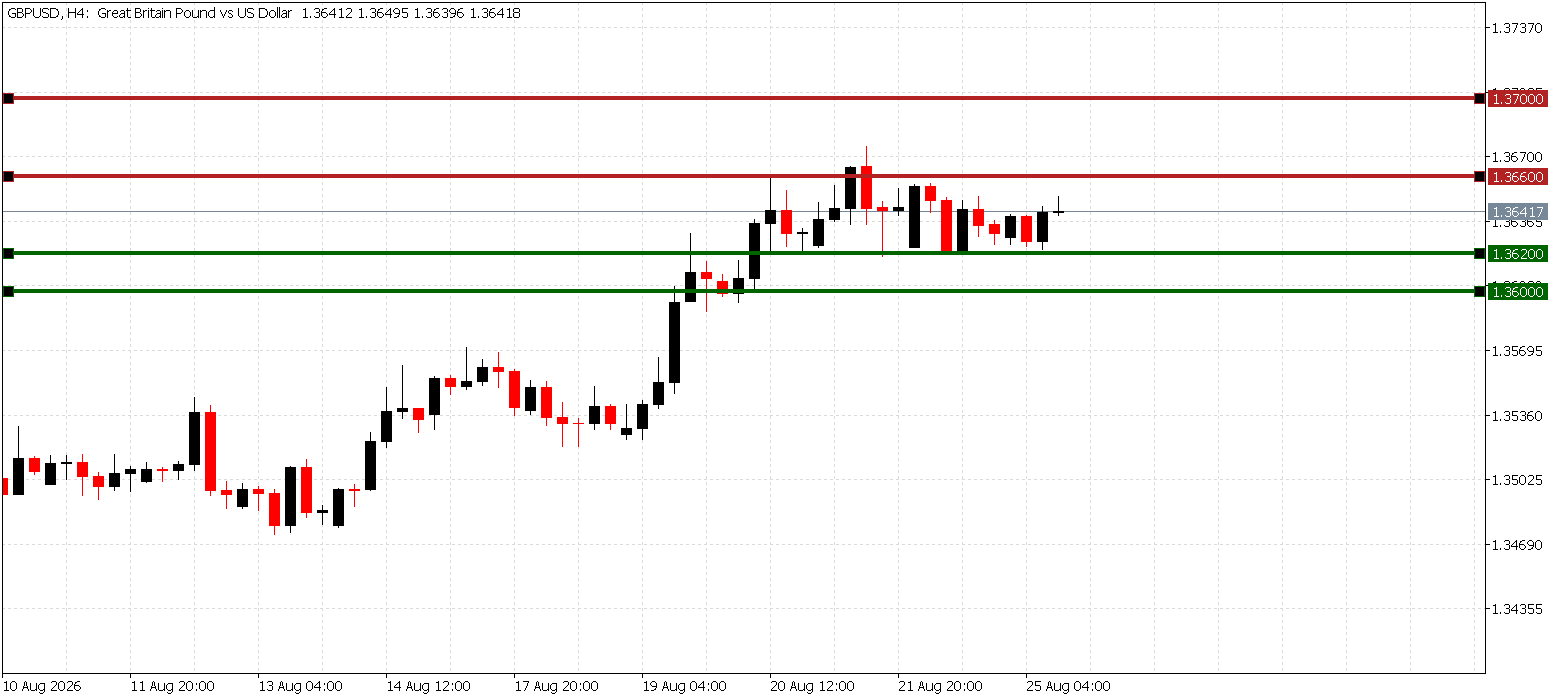
Source: TIOmarkets MT5 live GBP/USD chart
The short-term structure is constructive but compressed beneath resistance rather than extending through it.
The 21 August high near 1.3661 is the first decision level. A sustained daily close above that area would provide stronger evidence that the advance is continuing. Until that happens, repeated approaches without acceptance leave the pair vulnerable to a pullback within its range.
Initial support sits near the recent session low around 1.3622. A break beneath it would shift attention to the 1.3600 round-number area.
Because price is sitting close to the recent high rather than in a confirmed breakout, momentum is better assessed through acceptance above or below those boundaries than inferred from the rally itself.
Levels to watch:
- Resistance near 1.3660, then the 1.3700 round-number reference
- Support near 1.3622, then 1.3600
- Below that, the pair would re-enter the range it occupied through mid-August
Trade the GBP/USD Pair
Will the British Pound break through resistance, or is a pullback imminent? Apply your technical and fundamental strategies on the MT4 and MT5 platforms and react to market-moving events as they happen.
Trading is risky
Fundamental and macro drivers
The UK-US policy contrast is not one-directional, and treating it as such is where most sterling commentary goes wrong.
On the UK side, July's inflation acceleration and the divided July vote can support the pound if investors expect Bank Rate to stay restrictive for longer. But the Bank also flagged uncertainty around energy prices, and the July print fell within the temporary rebound it had already described. Inflation data does not translate automatically into a stronger pound when the central bank has pre-committed to reading it as transitory.
On the US side, PCE matters because it is the measure the Committee prioritises. A firmer reading, or an upward GDP revision, could support yields and the dollar. A softer outcome would leave GBP/USD better placed to challenge resistance.
The dollar's recent weakness has a specific and unusual source. Pressure has come primarily from fiscal and Treasury developments rather than from the Federal Reserve, whose July minutes leaned hawkish. That distinction matters because a currency move driven by fiscal considerations responds to different catalysts than one driven by rate expectations, and Friday's events touch both channels.
Energy prices and broad risk sentiment remain additional sources of volatility for both currencies.
Bullish scenario: next one to two weeks
A bullish scenario may gain support if the pair holds above 1.3622 and then secures sustained acceptance above 1.3661.
Softer-than-expected US PCE, weaker growth signals, a large downward payroll revision, or a Jackson Hole address markets read as neutral could each pressure the dollar. Under those conditions, the 1.3700 area becomes the next nearby upside reference.
A move back beneath 1.3622 would weaken this scenario.
Bearish scenario: next one to two weeks
A bearish scenario may develop if 1.3661 continues to cap rallies and price breaks beneath 1.3622.
Firmer US PCE or GDP data could lift yields and support the dollar, while any evidence that UK inflation pressure is proving temporary, consistent with the Bank's own framing, would reduce sterling's rate support. A decisive break beneath 1.3622 would bring 1.3600 into focus.
A sustained close above 1.3661 would invalidate the immediate bearish setup.
A note on market mechanics. The pair is compressed between two levels roughly forty pips apart, with three catalysts arriving inside seventy-two hours. Narrow ranges ahead of concentrated event risk frequently resolve with a move larger than the range itself, because orders accumulate on both sides and execute together when one boundary gives way.
Conclusion
GBP/USD sits near a meaningful short-term resistance area, with the pound supported by a still-restrictive Bank Rate and a divided Monetary Policy Committee.
But the supporting evidence is thinner than the headline suggests. July's inflation acceleration fell within the temporary rebound the Bank had already described, and UK growth is slowing. Sterling's position owes as much to dollar weakness, itself driven largely by fiscal rather than monetary developments, as to domestic strength.
For the coming one to two weeks, a durable break above 1.3661 would strengthen the bullish case, while a loss of 1.3622 would favour a pullback toward 1.3600. Wednesday's PCE reading and Friday's combination of Warsh and the payroll revision are the events most capable of determining which.
This article is market commentary for educational purposes only. It does not constitute investment advice, does not guarantee future market performance, and contains no forecast of central bank or government policy decisions.

Risk disclaimer: CFDs are complex instruments and come with a high risk of losing money rapidly due to leverage. You should consider whether you understand how CFDs work and whether you can afford to take the high risk of losing your money. Never deposit more than you are prepared to lose. Professional client’s losses can exceed their deposit. Please see our risk warning policy and seek independent professional advice if you do not fully understand. This information is not directed or intended for distribution to or use by residents of certain countries/jurisdictions including, but not limited to, USA & Countries included in the OFAC sanction list. The Company holds the right to alter the aforementioned list of countries at its own discretion.
TIOmarkets offers an exclusively execution-only service. The views expressed are for information purposes only. None of the content provided constitutes any form of investment advice. The comments are made available purely for educational and marketing purposes and do NOT constitute advice or investment recommendation (and should not be considered as such) and do not in any way constitute an invitation to acquire any financial instrument or product. TIOmarkets and its affiliates and consultants are not liable for any damages that may be caused by individual comments or statements by TIOmarkets analysis and assumes no liability with respect to the completeness and correctness of the content presented. The investor is solely responsible for the risk of his/her investment decisions. The analyses and comments presented do not include any consideration of your personal investment objectives, financial circumstances, or needs. The content has not been prepared in accordance with any legal requirements for financial analysis and must, therefore, be viewed by the reader as marketing information. TIOmarkets prohibits duplication or publication without explicit approval.
Join us on social media



Authors BIO

An experienced financial analyst and educator with over 8 years of expertise covering gold, forex, and global financial markets. Ahmed specializes in blending price action analysis with macroeconomic data to accurately interpret market movements, providing readers with comprehensive educational insights into trading and the financial world.