


Gold Price Forecast: XAU/USD Tests $4,400 as September Hike Odds Collapse
BY Eleni Antoniou
|August 17, 2026Gold trades near $4,380 an ounce, its highest level in two months, after two softer US inflation prints cut the market-implied probability of a September rate increase almost in half.
But context matters here. Gold's all-time high was roughly $5,600 in late January 2026, so at current levels the metal sits around 22% below that peak. This gold price forecast therefore describes a recovery within a larger decline, not a run at records.
The next two weeks will test whether that recovery has structural support. Two scheduled events dominate: Wednesday's FOMC minutes, and Kevin Warsh's first Jackson Hole address as Fed chair on 28 August.
- XAU/USD near $4,380, up roughly 9.7% over the past month and 31.9% year-on-year
- Gold sits about 22% below its January 2026 record of roughly $5,600
- September hike odds fell to around 35%, down from about 55% a week earlier, after soft CPI and core PPI
- The US dollar slipped toward two-month lows on Monday
- $4,400 is the immediate barrier, while the old July high near $4,200 has become support
- FOMC minutes land Wednesday 19 August, and Jackson Hole runs 27-29 August
- Central-bank buying is supportive, though the first-half picture is weaker than the headline quarter suggests
Why gold is rising: the real-yield mechanism
The move is not driven by safe-haven demand. It is driven by rate expectations, and the mechanism is worth stating precisely because it also defines the downside risk.
Gold pays no income. Its opportunity cost is therefore the real yield, meaning the inflation-adjusted return available on Treasuries. When markets price fewer rate increases, expected real yields compress, the cost of holding a non-yielding asset falls, and gold typically benefits.
That is exactly what has happened. Two data points reset expectations:
- US CPI came in subdued
- Core producer prices rose less than expected in July
The result is that markets now price roughly a 35% probability of a 25 basis point hike in September, down from about 55% a week earlier. The dollar has slipped toward two-month lows, and a sharper-than-expected fall in US retail sales reinforced the repricing on Monday.
The symmetry is the point. The same mechanism that lifted gold works in reverse. Any data or communication that revives hike expectations compresses the move as quickly as it created it.
The context most coverage omits
Gold is well below its peak, and this framing is absent from most current commentary.
- All-time high (29 January 2026): roughly $5,600, about 22% above current levels
- Current price (17 August 2026): near $4,380
- July low: roughly $3,960, about 11% below current levels
- July close: roughly $4,073, about 8% below current levels
Two readings follow from this, and both are legitimate.
The constructive read is that gold has recovered roughly 11% from its July low and reclaimed the entire July range, which is a genuine improvement in structure.
The cautionary read is that a market 22% below its high is in recovery, not in trend continuation. Rallies inside a broader decline face overhead supply from positions established at higher levels. That supply does not exist when an asset is making new highs.
Neither reading is a forecast. Both are context a trader should hold simultaneously.
Central-bank demand: read the half-year, not the quarter
Official-sector buying is frequently cited as a structural pillar for gold. The recent data supports that, but the headline number is misleading in isolation.
The World Gold Council reported central-bank purchases of approximately 289 tonnes in the second quarter of 2026, a strong quarter by historical standards and well above the year-ago period.
However, the first-quarter figure was subsequently revised sharply lower, and the first-half total came in around 345 tonnes, the weakest first half in four years.
What this means practically:
- Central-bank demand remains a supportive medium-term backdrop
- It is not a short-term timing signal, because the data is reported with a substantial lag
- Anyone citing "record central-bank buying" without the half-year context is presenting an incomplete picture
XAU/USD technical analysis
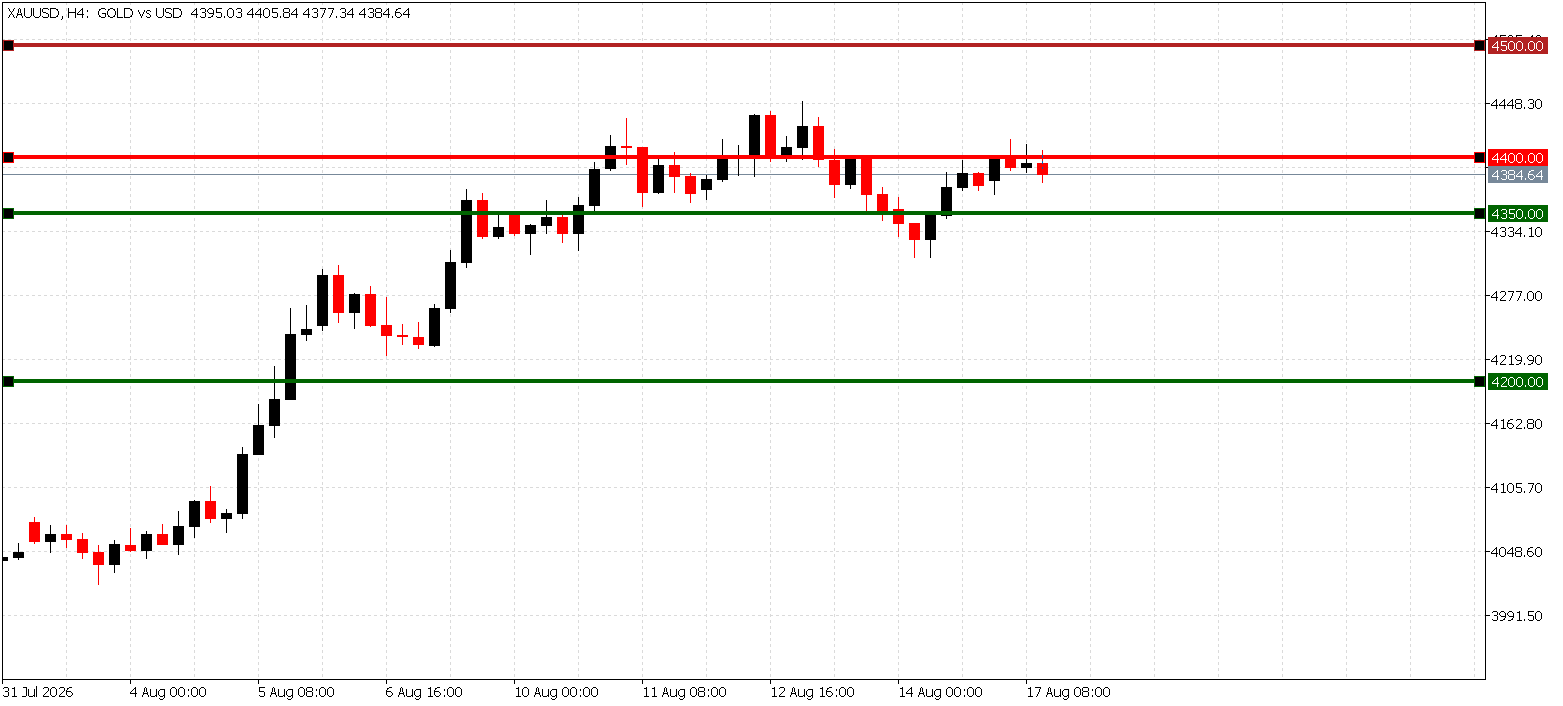
The structure has changed materially since July. Gold traded roughly $3,960 to $4,200 through July, closing the month near $4,073. It has since cleared that entire range.
The consequence is that levels which acted as resistance in July now sit well below price and function as support. The chart has been rebuilt accordingly.
Resistance levels to watch:
- $4,400: the immediate psychological barrier, with price consolidating just beneath it
- $4,500: the next round-number reference on a confirmed break
- Beyond that, structure thins considerably until far higher zones from the decline off the January peak
Support levels to watch:
- $4,350: Friday's intraday low, where profit-taking emerged
- $4,200: the July high, now the first structural support
- $4,105: the July pivot
- $4,000 and $3,960: the psychological level and the July low
Momentum favours the upside while price holds above $4,350, and the reclaimed July range gives the recovery a genuine floor. But gold has been consolidating near $4,370 to $4,380 rather than accelerating, which suggests the $4,400 area is being defended. A daily close above it would be the confirmation to watch.
The week ahead and Jackson Hole
The Fed held its target range at 3.50% to 3.75% on 29 July on a divided 9-3 vote, with three policymakers preferring a quarter-point increase.
Under Warsh, the Fed has removed forward guidance from its communication. With no road map issued between meetings, the minutes are one of the few available windows into the Committee's reasoning, and specifically into whether the three dissenters were a fringe or a near-majority.
Jackson Hole: the defining event of the window
The Kansas City Fed hosts the 2026 Jackson Hole Economic Policy Symposium from 27 to 29 August, with Warsh delivering the keynote on Friday morning, 28 August, his first since taking office on 22 May 2026.
Three factors raise the stakes for gold specifically:
- The information vacuum. With forward guidance removed, a set-piece speech from this chair carries information value that comparable remarks would not have carried previously.
- The timing. The symposium lands 19 days before the 16 September FOMC decision, with hike expectations already repriced to around 35%.
- The dependency. Gold's entire advance rests on those faded hike expectations, making Jackson Hole the most plausible scheduled event capable of reversing them.
Reported remarks from the 29 July press conference indicated Warsh had not settled on whether the August address would be broad in scope or used to prepare the ground for autumn policy, and that his focus would fall on longer-term structural questions rather than near-term guidance.
Bullish scenario: 17-28 August
This bullish gold price forecast scenario may strengthen if the FOMC minutes read as less concerned about inflation than the July statement implied, flash PMIs come in soft, and XAU/USD sustains a daily close above $4,400.
Under those conditions, $4,500 would be the first reference point, with scope for extension if the dollar's slide continues and Treasury yields decline further.
Supporting factors include continued dollar weakness, further compression in real yields, renewed official-sector buying, and a risk backdrop that sustains hedging demand.
Invalidation: a daily close back below $4,350, particularly alongside firmer yields, would reduce confidence in the breakout case.
Bearish scenario: 17-28 August
The bearish case may strengthen if the minutes reveal a Committee more broadly inclined toward tightening than the 9-3 vote suggested, US PMIs surprise to the upside, or the Jackson Hole address is read as leaning against current market pricing.
A sustained move below $4,350 would expose $4,200, and a break of that level would return attention to the $4,105 pivot.
Supporting factors include a rebound in US Treasury yields, renewed dollar strength, or a reversal in September rate pricing back toward the 55% level seen a week ago.
A note on market mechanics: gold's advance is built on the absence of expected hikes rather than on a positive gold-specific catalyst. Positioning of that kind can unwind quickly when the underlying assumption is challenged, which is precisely why the calendar rather than the chart is likely to determine the next directional move.
Key levels and catalysts
| Item | Detail |
| Resistance | $4,400, then $4,500 |
| Support | $4,350, then $4,200, then $4,105, then $4,000 |
| Reference high | Roughly $5,600 (29 January 2026) |
| 19 August | FOMC minutes from the 29 July meeting |
| 20 August | US jobless claims and Philadelphia Fed survey |
| 21 August | US flash manufacturing and services PMI |
| 27-29 August | Jackson Hole symposium |
| 28 August | Warsh keynote, his first as Fed chair |
| 16 September | Next FOMC decision |
| Ongoing | US dollar index, real yields, Middle East developments |
Conclusion
This gold price forecast describes a market that has recovered convincingly from its July lows but remains roughly 22% below its January peak, making it a recovery within a larger decline rather than a trend at records.
The advance has a single engine. Faded September hike expectations compressed real yields and lifted gold, and the same mechanism reverses if those expectations return. That construction makes the next two weeks unusually calendar-dependent.
Confirmation matters more than prediction. A daily close above $4,400 would establish that the recovery has extended beyond consolidation, while failure there, or a slip below $4,350, would suggest the market has simply arrived at the top of a new range.

Risk disclaimer: CFDs are complex instruments and come with a high risk of losing money rapidly due to leverage. You should consider whether you understand how CFDs work and whether you can afford to take the high risk of losing your money. Never deposit more than you are prepared to lose. Professional client’s losses can exceed their deposit. Please see our risk warning policy and seek independent professional advice if you do not fully understand. This information is not directed or intended for distribution to or use by residents of certain countries/jurisdictions including, but not limited to, USA & Countries included in the OFAC sanction list. The Company holds the right to alter the aforementioned list of countries at its own discretion.
TIOmarkets offers an exclusively execution-only service. The views expressed are for information purposes only. None of the content provided constitutes any form of investment advice. The comments are made available purely for educational and marketing purposes and do NOT constitute advice or investment recommendation (and should not be considered as such) and do not in any way constitute an invitation to acquire any financial instrument or product. TIOmarkets and its affiliates and consultants are not liable for any damages that may be caused by individual comments or statements by TIOmarkets analysis and assumes no liability with respect to the completeness and correctness of the content presented. The investor is solely responsible for the risk of his/her investment decisions. The analyses and comments presented do not include any consideration of your personal investment objectives, financial circumstances, or needs. The content has not been prepared in accordance with any legal requirements for financial analysis and must, therefore, be viewed by the reader as marketing information. TIOmarkets prohibits duplication or publication without explicit approval.
Join us on social media



Authors BIO

Eleni is a financial markets enthusiast contributing to content covering forex, indices, commodities, and global market developments. She is passionate about researching market-related topics and helping make financial information more accessible to traders.