


How to Invest in Gold: The Main Routes Explained
BY TIOmarkets
|November 12, 2026Investing in gold means taking exposure to the gold price through one of five main routes: physical bars and coins, physically backed exchange-traded products, digital gold accounts, gold mining shares, or contracts for difference (CFDs) on the price. Each route delivers something different: the metal itself, a claim on metal someone else holds, a share in a company's profits, or a contract on the price. Learning how to invest in gold therefore starts with deciding which of those four things to hold.
What follows sets out, for beginners, what an investor owns, pays and risks on each route, including why gold priced in euros behaves differently from gold priced in US dollars. Gold CFDs are leveraged, and leverage magnifies losses as well as gains: losses can build quickly, and traders can lose all the money they deposit.
How to Invest in Gold: The Main Routes at a Glance
A single ‘gold price’ hides the differences between routes. The benchmark most of them refer to, the LBMA Gold Price, is a US dollar price for unallocated gold delivered in London. Between that benchmark and the investor sit a legal structure, a chain of costs and a currency, and each route arranges them differently. Holding metal for years and taking a short-term position are also separate activities, the distinction between investing and trading. What the investor ends up holding differs by route:
- Bars and coins: the metal itself, at home or in a vault.
- ETFs and ETCs: a listed security that, where physically backed, rests on metal stored for the product.
- Digital gold: a recorded claim on metal held through a provider.
- Mining shares: part-ownership of a gold-producing company.
- CFDs: a contract on the price of XAU/USD or XAU/EUR, with no metal.
Only the CFD route uses leverage, in which a deposit controls a larger position. Leverage magnifies losses in the same proportion as gains, a modest adverse move can consume the deposit quickly, and a trader can lose all the money placed in the account.
Comparing Gold Investment Options Side by Side
The routes are easier to compare by the investor's aim than by product. Holding metal outside the financial system brings storage and resale costs; holding gold through a stock exchange brings annual charges; short-term price exposure brings leverage. Each aim corresponds to a route with its own main risk:
| What the chart or market shows | The approach traders use for it | Main risk |
| Aim to hold metal directly, outside the financial system | Bars or coins bought from a dealer | Storage, theft and a wide buy-back spread |
| Aim to follow the gold price through a share-dealing account | Physically backed ETF or ETC | Ongoing charges reduce the metal per security; currency of the listing |
| Aim to accumulate gold in small amounts | Digital gold account | Provider failure, especially where metal is unallocated |
| Aim for exposure to producers' earnings | Gold mining shares or miner funds | Company-specific setbacks; falls larger than gold's |
| Short-term price exposure in US dollars | XAU/USD CFD | Leveraged losses that build quickly and can take the whole deposit |
| Short-term price exposure in euros | XAU/EUR CFD | Leveraged losses beyond the expected move, plus EUR/USD changes |
Two features cut across the rows. Listed ETCs, mining shares and CFDs can be dealt during market hours, whereas selling bars or coins means accepting a dealer's buy-back price. Because the benchmark is set in US dollars, a sterling or euro investor on any route also holds a currency position. On the CFD rows, leverage magnifies losses as well as gains, losses can build quickly, and the whole deposit can be lost.
Costs of Buying Physical Gold: Bars and Coins
Physical prices start from the LBMA Gold Price, the London Bullion Market Association benchmark. It is set twice daily by auction, at 10:30 and 15:00 London time, in US dollars per fine troy ounce, the standard unit of weight for precious metals. Dealers sell bars and coins at a premium over spot, which covers fabrication, distribution and their mark-up, and buy them back below spot. The gap between the two prices is the dealer buy-back spread.
Bars and coins differ in what the premium pays for. A bar is valued on weight and fineness. A coin adds design and minting, and Sovereign and Britannia coins, struck by the Royal Mint, carry a national recognition that tends to raise the premium. Bars dominate private demand: World Gold Council data published on 3 November 2026 put global bar and coin demand in Q3 2026 at 267.8 tonnes, 19% lower year on year, of which bars accounted for 202.7 tonnes, official coins 35.3 tonnes and medals or imitation coins 29.8 tonnes.
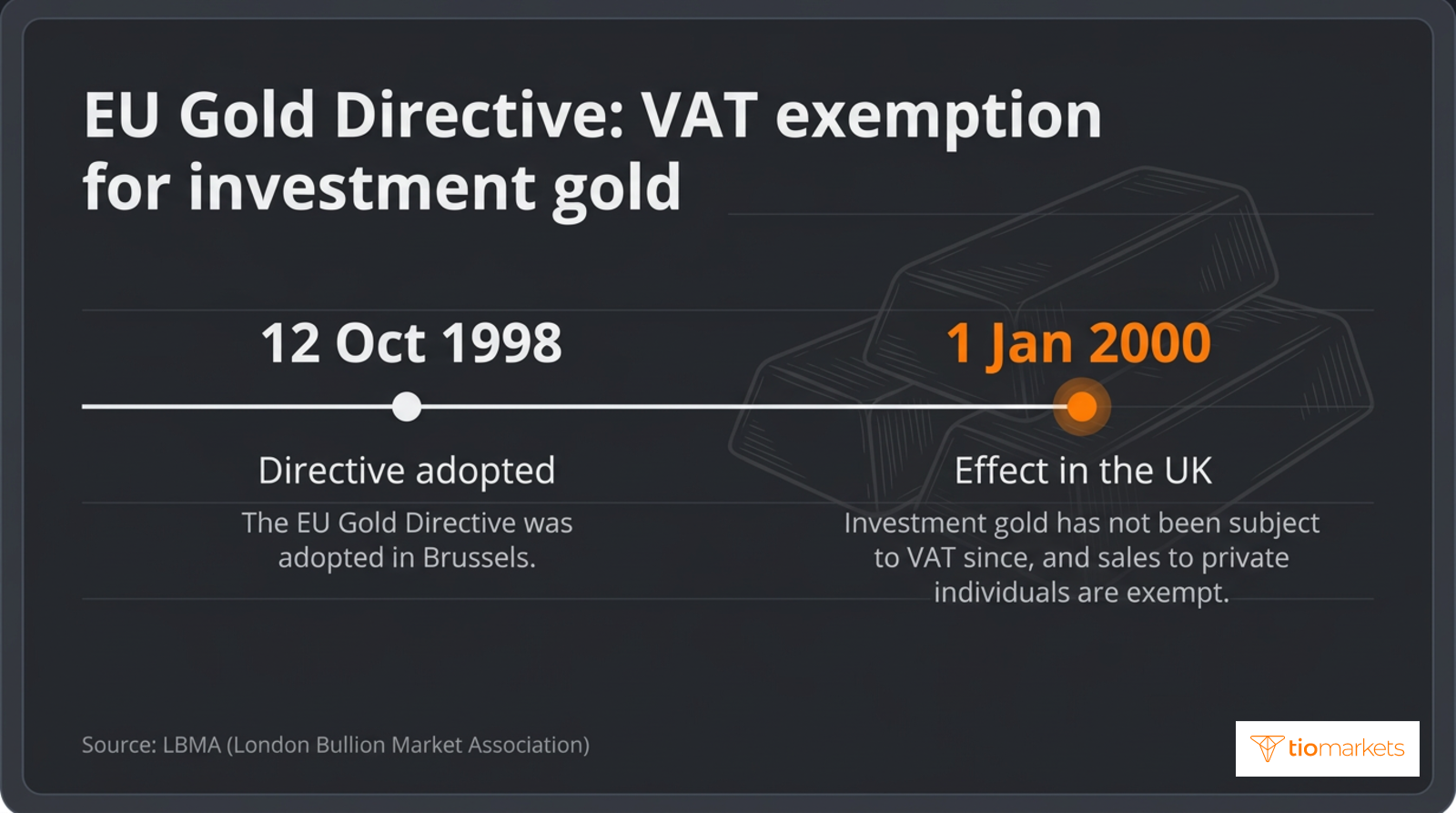
The rules on VAT on investment gold also shape the cost. Sales of investment gold to private individuals have been exempt from VAT in the UK since the EU Gold Directive took effect there on 1 January 2000, and the EU's special scheme for investment gold is obligatory for member states. Only gold of a specified quality qualifies. Capital gains tax treatment varies by item and holder, as official tax guidance sets out.
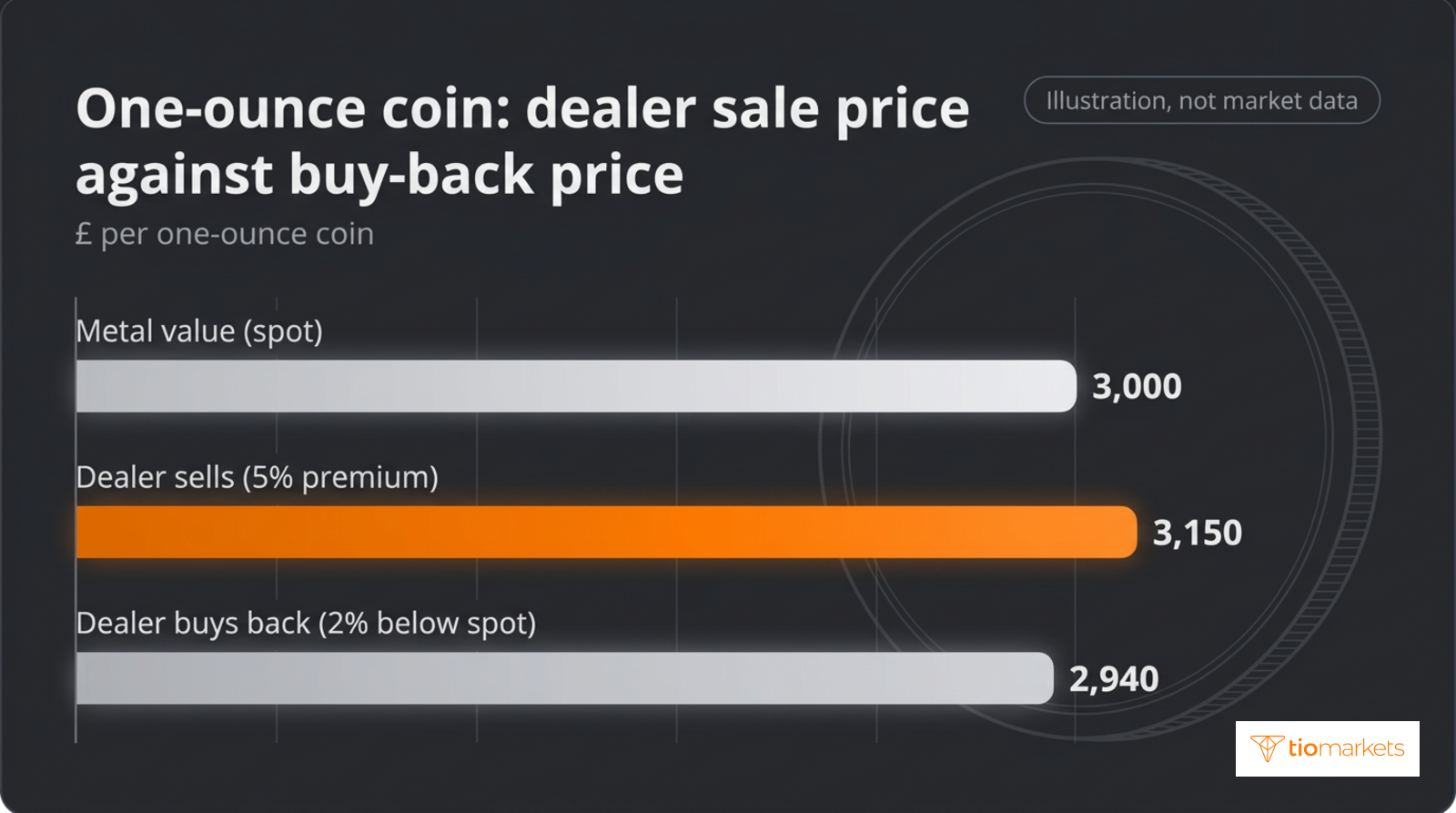
A hypothetical round trip shows how these costs combine. Suppose the metal in a one-ounce coin is worth £3,000. A dealer selling at a 5% premium charges £3,150, and one buying back at 2% below spot pays £2,940 if the price has not moved. The £210 round trip is 6.7% of the outlay, so spot would have to rise about 7.1%, to roughly £3,214, before the holder broke even.
Buying from a dealer and checking the price takes four steps:
- Note the spot price per troy ounce at the time of the quote.
- Compare several dealers' selling prices for the same bar or coin, and calculate each premium over spot.
- Ask each dealer for a same-day buy-back price to measure the buy-back spread, and confirm the item meets the quality conditions for investment gold.
- Arrange vault or home storage and insurance, and add their annual cost to the total.
The buy-back quote carries the most weight: it is the price at which the coin can actually be sold, and it sits below the spot price quoted on screens.
How to Invest in Gold ETF UK: Physically Backed ETCs
Exchange-traded gold dates from 2003. The first gold exchange-traded product, Gold Bullion Securities, began trading on the Australian Stock Exchange on 28 March 2003 with less than A$5 million in assets. It was developed by Gold Bullion Limited, a special purpose vehicle that Graham Tuckwell created with the World Gold Council. A London product of the same name followed that year. It was listed not as a fund but as a collateralised note backed 100% by allocated gold bullion.
That note structure survives in the exchange-traded commodity (ETC), a debt security backed by the commodity, whereas an exchange-traded fund (ETF) is a fund. A custodian is the firm that stores a product's metal on its behalf. Whether a product holds metal at all, which custodian holds it and whether the bars are allocated to it are set by each product's own terms, and only its prospectus or factsheet confirms them.
Disclosures differ from one product to the next. A London-listed physically backed ETC can be backed by allocated physical gold held by a custodian. A gold ETF can instead have a bank's London branch as custodian of bars meeting the LBMA's London Good Delivery standards for weight, fineness and marks; that standard describes the bars' quality, not whether they are allocated.
Synthetic products track the price through derivatives instead of holding metal, which leaves the holder exposed to a counterparty. Physically backed gold ETFs added 211 tonnes in Q3 2026, taking holdings to a record 4,256 tonnes, so the terms on which that metal is held apply to a large stock of bullion.
The main running cost is the ongoing charges figure, the annual charge as a percentage of the holding. One London-listed physically backed ETC has a total expense ratio of 0.12% a year, applied daily to the metal entitlement, which stood at 0.019411792 fine troy ounces per security in December 2025. Because the charge is taken in metal, it compounds: at a hypothetical 0.25% a year, a holding entitled to 20 troy ounces would be entitled to about 19.5 ounces after ten years.
Holding a London-listed ETC involves four steps:
- Confirm that the share-dealing account gives access to London-listed securities, and check whether an account type such as a stocks and shares ISA accepts the product.
- Read the prospectus or factsheet to confirm the product is physically backed, holds allocated metal and names its custodian.
- Compare ongoing charges, the bid–ask spread and the trading currency of each product.
- Record the metal entitlement per security at purchase, and compare it each year.
That yearly record shows what the charge has cost in metal, a cost the share price conceals whenever a rising gold price offsets a slowly shrinking entitlement.
What Is Digital Gold? Allocated and Unallocated Accounts
Digital gold is an online account that records a holding of gold by weight, often in fractions of an ounce, bought and sold through the provider without delivery. Because it allows small, regular purchases, it is one route to investing in gold with little money. The holding, however, is only as sound as the arrangement behind it.
That arrangement turns on allocated vs unallocated gold. Allocated gold means specific bars, or defined shares of them, are recorded in the customer's name and remain the customer's property. Unallocated gold is a general claim on the provider for a quantity of metal: the provider owns the pool, and the customer is a creditor.
The difference matters if a provider fails. Allocated bars are identifiable and, under the custody terms, belong to the customers named against them. Unallocated customers rank among the provider's creditors and may recover part of the value or none of it. This is counterparty risk, the risk that the other party cannot meet its obligations, and a low headline fee does nothing to reduce it.
For a saver working out how to buy digital gold in UK pounds, four checks on the provider come first:
- Read the terms for whether holdings are allocated or unallocated.
- Find the named custodian, the vault location and any independent audit of the metal.
- Compare the provider's buying and selling prices with spot to measure the spread.
- List storage, account, withdrawal and delivery fees, including any charge for converting the holding into bars.
The last check decides whether a fractional holding can ever become metal in hand, since conversion into bars can carry its own fees and minimum quantities.
How to Invest in Gold Stocks: Why a Miner Is Not Gold
Gold mining shares, and funds that hold them, give indirect exposure. The investor owns part of a company whose revenue depends on the gold price but whose results also depend on ore grades, costs, debt, management and the wider stock market. A miner's share can therefore fall while gold rises.
The link to gold runs through costs. Producers commonly report the all-in sustaining cost (AISC), the cost of producing an ounce including sustaining capital spending and overheads. Because much of that cost is fixed in the short run, the surplus per ounce moves by a larger percentage than the gold price, an effect known as operating gearing.
Consider a hypothetical miner with an AISC of $2,000 an ounce: with gold at $3,000, it earns a surplus of $1,000 an ounce. A 10% rise in gold, to $3,300, lifts the surplus by 30% to $1,300; a 10% fall, to $2,700, cuts it by 30% to $700. Operating gearing magnifies losses as well as gains. A share can drop quickly on one failed mine or cost overrun, and shareholders in a company that fails can lose all the money they invested.
Reading a miner's cost disclosures involves four steps:
- Find the AISC per ounce and the company's cost guidance in its latest quarterly or annual report.
- Compare it with the average gold price the company realised in the same period to estimate the surplus per ounce.
- Check production volumes and how much output depends on a single mine.
- Review net debt and any hedging of future output, which can limit how much of a price move reaches shareholders.
Cost figures are reported by the company and can be revised, so the trend across several reports reveals more than any single quarter.
How Gold CFDs Differ From Owning Gold: XAU/USD and XAU/EUR
A CFD on gold is an agreement to exchange the change in the price of XAU/USD or XAU/EUR, with no metal, custodian or claim on bars involved. A long position profits if the price rises and a short position if it falls; each loses when the price moves the other way.
CFDs are traded on margin, the deposit needed to keep a position open, and leverage lets that deposit control a larger position. Under the limits the European Securities and Markets Authority (ESMA) set for retail CFDs in March 2018, gold carries a maximum leverage of 20:1, against 30:1 for major currency pairs. At 20:1, a 5% move against a position equals the whole margin committed to it. Leverage therefore magnifies losses as well as gains, losses can build quickly in a fast market, and a trader can lose all the money deposited. A margin call is a warning level; a stop out is the separate level at which positions close automatically.
Each trade also pays the spread, the difference between the buy and sell price, and a position held overnight incurs an overnight swap, a financing charge or credit applied for each night it remains open. Because the swap recurs, the cost of a CFD position depends on how long it is held, whereas an ETC's charge is a percentage of the metal entitlement. How spreads, leverage and margin on XAU/USD combine depends on the instrument's contract specification.
Gold is priced in euros by conversion. The LBMA auction forms the price in US dollars and converts it into other currencies, and the euro benchmark is indicative and for settlement only. XAU/EUR follows the same arithmetic: it is, in effect, XAU/USD divided by EUR/USD. A euro-based holder therefore carries two exposures, the dollar gold price and the exchange rate.
A hypothetical period makes the effect concrete. If XAU/USD stays at $3,300 while EUR/USD rises from 1.10 to 1.20, XAU/EUR falls from €3,000 to €2,750, a decline of 8.3%, although the dollar gold price has not moved; a weaker euro works the other way. On a leveraged CFD, that currency move is magnified exactly as a gold move would be, and a price gap can carry a position past the stop-out level before it is closed.
What Are the Disadvantages of Investing in Gold?
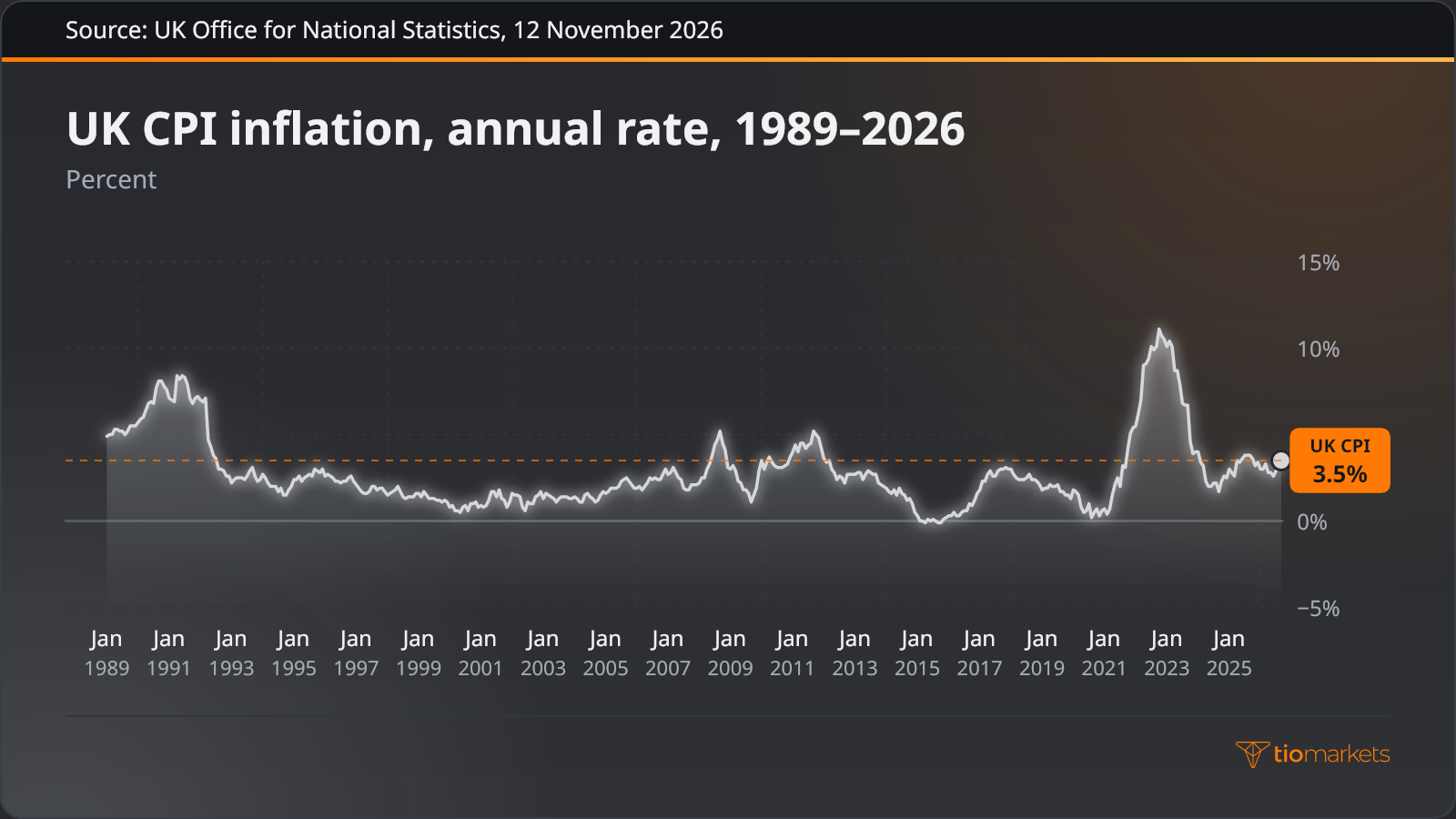
Gold pays no interest, dividend or coupon, so every route returns only the price change less costs. Those costs accumulate: premiums and storage on metal, ongoing charges on ETCs, account fees on digital gold, spreads and swaps on CFDs. With no income, inflation sets the yardstick. UK consumer price inflation (CPI), the annual change in consumer prices, has varied widely since 1989, and a sterling holding has to rise at least as fast, after costs, to keep its purchasing power.
The common mistakes share one cause, treating every route as the same ‘gold price’:
- Treating a mining share as gold, when its result depends on the company as much as on the metal.
- Ignoring the currency effect, so that a euro or sterling holder misreads a move in the dollar price.
- Overlooking whether metal is allocated or unallocated, and the counterparty risk that follows.
- Counting the purchase price but not the premium, buy-back spread, storage and insurance.
- Using leverage without understanding margin: losses are magnified as much as gains, can accumulate within a short time and can take the entire deposit.
Five questions apply before any route is chosen:
- What is owned: metal, a claim on metal, a share in a company or a contract on the price?
- Who holds any metal, and is it allocated in the holder's name?
- What does it cost to buy, to hold for a year and to sell?
- In which currency is the price measured, and is it the holder's own?
- Is leverage involved, and what happens to the deposit if the price moves against the position?
Conclusion
Gold is one market but not one investment. Bars and coins deliver the metal, ETCs and digital accounts a claim on metal held by someone else, mining shares a stake in a business, and CFDs a contract on the price. That choice, together with the currency in which the price is measured, sets what an investor owns, pays and risks, which a single headline ‘gold price’ conceals.
None of the routes removes price risk. Gold can fall in any currency, costs reduce the result on every route, and a miner can fail whatever the metal does. Where a CFD adds leverage, it enlarges losses as readily as gains, those losses can mount within a short period, and a trader can lose every pound or euro deposited.
Trade XAU/USD and XAU/EUR with TIOmarkets
Take your position on global markets via CFDs. Enjoy tight spreads, fast execution, and fast, flexible funding options.
Trading is risky
FAQ
Risk disclaimer: CFDs are complex instruments and come with a high risk of losing money rapidly due to leverage. You should consider whether you understand how CFDs work and whether you can afford to take the high risk of losing your money. Never deposit more than you are prepared to lose. Professional client’s losses can exceed their deposit. Please see our risk warning policy and seek independent professional advice if you do not fully understand. This information is not directed or intended for distribution to or use by residents of certain countries/jurisdictions including, but not limited to, USA & Countries included in the OFAC sanction list. The Company holds the right to alter the aforementioned list of countries at its own discretion.
TIOmarkets offers an exclusively execution-only service. The views expressed are for information purposes only. None of the content provided constitutes any form of investment advice. The comments are made available purely for educational and marketing purposes and do NOT constitute advice or investment recommendation (and should not be considered as such) and do not in any way constitute an invitation to acquire any financial instrument or product. TIOmarkets and its affiliates and consultants are not liable for any damages that may be caused by individual comments or statements by TIOmarkets analysis and assumes no liability with respect to the completeness and correctness of the content presented. The investor is solely responsible for the risk of his/her investment decisions. The analyses and comments presented do not include any consideration of your personal investment objectives, financial circumstances, or needs. The content has not been prepared in accordance with any legal requirements for financial analysis and must, therefore, be viewed by the reader as marketing information. TIOmarkets prohibits duplication or publication without explicit approval.
Join us on social media


Authors BIO

Behind every blog post lies the combined experience of the people working at TIOmarkets. We are a team of dedicated industry professionals and financial markets enthusiasts committed to providing you with trading education and financial markets commentary. Our goal is to help empower you with the knowledge you need to trade in the markets effectively.





