


What Is a Pip in Forex?
BY TIOmarkets
|November 17, 2026A pip is the standard unit for measuring a change in a currency pair's exchange rate. On most pairs it is a move of one in the fourth decimal place (0.0001); on Japanese yen pairs, a move of one in the second decimal place (0.01). It is a quoting convention tied to a decimal place, not a fixed sum of money or a fixed percentage of the price.
This explainer answers what is a pip in forex for newer traders reading EUR/USD, GBP/USD and USD/JPY quotes. It covers where the pip sits on each pair, why yen pairs differ, how it relates to the pipette and the MetaTrader point, and how to count pips without tenfold errors.
What Is a Pip in Forex?
Every currency pair is quoted as an exchange rate: the units of the quote currency needed to buy one unit of the base currency, the first currency in the pair. On EUR/USD a pip is therefore 0.0001 US dollars per euro, and a rise from 1.1050 to 1.1051 is a one-pip move.
The definition matters because traders use the pip as one unit for price moves, the width of the spread between the bid and ask price and the distance to a pending order, whether a pair is quoted near one or in the hundreds. One hundred pips make a big figure, a move of 0.01 on most pairs.
The Origin of the Pip and Fractional Pip Pricing
Trading platforms expand the word as “percentage in point” or as “price interest point”. The first fits the arithmetic, since 0.0001 is one hundredth of one percent of a single unit of currency. In ordinary English a pip is also a small seed in a fruit such as an orange, which some accounts give as the word's source.
Forex rates were traditionally quoted to the fourth decimal place, so a EUR/USD quote read 1.3801. In the early 2000s brokers began quoting fractional pips, a fifth digit that turned the same quote into 1.38015. Almost all brokers now show five decimals on most pairs and three on yen pairs.
Fractional pip pricing shows that the pip is a convention rather than an amount of money: as quotes gained a digit, the pip stayed on the fourth decimal. Reading the last digit of a five-digit quote as the pip misreads every move by a factor of ten.
What Is a Pip in USD/JPY and Other Yen Pairs
Japanese yen pairs are the main exception to the fourth-decimal rule. On USD/JPY, EUR/JPY and other yen pairs, the pip is the second decimal place, 0.01, and the fractional pip is the third. In a USD/JPY quote of 103.985, the 8 is the pip digit and the 5 is the fractional pip.
Official quotations show the practical side of why yen pairs have two decimal places. The ECB euro reference rates published by the European Central Bank for 13 November 2026 recorded one euro at 1.1052 US dollars and 176.83 Japanese yen: the dollar rate to four decimals and the yen rate to two, the same places the pip occupies on each pair.
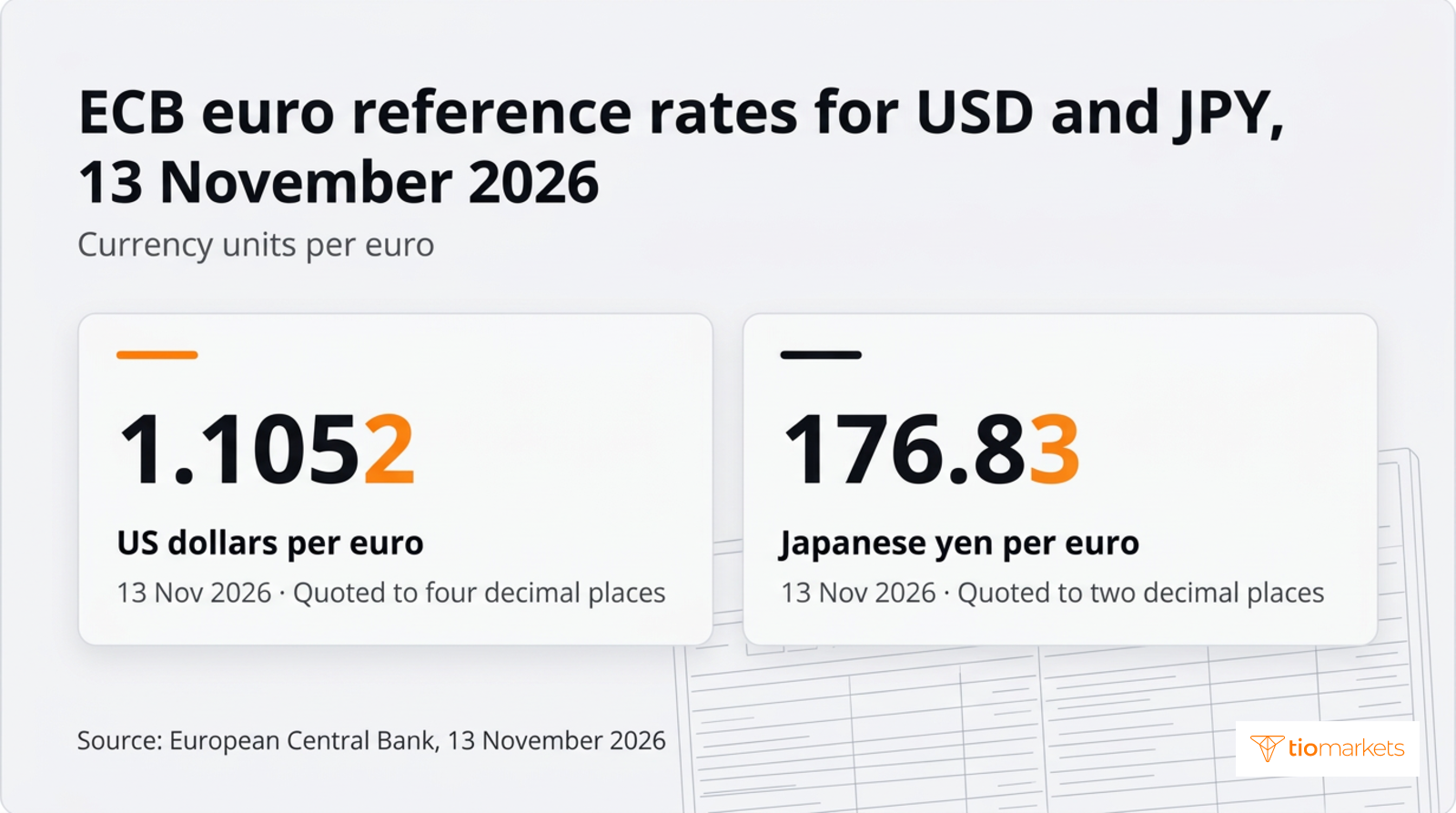
A pip is therefore not a fixed percentage of the price. At 1.1052, a EUR/USD pip of 0.0001 is slightly less than one hundredth of one percent of the rate; at 176.83, a EUR/JPY pip of 0.01 is a smaller share again. On USD/JPY, a move of one full yen is 100 pips, a big figure on a yen pair.
Pip vs Pipette vs Point
Pip vs pipette vs point is where tenfold counting errors begin. A pipette is a tenth of a pip: the fifth decimal on most pairs and the third on yen pairs. In MetaTrader 4 and MetaTrader 5, the point is the smallest price increment shown for a symbol; on five-digit and three-digit quotes it equals a pipette, so 10 points make one pip.
Automated trading code shows how easily point and pip are confused. Most expert advisors, programs that place trades automatically in MetaTrader, use the platform's Point variable as if it were a pip, which gives wrong distances on five-decimal quotes. One published correction for MT5 treats a Point of 0.00001 as a pip of 0.0001, and a Point of 0.001 on yen pairs as a pip of 0.01.
| Unit | Most pairs, e.g. EUR/USD | Yen pairs, e.g. USD/JPY | What it represents |
| Pip | 0.0001 (fourth decimal) | 0.01 (second decimal) | The standard unit for quoting price moves and spreads |
| Pipette (fractional pip) | 0.00001 (fifth decimal) | 0.001 (third decimal) | One tenth of a pip; 10 pipettes make 1 pip |
| Point in MT4 and MT5 | 0.00001 on a five-digit quote | 0.001 on a three-digit quote | The platform's smallest increment; equal to a pipette, so 10 points make 1 pip |
How Do You Count Pips?
Learning how to count pips in forex comes down to one formula: the difference between two prices divided by the pip size, 0.0001 on most pairs and 0.01 on Japanese yen pairs. For a long position the entry price is subtracted from the exit price; for a short position, the exit price from the entry price. Counting the pips between two prices takes four steps:
- Identify the pip decimal for the pair: the fourth decimal on EUR/USD and most pairs, the second on yen pairs.
- Subtract one price from the other, in the order the position's direction requires.
- Divide the difference by the pip size, 0.0001 or 0.01, to give the move in pips.
- Where the platform shows a fifth or third decimal, divide any count in pipettes or points by 10 to convert it to pips.
The result measures distance on the price scale, not the money value of a move, which depends on position size. A count is only as accurate as the pip size chosen in the third step.
On EUR/USD, a move from 1.0980 to 1.0995 gives 1.0995 − 1.0980 = 0.0015, and 0.0015 ÷ 0.0001 = 15 pips, or 150 pipettes. On EUR/JPY, the euro reference rate was 184.09 on 31 December 2025 and 176.83 on 13 November 2026; the difference of 7.26, divided by 0.01, is a fall of 726 pips. These are historical rates, and past performance is not a reliable indicator of future results.
Daily reference rates show the same arithmetic. The US dollar reference rate fell from 1.1214 on 10 November 2026 to 1.1127 on 11 November 2026, a one-day move of 87 pips. The rates are published at around 16:00 CET each working day and are for information only, not for use in market transactions.
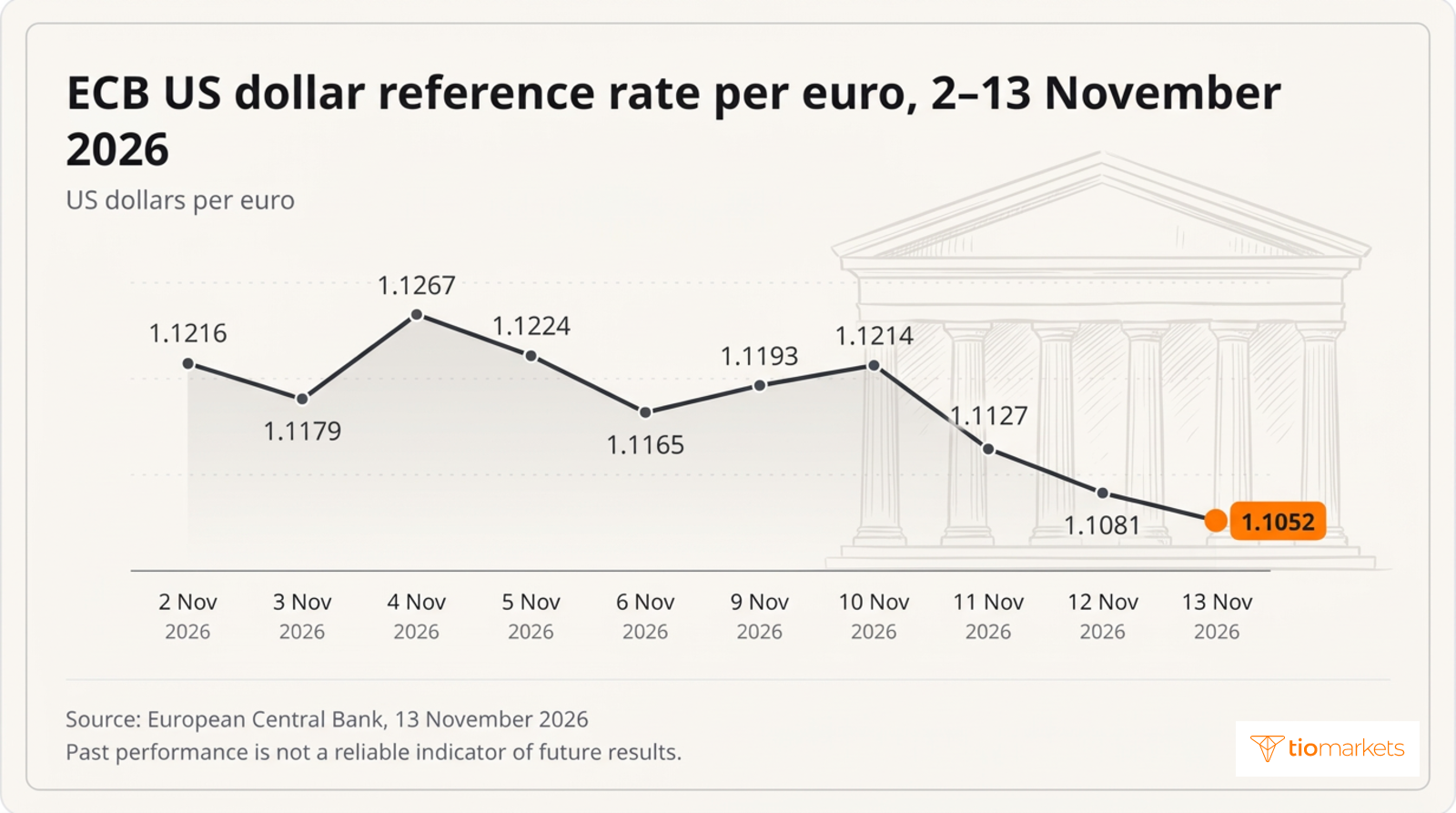
The same method expresses the spread, the ask price minus the bid price, in pips: the spread divided by the pip size, or a spread a platform shows in points divided by 10.
Pip Value on a Standard, Mini and Micro Lot
Pip value is a separate calculation from pip counting: the position size multiplied by the pip size, with the result in the quote currency. A standard lot is 100,000 units of the base currency, a mini lot 10,000, a micro lot 1,000 and a nano lot 100, as set out in more detail in lot sizes, mini lots and micro lots. On EUR/USD, 100,000 × 0.0001 gives 10 US dollars per pip on a standard lot, 1 US dollar on a mini lot and 0.10 US dollars on a micro lot. A single pipette on a standard lot is worth 1 US dollar.
Because the result is in the quote currency, pip value depends on the pair as well as on position size. One pip on a standard lot is worth 10 Swiss francs on USD/CHF and, at 100,000 × 0.01, 1,000 yen on USD/JPY. Converting those amounts into the currency of a trading account is a further step.
Common Pip Mistakes
Most pip errors share one cause: confusing the decimal that defines the pip with the last digit a platform displays. Each follows from applying a convention learned on one pair or platform to another.
- Reading points as pips. A distance that MetaTrader 5 shows as 150 points on EUR/USD is 15 pips, not 150, so a stop-loss order set on the belief that the gap is 150 pips sits ten times closer to the price than intended.
- Using the wrong decimal on yen pairs. Applying 0.0001 to USD/JPY counts a move of 0.01 as 100 pips instead of one, while applying 0.01 to EUR/USD understates moves a hundredfold.
- Treating a pip as a fixed amount of money. A pip is worth 10 US dollars on a standard lot of EUR/USD and 1,000 yen on a standard lot of USD/JPY, and less on smaller positions; no single cash value applies.
- Carrying forex conventions to other instruments. The pip describes price moves in the forex market, while futures markets use points and ticks, each contract with its own tick size, so decimal rules for currency pairs cannot be assumed elsewhere.
The last mistake carries particular weight for CFDs, contracts for difference that trade price moves without ownership of the asset. CFDs on gold, stock indices or cryptocurrencies are quoted with their own decimals, and they are leveraged products. On a distance miscounted on one of them, leverage magnifies losses just as it would gains, those losses can mount quickly in a sharp move, and a trader can lose the entire deposit.
Conclusion
A pip is a counting unit fixed to a decimal place, the fourth on most currency pairs and the second on yen pairs, rather than a sum of money. Pipettes and MetaTrader points sit one decimal further out, each a tenth of a pip, and pip value is a separate calculation through position size and the quote currency. Keeping the three apart puts quotes, spreads and order distances on EUR/USD, GBP/USD and USD/JPY on one consistent scale.
The convention has clear limits. A pip count measures distance, not value, and it does not transfer unchanged to gold, indices or cryptocurrencies. On leveraged forex and CFD positions every pip carries a money value: leverage amplifies losses as well as gains, a loss can grow quickly over a handful of pips, and traders can lose all the money they deposit.
Trade from anywhere with the TIOmarkets Trading and Investing Mobile App
Trade over 950 instruments with built-in TradingView charts and competitive spreads, all from your phone, in real time.
Trading is risky
FAQ
Risk disclaimer: CFDs are complex instruments and come with a high risk of losing money rapidly due to leverage. You should consider whether you understand how CFDs work and whether you can afford to take the high risk of losing your money. Never deposit more than you are prepared to lose. Professional client’s losses can exceed their deposit. Please see our risk warning policy and seek independent professional advice if you do not fully understand. This information is not directed or intended for distribution to or use by residents of certain countries/jurisdictions including, but not limited to, USA & Countries included in the OFAC sanction list. The Company holds the right to alter the aforementioned list of countries at its own discretion.
TIOmarkets offers an exclusively execution-only service. The views expressed are for information purposes only. None of the content provided constitutes any form of investment advice. The comments are made available purely for educational and marketing purposes and do NOT constitute advice or investment recommendation (and should not be considered as such) and do not in any way constitute an invitation to acquire any financial instrument or product. TIOmarkets and its affiliates and consultants are not liable for any damages that may be caused by individual comments or statements by TIOmarkets analysis and assumes no liability with respect to the completeness and correctness of the content presented. The investor is solely responsible for the risk of his/her investment decisions. The analyses and comments presented do not include any consideration of your personal investment objectives, financial circumstances, or needs. The content has not been prepared in accordance with any legal requirements for financial analysis and must, therefore, be viewed by the reader as marketing information. TIOmarkets prohibits duplication or publication without explicit approval.
Join us on social media


Authors BIO

Behind every blog post lies the combined experience of the people working at TIOmarkets. We are a team of dedicated industry professionals and financial markets enthusiasts committed to providing you with trading education and financial markets commentary. Our goal is to help empower you with the knowledge you need to trade in the markets effectively.