SNB Rate Decision: Why a Hold May Still Move the CHF
BY Ahmed Osama
|September 22, 2026The Swiss National Bank is widely expected to keep its policy rate at 0% on 24 September. The bigger question is whether stronger Swiss growth, 0.8% inflation and a softer franc lead the SNB to sound less relaxed about future price pressure. That message could matter for EUR/CHF, USD/CHF, Swiss yields and export-heavy equities even if the rate does not move.
SNB Rate Decision Insights
- The SNB decision is due at 07:30 UTC on Thursday, 24 September 2026; the news conference begins at 08:00 UTC.
- All 35 economists in a Reuters poll published on 21 September expected the policy rate to remain at 0%.
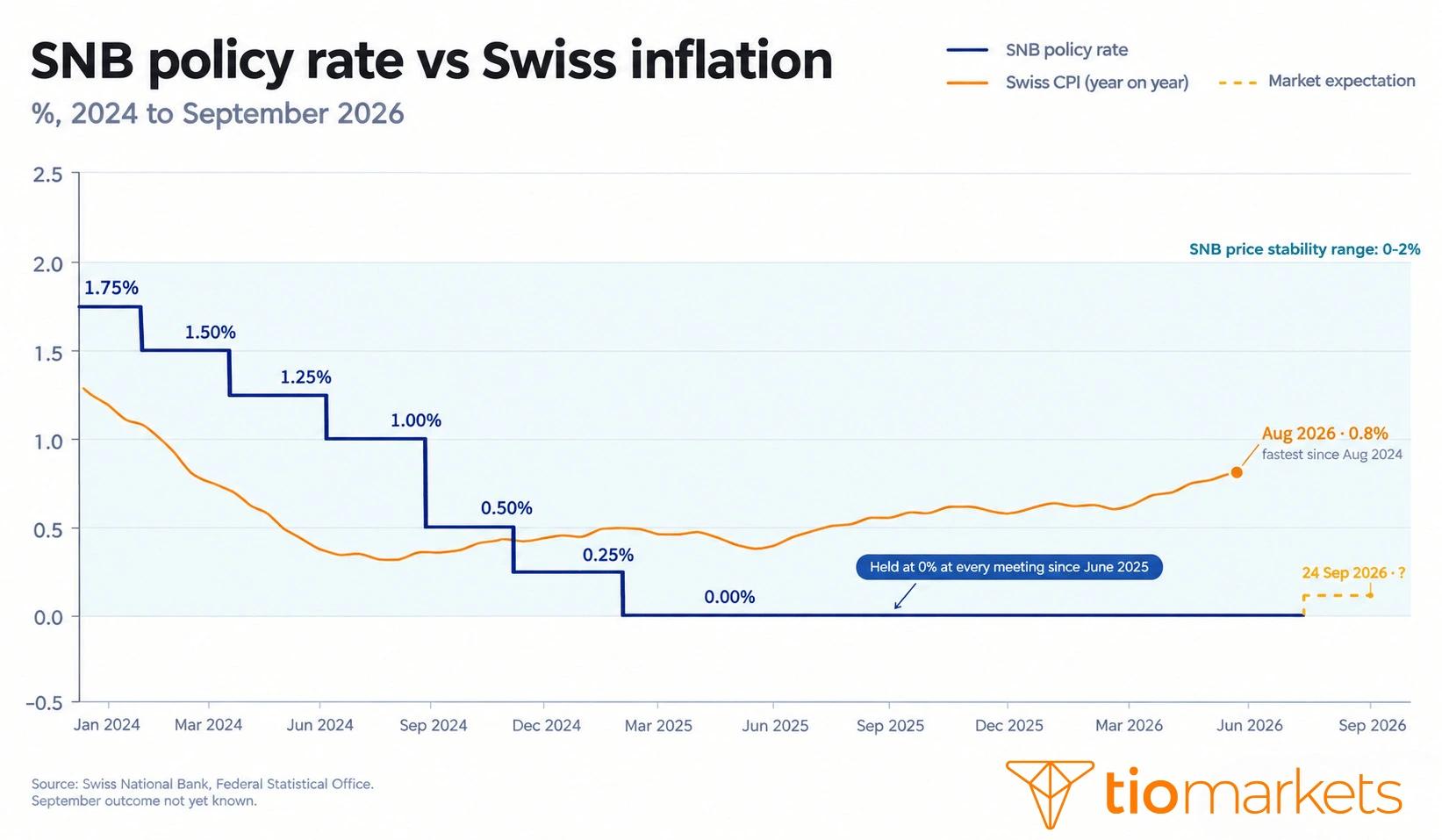
- Swiss inflation rose to 0.8% year on year in August, the fastest pace since August 2024, and core inflation edged up to 0.4%. Second-quarter GDP adjusted for sporting events grew 1.5%, the strongest since 2021.
- The key signals are likely to be the new conditional inflation forecast, language on foreign-exchange intervention and the SNB’s assessment of energy-driven price risks.
- A hawkish hold could support the franc; a dovish hold or surprise cut could weaken it. Both outcomes remain scenarios, not forecasts or trading recommendations.
What to Expect From the SNB Rate Decision
The Swiss National Bank will publish its September monetary policy assessment at 09:30 local time in Switzerland on 24 September. That is 07:30 UTC, 08:30 in London and 03:30 in New York. Introductory remarks and the news conference are scheduled for 10:00 CEST.
The starting rate is 0%. In June, the SNB kept that rate unchanged and said it had an increased willingness to intervene in the foreign-exchange market if rapid and excessive franc appreciation threatened price stability. Its conditional forecast put average inflation at 0.6% in 2026, 0.6% in 2027 and 0.7% in 2028, assuming the policy rate remained at 0% throughout the forecast horizon.
The consensus for September is unusually clear. Every economist in Reuters’ 21 September poll expected no rate change; 29 of 31 respondents also expected 0% through year-end. A hold would therefore confirm the central case, but it would not make the meeting irrelevant. When the rate outcome is well anticipated, small changes in the inflation path or policy language can reshape expectations for the next move.
Why the SNB Rate Decision Matters Despite a Clear Consensus
Switzerland’s latest data give the SNB reasons to be patient and reasons to keep its options open.
Consumer prices rose 0.8% from a year earlier in August, according to the Federal Statistical Office, the fastest annual rate since August 2024 and above the 0.5% expected. Core inflation, which excludes volatile items such as energy and unprocessed food, edged up to 0.4% from 0.3%, its first increase this year. Higher petroleum prices and a weaker franc, which has raised the cost of imported goods, contributed to the pickup. Inflation remains inside the SNB’s price-stability range, but the composition matters: energy and the exchange rate can move imported prices quickly in a small, open economy.
Growth has also surprised on the upside. SECO reported that GDP adjusted for sporting events expanded 1.5% quarter on quarter in the second quarter, after 0.5% in the first, the strongest quarterly growth since the third quarter of 2021. The government’s expert group subsequently raised its 2026 growth forecast to 1.7% from 0.9%, although it cautioned that almost half of the second-quarter increase came from the volatile chemical and pharmaceutical industry and expects some correction in the second half.
That combination does not automatically require higher rates. SECO still forecasts average inflation of 0.6% in both 2026 and 2027, and the SNB said in June that medium-term inflation pressure was virtually unchanged. It does, however, reduce the urgency for renewed easing and raises the value of the SNB’s forward-looking guidance.
Three SNB Signals That Could Move the Franc
The Conditional Inflation Forecast
The SNB publishes a forecast conditioned on a constant policy rate. In June, the path stayed inside the price-stability range across the horizon. A visible upward revision, particularly for 2027 or 2028, would suggest less tolerance for prolonged monetary accommodation. A lower path would strengthen the argument that 0% can remain in place for longer.
Foreign Exchange Intervention Language
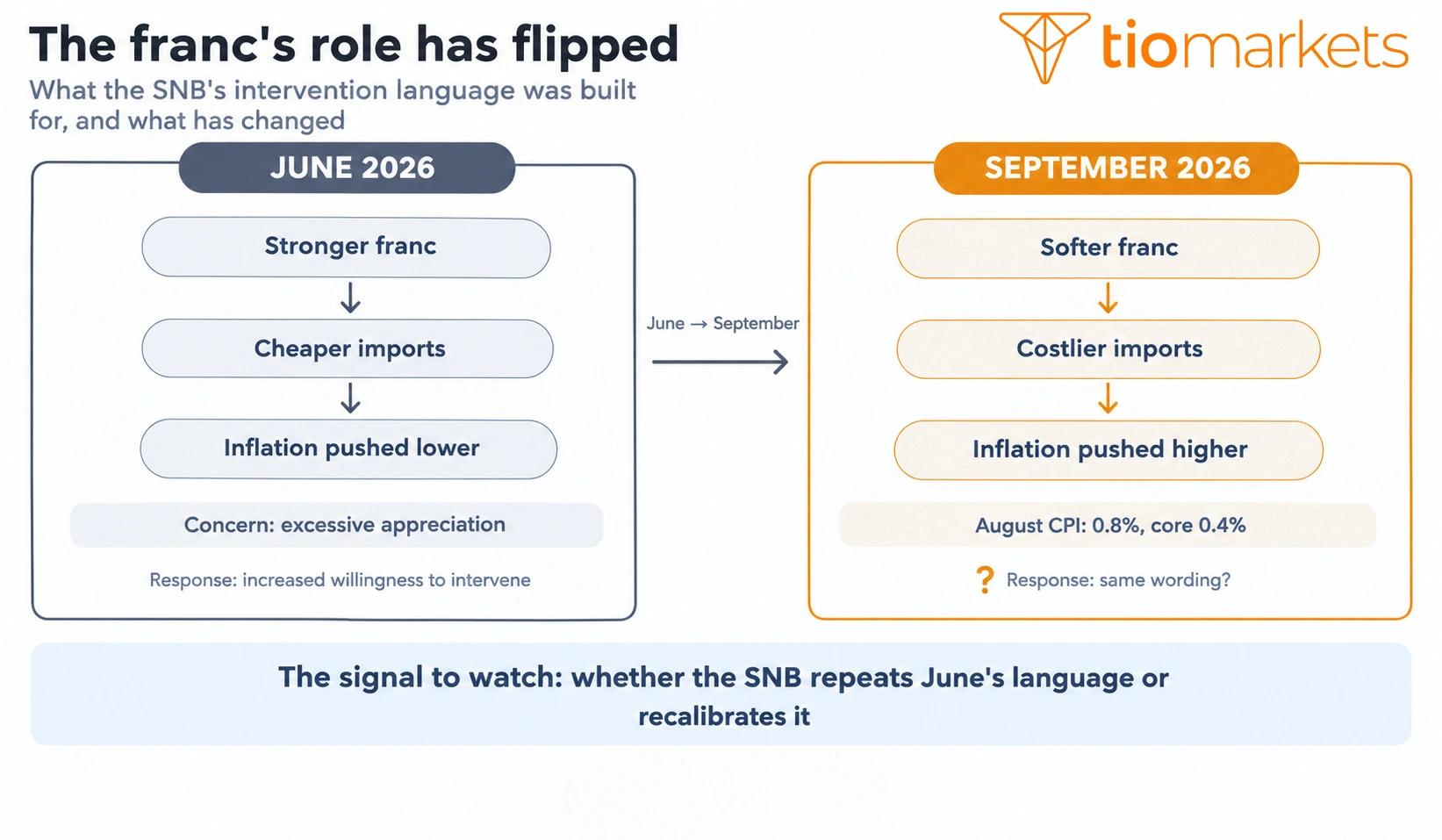
In June, the SNB said its willingness to intervene in the currency market had increased. A repeat would signal continued concern about abrupt franc strength. Softer wording could imply greater comfort with the exchange rate; stronger wording could indicate that the SNB still sees intervention as an important tool even with the policy rate at zero.
This is where September differs most from June. The intervention language was written when the concern was franc strength. Since then, reporting points to a softer franc against the euro, and the August inflation release attributed part of the pickup to the weaker currency raising import prices.
A repeat of June's wording would signal that the SNB still regards appreciation as the main risk. A recalibration would acknowledge that the exchange rate is now adding to inflation rather than suppressing it, which would be a meaningful shift in how the Bank describes its most important tool.
Energy and Second Round Effects
The June discussion summary said inflation risks had shifted upward because higher energy costs could spread into processed food, private transport, tourism and food services, although evidence of broad second-round effects was limited at the time. September’s assessment can show whether the Governing Board still sees the shock as temporary or increasingly persistent. August's core reading, the first increase this year, makes that question more pressing than it was in June.
The Data Dashboard Before the Meeting
| Indicator | Latest | Reference | Why it matters |
| SNB policy rate | 0.00% | 23 Sep 2026 | Starting point for the decision |
| Swiss CPI | +0.8% y/y | Aug 2026 | Still low, but up from +0.4% in July |
| Sport-adjusted GDP | +1.5% q/q | Q2 2026 | Strong growth, partly pharma-driven |
| SECO 2026 GDP forecast | +1.7% | 17 Sep 2026 | Raised from +0.9% in June |
| EUR/CHF | 0.9380_0.9480 | 23Sep 2026 | Main channel for franc-policy signalling |
| USD/CHF | 0.8150_0.8250 area | 23 Sep 2026 | Also reflects the global rate backdrop |
| Swiss Confederation yield | 0.550% | 21 Sep 2026 | Domestic rates reference published by SNB |
| Swiss core CPI | +0.4% y/y | Aug 2026 | First increase this year |
Market levels are reference observations from the SNB website, not entry or exit points. Refresh immediately before publication.
Three Scenarios After the SNB Rate Decision
The scenarios below describe possible market interpretations. They do not assign probabilities beyond the published consensus and do not constitute investment advice.
| Scenario | Trigger | Possible implication | Evidence to monitor | What weakens it |
| CHF upside Hawkish hold | Rate stays at 0%, but 2027–28 inflation is revised higher or the SNB stresses second-round risks. | Franc may strengthen; short Swiss yields may rise; a stronger CHF may weigh on exporters’ translated earnings. | Forecast path, price-risk language, response on timing of normalisation. | Forecast remains flat and intervention language strengthens. |
| Base case Balanced hold | Rate stays at 0%; forecast and intervention wording change little. | Initial reaction may fade as markets return to global rate and risk drivers. | Magnitude of forecast changes; tone of the news conference. | Any clear signal that the next move has shifted closer. |
| CHF downside Dovish hold or cut | Forecast is revised lower, intervention concern intensifies, or the SNB unexpectedly cuts below 0%. | Franc may weaken; short yields may fall; exporters could receive near-term currency support. | Deflation concern, franc language, sight-deposit remuneration. | Inflation path stays firmer or the SNB rejects further easing. |
Monitor Swiss Franc Pairs in Real Time
Trade with competitive spreads and advanced charting across EUR/CHF, USD/CHF, and major FX pairs on MT4, MT5, and the TIOmarkets app.
Trading is risky
Cross Asset Channels to Watch
The Swiss franc is likely to be the first transmission channel. EUR/CHF has been trading in the 0.9380–0.9480 area, close to its 2026 high of 0.9451 reached on 14 September, while USD/CHF has been trading in the 0.8150–0.8250 area. These bands offer simple reference zones for assessing the direction and durability of the initial response; they are not recommendations or forecasts.
Swiss short-term rates and Confederation bond yields may react if the forecast changes the expected timing of policy normalisation. Equities require a more balanced reading. A weaker franc can support the translated revenue of internationally exposed companies, while a stronger franc can create a currency headwind. At the same time, a hawkish message tied to stronger domestic activity may be interpreted differently across banks, defensives and exporters.
Global conditions can easily dominate. The euro-area and US rate outlook, energy prices, trade-policy news and safe-haven flows can move CHF pairs independently of the SNB. A same-day currency move should therefore be described as consistent with the decision and surrounding market conditions, not automatically caused by one sentence in the statement.
Key Events and Reference Levels
| Time | Event | What to watch |
| 24 September, 09:30 CEST | SNB policy decision and statement | Rate, conditional inflation forecast, intervention language |
| 24 September, 10:00 CEST | Introductory remarks and news conference | Clarification on energy prices, the franc and the next move |
| 30 September, 15:00 CEST | SNB Quarterly Bulletin 3/2026 | Fuller policy and economic analysis |
| 22 October, 09:30 CEST | Summary of the September policy discussion | Detail on risks and alternatives considered |
| 10 December, 09:30 CET | Next scheduled SNB assessment | Next formal opportunity to change the rate |
Risks and Uncertainties
The largest uncertainty is the path of energy prices and whether higher costs spread beyond fuel and transport. A renewed geopolitical escalation could raise inflation while weakening global activity, leaving the SNB with conflicting signals. Faster global growth or a persistently softer franc could lift imported inflation; renewed risk aversion could strengthen the franc and suppress it.
Swiss growth figures also require care. The second-quarter expansion was unusually strong and partly driven by a volatile industry. A single quarter does not establish a durable acceleration. Policy signals may also be overshadowed by international central-bank expectations or market moves already underway before the release.
Conclusion
A 0% hold is the consensus for 24 September, but it is only the first line of the story. The updated inflation forecast, the SNB’s view of energy-related price pressure and its willingness to resist rapid franc appreciation will shape how markets interpret the meeting. The useful question is not simply whether the rate changes, but whether the SNB’s balance of risks has moved closer to eventual tightening, prolonged stability or renewed easing.

Risk disclaimer: CFDs are complex instruments and come with a high risk of losing money rapidly due to leverage. You should consider whether you understand how CFDs work and whether you can afford to take the high risk of losing your money. Never deposit more than you are prepared to lose. Professional client’s losses can exceed their deposit. Please see our risk warning policy and seek independent professional advice if you do not fully understand. This information is not directed or intended for distribution to or use by residents of certain countries/jurisdictions including, but not limited to, USA & Countries included in the OFAC sanction list. The Company holds the right to alter the aforementioned list of countries at its own discretion.
TIOmarkets offers an exclusively execution-only service. The views expressed are for information purposes only. None of the content provided constitutes any form of investment advice. The comments are made available purely for educational and marketing purposes and do NOT constitute advice or investment recommendation (and should not be considered as such) and do not in any way constitute an invitation to acquire any financial instrument or product. TIOmarkets and its affiliates and consultants are not liable for any damages that may be caused by individual comments or statements by TIOmarkets analysis and assumes no liability with respect to the completeness and correctness of the content presented. The investor is solely responsible for the risk of his/her investment decisions. The analyses and comments presented do not include any consideration of your personal investment objectives, financial circumstances, or needs. The content has not been prepared in accordance with any legal requirements for financial analysis and must, therefore, be viewed by the reader as marketing information. TIOmarkets prohibits duplication or publication without explicit approval.
Join us on social media



Authors BIO

An experienced financial analyst and educator with over 8 years of expertise covering gold, forex, and global financial markets. Ahmed specializes in blending price action analysis with macroeconomic data to accurately interpret market movements, providing readers with comprehensive educational insights into trading and the financial world.