


USD/CAD Forecast: Pair Breaks 1.3800 as Treasury Move Hits Dollar
BY Eleni Antoniou
|August 20, 2026USD/CAD trades near 1.3760, having broken decisively through the 1.3800 support that had held through mid-August. The pair now sits close to 1.3750, the next reference level beneath it.
The break carries an unusual signature, and it defines this USD/CAD forecast: the Federal Reserve's July minutes, released Wednesday, showed a Committee tilting more hawkish, and the dollar fell anyway.
That inversion has a specific cause. A Treasury Department announcement is currently moving the dollar more than the central bank is.
Key takeaways
- USD/CAD near 1.3760, having broken 1.3800 support, with 1.3750 the immediate reference
- The dollar index sits near two-month lows around 99.45, after touching 99.29 on Monday
- The FOMC minutes showed a hawkish tilt, yet the dollar declined roughly 0.8% on the day
- The Treasury announced it would at least double long-bond buybacks, and long-dated yields fell around 10 basis points, the largest drop since October 2025
- September hike odds have fallen to around 35%, from roughly 52% a week earlier
- The US paused tariffs on Canadian imports, removing a specific overhang on the currency
- Canada retail sales and preliminary Q2 GDP land Friday 21 August
Why the dollar fell on hawkish minutes
This is the central dynamic, and it is worth setting out carefully because it explains the technical break.
What the minutes showed
The minutes of the 28-29 July meeting, released Wednesday at 2:00 pm Eastern, showed that a growing number of officials are increasingly concerned about the persistence of elevated price pressures and the inflation outlook. Reporting on the release characterised the Committee's centre of gravity as shifting in a more hawkish direction.
The meeting itself produced three dissents, with regional Fed Presidents Logan, Hammack and Kashkari all voting for a 25 basis point increase.
Under ordinary conditions, that content supports the dollar. It did not.
What overwhelmed it
Two forces worked against the minutes.
First, the data cycle. The dollar entered the week on the back of four consecutive soft US prints: July retail sales fell for the first time in nine months, core retail sales declined, payrolls shrank, and July inflation readings came in subdued. The University of Michigan consumer sentiment survey then dropped to 51 in August from 55.2, well below forecasts.
The result was a repricing of hike expectations. Futures pricing now implies roughly a 35% probability of a September increase, down from about 52% a week earlier, and markets no longer fully price an increase by year-end.
Second, and more immediately, the Treasury acted. With the 30-year Treasury yield reaching a 19-year high this week, the Treasury Department announced it would increase the size of government debt repurchases by at least double.
The market response was sharp. Long-dated US yields fell around 10 basis points, the largest single-day decline since October 2025, and the dollar dropped roughly 0.8% on the day.
The structural point
The Fed under Kevin Warsh has removed forward guidance from its communication, deliberately reducing the signals it sends between meetings. The Treasury has simultaneously expanded its buyback operations at the long end of the curve.
For a currency trader, that combination matters more than any single data point. The variable most likely to move the dollar in the near term may now sit outside the central bank, which is not the configuration most FX positioning is built around.
The Canadian side
The Bank of Canada held its overnight rate at 2.25% on 15 July, describing an improving economy while flagging Middle East oil volatility and US trade policy as key uncertainties.
Two developments since then support the Canadian dollar:
- Canadian inflation data has firmed, with gasoline a significant contributor, which complicates any case for near-term easing. A single print does not establish a policy path, but it removes urgency from the easing argument
- The US paused tariffs on Canadian imports. Prime Minister Carney said key work remains, so this is a de-escalation rather than a settlement, but it removes a specific overhang that had weighed on the currency
The rate gap still favours the dollar. The Fed's 3.50% to 3.75% range sits well above the Bank of Canada's 2.25%, a spread of roughly 125 to 150 basis points. That structural advantage has not changed.
What has changed is the direction of travel. Markets are pricing the Fed away from further tightening while Canadian inflation shows resilience, and over a one-to-two week horizon it is the change in the gap rather than its level that drives the pair.
USD/CAD technical analysis
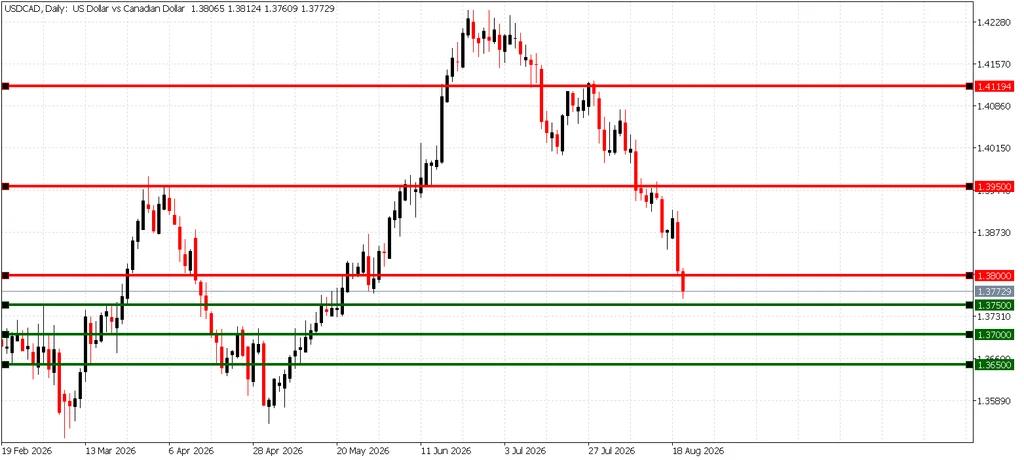
Source: TIOmarkets MT5 live USD/CAD chart
The daily structure has deteriorated steadily from the July peak above 1.42. The pair printed lower highs through early August, lost the 1.3950 to 1.4020 band that had acted as a floor, and has now broken 1.3800.
Resistance levels to watch:
- 1.3800: the level just lost, now the first barrier on any recovery attempt
- 1.3950: the lower edge of the former support band
- 1.4020 to 1.4120: the broader zone where late-July rallies stalled
Support levels to watch:
- 1.3750: the immediate reference, roughly 10 pips beneath current price
- 1.3700: the psychological level below it
- 1.3650: the deeper reference should selling extend
The structural read is bearish while price holds below 1.3800. The sequence of lower highs, the loss of two successive support bands, and the proximity to 1.3750 all point the same way.
But note the position. At 1.3760 the pair sits directly on top of support after a sustained decline, which is where short-term rebounds most often begin. A daily close beneath 1.3750 would confirm continuation, while a recovery above 1.3800 would suggest the break was a stop-run rather than a structural move.
Bullish scenario: 20-28 August
This bullish USD/CAD forecast scenario may strengthen if the pair reclaims 1.3800 and holds it, which would require a genuine catalyst given current momentum.
The most plausible triggers are Canadian retail sales and Q2 GDP on Friday disappointing relative to expectations, a Jackson Hole address read as leaning hawkish, or a renewed rise in long-dated Treasury yields that reverses the recent dollar decline.
Above 1.3800, 1.3950 becomes the first meaningful objective, with the 1.4020 to 1.4120 zone beyond it.
Invalidation: a daily close beneath 1.3750 would remove this scenario in the near term.
Bearish scenario: 20-28 August
The bearish case may strengthen if Canadian data on Friday comes in resilient, oil holds its recent gains, and the dollar's decline extends as hike expectations continue to fade.
A daily close beneath 1.3750 would open 1.3700, with 1.3650 the next reference if selling accelerates.
Supporting factors include further softness in US data, additional Treasury action at the long end, a Jackson Hole address that markets read as neutral or accommodative, and continued progress on the US-Canada trade file.
Invalidation: a sustained recovery above 1.3800 would challenge this view.
A note on market mechanics. The current move is driven by dollar weakness rather than Canadian strength, and its proximate cause is a Treasury operation rather than a monetary decision. Moves with that construction can reverse quickly if the intervening authority steps back, which is a different risk profile from a trend built on rate differentials.
Key levels and catalysts
| Item | Detail |
| Resistance | 1.3800, then 1.3950, then 1.4020 to 1.4120 |
| Support | 1.3750, then 1.3700, then 1.3650 |
| 21 August | Canada retail sales for June and preliminary Q2 GDP |
| 27-29 August | Jackson Hole symposium |
| 28 August | Warsh keynote, his first as Fed chair |
| 2 September | Bank of Canada rate decision |
| 15-16 September | Next FOMC meeting |
| Ongoing | Long-dated Treasury yields, oil prices, US-Canada trade developments |
Conclusion
This USD/CAD forecast describes a pair that has broken support on a dollar decline the Federal Reserve did not cause.
The minutes were hawkish and the dollar fell. That inversion points to the Treasury's expanded buyback operations, and to a data cycle that has already repriced September hike odds down to roughly 35%, as the operative drivers.
1.3750 is the level that matters now. A daily close beneath it would confirm the break and open 1.3700, while a recovery above 1.3800 would suggest the market overshot on a single day's headlines. Friday's Canadian data and Warsh's Jackson Hole address on 28 August are the two scheduled events most capable of settling the question.
This article is market commentary for educational purposes only. It does not constitute investment advice, does not guarantee future market performance, and contains no forecast of central bank or government policy decisions.

Risk disclaimer: CFDs are complex instruments and come with a high risk of losing money rapidly due to leverage. You should consider whether you understand how CFDs work and whether you can afford to take the high risk of losing your money. Never deposit more than you are prepared to lose. Professional client’s losses can exceed their deposit. Please see our risk warning policy and seek independent professional advice if you do not fully understand. This information is not directed or intended for distribution to or use by residents of certain countries/jurisdictions including, but not limited to, USA & Countries included in the OFAC sanction list. The Company holds the right to alter the aforementioned list of countries at its own discretion.
TIOmarkets offers an exclusively execution-only service. The views expressed are for information purposes only. None of the content provided constitutes any form of investment advice. The comments are made available purely for educational and marketing purposes and do NOT constitute advice or investment recommendation (and should not be considered as such) and do not in any way constitute an invitation to acquire any financial instrument or product. TIOmarkets and its affiliates and consultants are not liable for any damages that may be caused by individual comments or statements by TIOmarkets analysis and assumes no liability with respect to the completeness and correctness of the content presented. The investor is solely responsible for the risk of his/her investment decisions. The analyses and comments presented do not include any consideration of your personal investment objectives, financial circumstances, or needs. The content has not been prepared in accordance with any legal requirements for financial analysis and must, therefore, be viewed by the reader as marketing information. TIOmarkets prohibits duplication or publication without explicit approval.
Join us on social media



Authors BIO

Eleni is a financial markets enthusiast contributing to content covering forex, indices, commodities, and global market developments. She is passionate about researching market-related topics and helping make financial information more accessible to traders.