


USD/CAD Market Analysis: Loonie Tests Key Support
BY Eleni Antoniou
|August 13, 2026USD/CAD enters 13 August 2026 near the lower end of its recent range around 1.3950, after a stronger Canadian employment report and softer US labour and inflation signals.
USD/CAD market overview
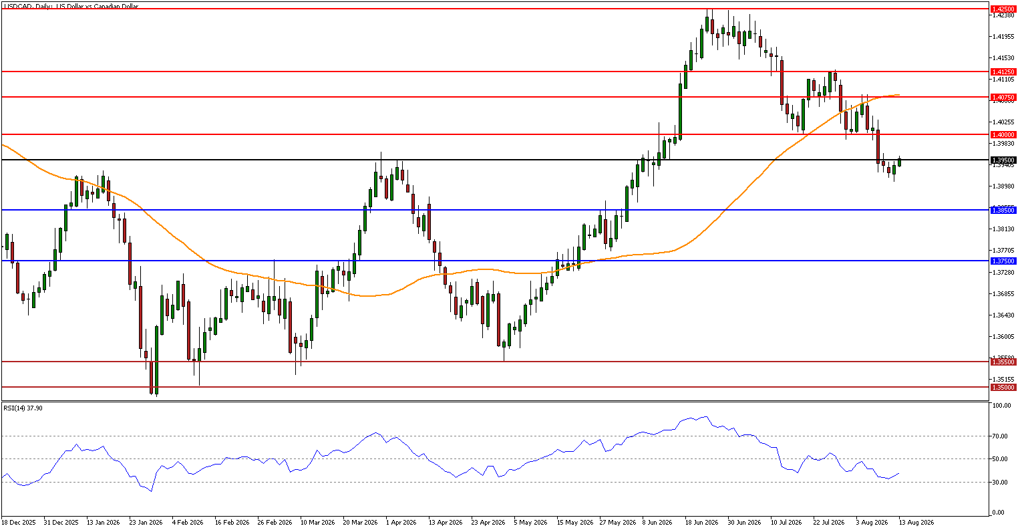
USD/CAD has reversed lower from its late-June peak, reaching 1.4247 on 24 June before easing through July and falling to 1.3907 on 12 August. The move places the pair near an important support, now potential resistance area around 1.3950 and below the 1.4000 psychological level.
The decline reflects a shift in relative data momentum. Canada added 75,100 jobs in July and the unemployment rate fell to 6.4%, its lowest level in two years. By contrast, US nonfarm payrolls unexpectedly declined by 23,000 in July, although the US unemployment rate edged down to 4.1%. The labour-market divergence reduced some of the US dollar's yield-driven advantage, even though US policy rates remain materially above Canadian rates.
Oil remains a second major influence. Canada is a significant crude exporter, so firmer oil prices can improve the country's terms of trade and support the Canadian dollar. However, conflict-driven oil gains may also raise US inflation expectations and generate defensive demand for the US dollar. The relationship is therefore supportive for CAD only when higher oil does not trigger a broader risk-off move.
Latest USD/CAD market news
The Bank of Canada held its overnight rate at 2.25% on 15 July. Its July Monetary Policy Report said the Canadian economy was showing signs of improvement after a weak period, while inflation was expected to ease gradually toward 2%. The Bank also stressed substantial uncertainty around the Middle East conflict, oil prices and US trade policy.
Canadian inflation had already moderated in June. Headline CPI slowed to 2.8% year over year, while the Bank of Canada's preferred underlying measures were mixed but generally softer: CPI-trim was 1.8%, CPI-median 1.9% and CPI-common 2.6%. The 17 August release of July CPI will be important because another benign reading could preserve the Bank's room to remain patient, while renewed price pressure could strengthen expectations that the next policy move may be tighter.
The Federal Reserve held the federal funds target at 3.50%-3.75% on 29 July. The 9-3 vote was unusually divided, with three officials preferring a 25-basis-point increase. That hawkish dissent initially supported the dollar, but subsequent US data complicated the message. July payrolls contracted, and July CPI rose only 0.1% month over month and 3.4% year over year. Core CPI increased 0.2% on the month and 2.5% over twelve months, both slightly cooler than June's annual rates.
The policy gap still favours the US dollar by roughly 125-150 basis points, depending on the point within the Fed's target range. Yet softer US activity data and easing inflation reduce the probability that the full gap will translate into sustained USD/CAD upside. The next leg is likely to be data-led.
USD/CAD technical analysis
The daily structure has shifted from an advance into a possible corrective downtrend. After topping at 1.4247 in late June. USD/CAD then formed a lower rebound high near 1.4125 on 27 July and then broke below 1.4000. The price now sits below it’s 50-day moving average. A simple 14-day RSI calculation is near 37, showing weak momentum without yet moving into oversold territory.
Immediate potential support is located at 1.3850. On the upside, 1.3950 - 1.4000 is the first recovery zone that bears might defend. Above it, 1.4075 - 1.4125 is the more important resistance area because it contains the late-July rebound high and sits around the 50-day moving average. The major ceiling remains 1.4250.
Fundamental and macro drivers for USD/CAD
Relative monetary policy: The Fed's 3.50%-3.75% target range remains well above the Bank of Canada's 2.25% rate. That differential is a structural USD support. It becomes more powerful if US producer prices, retail sales or the July FOMC minutes reinforce a hawkish Fed outlook. It becomes less influential if weak US employment broadens into softer consumption and rate expectations fall.
Canadian growth and inflation: July's employment gain improved the near-term Canadian outlook, but one strong report does not settle the trend. Traders will watch whether July CPI and June retail sales confirm that domestic demand is recovering without reigniting persistent inflation. Stronger activity with contained inflation would be a constructive mix for CAD.
Oil and risk sentiment: Higher crude prices usually help CAD through Canada's export channel. The benefit can be diluted when oil rises because of supply disruption or geopolitical escalation, since those episodes can also strengthen the dollar through safe-haven flows and raise global inflation risk.
US-Canada trade policy: The Bank of Canada continues to identify US trade policy as a major uncertainty. Any escalation affecting Canadian exports could weaken business investment and CAD. Evidence that most North American trade remains exempt from broad tariffs would reduce that risk premium.
USD/CAD price forecast: bullish scenario
A bullish USD/CAD scenario would gain support if the pair holds 1.3950 and reclaims 1.4000. Hotter US PPI, resilient US retail sales, hawkish July FOMC minutes, weaker Canadian CPI-adjusted consumption, or a risk-off geopolitical shock could provide the catalyst.
Momentum above 1.4000 would weaken the short-term bearish structure and open a retest of 1.40751. The bullish case could lose credibility on a sustained break below 1.3950, especially if oil remains firm and Canadian data continue to surprise positively.
USD/CAD price forecast: bearish scenario
A bearish USD/CAD scenario would gain support if price remains below the 50-day moving average and fails to recover beyond the 1.4125 level. Softer US producer prices or retail sales, dovish interpretation of the FOMC minutes, a firm Canadian CPI or retail-sales report, and stable-to-higher oil prices without a broader risk-off move could reinforce CAD strength.
The first downside area could be 1.3850, followed by 1.3750. A sustained recovery above 1.4075 - 1.4125 would challenge the bears.
Key USD/CAD levels and catalysts to watch
- Support: 1.3850, 1.3750
- Resistance: 1.4000, 1.4075, 1.4125, then 1.4250
Catalysts
- 13 August: US PPI and weekly jobless claims
- 14 August: US retail sales and consumer sentiment
- 17 August: Canada CPI for July
- 18 - 19 August: US industrial production and July FOMC minutes
- 21 August: Canada retail sales for June
Conclusion
The near-term USD/CAD trading outlook indicates a short-term bearish structure, while price remains below 1.4075 - 1.4125, but the pair is approaching support where volatility may rise. The 14-day RSI is approaching oversold territory, and a substantial US-Canada policy-rate gap, reinforced by the possibility that producer prices, consumption or geopolitical risk revive a more hawkish Fed narrative.
Selling pressure would support the case for 1.3850, while a close above 1.400 would shift focus back toward 1.4075. This is general market commentary for your educational purposes only.

Risk disclaimer: CFDs are complex instruments and come with a high risk of losing money rapidly due to leverage. You should consider whether you understand how CFDs work and whether you can afford to take the high risk of losing your money. Never deposit more than you are prepared to lose. Professional client’s losses can exceed their deposit. Please see our risk warning policy and seek independent professional advice if you do not fully understand. This information is not directed or intended for distribution to or use by residents of certain countries/jurisdictions including, but not limited to, USA & Countries included in the OFAC sanction list. The Company holds the right to alter the aforementioned list of countries at its own discretion.
TIOmarkets offers an exclusively execution-only service. The views expressed are for information purposes only. None of the content provided constitutes any form of investment advice. The comments are made available purely for educational and marketing purposes and do NOT constitute advice or investment recommendation (and should not be considered as such) and do not in any way constitute an invitation to acquire any financial instrument or product. TIOmarkets and its affiliates and consultants are not liable for any damages that may be caused by individual comments or statements by TIOmarkets analysis and assumes no liability with respect to the completeness and correctness of the content presented. The investor is solely responsible for the risk of his/her investment decisions. The analyses and comments presented do not include any consideration of your personal investment objectives, financial circumstances, or needs. The content has not been prepared in accordance with any legal requirements for financial analysis and must, therefore, be viewed by the reader as marketing information. TIOmarkets prohibits duplication or publication without explicit approval.
Join us on social media



Authors BIO

Eleni is a financial markets enthusiast contributing to content covering forex, indices, commodities, and global market developments. She is passionate about researching market-related topics and helping make financial information more accessible to traders.