


USD/JPY Market Analysis: Yen Tests 163
BY Panagiotis Philippou
|July 22, 2026USD/JPY is trading around the 163 area on July 22, 2026, keeping the yen close to multi-decade lows and leaving traders focused on intervention risk, U.S. Treasury yields, oil prices and the next Federal Reserve and Bank of Japan policy decisions.
The analysis below uses recent public market data and news available at the time of writing.
USD/JPY Market overview
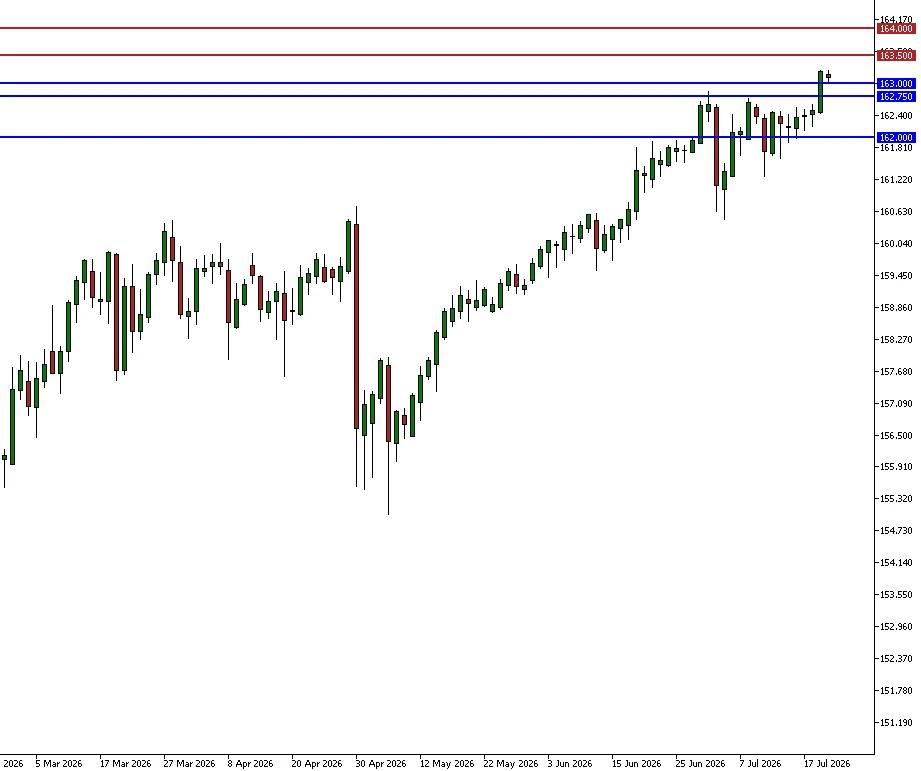
USD/JPY has moved from a tight consolidation around 162.0-162.6 into a test of the 163 handle, suggesting buyers have kept pressure on the yen
The broader backdrop remains dollar-supportive because U.S. yields are still elevated compared with Japanese yields. The Federal Reserve is heading into its July 28-29 meeting with inflation still central to the policy debate, while the BOJ meets on July 30-31 after raising rates to 1.00% in June. That policy calendar gives USD/JPY a catalyst-heavy setup into the end of July.
Latest market news
Recent market news keeps the yen under pressure from three linked themes: intervention risk, oil-driven trade pressure and relative rate expectations. The Financial Times reported that Japan pledged to take bold action as yen weakness intensified and USD/JPY moved above 163, although traders remain uncertain about the level or conditions that would trigger direct intervention.
Japan also reported a June trade deficit of 406.9 billion yen, according to Associated Press coverage of Ministry of Finance data. Imports rose 25% year over year, helped by higher oil prices and a weaker yen, while exports rose 19%. For USD/JPY, the trade data matters because expensive energy imports can worsen yen sentiment even when export values rise.
On the policy side, Reuters reporting carried by Economic Times said Japan has moved to reaffirm BOJ operational independence after market concerns around the government economic blueprint. BOJ communication from the June meeting also pointed to underlying inflation gradually moving toward the 2% target area, which keeps gradual normalization on the table even if the next decision is not guaranteed to deliver another hike.
In the United States, Federal Reserve Vice Chair Philip Jefferson signaled that the current policy stance remains appropriate but that policymakers could reassess if inflation does not keep improving. That leaves the dollar sensitive to U.S. inflation expectations, Treasury yields and any change in the Fed statement at the July meeting.
USD/JPY technical analysis
The short-term trend remains constructive while USD/JPY holds above the 162.00-162.10 area. The pair spent much of the past two weeks moving sideways around 162 before pushing toward 163.15 on July 22. This looks less like a smooth trend extension and more like a slow grind higher, with intervention risk making upside follow-through vulnerable to sudden reversals.
Near-term resistance is clustered around 163.35 and 163.51, based on daily resistance levels from the July 22 technical table. A sustained move above that zone would keep the bullish USD/JPY price forecast alive and could open a test of the next psychological area around 164.00. However, the higher the pair trades above 163, the greater the chance that official warnings become a stronger short-term drag.
Initial support sits around 162.93 and 162.77. Below that, the recent BOJ price series makes 162.00-162.10 the broader pivot. A break under 162.00 would weaken the latest bullish structure and suggest the market is pricing a stronger yen catalyst, such as intervention, a softer dollar or a more hawkish BOJ interpretation.
Fundamental and macro drivers
For forex traders, USD/JPY remains highly sensitive to the U.S.-Japan rate gap. U.S. Treasury yields near the upper end of recent ranges support dollar carry, while Japanese yields have not risen enough to offset that advantage. If the Fed sounds patient or hawkish on July 29, the dollar could stay supported into the BOJ decision.
Japan-specific fundamentals are more mixed. A weak yen supports exporters but raises import costs, especially for energy. With oil still an important inflation and trade-balance driver, a weaker yen can become politically uncomfortable quickly. That is why intervention risk is not only a technical issue; it is tied to inflation pressure, household purchasing power and confidence in policy settings.
The BOJ meeting on July 30-31 is the second major catalyst. After the June rate increase to 1.00%, markets may focus less on the rate decision itself and more on guidance, inflation forecasts and the tone around further normalization. Clearer hawkish language would likely help the yen, while cautious language could leave USD/JPY supported unless Japan's Ministry of Finance takes action.
Bullish scenario for the USD/JPY
A bullish USD/JPY scenario may gain support if the pair holds above 162.77-162.93 and U.S. yields remain firm into the Fed meeting. In that case, traders may watch for a sustained break above 163.35-163.51. A daily hold above that resistance band could shift focus toward 164.00 and potentially the 164.50 area, especially if the Fed avoids dovish language and the BOJ signals patience after June tightening.
This scenario would be strongest if intervention warnings remain verbal, oil prices keep pressure on Japan's trade backdrop, and dollar sentiment stays supported by yield differentials. The main risk to the bullish case is that momentum above 163 triggers a sharper official response or profit-taking ahead of the BOJ meeting.
Bearish scenario for the USD/JPY
A bearish USD/JPY scenario may develop if the pair fails near 163.35-163.51 and slips back below 162.77. That would suggest the breakout is losing momentum. A deeper move below 162.00 would be more important technically because it would break the recent pivot area and bring 161.40-161.70 back into view.
The bearish case could be supported by direct Japanese FX intervention, stronger BOJ normalization signals, softer U.S. yields, or a Fed tone that reduces expectations for higher rates. Because intervention can create fast, disorderly moves, traders may treat downside breaks with extra caution rather than assuming the pair will follow ordinary technical rhythm.
Key levels and catalysts to watch
- Resistance: 163.50, and the psychological 164.00 area.
- Support: 163.00, 162.75, 162.00
- Catalysts: Japanese intervention signals, U.S. Treasury yields, oil prices, the Federal Reserve decision on July 28-29, the BOJ decision on July 30-31, and any changes in inflation or trade-balance expectations.
USD/JPY can move abruptly when intervention speculation rises, so technical levels may be crossed quickly during policy headlines or thin-liquidity periods.
Conclusion
USD/JPY remains upward-biased while it trades near 163 and above the recent 162.00-162.10 pivot, but the pair is also entering a higher-risk zone for policy headlines. The bullish scenario depends on firm U.S. yields, patient BOJ guidance and a clean move above 163.35-163.51. The bearish scenario depends on a failure at resistance, a break below 162.77 and especially a move below 162.00, potentially driven by intervention risk or a shift in central-bank expectations.
For the next 1-2 weeks, the trading outlook is likely to be shaped less by one single data point and more by the combined message from the Fed, the BOJ and Japanese authorities. That makes USD/JPY a momentum pair, but one where headline risk deserves as much attention as the chart.

Risk disclaimer: CFDs are complex instruments and come with a high risk of losing money rapidly due to leverage. You should consider whether you understand how CFDs work and whether you can afford to take the high risk of losing your money. Never deposit more than you are prepared to lose. Professional client’s losses can exceed their deposit. Please see our risk warning policy and seek independent professional advice if you do not fully understand. This information is not directed or intended for distribution to or use by residents of certain countries/jurisdictions including, but not limited to, USA & Countries included in the OFAC sanction list. The Company holds the right to alter the aforementioned list of countries at its own discretion.
TIOmarkets offers an exclusively execution-only service. The views expressed are for information purposes only. None of the content provided constitutes any form of investment advice. The comments are made available purely for educational and marketing purposes and do NOT constitute advice or investment recommendation (and should not be considered as such) and do not in any way constitute an invitation to acquire any financial instrument or product. TIOmarkets and its affiliates and consultants are not liable for any damages that may be caused by individual comments or statements by TIOmarkets analysis and assumes no liability with respect to the completeness and correctness of the content presented. The investor is solely responsible for the risk of his/her investment decisions. The analyses and comments presented do not include any consideration of your personal investment objectives, financial circumstances, or needs. The content has not been prepared in accordance with any legal requirements for financial analysis and must, therefore, be viewed by the reader as marketing information. TIOmarkets prohibits duplication or publication without explicit approval.
Join us on social media



Authors BIO

Panagiotis is an online trading specialist with extensive experience in forex, indices, and commodities. He enjoys sharing his experience to help traders better understand global financial markets.