


What Is a Stop Loss & How Stop Loss Orders Work in Trading
BY Maria K.
|September 30, 2026A stop loss order is an instruction to automatically close a trading position when the market price reaches a predetermined level less favorable than the current price. Stop loss orders function as risk management tools in trading, though they do not guarantee protection against all losses.
This article covers what is a stop loss, how stop loss works, the different types available, calculation methods, execution mechanics, and scenarios where stop losses may or may not be appropriate for different trading approaches.
Traders across various markets use stop loss orders to help manage downside exposure on open positions. The stop loss meaning centers on automatic execution; once set, the order requires no further action from the trader to trigger.
What Is a Stop Loss Order?
Now let’s get to the basics: what is a stop loss. A stop loss order is a conditional order that triggers an automatic position closure when an asset's price moves to a specified stop price level. For long positions, the stop price sits below the entry price; for short positions, it sits above.
The basic purpose of a stop loss order involves setting a predefined exit point that activates without requiring the trader to manually close the position. When a trader places a stop loss, they provide an instruction to their broker specifying the price level at which the position should close if the market moves unfavorably.
Stop loss orders relate to other conditional order types, including limit orders and stop limit orders, each with distinct execution characteristics and use cases.
How Do Stop Loss Orders Work?
When the market price reaches or passes through the stop price level, a stop loss order converts into a market order and executes at the next available price. The conversion and execution process typically happens within milliseconds in liquid markets, though the fill price may differ from the stop price.
Stop Loss Order Execution Process
The trigger mechanism activates when the market price touches or crosses the specified stop level. At this point, the stop loss order converts from a dormant conditional instruction into an active market order seeking immediate execution. The order then fills at whatever price the market offers at that moment.
The time between trigger and fill depends on market conditions, liquidity, and the trading venue's infrastructure. In highly liquid markets during normal trading hours, execution typically occurs almost instantaneously, though rapid price movement can create gaps between the stop price and execution price.
Stop Loss Orders for Long vs Short Positions
For long positions where the trader profits from rising prices, the stop loss sits below the entry price. If a trader buys shares at $50 and wants to limit potential losses, they might place a stop loss at $45, meaning the position would close automatically if the price drops to that level.
For short positions where the trader profits from falling prices, the logic reverses. A short seller who enters at $50 expecting the price to decline would place a stop loss above $50 (perhaps at $55) to limit losses if the price rises instead.
Stop Loss Order Example
To illustrate what is a stop loss in practice, consider a stock trading scenario where a trader sets a stop price below their entry to limit potential losses if the position moves against them.
Consider a trader who purchases 100 shares of a stock at $100 per share, representing a $10,000 position. They place a stop loss order at $95, intending to limit their potential loss to approximately $5 per share, or $500 total. If the stock price drops to $95, the stop loss triggers and converts to a market order. Assuming immediate execution at $95, the trader exits with a $500 loss before any further decline.
What Are the Different Types of Stop Loss Orders?
Once traders understand what is a stop loss at a basic level, the next step involves exploring the different types available and how each functions.
The main types of stop loss orders include standard stop loss orders that execute at market price once triggered, trailing stop loss orders that move with favorable price movements, and guaranteed stop loss orders that promise execution at the exact stop price.
- Standard Stop Loss Orders: Sometimes called basic or regular stop losses, represent the most common type. Once the stop price is reached, the order becomes a market order and executes at the best available price. This type is commonly used in liquid markets where slippage between stop price and execution price tends to be minimal.
- Trailing Stop Loss Orders: They automatically adjust as the market price moves favorably. The trailing distance or percentage maintains a set gap from the highest price reached for long positions or lowest price reached for shorts. For example, a 5% trailing stop on a stock purchased at $100 would initially sit at $95, but if the stock rises to $120, the stop would trail up to $114.
- Guaranteed Stop Loss Orders: They promise execution at exactly the specified stop price regardless of market gaps or volatility. This protection against slippage typically comes with a premium fee or wider spread. Guaranteed stops eliminate gap risk but increase transaction costs.
- Stop Limit Orders: They differ from standard stop losses by incorporating two price levels: the stop price that triggers the order and a limit price that sets the minimum acceptable execution price. If the market gaps past both prices, the order may not execute at all, potentially leaving the position open during unfavorable moves.
What Happens When a Stop Loss Order Is Triggered?
When triggered, a standard stop loss order becomes a market order and executes at the best available price, which may differ from the stop price due to market conditions, liquidity, or price gaps; a phenomenon known as slippage. Read the next subsection for more information on stop loss slippage.
The order conversion process happens automatically once price touches the stop level. The resulting market order then competes with other orders for available liquidity at that moment. In calm markets with normal trading volume, the execution price typically matches or comes very close to the stop price.
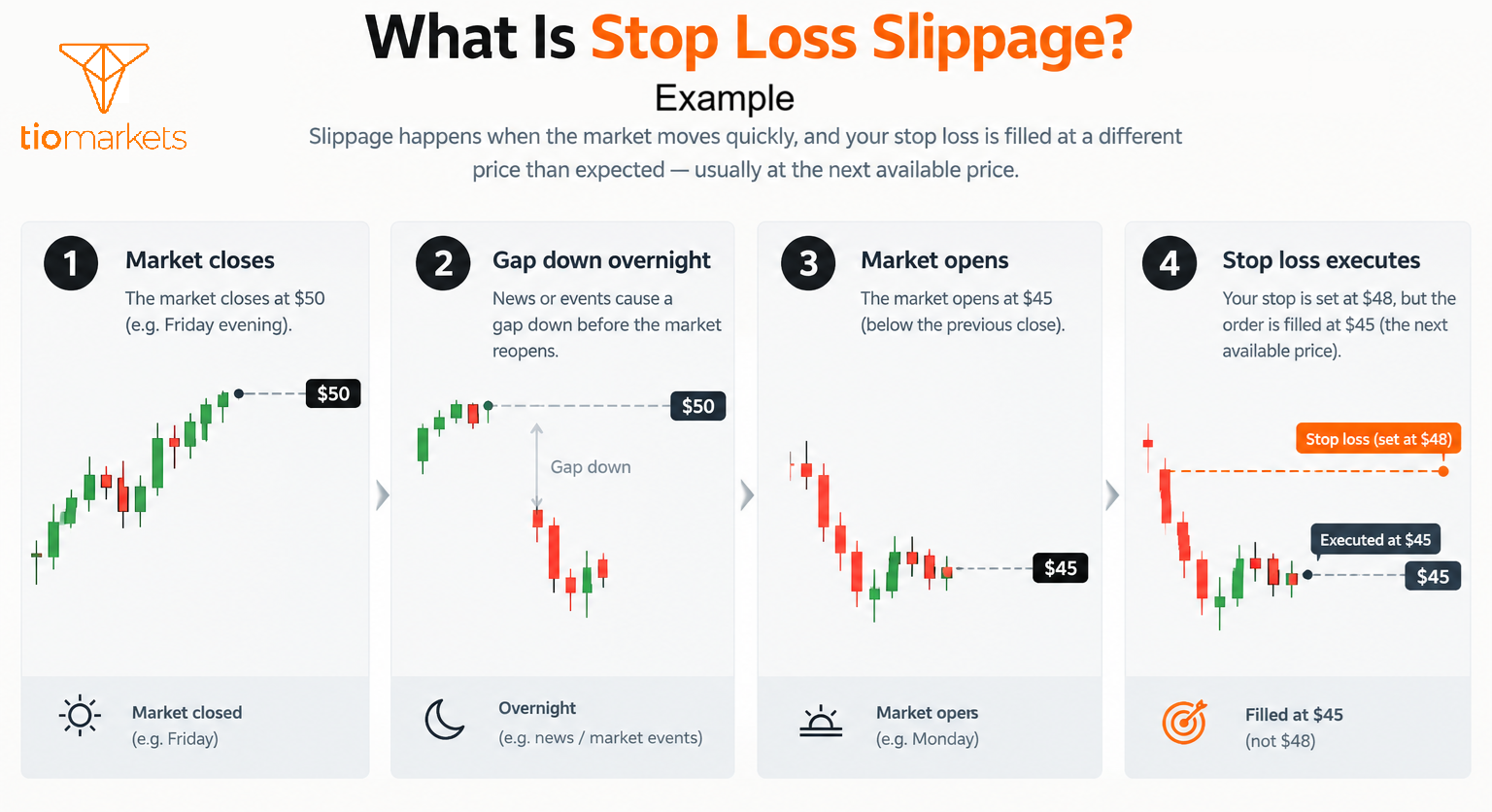
Gap scenarios present particular challenges. If a stock closes at $50 and opens the next day at $45 due to overnight news, a stop loss set at $48 would trigger at the $45 opening price, not $48. Weekend gaps in forex markets and earnings announcements in stocks commonly create such scenarios. A trader expecting $48 might receive $45, significantly increasing the realized loss.
What Is Stop Loss Slippage?
Stop loss slippage occurs when a stop loss order executes at a price less favorable than the specified stop price, typically due to rapid market movements, low liquidity, or price gaps that cause the market to jump past the stop level.
Common causes of slippage include high volatility periods when prices move faster than orders can execute, overnight and weekend gaps when markets reopen at different price levels, and low liquidity conditions where insufficient orders exist at the stop price level. A stop loss set at $50 might execute at $49.50 or lower during volatile conditions, increasing the loss beyond the planned amount. Guaranteed stop loss orders, where available, eliminate slippage risk by ensuring execution at the exact stop price.
How to Calculate Stop Loss Levels
Knowing what is a stop loss is only part of the equation; traders also need to determine where to place it. Stop loss levels can be calculated using percentage-based methods, dollar-amount methods, or technical analysis methods that incorporate chart patterns and support levels.
Percentage-Based Stop Loss Calculation: This involves setting the stop at a fixed percentage below the entry price. A 5% stop loss on a $100 entry would place the stop at $95. Different trading styles tend toward different percentage ranges, with shorter-term traders often using tighter stops and longer-term position traders using wider stops to accommodate normal price fluctuations.
Dollar Amount Stop Loss Calculation: It starts with the maximum acceptable loss and works backward to determine position size and stop placement. If a trader accepts a maximum $500 loss on a position and wants a $5 stop distance, they would limit position size to 100 shares.
Technical Analysis-Based Stop Loss Placement: With this approach, traders place stops beyond key support or resistance levels, allowing the position room to fluctuate within normal ranges while closing if those levels break. Volatility-adjusted methods using indicators like Average True Range (ATR) account for each asset's typical price movement when setting stop distances.
Advantages and Limitations of Stop Loss Orders
Understanding what is a stop loss includes recognizing both its benefits and its constraints as a risk management tool.
Advantages: Stop loss orders provide automated risk management, remove emotional decision-making from loss-taking, enable traders to define maximum acceptable losses in advance, and function without requiring constant market monitoring.
Key advantages include:
- Automated execution without manual intervention
- Removal of emotion from exit decisions
- Predefined risk parameters established before entering trades
- Protection during market hours without active monitoring
Limitations: Stop loss orders do not guarantee execution at the stop price (except guaranteed stops), can result in premature exits during temporary price swings, and may execute at worse prices during gaps or volatile conditions.
Key limitations include:
- No execution price guarantee with standard stops
- Slippage and gap risk during volatile periods
- Premature exits when normal volatility triggers stops
- Potential for being stopped out just before price reverses
When to Use Stop Loss Orders
Grasping what is a stop loss and how it functions helps traders evaluate when this order type may or may not suit their approach.
When stop losses may be appropriate: Stop loss orders may suit traders wanting to automate risk management for active positions, limit exposure during periods when they cannot monitor markets, or enforce predetermined risk parameters without emotional interference.
Active trading scenarios, leveraged position management, and situations requiring automated risk control often align with stop loss usage. Short-term positions may benefit more from hard stops than long-term investments designed to withstand volatility.
Adapting stop losses to market conditions: Different market environments may require adjusted stop loss approaches rather than standard placement.
Volatile markets may warrant wider stop distances or volatility-adjusted methods like ATR-based placement. Low-liquidity conditions may call for guaranteed stop loss orders or adjusted position sizing to account for potential slippage. Ranging markets may require stop placement beyond typical support and resistance levels.
If you want to further your knowledge, read this article on how to set a stop loss on MT4.
How Do Stop Loss Orders Differ from Take Profit Orders?
Stop loss orders close positions at less favorable prices to limit losses, while take profit orders close positions at more favorable prices to secure gains. Both are conditional orders but trigger under opposite market conditions.
A long position might have a stop loss below entry price and a take profit above entry price, creating a defined range for automatic exit in either direction. Take profits lock in gains when targets are reached; stop losses limit downside when trades move unfavorably.
Conclusion
Now that we learned what is a stop loss, it's clear these orders serve as risk management tools with specific functions and limitations that vary by order type and market conditions.
Understanding execution mechanics, including how stops convert to market orders and how slippage can affect fill prices, helps traders set appropriate expectations for stop loss performance. Market conditions, trading timeframes, and individual risk parameters all factor into whether stop losses may suit particular trading approaches.
FAQ
Risk disclaimer: CFDs are complex instruments and come with a high risk of losing money rapidly due to leverage. You should consider whether you understand how CFDs work and whether you can afford to take the high risk of losing your money. Never deposit more than you are prepared to lose. Professional client’s losses can exceed their deposit. Please see our risk warning policy and seek independent professional advice if you do not fully understand. This information is not directed or intended for distribution to or use by residents of certain countries/jurisdictions including, but not limited to, USA & Countries included in the OFAC sanction list. The Company holds the right to alter the aforementioned list of countries at its own discretion.
TIOmarkets offers an exclusively execution-only service. The views expressed are for information purposes only. None of the content provided constitutes any form of investment advice. The comments are made available purely for educational and marketing purposes and do NOT constitute advice or investment recommendation (and should not be considered as such) and do not in any way constitute an invitation to acquire any financial instrument or product. TIOmarkets and its affiliates and consultants are not liable for any damages that may be caused by individual comments or statements by TIOmarkets analysis and assumes no liability with respect to the completeness and correctness of the content presented. The investor is solely responsible for the risk of his/her investment decisions. The analyses and comments presented do not include any consideration of your personal investment objectives, financial circumstances, or needs. The content has not been prepared in accordance with any legal requirements for financial analysis and must, therefore, be viewed by the reader as marketing information. TIOmarkets prohibits duplication or publication without explicit approval.
Join us on social media



Authors BIO

Maria is a writer and content strategist with over 10 years of experience in the finance industry. She specializes in developing research-backed articles that help financial professionals navigate complex market topics with confidence. Her expertise spans forex, stocks, CFDs and global markets, creating insightful content that educates readers and supports informed decision-making.