


Base Currency Quote Currency Explained
BY TIOmarkets
|November 11, 2026The base currency is the first currency in a forex pair and the unit being priced. The quote currency is the second, and the price of one unit of the base is stated in it. Under the base currency quote currency order of EUR/USD, a euro reference rate of 1.1214 for 10 November 2026 reads as 1.1214 US dollars for one euro.
That order follows a market convention rather than chance. The quote currency also decides more than how a price is displayed, because pip value and a trade's result are measured in it first. This explainer covers how to identify each currency, why the euro comes first, what a long and short position means for each side, a worked USD/JPY calculation and how to invert a pair.
What Are Base Currency and Quote Currency?
A currency pair states the value of one currency in terms of another. The first code, left of the slash, is the base currency and always has a value of one. The second is the quote currency, also called the counter currency. The exchange rate shows how many units of the quote buy one unit of the base, so EUR/USD at 1.1214 means 1.1214 US dollars per euro.
Every other figure on a trading screen inherits this definition. The bid and ask price, the size of a pip and the direction of a position all treat the base as the item bought or sold, and the quote as the money in which it is measured. A trader who reads a rising EUR/USD rate as a stronger dollar has therefore misread both currencies at once.
Base Currency vs Quote Currency: Key Differences
GBP/USD shows how the two roles divide. Sterling is the unit being priced; the US dollar is the measuring currency. Because the dollar is the quote, a pip on a standard lot of GBP/USD is worth $10, as it is on EUR/USD, AUD/USD and other pairs where the dollar sits second.
| Feature | Base currency | Quote currency |
| Position in GBP/USD | First, left of the slash: GBP | Second, right of the slash: USD |
| Role in the rate | The unit being priced, always one | The currency the price is stated in |
| Other name | – | Counter currency |
| Long GBP/USD position | Pound sterling bought | US dollar sold |
| Short GBP/USD position | Pound sterling sold | US dollar bought |
| One standard lot | 100,000 units of GBP | Varies with the rate |
| Pip value set in | – | US dollars: $10 per pip on a standard lot |
| Profit or loss first counted in | – | US dollars, before conversion to the account currency |
The practical consequence lies in the measuring currency. The result of a GBP/USD trade, positive or negative, is counted in dollars first, and a sterling or euro account sees it only after conversion at the rate prevailing at that moment. Measuring the result in dollars fixes the currency of record; it does not limit the size of a loss.
How to Tell Which Currency Is the Base
Getting the base currency quote currency order right starts with the ISO 4217 currency codes. ISO 4217 is the international standard of three-character codes such as USD, EUR, JPY, GBP and AUD. In most codes the first two letters name the country and the third the currency. Platforms write a pair as EUR/USD or EURUSD, and in both forms the first three letters are the base.
The order itself is a market convention, not a platform choice. The seven major currency pairs are EUR/USD, USD/JPY, GBP/USD, USD/CAD, USD/CHF, AUD/USD and NZD/USD. In these pairs the US dollar is the quote against the euro, sterling and the Australian and New Zealand dollars, but the base against the Canadian dollar, the Swiss franc and the yen. The euro also precedes sterling, so the euro reference rate for the pound, 0.83545 on 10 November 2026, is stated in pounds per euro.
Cross currency pairs are those that leave out the US dollar. In the euro reference rates every currency, including sterling and the yen, is quoted against the euro as base currency. The size of the rate offers a quick check. A figure near 177 for the euro and the yen can only be yen per euro, consistent with the reference rate of 177.38 for 10 November 2026.
Why Is EUR Always the Base Currency?
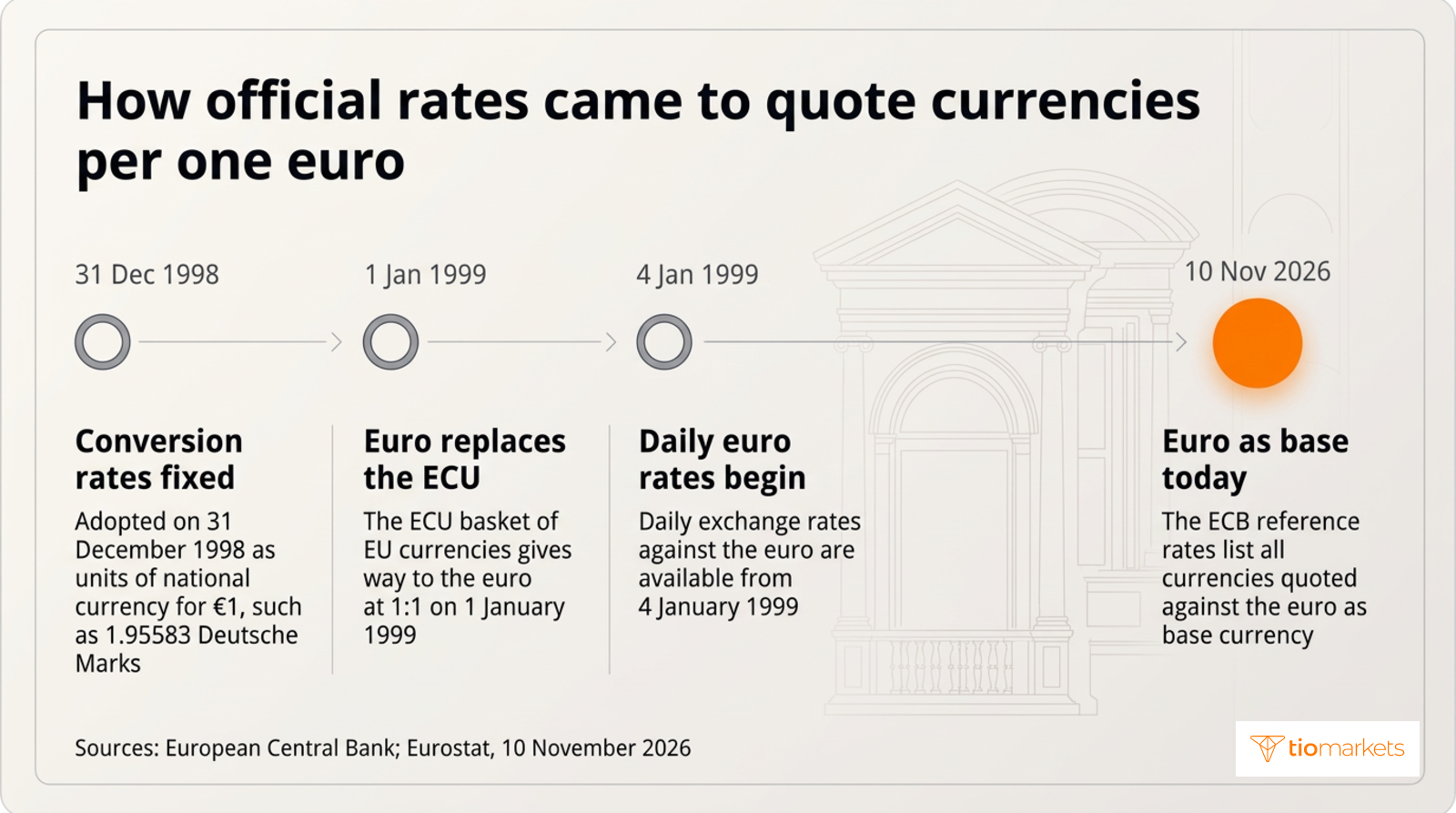
The euro has been the base in official rates since its launch. The irrevocable conversion rates were fixed on 31 December 1998 and took effect at 0.00 on 1 January 1999. They were expressed as units of national currency for €1, such as 1.95583 Deutsche Marks, 6.55957 French francs and 1936.27 Italian lire. On the same date, 1 January 1999, the euro replaced the ECU, a basket of EU currencies, at 1:1. Market quotation has kept that orientation: EUR/USD prices one euro in dollars rather than appearing as USD/EUR.
The European Central Bank reference rates, which the ECB publishes as the euro foreign exchange reference rates, still list every currency against the euro as base currency. The table has columns for currency code, currency name, spot rate and a chart. For 10 November 2026 it showed 1.1214 US dollars, 0.83545 pounds sterling, 0.9203 Swiss francs, 1.5852 Canadian dollars, 1.6244 Australian dollars and 1.9925 New Zealand dollars per euro, alongside 177.38 yen.
The rates come from a daily concertation procedure between central banks across Europe, normally held around 14:10 CET. They are published at around 16:00 CET on working days other than TARGET closing days, and they serve for information rather than for market transactions. Within the euro area each is an indirect quote, foreign currency per unit of home currency, whereas a direct quote gives the home price of one foreign unit. Direct and indirect quotes describe one exchange rate with base and quote reversed. The ECB's dollar feed words the indirect form as '1 EUR buys 1.1269 US dollar (USD)' for 6 October 2026.
What Buying and Selling a Currency Pair Means
Buying a currency pair means buying the base currency and selling the quote currency at the same time; selling the pair does the reverse. A long EUR/USD position is long euro and short US dollar, and a short USD/JPY position is short dollar and long yen. A trader buys a pair on the view that the base will gain against the quote, and sells it on the opposite view.
The quoted rate tracks the base. A rise in EUR/USD means each euro buys more dollars, so the euro has strengthened against the dollar; a fall means the reverse. Yet the dollar is the quote in EUR/USD and the base in USD/JPY. A broadly stronger dollar therefore shows as a falling EUR/USD and a rising USD/JPY, a pattern that misleads traders who read every chart as a dollar chart.
Where either position is opened with leverage, the trader commits only margin, the deposit needed to keep the position open, against a much larger exposure. That leverage magnifies losses on a long or short position as well as gains. A run of adverse pips can build a loss quickly, and a trader can lose all the money deposited.
Base Currency Quote Currency Example in USD/JPY
A base currency and quote currency example shows where a trade's result is counted. The prices used are illustrative, chosen for round arithmetic, and the account is held in US dollars. In yen-quoted pairs a pip is the second decimal place, 0.01, rather than the fourth, and one standard lot is 100,000 units of the base. The calculation takes six steps:
- Read the quote: USD/JPY at 150.00 means one US dollar costs 150.00 yen, with the dollar as base and the yen as quote.
- In this example, a long position of 1 standard lot buys 100,000 US dollars and sells 15,000,000 yen.
- Find the pip value: 100,000 units multiplied by the pip size of 0.01 gives 1,000 yen per pip, a value set in the quote currency.
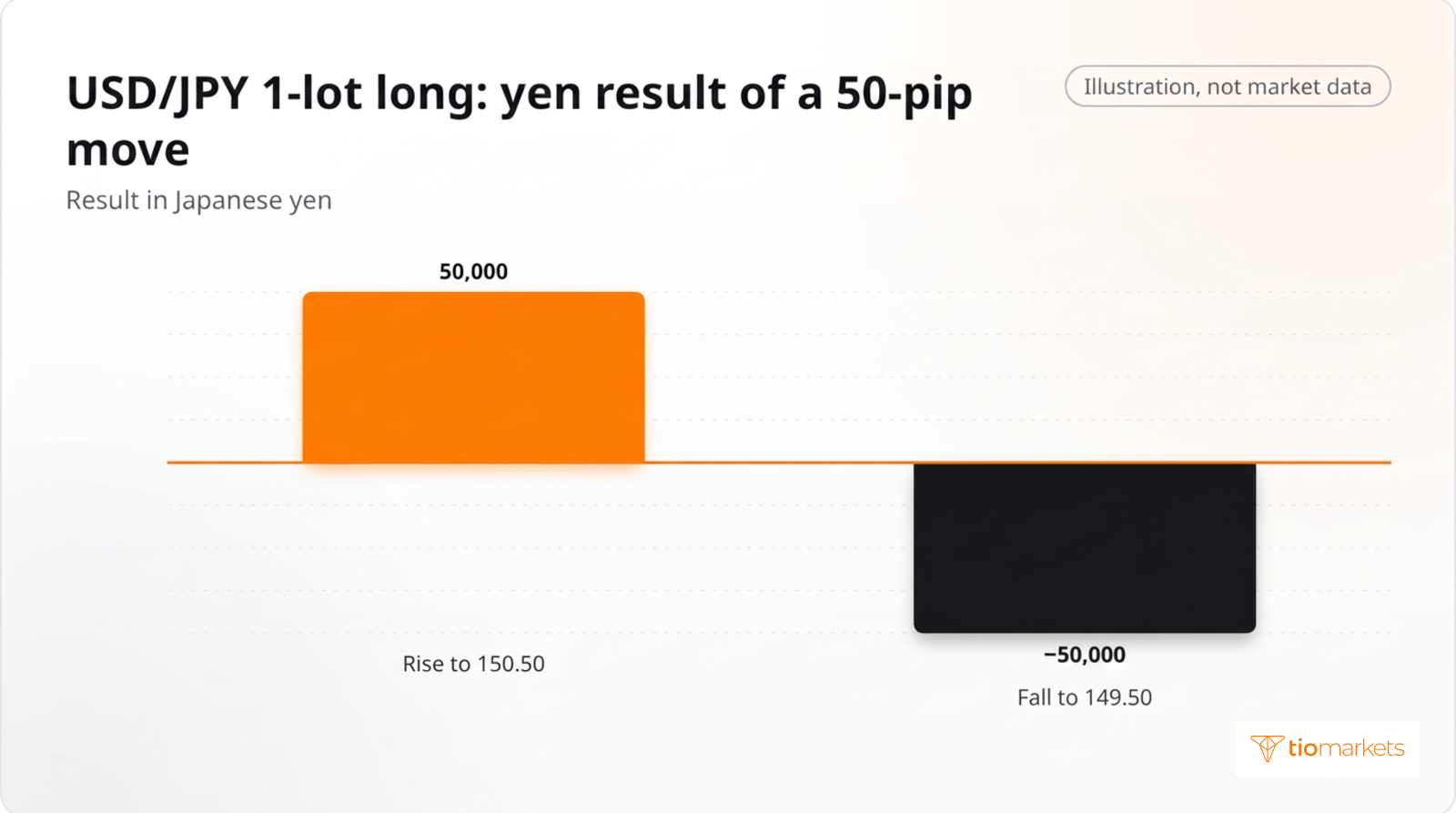
- Measure the move: a rise to 150.50 is 50 pips in the position's favour, and a fall to 149.50 is 50 pips against it.
- Count the result in yen: 50 pips at 1,000 yen per pip is a gain of 50,000 yen at 150.50 or a loss of 50,000 yen at 149.50.
- Convert into the account currency: dividing by the rate at conversion gives a gain of about $332.23 or a loss of about $334.45.
The calculation has two limits. The first is conversion, which uses the rate at the moment the yen is converted, so equal yen results of plus and minus 50,000 become unequal dollar amounts; a sterling account would convert at the GBP/JPY rate and arrive at another figure. The second is exposure. A 15,000,000 yen position opened on margin is far larger than the deposit behind it. Leverage magnifies a yen loss as it magnifies a yen gain, a 50-pip move can build that loss quickly, and the trader can lose all the money deposited.
Unlike EUR/USD, where a pip on a standard lot is fixed at $10, the dollar value of a USD/JPY pip changes with the exchange rate. The question of which currency is profit counted in therefore has a two-stage answer: the quote currency first and the account currency second. The same sequence applies when calculating profit on a forex trade in any pair.
How to Invert a Currency Pair
Inverting a pair swaps the base and the quote, and the new rate is the reciprocal of the old one: one divided by the original rate. A EUR/USD rate of 1.1214 becomes a USD/EUR rate of about 0.89174 euros per dollar, and one divided by 0.89174 returns 1.1214. The same calculation turns a direct quote into an indirect one.
A pip does not carry over one for one. A 10-pip rise in EUR/USD, from 1.1214 to 1.1224, moves the inverted rate from about 0.89174 to about 0.89095, a change of roughly 7.9 pips, because a reciprocal rescales every move by the level of the rate. The common mistakes in reading pairs follow from these points:
- Reading the pair the wrong way round, which reverses the meaning of every rise and fall in the rate.
- Assuming pip value is set in the account currency, when it is set in the quote currency and converted afterwards.
- Applying a pip move in one quotation directly to its inverse.
- Expecting a USD/JPY pip to be worth $10, a figure that holds only where the US dollar is the quote currency.
Conclusion
Base and quote are not notation details. The base is the unit being priced and the quote is the currency it is priced in, and the order between them follows a convention visible in the euro's 1999 conversion rates, in the euro reference rates and in how the majors are written. Because the price is measured in the quote currency, pip value and a trade's profit or loss are counted there first and only then translated into the account currency.
Knowing which currency is which removes a source of error; it does not reduce market risk. Exchange rates can move sharply against a position, and conversion adds a second rate that alters the final figure. Leveraged forex trading carries a high risk of losing money: leverage magnifies losses as well as gains, losses can build quickly when a rate moves against a position, and traders can lose all the money they deposit.
Trade EUR/USD and USD/JPY with TIOmarkets
Take your position on global markets via CFDs. Enjoy tight spreads, fast execution, and fast, flexible funding options.
Trading is risky
FAQ
Risk disclaimer: CFDs are complex instruments and come with a high risk of losing money rapidly due to leverage. You should consider whether you understand how CFDs work and whether you can afford to take the high risk of losing your money. Never deposit more than you are prepared to lose. Professional client’s losses can exceed their deposit. Please see our risk warning policy and seek independent professional advice if you do not fully understand. This information is not directed or intended for distribution to or use by residents of certain countries/jurisdictions including, but not limited to, USA & Countries included in the OFAC sanction list. The Company holds the right to alter the aforementioned list of countries at its own discretion.
TIOmarkets offers an exclusively execution-only service. The views expressed are for information purposes only. None of the content provided constitutes any form of investment advice. The comments are made available purely for educational and marketing purposes and do NOT constitute advice or investment recommendation (and should not be considered as such) and do not in any way constitute an invitation to acquire any financial instrument or product. TIOmarkets and its affiliates and consultants are not liable for any damages that may be caused by individual comments or statements by TIOmarkets analysis and assumes no liability with respect to the completeness and correctness of the content presented. The investor is solely responsible for the risk of his/her investment decisions. The analyses and comments presented do not include any consideration of your personal investment objectives, financial circumstances, or needs. The content has not been prepared in accordance with any legal requirements for financial analysis and must, therefore, be viewed by the reader as marketing information. TIOmarkets prohibits duplication or publication without explicit approval.
Join us on social media


Authors BIO

Behind every blog post lies the combined experience of the people working at TIOmarkets. We are a team of dedicated industry professionals and financial markets enthusiasts committed to providing you with trading education and financial markets commentary. Our goal is to help empower you with the knowledge you need to trade in the markets effectively.