


Trading the News: A Beginner's Guide
BY Maria K.
|September 16, 2026Trading the news involves making decisions based on scheduled economic data releases, announcements, and other unexpected events that cause rapid price movements across online financial markets.
Trading the news means placing trades around those major economic announcements and events that move asset prices significantly. For example, when the Federal Reserve unexpectedly raises interest rates, the US dollar often jumps in value within seconds of the announcement. Employment figures, inflation reports, and earnings releases can cause currencies, stocks, and commodities to move substantially within minutes of their publication.
Some traders seek to take advantage of the increased price volatility around these events, although outcomes are uncertain and losses can occur. This article explains what trading the news involves, which events matter most, and how beginners can approach this trading technique.
What Types of News Events Impact Financial Markets?
News events that impact markets fall into two categories: scheduled releases (interest rate decisions, jobs reports, earnings) and unscheduled events (wars, natural disasters, surprise policy changes).
Scheduled vs Unscheduled News Events
Scheduled news releases appear on economic calendars days or weeks in advance, allowing traders to prepare their strategies accordingly. These include central bank interest rate announcements, monthly jobs reports, GDP figures, and corporate earnings releases that occur on predictable dates throughout the year. Traders can prepare for these events because they know exactly when data will be published and can analyze historical market reactions.
Unscheduled events happen without warning: geopolitical conflicts, natural disasters, sudden policy shifts, or corporate scandals that emerge unexpectedly. Markets tend to react more dramatically to unscheduled news because traders have no time to prepare positions or analyze potential outcomes before prices begin moving.
| Scheduled Events | Unscheduled Events |
| Interest rate decisions, Jobs reports, Earnings reports, GDP releases, Inflation data | Wars/conflicts, Natural disasters, CEO resignations, Surprise policy changes, Corporate scandals |
Understanding the difference between these event types helps traders develop appropriate strategies for trading the news with each scenario they may encounter.
How Social Media Has Changed Economic News Trading
Social media platforms spread market-moving information faster than traditional news channels ever could before. Statements from executives, government officials, or influential figures on platforms like Twitter can cause immediate price reactions across multiple asset classes simultaneously. This speed means traders must stay alert to information across various channels, but it also increases the risk of reacting to misinformation or unverified reports.
The democratization of information has created both opportunities and challenges for news traders at all experience levels. Verification of news sources has become increasingly important as the speed of information flow continues to accelerate in financial markets.
How Do Different News Events Affect Different Markets?
Different markets respond to different news categories: interest rate changes primarily affect currencies and bonds, jobs data impacts stocks and forex, while supply reports move commodity prices significantly.
Interest Rate Decisions
Central bank interest rate decisions are among the most powerful market movers that traders monitor throughout the year. The Federal Reserve, European Central Bank, Bank of England, and other major central banks announce policy decisions on scheduled dates that appear on economic calendars.
Key relationships that traders often observe include:
- Rates up → Currency usually strengthens as higher rates attract foreign capital seeking better returns
- Rates up → Stock markets often fall initially as borrowing costs increase for businesses and consumers
- Rates up → Existing bond prices fall because newly issued bonds offer more attractive yields to investors
These relationships represent general tendencies rather than guaranteed outcomes, as multiple factors influence market reactions simultaneously.
Jobs and Employment Data
Employment reports like the US Non-Farm Payrolls (NFP) show economic health and influence what central banks may do next with monetary policy. Strong employment figures suggest a healthy economy, while weak data may indicate economic challenges that could prompt policy responses.
Key relationships that markets often exhibit include:
- Strong jobs data → Currency tends to strengthen as economic outlook improves, stocks often rise on positive sentiment
- Weak jobs data → Currency tends to weaken as economic concerns emerge, stocks often fall on negative sentiment
The NFP report, released on the first Friday of each month, is considered one of the most important regular economic releases for forex and stock traders. If you are registered with TIOmarkets, you receive an email notification with a dedicated NFP review so you can analyse and trade accordingly.
Corporate Earnings Reports
Earnings releases directly impact individual stock prices and can influence broader market sentiment in related sectors. Companies that exceed analyst expectations often experience positive price reactions, although market responses vary depending on broader expectations and forward guidance.
Key relationships observed in equity markets include:
- Earnings beat expectations → Stock usually rises as investors reward better-than-anticipated performance
- Earnings miss expectations → Stock usually falls as investors reassess growth prospects and valuations
However, market reactions to earnings can be complex, with factors like forward guidance sometimes mattering more than the headline numbers themselves.
Commodity Supply Reports
Commodity prices respond to supply and demand news that affects the balance between available inventory and consumption patterns worldwide.
Key relationships that commodity traders monitor include:
- Oil inventory drops → Oil prices may rise depending on broader supply and demand conditions.
- OPEC cuts production → Oil prices usually rise as coordinated supply reductions affect global availability
- Good crop weather → Agricultural prices usually fall as favorable conditions suggest abundant harvests ahead
Quick Reference: What to Watch by Market
| Market | Focus |
| Forex | Interest rates, jobs reports, inflation (CPI) |
| Stocks | Earnings reports, Fed announcements, jobs data |
| Commodities | Inventory reports, weather, OPEC decisions |
| Bonds | Interest rate expectations, inflation data |
How to Trade the News?
Most retail traders use manual methods - watching calendars and placing trades themselves - while automated systems exist but require technical knowledge and capital beyond most beginners.
Manual News Trading
Financial news trading manually involves monitoring economic calendars, setting alerts for events, and placing trades based on your interpretation of the released data. This approach is how most retail traders operate because it requires minimal technical infrastructure and allows for human judgment in decision-making.
Before trading any news event, traders typically consider these preparation steps:
- Identify which event you plan to trade and understand its potential market impact
- Determine your entry price and directional bias based on different outcome scenarios
- Set your stop-loss level to define maximum acceptable loss on the trade
- Decide your position size, often smaller for high-impact news due to increased volatility
Automation in Trading the News
Automated systems use computer programs to scan news feeds and place trades without human input during the critical moments following releases. These systems can react within milliseconds, far faster than any human can process information and execute orders manually.
Note for beginners: Automated trading requires significant technical knowledge, robust infrastructure, and substantial capital to implement effectively. Most retail traders focus on manual methods first to develop their understanding of market dynamics before considering automation.
Using Economic Calendars
Economic calendars list upcoming events, release times, and analyst forecasts that help traders prepare for market-moving announcements. They are the primary tool for planning news trades and understanding what events may affect your positions.
Popular free economic calendars are available online through various financial websites and broker platforms, including the TIOmarkets website and mobile app.
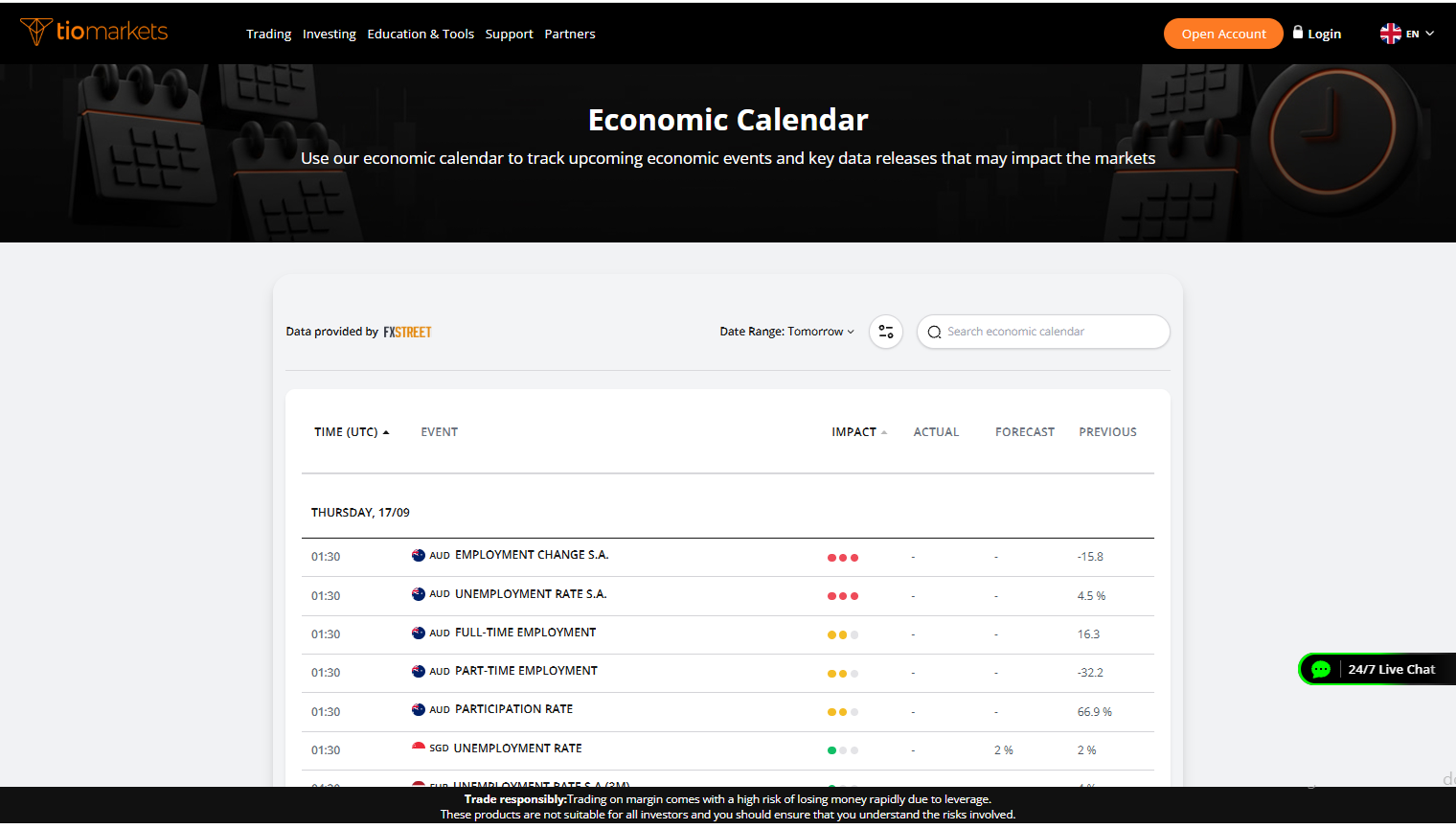
Most calendars rate events by expected impact (high, medium, low), which helps traders prioritize their attention. Traders focus on high-impact events when starting out because they often generate larger market movements and are widely monitored by traders.
When Trading the News Makes Sense
Traders can place trades before, during, or after news releases, with each timing approach carrying different risk profiles and potential outcomes for consideration.
How Long Do News Effects Last?
News events typically unfold in three phases. The initial spike occurs within seconds to five minutes, featuring the fastest price movement but also the widest spreads and highest slippage risk. The secondary reaction spans 5-60 minutes as markets process the full context and spreads normalize. Finally, trend establishment can extend hours to days if the news represents a genuine shift in market expectations. Not all events reach the third phase; minor surprises often exhaust their impact within the first hour.
Timing Comparison
| Timing | Risk Level | Pros | Cons | Often Suited For |
| Before news | High | Larger potential price movements | Wrong predictions may lead to significant losses | Experienced traders |
| During news | Medium-High | React to real data immediately | Spreads widen, prices can be erratic | Fast decision-makers |
| After news | Lower | More information available, calmer markets | Smaller moves may remain | Beginners learning the approach |
Why Some Beginners Trade After Releases
Trading after news releases allows traders to:
- See the actual data before committing capital to a position
- Observe how the market interprets the news before making decisions
- Avoid the chaotic first few minutes when spreads are widest
- Enter when spreads have normalized to typical levels
The trade-off is that much of the price move may have already occurred by the time calmer conditions return. However, capturing a smaller, more predictable move is often preferable to attempting to navigate the initial volatile reaction.
Note for beginners: Some traders start trading 15-30 minutes after high-impact releases as it allows observation of clearer trends with potentially less execution risk during the learning process.
How Expectations Affect Trading the News?
Market prices typically reflect what traders expect before releases, so the surprise element, i.e. how much actual data differs from expectations - often determines the magnitude of price movement.
Why "Good News" Sometimes Causes Prices to Fall
Markets tend to price in expectations before news releases occur, a phenomenon known as "pricing in" or "discounting" future events. When data matches forecasts, prices often barely move because the information was already factored into current valuations by market participants.
The key relationship traders often observe:
- Actual data much better than expected → Tends to produce significant upward movement
- Actual data matches expectations → Often results in small movement or none at all
- Actual data much worse than expected → Tends to produce significant downward movement
Example of Expectations in Practice
If analysts expect 200,000 new jobs and the report shows 195,000, the market may barely react because the result is close enough to expectations. However, if the report shows 150,000 or 280,000, traders often observe more significant price movement as the market adjusts to unexpected information.
Checking the consensus forecast before trading any scheduled release is considered essential preparation by most news traders, as understanding expectations provides context for interpreting actual results.
What Are the Risks of Trading the News?
The news trading strategy has risks including unpredictable reactions, widened spreads, slippage, and rapid price reversals that can affect traders at all experience levels.
Markets Do Not Always React Logically
Sometimes markets move opposite to what the news suggests. A currency might strengthen despite bad data if results are "less bad than feared." Context matters as much as headline numbers.
Slippage and Wider Spreads
Slippage occurs when your order fills at a different price than expected: you click buy at 1.1000 but fill at 1.1015. During volatile releases, prices move rapidly between order submission and execution. Spread widening means trading costs increase dramatically during news events. A spread normally at 1 pip might jump to 10 pips or more, significantly affecting profitability.
Rapid Reversals
Initial reactions often reverse within minutes as markets process information. Chasing the first move without understanding this pattern can lead to losses.
Real-World Example
In January 2015, the Swiss National Bank unexpectedly removed its currency floor. EUR/CHF dropped approximately 30% in minutes. Many traders (including professionals) suffered substantial losses, with some accounts eliminated entirely. This illustrates why risk management remains essential for news-based trading.
What Common Mistakes Do Beginners Make?
New news traders often trade too many events, use excessive leverage, skip stop-losses, and chase moves that have already substantially occurred.
Mistake #1: Trading Every News Event: Not all news events are worth trading, as many produce minimal price movement or unpredictable reactions. Focusing on high-impact events in markets you understand may be more productive than attempting to trade every release on the economic calendar.
Mistake #2: Using Too Much Leverage: Volatility during news can affect overleveraged accounts severely in seconds if the market moves against the position. Some traders reduce position size for news trades as it helps manage the increased risk that comes with heightened volatility.
Mistake #3: Not Using a Stop-Loss: Setting a stop-loss BEFORE the news hits is generally considered important preparation. Assuming you will react fast enough to exit manually during volatile conditions may prove unrealistic when prices move rapidly.
Mistake #4: Chasing Moves: If you miss the initial move, chasing it by entering at extended prices may increase risk of entering near a reversal point. Waiting for a pullback or skipping the trade entirely remains an option, as additional opportunities will emerge over time.
Mistake #5: Ignoring the Consensus: Trading without knowing market expectations removes important context for understanding how markets may react to releases. Checking forecasts before trading news releases helps distinguish between expected results and genuine surprises.
How Can Traders Prepare for News Trades?
Preparation involves checking the economic calendar, noting expectations, marking chart levels, setting risk parameters, and deciding on a plan before the event occurs.
Pre-Trade Checklist
Consider using this checklist before news trades:
- Check economic calendar for upcoming high-impact events
- Note the consensus expectation and previous reading for comparison
- Mark support and resistance levels on your chart for reference
- Consider your trade direction based on different outcome scenarios
- Set your stop-loss level before news hits to define risk
- Reduce position size for volatile events to manage exposure
- Identify potential profit target levels based on technical analysis
- Plan to be at your screen 10-15 minutes before release time
Combining News with Chart Analysis
Using both fundamental market news analysis and technical chart analysis together can provide complementary information. The news tells you WHY the market might move based on economic factors; the chart tells you WHERE it might go based on historical price behavior and technical levels.
Identifying key support and resistance levels before news releases provides reference points for potential targets or barriers after the news hits and price begins moving.
Start with a Demo Account
Practicing news trading with virtual money first allows traders to experience slippage, spread widening, and fast price movements without risking real capital. Most brokers like TIOmarkets offer free demo accounts that simulate live market conditions, providing a learning environment for developing event-driven trading skills.
What Trading the News Looks Like: Step-by-Step Example
This hypothetical example walks through a Non-Farm Payrolls trade from preparation through execution to illustrate the news trading process.
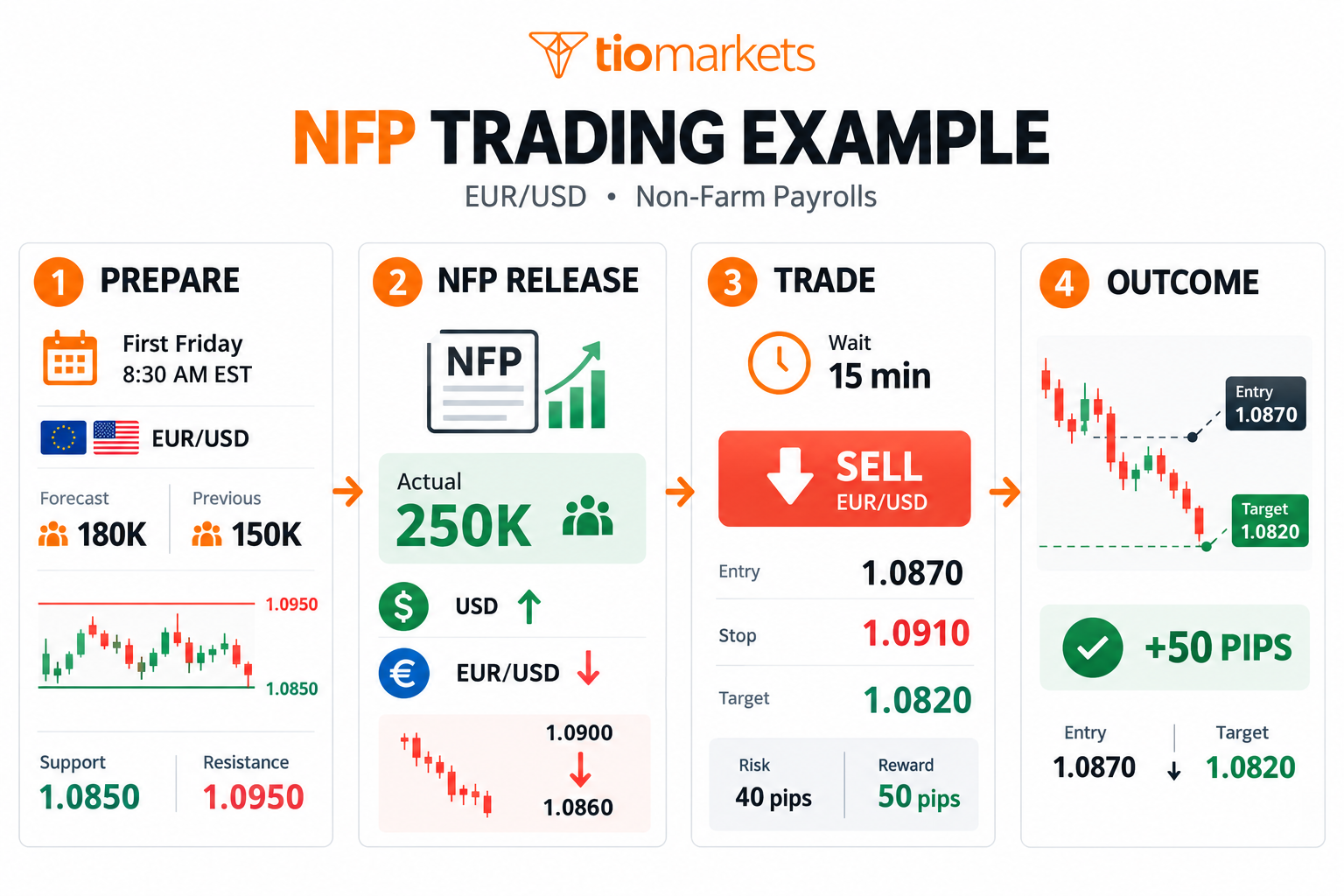
This example is for educational illustration only. Actual trading outcomes vary, and past market behavior does not guarantee future results.
Quick Reference: Top News Events for Traders
The highest-impact news events include central bank rate decisions, Non-Farm Payrolls, inflation reports, GDP releases, and corporate earnings announcements.
The Biggest 5 Events that Move the Financial Markets
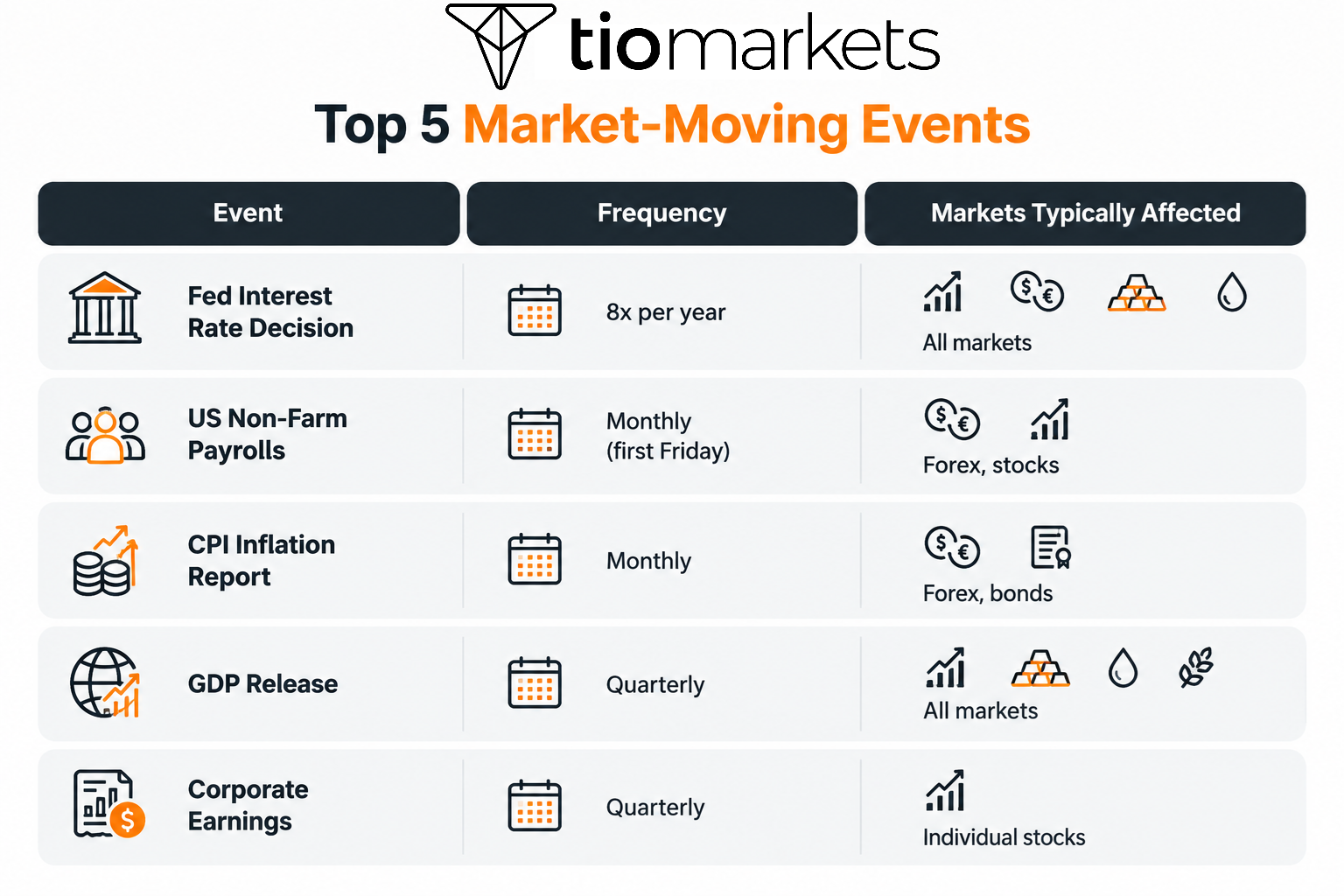
Starting by following one or two event types before expanding to others may help build familiarity with how specific releases tend to affect markets.
Conclusion
Trading the news focuses on capturing price movements from economic releases, corporate announcements, and major events that affect market sentiment. Different news categories affect different markets.
The key to news trading is preparation. Checking economic calendars regularly, understanding consensus expectations, marking chart levels, and setting stop-losses before news hits are all part of a structured approach to this trading technique.
For those new to news trading, starting by observing or trading AFTER releases when markets have calmed may reduce exposure to the most volatile conditions.
FAQ
Risk disclaimer: CFDs are complex instruments and come with a high risk of losing money rapidly due to leverage. You should consider whether you understand how CFDs work and whether you can afford to take the high risk of losing your money. Never deposit more than you are prepared to lose. Professional client’s losses can exceed their deposit. Please see our risk warning policy and seek independent professional advice if you do not fully understand. This information is not directed or intended for distribution to or use by residents of certain countries/jurisdictions including, but not limited to, USA & Countries included in the OFAC sanction list. The Company holds the right to alter the aforementioned list of countries at its own discretion.
TIOmarkets offers an exclusively execution-only service. The views expressed are for information purposes only. None of the content provided constitutes any form of investment advice. The comments are made available purely for educational and marketing purposes and do NOT constitute advice or investment recommendation (and should not be considered as such) and do not in any way constitute an invitation to acquire any financial instrument or product. TIOmarkets and its affiliates and consultants are not liable for any damages that may be caused by individual comments or statements by TIOmarkets analysis and assumes no liability with respect to the completeness and correctness of the content presented. The investor is solely responsible for the risk of his/her investment decisions. The analyses and comments presented do not include any consideration of your personal investment objectives, financial circumstances, or needs. The content has not been prepared in accordance with any legal requirements for financial analysis and must, therefore, be viewed by the reader as marketing information. TIOmarkets prohibits duplication or publication without explicit approval.
Join us on social media



Authors BIO

Maria is a writer and content strategist with over 10 years of experience in the finance industry. She specializes in developing research-backed articles that help financial professionals navigate complex market topics with confidence. Her expertise spans forex, stocks, CFDs and global markets, creating insightful content that educates readers and supports informed decision-making.