


USD/JPY Market Analysis: Post-Intervention Outlook
BY Eleni Antoniou
|August 5, 2026USD/JPY is trading near 157.70 after one of its sharpest reversals of 2026. The pair fell from above 163 as US and Japanese authorities coordinated intervention action to support the yen, then stabilised above the reported post-intervention low near 155. This USD/JPY market analysis examines whether official resistance to yen weakness can outweigh the still-wide US - Japan interest-rate gap.
USD/JPY Market overview
USD/JPY was near 157.70 in early trading today. That leaves the pair roughly 4% below the price of 163.93 on 24th July. The move is significant because it interrupted a persistent upward trend in which the dollar had reached levels not seen against the yen for about four decades.
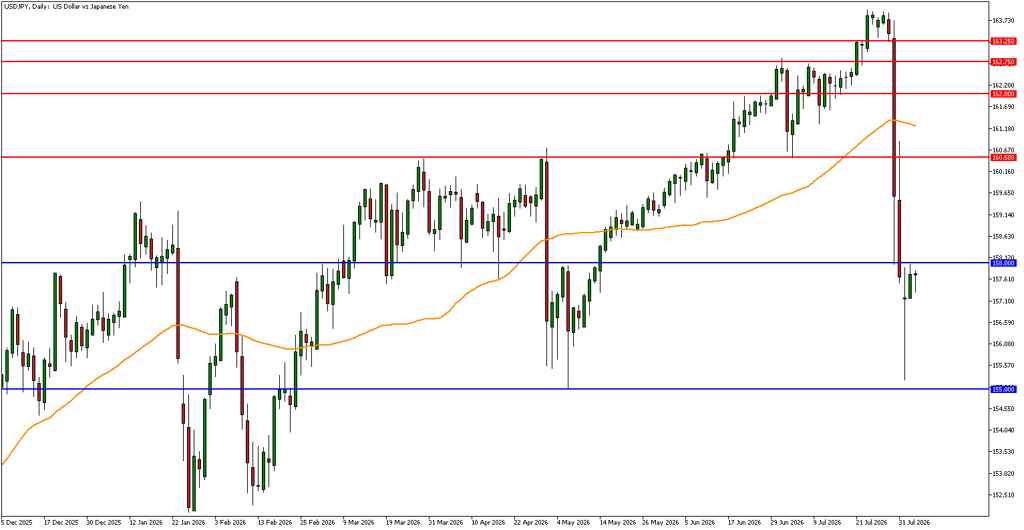
The immediate market structure is now transitional. Before the intervention, USD/JPY had spent much of July between roughly 160.50 and 164. After the sharp drop toward 155, the rebound into the upper 157 area shows that the yield advantage of the US dollar has not disappeared. At the same time, the failure to reclaim 158 so far indicates that intervention risk and a more hawkish Bank of Japan are limiting the pair’s recovery.
This creates a two-sided trading outlook. A move back above 158 would suggest that carry demand and relatively high US yields are regaining control. A sustained break below the 155 intervention low would indicate that the policy shock has developed into a broader yen recovery.
Latest USD/JPY market news
US and Japanese officials confirmed coordinated foreign-exchange action after the dollar traded above 163 yen. The intervention was unusual because the US Treasury participated alongside Japan. Current reporting indicates that the New York Fed, acting for the Treasury, sold euros to buy yen, while Japanese authorities were able to obtain dollar liquidity against Treasury holdings rather than liquidating those securities outright.
The operation matters beyond the initial price move. It demonstrated that authorities were concerned not only about the level of USD/JPY, but also about the speed and disorderliness of the yen’s decline. Officials also signalled a willingness to act again. That makes a rapid return toward the recent highs more difficult unless economic data materially strengthens the case for higher US rates.
The Federal Reserve remained on hold, but the vote was hawkish
The Federal Reserve kept the federal funds target at 3.50%–3.75% on 29 July. Three policymakers dissented in favour of a rate increase, highlighting concern that inflation remains above the 2% objective. For USD/JPY, the decision preserved the dollar’s yield advantage and limited the case for a sustained yen rally based on interest rates alone.
Strong US payrolls or another firm inflation reading would reinforce the prospect that US rates remain high or rise further, which would generally support USD/JPY. Softer labour-market and inflation data would narrow expected rate differentials and could extend the yen’s post-intervention gains.
The Bank of Japan kept its tightening bias
The Bank of Japan held its policy rate at 1.00% on 31 July, following the June increase to the highest level in 31 years. Governor Kazuo Ueda warned against falling behind the inflation curve and suggested that small, timely adjustments could reduce the risk of more disruptive moves later.
The BOJ is still moving gradually, and its policy rate remains well below the Federal Reserve’s. However, the direction of travel is different from the ultra-loose policy that historically underpinned yen-funded carry trades. Expectations of further BOJ tightening can therefore amplify any intervention-led decline in USD/JPY, particularly when positioning is crowded or volatility rises.
Lower oil prices offer the yen some relief
Japan is a major energy importer, so lower oil prices can ease pressure on the trade balance and imported inflation. That can be yen-supportive at the margin, even though a broader risk-on rally may encourage investors to rebuild carry positions funded in yen.
USD/JPY technical analysis
The daily price structure has shifted from an established uptrend into a potentially volatile corrective phase. Through much of 2026, USD/JPY maintained a sequence of elevated closes from 155 and reached just under 164. The subsequent intervention drove the pair lower toward an approximate 155 low. The rebound to around 157.50 has recovered part of the move, but it has not repaired the break yet.
USD/JPY bullish scenario: recovery above 158
A bullish USD/JPY scenario may gain support if the pair holds above the 158 pivot, US payrolls and inflation remain firm, and Treasury yields rise. A daily or weekly close above 158 would be the first important confirmation that dollar demand is absorbing intervention-related selling.
Above 158, the next resistance is 160.50, followed by 162. Progress may become slower as the pair approaches the intervention zone, because officials have demonstrated both the capacity and willingness to respond to disorderly yen weakness. A sustained break below 155 could possibly invalidate this recovery scenario.
USD/JPY bearish scenario: intervention low breaks
A bearish USD/JPY scenario may develop if US employment or CPI data weakens, Treasury yields fall, or authorities reinforce the intervention message. Failure below 158 followed by lower prices would increase pressure on the 155.00 support zone.
A decisive break below 155 could indicate that the post-intervention rebound has failed and could extend the correction toward the low-150s. Confidence would depend on whether the move is accompanied by lower US yields and stronger BOJ tightening expectations. A sustained recovery above 158 would potentially invalidate the immediate bearish setup.
Conclusion
The USD/JPY price forecast for the next one to two weeks is balanced but unusually event-sensitive. The dollar retains a substantial interest-rate advantage, which supports rebounds while US data remains firm. Against that, coordinated US-Japan intervention has potentially broken the short-term uptrend, raised the credibility of the 164 resistance zone and increased the risk of abrupt volatility.

Risk disclaimer: CFDs are complex instruments and come with a high risk of losing money rapidly due to leverage. You should consider whether you understand how CFDs work and whether you can afford to take the high risk of losing your money. Never deposit more than you are prepared to lose. Professional client’s losses can exceed their deposit. Please see our risk warning policy and seek independent professional advice if you do not fully understand. This information is not directed or intended for distribution to or use by residents of certain countries/jurisdictions including, but not limited to, USA & Countries included in the OFAC sanction list. The Company holds the right to alter the aforementioned list of countries at its own discretion.
TIOmarkets offers an exclusively execution-only service. The views expressed are for information purposes only. None of the content provided constitutes any form of investment advice. The comments are made available purely for educational and marketing purposes and do NOT constitute advice or investment recommendation (and should not be considered as such) and do not in any way constitute an invitation to acquire any financial instrument or product. TIOmarkets and its affiliates and consultants are not liable for any damages that may be caused by individual comments or statements by TIOmarkets analysis and assumes no liability with respect to the completeness and correctness of the content presented. The investor is solely responsible for the risk of his/her investment decisions. The analyses and comments presented do not include any consideration of your personal investment objectives, financial circumstances, or needs. The content has not been prepared in accordance with any legal requirements for financial analysis and must, therefore, be viewed by the reader as marketing information. TIOmarkets prohibits duplication or publication without explicit approval.
Join us on social media



Authors BIO

Eleni is a financial markets enthusiast contributing to content covering forex, indices, commodities, and global market developments. She is passionate about researching market-related topics and helping make financial information more accessible to traders.