What Is Paper Trading? All About Simulated Trades
BY Maria K.
|October 7, 2026Paper trading refers to simulated trading practice using virtual money instead of real capital. In forex CFD trading, this risk-free method allows traders to test strategies, learn platform mechanics, and build skills without financial consequences. The practice has evolved from manual record-keeping to sophisticated digital platforms that mirror live market conditions.
Understanding what is paper trading helps new and experienced traders alike develop their approach before committing real funds. This guide covers how paper trading works, its benefits and limitations, key differences from live trading, and practical steps to begin practicing effectively.
Key Takeaway: Paper trading is simulated trading using virtual money. It helps traders learn platform mechanics, experiment with approaches, and build skills before committing real capital - though psychological factors differ from live trading.
Whether you're learning forex CFD trading fundamentals or testing a new trading strategy, simulated trading environments provide valuable learning opportunities. Modern demo account trading platforms offer real-time market data and realistic execution scenarios, making virtual trading practice more accessible than ever before.
What Is Paper Trading?
Paper trading is a practice method where traders execute simulated buy and sell orders using virtual funds while tracking real market prices. The term originated when traders manually recorded hypothetical trades on paper before digital platforms existed. Today, forex CFD traders use demo accounts to practice trading currency pairs and other instruments risk-free.
The core principle behind the method remains unchanged: learning without financial risk. Traders can experiment with different approaches, make mistakes, and develop their skills while their actual capital stays protected. This makes simulated trading particularly valuable during the learning phase when errors are most likely to occur.
Modern trading simulation platforms integrate with live market data feeds, allowing practice trades to reflect current market conditions. When you open a position in a practice trading account, the platform tracks your entry price, position size, leverage used, and calculates profit or loss based on actual price movements throughout the trading session.
How Paper Trading Works
Paper trading platforms provide virtual account balances and track simulated positions against live market data. When you place a paper trade, the system records your entry price, position size, and calculates profit or loss based on actual price movements in the underlying market.
Virtual account funding ranges from few to hundred thousand of dollars in simulated capital, depending on the broker and platform. This virtual balance allows traders to practice with amounts that reflect their intended live trading capital, creating more realistic practice conditions from the start.
Real-time market data integration means paper trades respond to the same price movements affecting live traders. Position tracking functions mirror live account features, including profit and loss calculations, margin requirements, and portfolio management tools available on the trading platform.
Order execution simulation covers various order types, including market orders, limit orders, and stop losses. Traders can practice setting entry and exit points, managing open positions, and implementing risk management techniques without financial exposure during the learning process.
Are Paper Trading and Demo Accounts the Same?
Modern demo accounts are the digital evolution of traditional paper trading. While the terms are used interchangeably in forex markets today, demo accounts refer specifically to broker-provided simulation platforms that replicate trading environments with real spreads, leverage options, and full platform functionality.
Traditional paper trading involved manually recording hypothetical trades and tracking their performance against market prices. Demo account trading automates this process and adds features like real-time execution, portfolio tracking, and access to technical analysis tools available on live trading platforms.
Most forex CFD traders today use the term "demo account" when referring to virtual trading practice, though "paper trading" remains common in broader financial discussions.
What Are the Benefits and Limitations of Paper Trading?
Paper trading eliminates financial risk while providing hands-on experience with forex CFD trading mechanics. However, the experience differs from risking real capital, so traders benefit from understanding both its advantages and limitations before relying on demo results.
Why Do Forex CFD Traders Use Paper Trading?
Zero financial risk stands as the primary benefit of simulated trading environments. Traders can experiment with different strategies, test various currency pairs, and explore platform features without any possibility of monetary loss during their learning and development phase.
Platform familiarization represents another significant advantage, particularly when learning platforms like MT4 or MT5. Understanding order placement, chart analysis tools, and account management features becomes easier when mistakes carry no financial consequences for the trader.
Key benefits
- Strategy experimentation without capital exposure
- Understanding leverage mechanics safely
- Building confidence before committing real funds
- Learning order types and execution procedures
- Testing across different market conditions
Who benefits most:
- Beginners: Learning order types, currency pair dynamics, leverage concepts, and trading terminology
- Experienced traders: Testing new strategies, exploring unfamiliar instruments, evaluating different platforms
- Strategy development: Validating trade setups, refining entry and exit techniques, testing position sizing approaches
What Are the Key Limitations?
The inability to replicate psychological pressure represents the most significant limitation of demo trading. When no real money is at risk, decision-making processes differ fundamentally from live trading situations where actual capital faces potential loss.
Overconfidence from simulated success can create unrealistic expectations about live trading results. Traders may take larger risks in demo environments than they would with real capital, developing habits that don't transfer well to live market conditions.
Execution quality differences between demo and live accounts can affect trading results. Slippage, spread widening during volatile periods, and order fill challenges may not appear in demo environments but occur regularly in live trading situations.
When paper trading becomes counterproductive:
- Extended simulation periods without progression toward live trading
- Developing unrealistic profit expectations based on demo results
- Trading with position sizes that exceed intended live trading capital
What’s the Difference Between Paper Trading & Live Trading?
Paper trading and live forex CFD trading differ primarily in execution realities and psychological factors. Simulated environments cannot replicate the emotional pressure of risking real money or the execution challenges present in live forex markets during high volatility periods.
Key Differences Explained
| Factor | Paper/Demo Trading | Live Trading |
| Capital at risk | Virtual funds only | Real money |
| Emotional pressure | Minimal | Significant |
| Order execution | Typically instant | May experience slippage |
| Spread conditions | Often fixed/ideal | Variable, widens during volatility |
| Decision-making | Lower pressure | Higher stakes affect judgment |
| Financial consequences | None | Real profit/loss |
Order fills in demo accounts may not reflect actual market liquidity conditions that affect live traders. During high-volume news events or volatile periods, live traders may experience slippage or requotes that demo platforms don't simulate accurately.
The absence of genuine financial risk fundamentally affects decision quality during trading. Emotional discipline, which many traders consider essential for long-term success, cannot be fully developed in environments where losses carry no real consequences.
Demo confidence may not transfer directly to live trading situations. Many traders report different psychological responses when real capital becomes involved, even after extended successful demo trading periods.
How Do You Start with Paper Trading Forex CFDs?
Starting CFD demo trading requires selecting a demo account from a regulated broker. Most forex brokers, including TIOmarkets, offer free demo accounts with virtual balances and access to real-time market data without requiring any initial deposit.
Broker Demo Account Options
Most regulated forex CFD brokers provide free demo accounts that mirror live trading conditions. Registration typically requires only basic contact information, and traders can begin practicing immediately without financial commitment or deposit requirements.
What TIOmarkets offers:
- Free demo account with $50,000 virtual funds for practice
- Access to the same platforms used for live trading (MT4, MT5 & app)
- Live price feeds on all instruments
- Instant order execution
- Full range of currency pairs & CFD instruments like stocks, indices and commodities
- Seamless transition path from demo to live account
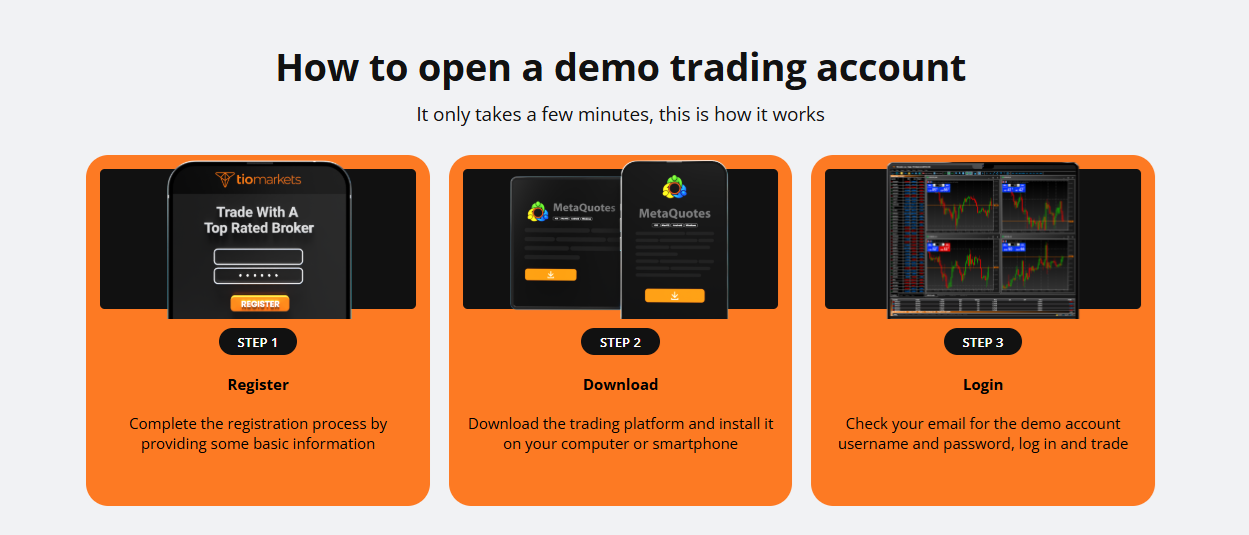
Step-by-step demo account opening process
Opening a demo trading account only takes a few minutes, and this is how it works.
STEP 1: Register by completing the process & providing some basic information
STEP 2: Download the trading platform and install it on your computer or smartphone
STEP 3: Check your email for the demo account username and password, log in and trade
Setting Up for Effective Practice
Selecting realistic virtual capital - matching your demo balance to intended live trading amounts - helps create meaningful practice conditions. If you plan to trade with $1,000 in a live account, practicing with $100,000 in demo funds may develop unrealistic position sizing habits that don't transfer to live trading.
Implementing risk management from day one builds good habits before real capital becomes involved. Many traders use 1-2% risk per trade as a common guideline, though appropriate risk levels depend on individual circumstances, trading strategy, and risk tolerance. There is no universally correct percentage.
Best practices for effective demo trading:
- Treat demo trades as real trading decisions
- Maintain detailed trading journals documenting entry reasons and outcomes
- Trade realistic lot sizes based on intended live capital
- Review performance regularly, ideally weekly or monthly
- Practice during different forex market sessions
- Simulate the same trading schedule you plan to use when live
When Should You Transition from Demo to Live Trading?
Transitioning to live forex CFD trading typically happens after demonstrating consistent results over a few months, disciplined risk management, and confident strategy execution. Beginning with minimal position sizes helps manage the psychological adjustment.
Performance consistency over multiple months across different market conditions provides more reliable indicators than short-term demo success. Psychological readiness varies between individuals, and some traders may require longer demo periods before feeling prepared for live trading.
Starting with micro or mini lots limits initial exposure while you adjust to the psychological differences between demo and live trading. Many traders continue using demo accounts for testing new strategies even after transitioning to live trading.
TIOmarkets offers a straightforward process from demo to live account, allowing traders to transition when they feel ready while maintaining access to demo features for ongoing strategy development.
Conclusion
Paper trading serves as an essential learning tool for forex CFD traders at all experience levels. The ability to practice with real market data while eliminating financial risk creates valuable learning opportunities that weren't available before digital trading platforms existed.
Understanding both the benefits and limitations of simulated trading helps set realistic expectations. Demo account trading develops technical skills and platform familiarity effectively, though psychological preparation for live trading requires actual capital exposure.
A balanced approach combines demo practice with ongoing education about market dynamics, risk management, and trading psychology. Brokers like TIOmarkets provide the demo account tools needed to practice effectively before committing real funds.
Paper trading represents a foundation for trading development rather than a final destination. Starting with a free demo account allows you to build skills and confidence before transitioning to live forex CFD trading.
FAQ
Risk disclaimer: CFDs are complex instruments and come with a high risk of losing money rapidly due to leverage. You should consider whether you understand how CFDs work and whether you can afford to take the high risk of losing your money. Never deposit more than you are prepared to lose. Professional client’s losses can exceed their deposit. Please see our risk warning policy and seek independent professional advice if you do not fully understand. This information is not directed or intended for distribution to or use by residents of certain countries/jurisdictions including, but not limited to, USA & Countries included in the OFAC sanction list. The Company holds the right to alter the aforementioned list of countries at its own discretion.
TIOmarkets offers an exclusively execution-only service. The views expressed are for information purposes only. None of the content provided constitutes any form of investment advice. The comments are made available purely for educational and marketing purposes and do NOT constitute advice or investment recommendation (and should not be considered as such) and do not in any way constitute an invitation to acquire any financial instrument or product. TIOmarkets and its affiliates and consultants are not liable for any damages that may be caused by individual comments or statements by TIOmarkets analysis and assumes no liability with respect to the completeness and correctness of the content presented. The investor is solely responsible for the risk of his/her investment decisions. The analyses and comments presented do not include any consideration of your personal investment objectives, financial circumstances, or needs. The content has not been prepared in accordance with any legal requirements for financial analysis and must, therefore, be viewed by the reader as marketing information. TIOmarkets prohibits duplication or publication without explicit approval.
Join us on social media



Authors BIO

Maria is a writer and content strategist with over 10 years of experience in the finance industry. She specializes in developing research-backed articles that help financial professionals navigate complex market topics with confidence. Her expertise spans forex, stocks, CFDs and global markets, creating insightful content that educates readers and supports informed decision-making.