BOE Rate Decision: Why a 3.75% Hold May Still Move Sterling
BY Ahmed Osama
|September 16, 2026A hold at 3.75% remains the base case for Thursday 17 September, but markets have repriced sharply: LSEG data showed a 30% chance of a quarter-point rise on Monday, up from under 10% a week earlier. For sterling, the vote split, the Bank's language on energy-driven inflation and the next quantitative tightening (QT) target may matter more than the rate itself.
The BoE Decision at a Glance
- The Monetary Policy Committee announces its interest rate decision and minutes at 12:00 BST on Thursday 17 September; no new Monetary Policy Report is scheduled.
- The Interest Rate has been 3.75% since December 2025. In July, six members voted to hold and three preferred a 25-basis-point increase to 4.00%.
- Markets have repriced quickly: LSEG data showed a 30% probability of a September hike on Monday, up from under 10% a week earlier, with a November move close to fully priced.
- August CPI rose to 3.1% from 2.9%, but core CPI held at 2.6% and services inflation was unchanged at 3.4%. The increase came almost entirely from motor fuels.
- A rate hold is the base case, yet a 5-4 vote, firmer inflation language or a faster-than-expected pace of gilt reduction could read as hawkish.
- The Federal Reserve decision later today can materially change GBP/USD’s starting point before the BoE announcement.
A hold is expected, but this is not a quiet meeting
The Bank of England’s nine-member Monetary Policy Committee is due to publish its September decision and meeting minutes at 12:00 BST on Thursday 17 September 2026. The Bank’s official calendar shows that this is an interim meeting, so there will be no new quarterly Monetary Policy Report or scheduled forecast update.
Most economists still expect the Interest Rate to remain at 3.75%, but market pricing has moved quickly. LSEG data showed roughly a 30% probability of a quarter-point rise on Monday, up from under 10% at the start of the previous week, with a November increase close to fully priced. Friday's stronger-than-expected GDP report made the decision less comfortable without overturning the base case.
An interest rate hold is broadly priced in, the new information will come from the vote, the language and the balance-sheet decision.
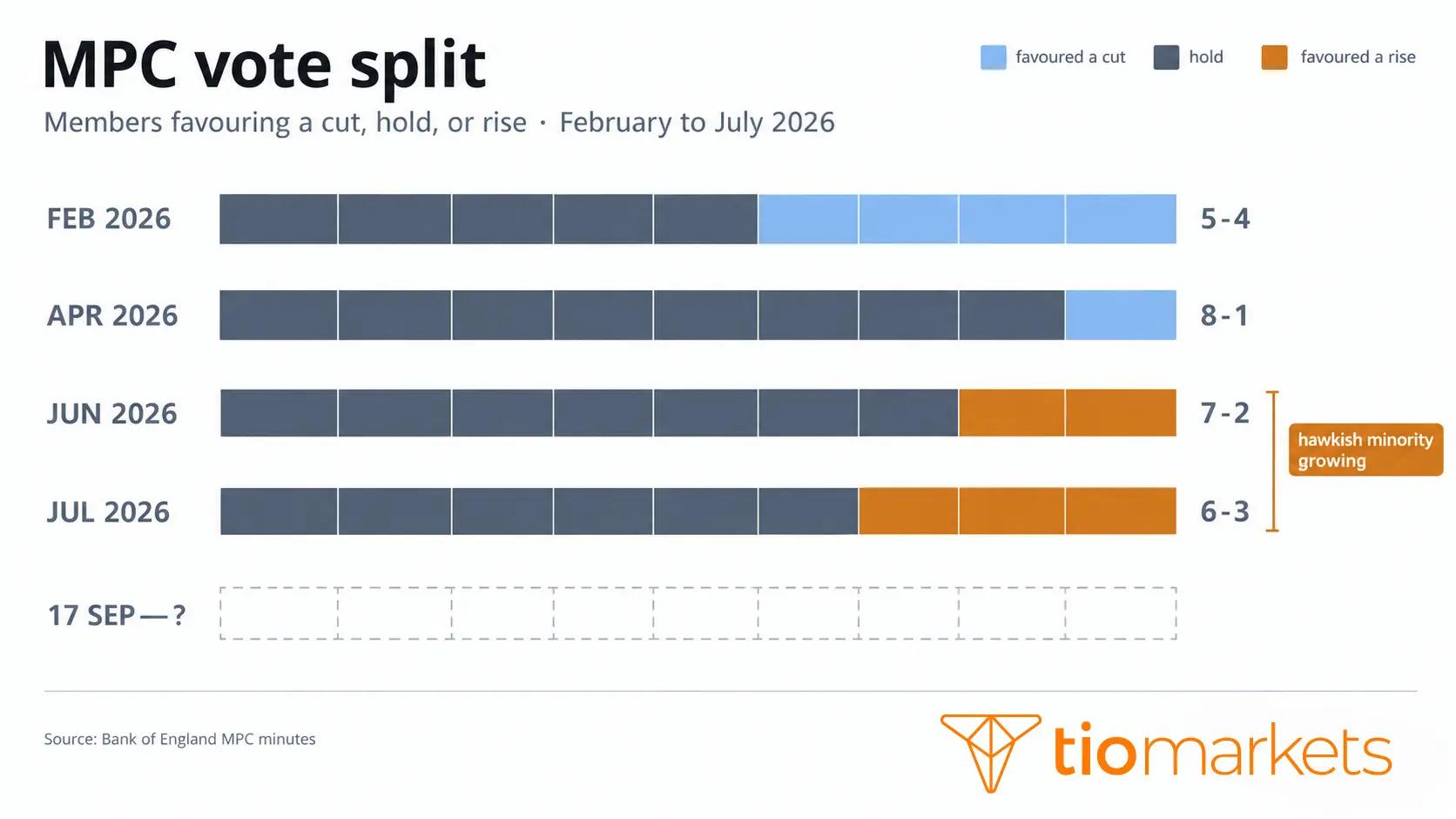
The previous meeting ended with a 6-3 vote to hold. Megan Greene, Catherine Mann and Huw Pill preferred to raise the Interest Rate by 25 basis points to 4.00%, arguing for a more proactive response to the risk that the energy shock becomes embedded in wages and prices. Pill reinforced that position in remarks on 3 September, while stressing that policy must respond systematically to forward-looking inflation pressure.
In February the committee split 5-4 with four members voting to cut. By April the hold majority was 8-1, by June 7-2, and by July 6-3 with three members wanting a rise. The hawkish minority has grown at three consecutive meetings, and the committee has moved from debating cuts to debating hikes inside six months.
The inflation problem has changed shape
UK CPI inflation has risen for two consecutive months, from 2.6% in June to 2.9% in July and 3.1% in August, according to the Office for National Statistics. But the composition has stayed consistent throughout: energy and goods have driven the increase, while services inflation and core CPI have held steady.
The MPC cannot reverse a global energy shock, but it can react if higher energy costs begin to alter wage bargains, business pricing and inflation expectations. In July, the Bank projected CPI inflation to average 3.2% in the fourth quarter of 2026, with risks tilted to the upside because the scale and duration of the Middle East energy shock remained uncertain.
August CPI, released this morning, made that distinction unusually clear. Headline inflation rose to 3.1% from 2.9%, matching the consensus. But core CPI was unchanged at 2.6% and services inflation was unchanged at 3.4%. The all-goods rate jumped from 2.2% to 2.7%, its highest since September 2025.
Transport did almost all of the work. The division's annual rate rose from 3.6% to 4.6%, contributing 0.69 percentage points to the headline rate, the largest of any category. Within that, motor fuel prices rose 23.0% over twelve months, up from 15.5% the previous month. Petrol rose 9.1 pence per litre between July and August to 161.3 pence, the highest since November 2022, while diesel rose 14.2 pence to 181.8 pence.
For the committee, that composition is close to the best available version of a higher headline number. Energy pushed the index up; the measures that track domestically generated inflation did not move.
One procedural detail matters here. The ONS granted the Bank exceptional pre-release access to the data at 10:00 BST on Monday 14 September, so that it was available for the MPC meeting held that day. The committee has already voted with these figures in hand.
Forward-looking evidence is less alarming than the headline inflation path. In the Bank’s August Decision Maker Panel, firms’ one-year CPI expectations fell to 3.1% on a three-month average basis, while expected wage growth remained 3.4%, below firms’ reported 4.0% realised wage growth. The Bank’s Agents said 2026 pay settlements averaged about 3.6%, employment intentions were broadly flat and recruitment difficulties remained below normal.
Growth is firmer, while labour demand is soft
The activity data do not point cleanly in one direction. ONS estimates show monthly GDP grew 0.4% in July and by 0.4% in the three months to July. Services expanded, but production and construction both contracted over the three-month period. July retail sales volumes fell 0.5% on the month even though the three-month measure rose 1.1%.
The labour market offers the clearer disinflationary counterweight. The unemployment rate was 4.9% in May to July, up 0.2 percentage points from a year earlier. Payrolled employment fell by 19,000 in July, and the provisional August estimate showed another 26,000 decline. Regular pay growth was 3.5%, while private-sector regular pay growth was 2.9%. These figures reduce the immediate case for a hike, although data-quality caveats and the persistence of above-target inflation mean they do not settle the debate.
Do not ignore quantitative tightening (QT)
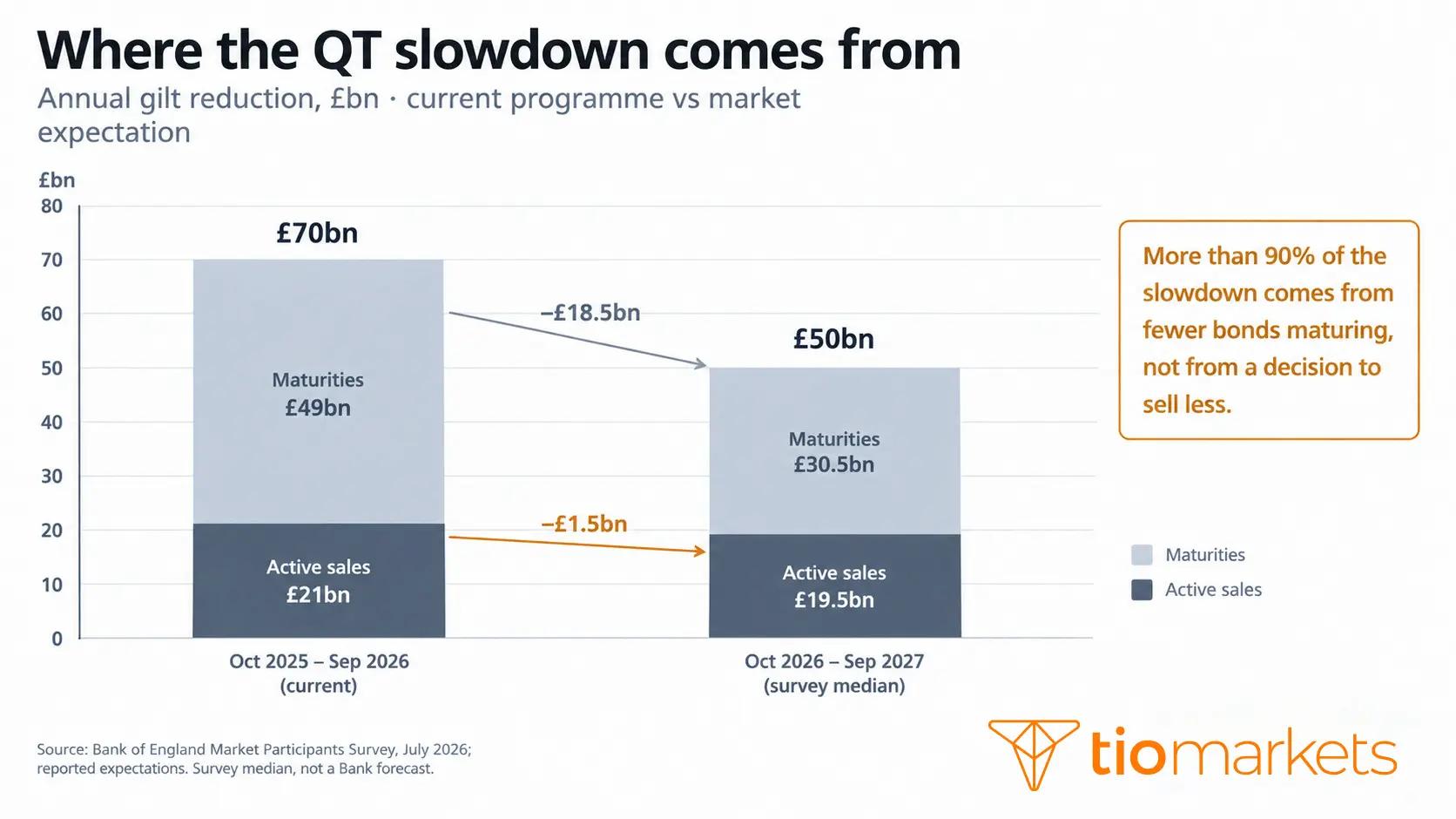
September is also when the MPC normally sets the next annual target for reducing the stock of gilts held in the Asset Purchase Facility. The current programme aims to reduce holdings by £70 billion between October 2025 and September 2026, taking the stock to £488 billion through maturities and active sales.
The Bank’s July survey of market participants pointed to a median expectation of a £50 billion reduction for the year to September 2027. A slower pace near that figure would not be the same as restarting quantitative easing: the balance sheet would still shrink. But the mix between maturities and active sales can affect gilt supply, term premia and financial conditions, particularly at longer maturities.
But a £50 billion headline would be less dovish than it looks. Reporting on the expected composition suggests passive maturities falling from roughly £49 billion to £30.5 billion, while active sales declined only from £21 billion to about £19.5 billion. On that basis, more than 90% of the slowdown would come from fewer bonds maturing rather than from a decision to sell less.
Active sales are the part the Bank actually controls, which is why the composition matters more than the total. A headline that meets expectations could still surprise if the active-sales figure or the maturity mix differs.
Three scenarios for GBP, gilts and UK equities
These are analytical scenarios, not forecasts or trading recommendations.
| Scenario | Trigger | Possible implication | What weakens it |
| Base: hold with a divided committee | 3.75%; vote near 6-3; inflation concern balanced by labour slack; QT near consensus | Sterling and short gilt yields may react modestly. Attention shifts to wording and November. | A materially different CPI print, vote or QT target |
| Hawkish: tighter signal | 5-4 vote, stronger persistence warning, faster QT, or a surprise hike to 4.00% | GBP could strengthen and gilt yields rise. Rate-sensitive UK shares may face pressure; FTSE 100 response may be complicated by its overseas earnings. | Minutes frame inflation as temporary or stress a weaker demand outlook |
| Dovish: more patience | 7-2 or wider hold, stronger focus on jobs and demand, or slower QT than expected | GBP and gilt yields could fall. Domestic rate-sensitive shares may benefit, while a weaker pound can mechanically lift the sterling value of overseas FTSE earnings. | Inflation language remains firm or the vote does not broaden |
Navigate Market Volatility with Precision
Whether the BoE holds or hikes, stay ahead of the markets. Trade over 950+ instruments including GBP pairs with tight spreads and fast excution.
Trading is risky
Market reference points and event sequence
GBP/USD traded near 1.3480 early on 16September, while EUR/GBP was around 0.8570. The FTSE 100 traded on 16 September at 10,694.4. These are context points, not recommendations; refresh all prices immediately before publication.
- Wednesday 16 September, 07:00 BST: UK August CPI, published at 3.1% with core and services unchanged.
- Wednesday 16 September, 19:00 BST: Federal Reserve decision, followed by its press conference. This can move the dollar and global yields before London opens.
- Thursday 17 September, 12:00 BST: BoE decision, minutes, vote and expected annual QT decision.
- Friday 18 September, 07:00 BST: UK August retail sales, the first major domestic release after the decision.
For charting context, monitor whether GBP/USD remains above or below the 1.3400-1.3600 area and whether EUR/GBP stays within the 0.8500-0.8600 area. The FTSE 100’s 10,700 region and its 52-week high near 10,989 are useful reference zones. These round-number areas are not guaranteed support or resistance and must be rechecked against the latest TIOmarkets pricing feed.
Risks and uncertainties
With August CPI now published, the largest remaining uncertainty is how the committee weighs a rising headline rate against core and services measures that have not moved. Energy prices and Middle East developments can also change quickly. Labour-market estimates are subject to revision, and the ONS advises focusing on longer-term movements across several indicators. In markets, GBP/USD may react more to the Federal Reserve or broader risk sentiment than to the BoE, while the FTSE 100’s international revenue exposure can produce a different response from domestically focused UK shares.
Conclusion
A 3.75% hold would confirm that most members still see time to judge whether the energy shock fades or spreads. It would not make the meeting uneventful. The vote split, the balance between inflation and labour-market language, and the next QT target will reveal whether the committee is moving closer to a hike, settling into a prolonged pause, or becoming more confident that existing restraint is enough.

Risk disclaimer: CFDs are complex instruments and come with a high risk of losing money rapidly due to leverage. You should consider whether you understand how CFDs work and whether you can afford to take the high risk of losing your money. Never deposit more than you are prepared to lose. Professional client’s losses can exceed their deposit. Please see our risk warning policy and seek independent professional advice if you do not fully understand. This information is not directed or intended for distribution to or use by residents of certain countries/jurisdictions including, but not limited to, USA & Countries included in the OFAC sanction list. The Company holds the right to alter the aforementioned list of countries at its own discretion.
TIOmarkets offers an exclusively execution-only service. The views expressed are for information purposes only. None of the content provided constitutes any form of investment advice. The comments are made available purely for educational and marketing purposes and do NOT constitute advice or investment recommendation (and should not be considered as such) and do not in any way constitute an invitation to acquire any financial instrument or product. TIOmarkets and its affiliates and consultants are not liable for any damages that may be caused by individual comments or statements by TIOmarkets analysis and assumes no liability with respect to the completeness and correctness of the content presented. The investor is solely responsible for the risk of his/her investment decisions. The analyses and comments presented do not include any consideration of your personal investment objectives, financial circumstances, or needs. The content has not been prepared in accordance with any legal requirements for financial analysis and must, therefore, be viewed by the reader as marketing information. TIOmarkets prohibits duplication or publication without explicit approval.
Join us on social media



Authors BIO

An experienced financial analyst and educator with over 8 years of expertise covering gold, forex, and global financial markets. Ahmed specializes in blending price action analysis with macroeconomic data to accurately interpret market movements, providing readers with comprehensive educational insights into trading and the financial world.